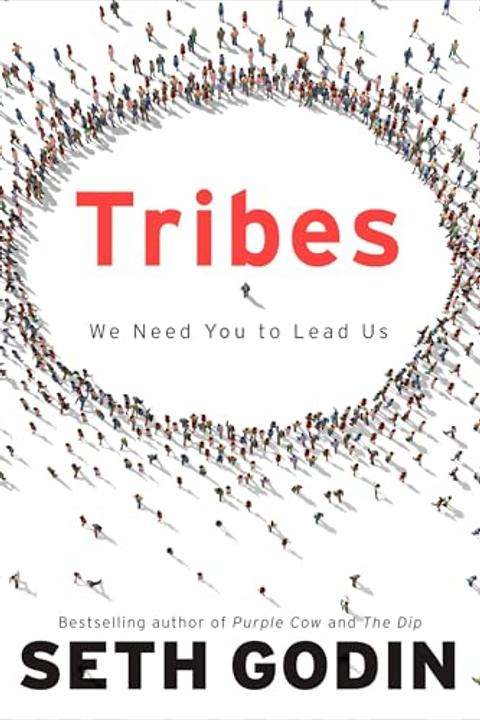
Tribes: We Need You to Lead Us
by Seth Godin
Why read this book
- It reframes leadership as something anyone can do right now, not a title you're granted, which is a useful jolt for founders and marketers sitting on an idea.
- The heretic framing gives language for the discomfort of challenging the status quo, and argues that discomfort is the leading indicator that leadership is needed.
- It connects directly to marketing: Godin's case that a tighter, more engaged niche beats a bigger, indifferent audience is a clean antidote to vanity-metric thinking.
- It's short and quotable, so the core argument is easy to revisit and apply without re-reading the whole book.
In one sentence
Seth Godin's argument that the internet has removed the old barriers to leadership, so anyone with an idea and the will to lead can build and rally a tribe, a group of people connected to each other and to a shared idea.
Key takeaways
- A tribe is "a group of people connected to one another, connected to a leader, and connected to an idea." It needs only two things: a shared interest and a way to communicate.
- The internet erased the old constraints on tribes. Geography, cost, and access used to cap how many people a leader could organize; cheap, instant communication removed that ceiling, so the binding constraint now is leadership, not reach.
- Leadership is not management. Management is about manipulating resources to get a known job done; leadership is about creating change you believe in, often without knowing exactly where it leads.
- Heretics are the new leaders: the people who challenge the status quo, get out in front of their tribe, and create movements, rather than waiting for permission or consensus.
- Niche leadership beats mass mediocrity. Godin pushes leaders to tighten the tribe, deepen the connection with the people who already care, rather than chasing a bigger but more indifferent audience.
- Curiosity over certainty: a curious person explores an idea first and decides what to believe afterward; a fundamentalist decides what's acceptable before exploring it. Leaders need the former to act without guarantees.
- Change isn't made by asking permission, it's made by asking forgiveness later. Waiting for buy-in is usually a way of avoiding the discomfort that leadership requires.
- Faith is the leader's unstated fuel. You commit to a direction before you have proof it will work, because proof, by definition, isn't available yet to someone doing something new.
- Organizations resist new tribes and new leaders because they're built to manage the status quo efficiently, and a heretic's change threatens the systems, incentives, and certainty that management depends on.
Summary
Tribes opens with a claim about timing: for most of history, leading a tribe was expensive and hard. You needed proximity, capital, or institutional backing to organize a group of people around an idea. Godin's argument is that the internet quietly removed that constraint. Anyone can now find the people who share an interest and give them a way to communicate, which means the scarce resource isn't an audience anymore, it's someone willing to lead one. "A tribe is a group of people connected to one another, connected to a leader, and connected to an idea," and that's a structurally easier thing to build today than at any point before.
The book's sharpest distinction is leadership versus management. Management, in Godin's framing, is about manipulating resources to get a known job done: optimizing a process whose destination is already agreed on. Leadership is about creating change you believe in, frequently without consensus and without a guaranteed outcome. That's why leadership is uncomfortable. Godin argues the discomfort itself is diagnostic: when standing up in front of strangers, proposing something that might fail, or challenging the status quo feels uncomfortable, that discomfort marks exactly where a leader is needed and exactly where most people quietly opt out.
The person willing to sit with that discomfort is the heretic, Godin's name for the leader who challenges an organization's or industry's settled assumptions. Heretics don't win by being right in the abstract; they win by having the most faith in their idea and the willingness to act on it before it's proven. Faith, in this sense, isn't religious, it's the leader's substitute for certainty. Curiosity is the companion trait: a curious person explores an idea before judging it, while a fundamentalist judges first and explores only what already fits. Godin's bet is that curious heretics, not cautious managers, are the ones who find what's next.
A recurring thread is that bigger isn't the goal, tighter is. Godin pushes back on the instinct to widen a tribe for its own sake, arguing that a smaller, tightly connected tribe that communicates quickly and with conviction outperforms a larger, looser one. That logic underlies his broader marketing philosophy: marketing isn't advertising to the masses anymore, it's engaging an existing tribe and giving them stories worth spreading. Organizations resist this because they're built to manage what's known, not to absorb leaders who want to change it; the heretic's job is to act anyway, ask forgiveness rather than permission, and trust that a tribe, once truly connected, will follow.
Reflections
The leadership-versus-management split is the idea that does the most work here: leadership as creating change you believe in, without the comfort of consensus, versus management as optimizing toward an already-agreed destination. That distinction explains why so much organizational resistance to new ideas isn't malicious, it's structural — management is built to protect a known process, and a heretic's change is, almost by definition, a threat to that process.
The "tighten the tribe before you grow it" instinct is the most counterintuitive and most useful part for anyone doing marketing, since the default move is always to chase a bigger audience rather than deepen the one you have.
Where the book is thinnest is the gap between "have faith and act" and the actual mechanics of building something people will follow — it's a permission slip and a posture more than a method, which is fine for what it's trying to do, but it leaves the harder operational questions to other books.
“"A tribe is a group of people connected to one another, connected to a leader, and connected to an idea."”
— Seth Godin
Who should read this
- Founders and marketers deciding between chasing a bigger, indifferent audience and deepening a smaller, more engaged one.
- Anyone with an idea who's waiting for a title, a promotion, or permission before they'll consider themselves a leader.
- People inside organizations who feel the pull to challenge the status quo but read that discomfort as a signal to back off instead of lean in.
- Skip it if you're looking for tactical, channel-by-channel marketing advice; this is a philosophy of leadership and audience-building, not a how-to guide.
Favorite quotes
- "A tribe is a group of people connected to one another, connected to a leader, and connected to an idea."
- "Leadership, on the other hand, is about creating change you believe in."
- "Heretics are the new leaders. The ones who challenge the status quo, who get out in front of their tribes, who create movements."
- "Change isn't made by asking permission. Change is made by asking forgiveness, later."
- "A fundamentalist is a person who considers whether a fact is acceptable to his religion before he explores it. As opposed to a curious person who explores first then considers whether or not he wants to accept the ramifications."
FAQ
What is a tribe according to Seth Godin?
"A group of people connected to one another, connected to a leader, and connected to an idea." Godin says it needs only two things: a shared interest and a way to communicate.
What is the main idea of Tribes?
That the internet has removed the old barriers to organizing people around an idea, so leadership, not access or audience size, is now the scarce resource. Anyone willing to lead can build a tribe.
What's the difference between leadership and management in Tribes?
Management is about manipulating resources to get a known job done. Leadership is about creating change you believe in, usually without consensus or certainty about the outcome.
What does Godin mean by "heretic"?
The heretic is the person who challenges an organization's or industry's settled assumptions and acts on an idea before it's proven, rather than waiting for permission or broad agreement.
Why does Godin say to tighten a tribe instead of growing it?
A smaller, tightly connected tribe communicates faster and with more conviction than a larger, looser one, so deepening engagement with people who already care tends to outperform chasing a bigger but indifferent audience.
Is Tribes worth reading?
Yes if you want a short, energizing case for leading instead of waiting to be chosen. It's light on tactics and heavy on conviction, so pair it with more operational marketing or leadership books if you need the how-to.
Detailed Notes
Click to expand the full detailed notes →
Detailed Notes
Click to expand the full detailed notes →
- Definition of a tribe: "A group of people connected to one another, connected to a leader, and connected to an idea." Needs only a shared interest and a way to communicate.
- The internet's effect: removed the geographic and cost constraints that used to cap tribe size and leader access. The scarce resource is no longer reach, it's leadership.
- Leadership vs. management: management manipulates resources to get a known job done; leadership creates change you believe in, often without consensus or a guaranteed outcome.
- The heretic: the leader who challenges the status quo and gets out in front of the tribe rather than waiting for agreement. "Heretics are the new leaders."
- Discomfort as a signal: standing up in front of strangers, proposing something that might fail, challenging the status quo — that discomfort marks where a leader is needed, not where to retreat.
- Curiosity vs. fundamentalism: a curious person explores an idea before judging it; a fundamentalist judges first and only explores what already fits. Leaders need curiosity to act without certainty.
- Faith over proof: leaders commit to a direction before it's validated, because validation isn't available yet for something genuinely new.
- Ask forgiveness, not permission: "Change isn't made by asking permission. Change is made by asking forgiveness, later." Waiting for buy-in is often avoidance dressed up as diligence.
- Tighten before you grow: a smaller, tightly connected, fast-communicating tribe outperforms a larger, looser one. Marketing today is engaging that tribe with stories worth spreading, not mass advertising.
- Why organizations resist: they're built to manage the known efficiently; a heretic's change threatens the systems and certainty management depends on.
- Anchor quote: "A tribe is a group of people connected to one another, connected to a leader, and connected to an idea."