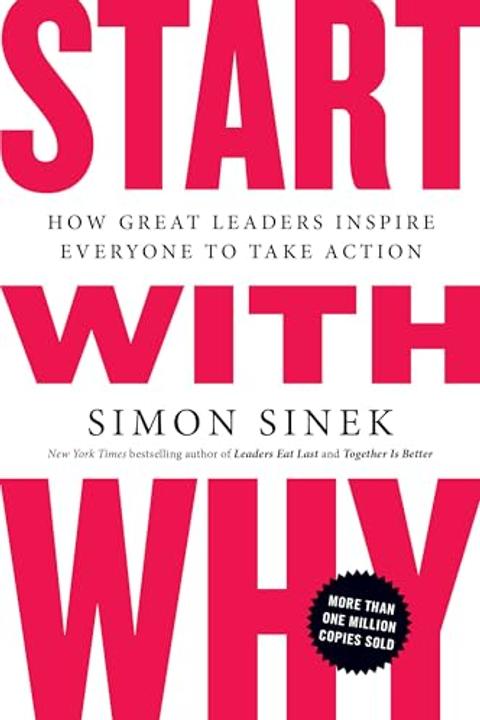
Start With Why: How Great Leaders Inspire Everyone to Take Action
by Simon Sinek
Why read this book
- It gives you one simple framework, the Golden Circle, that reorders how you pitch a company, a product, or yourself.
- The Apple and Wright Brothers and Martin Luther King examples make an abstract idea concrete and sticky.
- It separates inspiration from manipulation, which is a useful distinction if you're tired of selling on price, fear, or promotions.
- It's short, repetitive by design, and the central idea fits in a sentence, so you get most of the value fast.
In one sentence
Simon Sinek's argument that the leaders and companies who inspire action all start by communicating why they do what they do, not what they make or how they make it.
Key takeaways
- The Golden Circle has three layers: Why (your purpose or cause), How (the actions and principles that bring it to life), and What (the products or services you actually sell). Most people and companies communicate from the outside in, What to Why. Inspiring leaders flip it and start from the inside out, Why first.
- "People don't buy what you do; they buy why you do it." The Why is the reason someone chooses you over an equivalent competitor, even when they can't fully explain the choice.
- Why maps to the limbic brain (feelings, trust, gut decisions, no language). What maps to the neocortex (rational analysis, language). Starting with Why speaks to the part of the brain that actually drives behavior, which is why a clear Why feels persuasive before the facts are in.
- There are only two ways to influence behavior: manipulate it or inspire it. Manipulations (price cuts, promotions, fear, aspiration, peer pressure) work for transactions but don't build loyalty. Inspiration, anchored in a Why, does.
- Clarity, discipline, and consistency: you need a clear Why, the discipline to stay true to it through your How, and consistency so your What proves the Why. When the What stops matching the Why, trust breaks.
- The goal isn't to do business with everyone who needs what you have. It's to do business with people who believe what you believe. They become your most loyal customers and advocates.
- Leadership requires followers, and followers follow for themselves, not for the leader. People follow a clear Why because it gives them something to belong to and believe in.
- A Why is hard to keep alive as an organization scales. Sinek's "split" or "megaphone" idea: founders are usually the Why, the company is the How, and the danger is the message getting louder (more What) while the original Why fades.
Summary
Start With Why opens with a question: why do some people and organizations command loyalty and inspire action when their competitors, with similar products and resources, can't? Sinek's answer is that the inspiring ones all think, act, and communicate in the same order, and it's the reverse of how everyone else does it. He calls the pattern the Golden Circle: three rings, Why in the center, How around it, What on the outside. Most companies know what they do and how they do it, but few can clearly say why. And the Why, Sinek argues, is the part that actually moves people.
The line the whole book hangs on is "people don't buy what you do; they buy why you do it." His go-to example is Apple. On paper Apple makes computers like everyone else, but it communicates from the Why outward, a belief in challenging the status quo and thinking differently, and that's why people line up for products in categories Apple entered late. The What (a phone, a laptop) becomes proof of the Why rather than the reason to buy. Sinek backs this with a biology argument: the Why and How speak to the limbic brain, which handles trust and gut feeling but has no language, while the What speaks to the rational neocortex. That's his explanation for why a decision can feel right before you can justify it.
A second thread is the difference between manipulation and inspiration. Sinek says there are only two ways to get someone to act. You can manipulate them with price, promotions, fear, aspiration, novelty, or peer pressure, which works for a sale but never builds loyalty, or you can inspire them with a Why they share. Companies that lean on manipulations get stuck on a treadmill of discounts and gimmicks. Companies grounded in a Why earn the kind of loyalty where customers defend them and keep coming back without being prodded.
The back half is about keeping a Why alive. Sinek introduces the Celery Test (use your Why to filter decisions the way a grocery list filters what goes in the cart) and his "split" idea about why Whys fade as companies grow: the founder usually is the Why, the organization is the How, and as it scales the message tends to get louder on What while the original purpose blurs. He uses the Wright Brothers, Martin Luther King, Southwest Airlines, and Walmart's drift after Sam Walton as case studies.
It's worth being honest about the shape of the book. The core idea is genuinely useful and fits in a paragraph, and then it's repeated across many examples, so it can feel padded once you've got it. The neuroscience is more metaphor than rigorous science, and the case studies are chosen to fit the thesis. But as a reframe for how you talk about what you do, leading with purpose instead of features, it's a clean, memorable tool.
Reflections
The Golden Circle is one of those frameworks that's almost too simple, and that's also why it stuck.
Reordering a pitch from What to Why is a real, testable change, and "people don't buy what you do, they buy why you do it" is a sharper version of the positioning idea that you win in someone's head, not on the spec sheet.
Where I'd hold it loosely is the science.
The limbic-vs-neocortex story is a tidy metaphor doing more work than the evidence supports, and the examples are picked to fit. Treated as a communication tool rather than a law of nature, though, it earns its place: most founders, me included, default to leading with What, and the cost of that is sounding like everyone else.
“"People don't buy what you do; they buy why you do it."”
— Simon Sinek
Who should read this
- Founders and marketers who keep selling on features and price and can't figure out why customers feel interchangeable.
- Leaders trying to articulate a mission that rallies a team rather than just a list of goals.
- Anyone writing an "about" page, a pitch, or a personal brand who's leading with What they do instead of Why.
- Skip it if you already lead with purpose and just want tactics; the idea is simple enough that the TED talk or a long article covers most of it, and the book repeats the point.
Favorite quotes
- "People don't buy what you do; they buy why you do it."
- "There are only two ways to influence human behavior: you can manipulate it or you can inspire it."
- "The goal is not to do business with everybody who needs what you have. The goal is to do business with people who believe what you believe."
- "Working hard for something we do not care about is called stress. Working hard for something we love is called passion."
- "Great leaders are those who trust their gut. They are those who understand the art before the science. They win hearts before minds."
FAQ
What is the Golden Circle in Start With Why?
It's Sinek's three-ring model: Why (your purpose or cause) in the center, How (the principles and actions that deliver it) around it, and What (the products or services you sell) on the outside. Inspiring leaders communicate from the inside out, Why first, while most people communicate from the outside in.
What is the main idea of Start With Why?
That people and companies who inspire action start by communicating why they do what they do, not what they make. Or as Sinek puts it, "people don't buy what you do; they buy why you do it."
What does "people don't buy what you do, they buy why you do it" mean?
It means customers ultimately choose a company because they share its underlying belief or purpose, not because of features or specs. The product becomes proof of the Why rather than the reason to buy.
What is the difference between manipulation and inspiration in the book?
Manipulation drives behavior through price, promotions, fear, aspiration, or peer pressure and works only for one-off transactions. Inspiration drives behavior through a shared Why and builds lasting loyalty.
Is Start With Why based on real neuroscience?
Sinek connects the Golden Circle to brain structure, the limbic brain for Why and How, the neocortex for What, but it's used more as a useful metaphor than as rigorous neuroscience, and that's a common critique of the book.
Is Start With Why worth reading?
Yes if you lead with features and want a simple, memorable way to communicate purpose. The core idea is strong but repeated across many examples, so the TED talk or a summary may be enough if you just want the concept.
Detailed Notes
Click to expand the full detailed notes →
Detailed Notes
Click to expand the full detailed notes →
- The Golden Circle: three rings, Why (purpose/cause/belief) at the center, How (the principles and actions that realize it) in the middle, What (products and services) on the outside.
- Inside out vs. outside in: most people and companies communicate What → How → Why; inspiring leaders reverse it and start with Why.
- The core claim: "people don't buy what you do; they buy why you do it." The Why is the tiebreaker between you and an equivalent competitor.
- Apple example: sells the same hardware category as rivals but leads with a belief in challenging the status quo, so the product reads as proof of the Why.
- The brain mapping: Why and How → limbic brain (trust, feelings, gut, no language); What → neocortex (rational, language). Explains decisions that "feel right" before you can justify them.
- Manipulation vs. inspiration: the only two ways to drive behavior. Manipulations (price, promotions, fear, aspiration, novelty, peer pressure) work for transactions, not loyalty. Inspiration, via a shared Why, builds loyalty.
- Loyalty over transactions: the goal is customers who believe what you believe, not everyone who needs the product. Those believers defend you and stay.
- Clarity, discipline, consistency: a clear Why, the discipline to live it through How, and a What that consistently proves it. When What stops matching Why, trust erodes.
- Followers follow for themselves: people rally to a Why because it gives them something to belong to, not out of loyalty to the leader personally.
- The Celery Test: use your Why as a filter for decisions, the way a grocery list filters what ends up in the cart.
- Why Whys fade at scale: the founder is usually the Why, the company is the How; as it grows the message gets louder on What and the original purpose blurs (Sinek's "split"/megaphone idea).
- Case studies: Wright Brothers, Martin Luther King's "I Have a Dream," Southwest Airlines, and Walmart's drift after Sam Walton.
- Caveats: the neuroscience is metaphor more than rigor, examples are chosen to fit the thesis, and the single idea is repeated across the book.
- Anchor quotes: "People don't buy what you do; they buy why you do it." And: "There are only two ways to influence human behavior: you can manipulate it or you can inspire it."