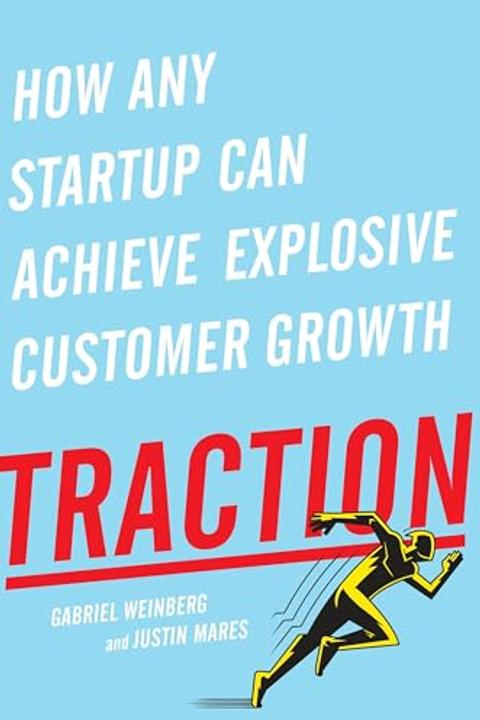
Traction: How Any Startup Can Achieve Explosive Customer Growth
by Gabriel Weinberg & Justin Mares
Why read this book
- It names and organizes the 19 traction channels available to any startup, which turns "we need more marketing" into a concrete list you can actually evaluate.
- The Bullseye Framework is a repeatable process for testing channels cheaply before committing real budget or time to one.
- It directly confronts the "if you build it, they will come" assumption that quietly sinks well-built products.
- It's written by founders (DuckDuckGo, Kinsa) who applied the framework themselves, so the advice is grounded in operating experience rather than theory.
In one sentence
Gabriel Weinberg and Justin Mares's argument that startups fail more often from a lack of customers than a lack of product, and that systematically testing traction channels with the Bullseye Framework is how you find the distribution strategy that actually works.
Key takeaways
- The central claim: "Almost every failed startup has a product. What failed startups don't have is enough customers." Most founders treat distribution as an afterthought, which is exactly backwards.
- The 50% rule: spend roughly half your time on product and half on traction, not nearly all of it on product with marketing bolted on at the end.
- The Bullseye Framework has three steps: brainstorm every traction channel that could plausibly work, run cheap tests across the most promising ones, then focus hard on the single channel that's working before moving to the next.
- There are 19 traction channels in total: viral marketing, PR, unconventional PR, SEM, social and display ads, offline ads, SEO, content marketing, email marketing, engineering as marketing, business development, sales, affiliate programs, existing platforms, trade shows, offline events, speaking engagements, community building, and targeting blogs.
- Most founders only seriously consider two or three channels (usually the ones their competitors are already using), which means the most promising channel for a given startup is often one nobody else in the category has tried yet.
- Traction is "quantifiable evidence of customer demand," not a vague sense that things are going well. You should be able to point to a number.
- Only one channel typically drives most of a startup's early growth at any given time. The goal of testing isn't to run every channel at once, it's to find that one channel fast and then go deep on it.
- Channels that work change as a company scales. The channel that gets you to product-market fit is often not the channel that gets you to your next stage of growth, so the Bullseye process gets repeated.
Summary
Traction opens with a blunt diagnosis: most startups don't die because the product was bad, they die because not enough people ever found out the product existed. Weinberg and Mares, who built DuckDuckGo and Kinsa respectively, argue that founders default to spending nearly all their time on product because building feels productive and distribution feels uncertain. Their fix is the 50% rule — treat traction as a discipline with the same weight as product development, not a final step you bolt on after launch.
The book's organizing device is the Bullseye Framework, a three-step process for finding which of 19 possible traction channels will actually work for a given startup. Step one is brainstorm: take every channel seriously, even ones that feel unlikely, and sketch out how it could plausibly work for your business. Step two is test: run small, cheap experiments across your most promising three to five channels to get real signal before betting on any of them. Step three is focus: once a channel is clearly outperforming the others, go all-in on it rather than continuing to split attention.
The 19 channels themselves form a checklist most founders never run through in full: viral marketing, PR, unconventional PR, search engine marketing, social and display ads, offline ads, SEO, content marketing, email marketing, engineering as marketing, business development, sales, affiliate programs, existing platforms, trade shows, offline events, speaking engagements, community building, and targeting blogs. The book's repeated observation is that founders gravitate toward two or three familiar channels, usually whatever their competitors are doing, and never seriously test the rest. That's a missed opportunity, because the most underused channel in a given industry is often the most promising one precisely because nobody else is competing for it.
A key structural point is that traction isn't permanent. The channel that gets early signups is often not the channel that scales the company, so the Bullseye process isn't a one-time exercise — it gets rerun as the business moves through stages. The book is light on theory and heavy on channel-by-channel tactics and founder case studies, which makes it more of a working reference than a single argument to absorb once.
Reflections
The line that does the most work here is the diagnosis, not the framework: most failed startups had a product, they just didn't have enough customers. That reframes "marketing" from a department to a founder-level discipline with the same priority as building.
The Bullseye Framework is useful mainly as a forcing function against the natural bias toward whatever channel feels familiar or comfortable — the value isn't in the three steps themselves, it's in being made to seriously evaluate all 19 channels instead of the two or three that come to mind first. The observation that the most underused channel in an industry is often the most promising one is the sharpest idea in the book, because it explains why copying a competitor's go-to-market is usually a worse bet than it looks.
The weakness is that the channel list will inevitably age — some of these (SEM, social ads, SEO) look different than they did when the book was written — but the underlying process of brainstorm, test cheap, then focus holds up regardless of which channels are current.
“"Almost every failed startup has a product. What failed startups don't have is enough customers."”
— Gabriel Weinberg & Justin Mares
Who should read this
- Founders and early operators who've built something they believe in but don't have a repeatable way to get it in front of customers.
- Anyone defaulting to one or two familiar marketing channels without having seriously evaluated the other seventeen.
- Marketers and growth people who want a shared vocabulary and checklist for channel testing rather than ad hoc experimentation.
- Especially relevant for Graham given his own focus on GTM and distribution as the binding constraint on his projects — this is a direct, practical companion to that work rather than a theory text.
- Skip it if you're past the channel-discovery stage and already running a mature, multi-channel growth function; the book is most useful pre-traction.
Favorite quotes
- "Almost every failed startup has a product. What failed startups don't have is enough customers."
- "The 50 percent rule: Spend 50 percent of your time on product and 50 percent on traction."
- "Often the most underutilized channels in an industry are the most promising ones."
- "You can get a competitive advantage by acquiring customers in ways your competitor isn't."
FAQ
What is the Bullseye Framework in Traction?
A three-step process for finding a startup's best growth channel: brainstorm every plausible traction channel, run cheap tests on the most promising ones, then focus resources on whichever channel shows the strongest results.
What are the 19 traction channels?
Viral marketing, PR, unconventional PR, SEM, social and display ads, offline ads, SEO, content marketing, email marketing, engineering as marketing, business development, sales, affiliate programs, existing platforms, trade shows, offline events, speaking engagements, community building, and targeting blogs.
What is the main idea of Traction?
That startups fail far more often from a lack of distribution than a lack of product, and that systematically testing traction channels — rather than defaulting to whatever's familiar — is how founders find the growth strategy that actually works for their business.
What is the 50% rule?
Weinberg and Mares's recommendation that founders split their time roughly evenly between building the product and pursuing traction, instead of treating marketing as something to figure out after the product is "done."
Who wrote Traction?
Gabriel Weinberg, founder and CEO of DuckDuckGo, and Justin Mares, co-founder of Kinsa, wrote the book together drawing on their own experience getting early customers.
Is Traction worth reading?
Yes for founders and operators who haven't yet built a deliberate distribution strategy. It's most valuable pre-traction or when a current growth channel is plateauing and a new one needs to be found.
Detailed Notes
Click to expand the full detailed notes →
Detailed Notes
Click to expand the full detailed notes →
- Core diagnosis: "Almost every failed startup has a product. What failed startups don't have is enough customers." Distribution failure, not product failure, is the more common cause of death.
- The 50% rule: spend half your time on product, half on traction. Most founders default to spending nearly all their time on product.
- Traction defined: quantifiable evidence of customer demand — a number, not a feeling.
- The Bullseye Framework, step 1 — Brainstorm: take all 19 channels seriously and sketch out how each could plausibly work for your specific business, even unlikely-seeming ones.
- Step 2 — Test: run small, cheap experiments across your top three to five channels to get real signal before committing significant time or budget.
- Step 3 — Focus: once one channel is clearly outperforming, commit resources there rather than continuing to spread effort across several.
- The 19 traction channels: viral marketing, PR, unconventional PR, SEM, social and display ads, offline ads, SEO, content marketing, email marketing, engineering as marketing, business development, sales, affiliate programs, existing platforms, trade shows, offline events, speaking engagements, community building, targeting blogs.
- Underused channels: "Often the most underutilized channels in an industry are the most promising ones." Founders tend to copy competitors' channels rather than finding gaps competitors haven't filled.
- Competitive advantage through channel choice: "You can get a competitive advantage by acquiring customers in ways your competitor isn't."
- The "if you build it, they will come" myth: the book repeatedly pushes back on the assumption that a good enough product markets itself — Weinberg and Mares treat this as the default failure mode they're writing against.
- Channels change over time: the channel that produces early traction is often not the one that scales the company, so the Bullseye process is meant to be rerun at each new stage of growth, not run once and abandoned.
- Anchor quote: "Almost every failed startup has a product. What failed startups don't have is enough customers."