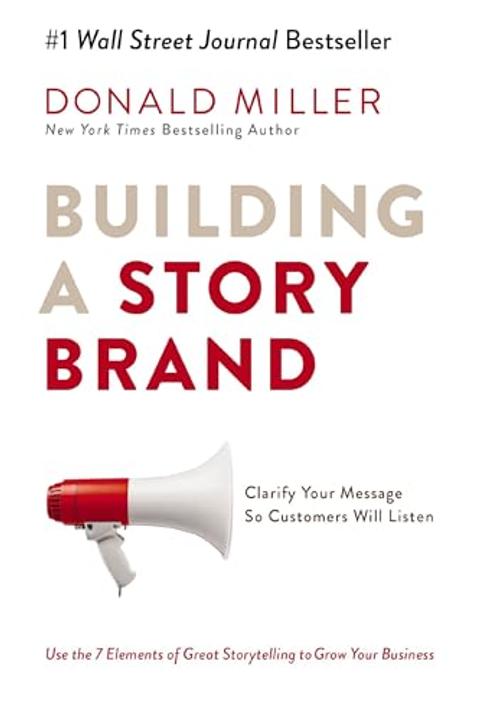
Building a StoryBrand: Clarify Your Message So Customers Will Listen
by Donald Miller
Why read this book
- It hands you one repeatable formula, the SB7 framework, for fixing a confusing website, pitch, or sales page.
- It reframes the most common branding mistake, making your company the hero, and shows why casting the customer as the hero converts better.
- It's practical, not abstract, with a clear output (the BrandScript) you can fill in and apply the same day.
- The core idea, "if you confuse, you lose," is short enough to remember and act on every time you write copy.
In one sentence
Donald Miller's argument that brands win by using the seven parts of every good story, with the customer cast as the hero and the brand as the guide, to clarify a message so confused buyers stop tuning out.
Key takeaways
- The SB7 framework is the spine of the book: a (1) Character (the customer) who has a (2) Problem meets a (3) Guide who gives them a (4) Plan and (5) Calls them to Action, that helps them avoid (6) Failure and ends in (7) Success. Every part of your marketing should map to one of these seven beats.
- The customer is the hero, not your brand. Your company is the guide (think Yoda, not Luke). Brands that cast themselves as the hero compete with the customer for that role and lose attention.
- "If you confuse, you lose." The brain burns calories to process information and tunes out anything unclear, so clarity beats clever every time. The goal of marketing is to be understood, not to be impressive.
- Customers buy solutions to internal problems, not just external ones. There are three problem layers: external (the tangible thing), internal (how it makes them feel), and philosophical (why it's just plain wrong that they have it). Most brands only sell to the external problem.
- Position your brand as the guide by showing two things: empathy (you understand their problem) and authority (you can actually solve it). A guide earns trust by proving competence without making it about themselves.
- Give the customer a simple, clear plan, usually three or four steps, so the path to buying feels obvious and low-risk. Confusion about "what do I do next" kills sales.
- Always include a direct call to action ("Buy Now," "Schedule a Call") and a transitional one (a free download, guide, or webinar). Customers don't act unless you clearly challenge them to.
- Define the stakes on both sides: what failure looks like if they don't buy, and what success looks like if they do. Story needs something at risk, so spell out what's at stake and paint a picture of life after the problem is solved.
Summary
Building a StoryBrand starts from a problem Miller saw over and over: companies talk about themselves in ways their customers can't follow, and confused buyers don't buy. His fix borrows the structure of every story humans have told for thousands of years. A character wants something, runs into a problem, meets a guide who gives them a plan and calls them to action, and that action leads either to success or to the failure they were trying to avoid. Miller compresses this into the SB7 framework and argues that any brand can plug its message into those same seven slots.
The reframe at the heart of the book is who the hero is. Most companies position themselves as the hero of their own story, the impressive, accomplished, decades-of-experience hero. Miller says that's the mistake. The customer is the hero. Your brand is the guide, the Yoda or Gandalf figure who has been there before and helps the hero win. A guide earns its role by signaling two things, empathy ("I understand what you're going through") and authority ("I know how to fix it"), without turning the spotlight back on itself.
Running underneath all of it is one rule: if you confuse, you lose. Miller leans on the idea that the brain is wired to conserve energy and will ignore anything that takes work to understand. So clarity isn't a nice-to-have, it's the whole game. He pushes brands to talk about the customer's problem on three levels, the external problem (the practical thing they need fixed), the internal problem (how that thing makes them feel), and the philosophical problem (why it's wrong that they have to deal with it at all), and argues most marketing only ever addresses the surface-level external one.
The back half is about turning the framework into something you ship. Miller introduces the BrandScript, a one-page tool where you fill in each of the seven elements for your own business, and then walks through applying it to a website: a clear header, obvious calls to action, a simple three-or-four-step plan, and explicit stakes. He distinguishes the direct call to action (buy, book, sign up) from the transitional one (download a free guide, watch a webinar) that nurtures people who aren't ready yet.
It's a tactical book, and that's both its strength and its ceiling. The framework is genuinely useful for cleaning up a muddled message, and the "customer is the hero" reframe is the kind of thing you keep catching yourself violating. The flip side is that it's formulaic by design, the examples repeat, and if you apply it too literally a lot of websites end up sounding the same. Treated as a checklist for clarity rather than a rulebook, it earns its place.
Reflections
The "if you confuse, you lose" rule is the part that sticks, and it's a sharper, more operational version of the positioning idea that you win in someone's head, not on the spec sheet.
Casting the customer as the hero is a real, testable change to how you write a homepage, and most founders, me included, default to making the brand the hero.
Where I'd hold it loosely is the formula itself.
Apply SB7 too literally and every site starts to sound identical, which is its own kind of noise. Treated as a clarity checklist rather than a script you have to follow word for word, though, it's a useful tool, and the BrandScript output is the rare branding exercise that produces something you can actually ship that day.
“"The customer is the hero, not your brand."”
— Donald Miller
Who should read this
- Founders and marketers whose website or pitch gets traffic but doesn't convert, and who suspect the message, not the product, is the problem.
- Anyone writing a homepage, a sales page, or an "about" section who keeps leading with how great their company is.
- Small business owners who want a fill-in-the-blank system rather than abstract branding theory.
- Skip it if you already write clear, customer-centered copy and just want advanced positioning; the idea is simple and repeated, so a summary or the BrandScript tool may cover most of the value.
Favorite quotes
- "The customer is the hero, not your brand."
- "If you confuse, you'll lose."
- "Story is the greatest weapon we have to combat noise, because it organizes information in such a way that people are compelled to listen."
- "Pretty websites don't sell things. Words sell things."
- "The most powerful marketing tool you have is the simple statement of what you offer."
FAQ
What is the StoryBrand framework (SB7)?
It's Miller's seven-part model based on the structure of every story: a (1) Character who has a (2) Problem meets a (3) Guide who gives them a (4) Plan and (5) Calls them to Action, that helps them avoid (6) Failure and ends in (7) Success. You map your marketing message onto these seven elements.
What is the main idea of Building a StoryBrand?
That brands should clarify their message by casting the customer as the hero and themselves as the guide, using the structure of story so confused buyers actually pay attention. As Miller puts it, "if you confuse, you lose."
Why does StoryBrand say the customer is the hero, not the brand?
Because the hero is the one with a problem to solve and a transformation to make, and that's the customer. If your brand plays the hero, you compete with the customer for that role. The brand's job is to be the guide who helps the hero win.
What is a BrandScript?
It's the one-page tool Miller provides for applying the framework: you fill in each of the seven SB7 elements for your own business, then use it to rewrite your website, emails, and pitch around a single clear message.
What are the three levels of a customer's problem?
External (the tangible, practical problem), internal (how that problem makes the customer feel), and philosophical (why it's just wrong that they have to deal with it). Miller says most marketing only addresses the external problem and misses the deeper two.
Is Building a StoryBrand worth reading?
Yes if your messaging is muddled and you want a concrete system to fix it. The framework is practical and memorable, but it's formulaic and repetitive by design, so a summary or the BrandScript tool may be enough if you just want the method.
Detailed Notes
Click to expand the full detailed notes →
Detailed Notes
Click to expand the full detailed notes →
- The SB7 framework: a (1) Character who has a (2) Problem meets a (3) Guide who gives them a (4) Plan and (5) Calls them to Action, that helps them avoid (6) Failure and ends in (7) Success.
- The customer is the hero, not your brand. The brand plays the guide (Yoda to the customer's Luke). Making your company the hero competes with the customer for the role.
- "If you confuse, you lose." The brain conserves calories and tunes out unclear messages, so clarity beats cleverness. The aim is to be understood, not to impress.
- Three levels of problem: external (the tangible thing), internal (how it makes them feel), philosophical (why it's wrong they have it). Most marketing only hits the external level.
- The guide signals two things: empathy ("I understand your problem") and authority ("I can solve it"). Trust comes from competence without making it about yourself.
- Give a simple plan: usually three or four steps so the path to buying feels obvious and low-risk. Ambiguity about the next step kills conversion.
- Two kinds of call to action: direct (Buy Now, Schedule a Call) and transitional (free download, guide, webinar) for people not ready yet. Customers don't act unless explicitly challenged.
- Define the stakes: what failure looks like if they don't act, and what success looks like if they do. Story needs something at risk, so spell out both.
- The BrandScript: the one-page tool for filling in all seven SB7 elements for your own business, then applying it to your website and messaging.
- Website application: a clear header that states what you offer, obvious calls to action, a simple step-by-step plan, and explicit stakes. "Pretty websites don't sell things. Words sell things."
- The grunt test: a visitor should be able to answer, within seconds, what you offer, how it makes their life better, and what to do to buy it.
- Caveats: the framework is formulaic by design, examples repeat, and applied too literally it can make many sites sound the same.
- Anchor quotes: "The customer is the hero, not your brand." And: "If you confuse, you'll lose."