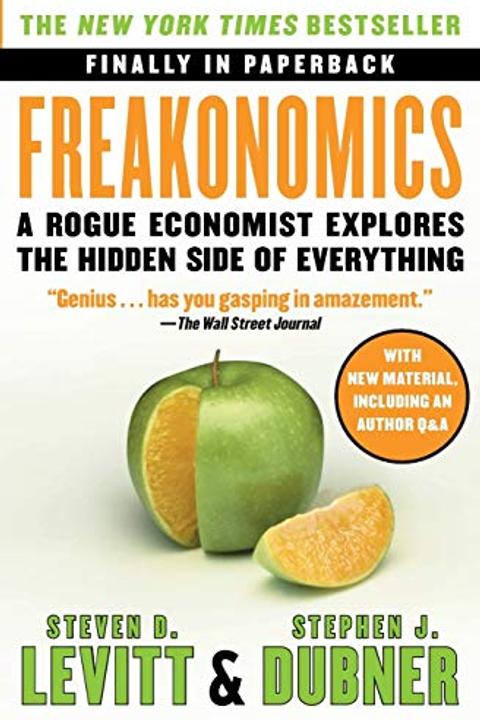
Freakonomics: A Rogue Economist Explores the Hidden Side of Everything
by Steven D. Levitt & Stephen J. Dubner
Why read this book
- It reframes economics as a way of asking questions — about incentives and hidden data — rather than a subject confined to markets and money.
- The case studies (cheating teachers, sumo wrestlers, the KKK, crack dealers) are genuinely surprising and make abstract ideas like information asymmetry stick.
- It's one of the clearest popular introductions to reading data skeptically and separating correlation from causation.
- It's short, conversational, and built from real research, so the method is easy to absorb even where individual conclusions are debatable.
In one sentence
Steven Levitt and Stephen Dubner's argument that economics is less a subject than a set of tools for asking the right questions, applied to cheating teachers, the KKK, crack dealers, and crime rates to show that incentives — not morality or intuition — usually explain what's really going on.
Key takeaways
- Economics is a toolkit, not a subject. "Since the science of economics is primarily a set of tools, as opposed to a subject matter, then no subject, however offbeat, need be beyond its reach." The book applies that toolkit to crime, parenting, and naming trends as readily as to markets.
- Incentives are the engine of behavior. Levitt and Dubner identify three basic flavors — economic, social, and moral — and argue that understanding which incentive is operating explains far more than appeals to character or culture.
- Data can catch cheating that intuition misses. Standardized test score patterns expose teachers who alter student answers; sumo match records expose wrestlers who trade wins when the incentive structure makes a loss nearly costless for one fighter and devastating for the other.
- Secrecy is a business model. The Ku Klux Klan's power rested on secret passwords and rituals; once a real-life infiltrator exposed them publicly, the secrets lost their value and the group's hold weakened. Real-estate agents run on a milder version of the same dynamic — they have more information about a property's true market value than their clients do, and that asymmetry is part of what they're paid for.
- Drug dealers mostly don't get rich. The internal economics of a crack-selling gang resemble a corporate hierarchy: a small number at the top earn real money, while most foot soldiers make close to minimum wage and absorb most of the risk — which is why so many still live with their mothers.
- The abortion-crime argument is the book's most controversial claim, and it should be treated as contested. Levitt links the legalization of abortion to a later drop in crime, but the methodology has been challenged by other economists, and the authors present it as a correlation worth investigating, not a proven causal chain.
- Correlation is not causation, and the book repeatedly uses this distinction as its central discipline — daring conclusions are floated, then the authors show the work (or the limits of the work) behind them.
- Conventional wisdom is often wrong, or at least under-examined, because it's easier to repeat than to test against data.
Summary
Freakonomics doesn't try to be a unified theory of economics. Levitt, the economist, and Dubner, the journalist, instead treat the book as a demonstration of a method: take a question nobody thought was economic, find a clever dataset, and let the numbers surface an answer that intuition wouldn't have predicted. The unifying thread is incentives — the authors argue that almost any puzzling human behavior makes more sense once you identify what's actually rewarded or punished, whether the incentive is economic, social, or moral.
The book's most memorable chapters pair unlikely subjects. Schoolteachers and sumo wrestlers turn out to have the same vulnerability to cheating once the incentive structure is right — high-stakes testing in one case, an asymmetric payoff for wins in the other — and in both cases the cheating shows up as a detectable pattern in the data, not just a suspicion. The Ku Klux Klan and real-estate agents both derive power from information the public doesn't have; expose the information and the power erodes, whether that's a Klansman's secret password or an agent's read on what a house will actually sell for. Crack-dealing gangs are run like fast-food franchises, with a small number of people at the top capturing most of the upside and a large pool of underpaid, high-risk workers below them, which is the economic reason so many dealers still live with their mothers.
The chapter that draws the most pushback links the legalization of abortion to the drop in U.S. crime roughly two decades later. Levitt and Dubner argue that unwanted children, on average, faced a higher statistical risk of later involvement in crime, and that legal abortion reduced the number of children born into those circumstances. It's presented as one of the book's central "rogue" findings, but it has been challenged on methodological grounds by other economists, and even within the book the authors are explicit that they're working with correlation, not a proven mechanism. It's best read as an illustration of the book's method — and its limits — rather than as settled science.
Running underneath all of it is a single discipline: don't accept the obvious explanation, find the data, and be honest about what correlation can and can't tell you. The book is more a way of looking than a set of conclusions, and the conclusions it does reach are more durable the more skeptically you hold them.
Reflections
The line that does the most work in this book isn't a finding, it's a method: ask what's actually being rewarded, then go find the data instead of trusting the obvious story. That holds up regardless of whether you buy every individual conclusion.
The teacher-and-sumo-wrestler pairing is the cleanest demonstration of it — two completely different worlds, same underlying logic, and the cheating only becomes visible once someone looks at the numbers instead of the reputations. The information-asymmetry chapter (KKK and real-estate agents) is the most quietly useful idea in the book, because it generalizes well past either example — anywhere someone is paid to know more than you do, the incentive runs toward not fully closing that gap.
The abortion-crime chapter is the hardest to sit with, not because the question is illegitimate, but because it's exactly the kind of claim the book's own correlation-versus-causation warning should be pointed back at — and to its credit, Levitt and Dubner mostly do that themselves, even if the conclusion still drew years of methodological criticism from other economists.
Read as a way of asking questions, the book holds up well. Read as a set of final answers, it asks to be checked.
“"Morality, it could be argued, represents the way that people would like the world to work, whereas economics represents how it actually does work."”
— Steven D. Levitt & Stephen J. Dubner
Who should read this
- Anyone curious about how economists actually think — the toolkit, not the textbook version of supply and demand.
- Readers who enjoy pop-science built on real (if contested) research, in the vein of Malcolm Gladwell or Michael Lewis.
- People who want a primer on reading data skeptically, especially the correlation-versus-causation trap.
- Skip it if you're looking for settled, uncontroversial conclusions — several of the book's signature claims, especially the abortion-crime argument, are genuinely disputed among economists, and the book is better read as a method demonstration than a set of final answers.
Favorite quotes
- "Morality, it could be argued, represents the way that people would like the world to work, whereas economics represents how it actually does work."
- "An incentive is a bullet, a lever, a key: an often tiny object with astonishing power to change a situation."
- "There are three basic flavors of incentive: economic, social, and moral."
- "Since the science of economics is primarily a set of tools, as opposed to a subject matter, then no subject, however offbeat, need be beyond its reach."
- "Information is a beacon, a cudgel, an olive branch, a deterrent — all depending on who wields it and how."
FAQ
What is the main idea of Freakonomics?
That economics is best understood as a set of tools — centered on incentives and data — for investigating any question, not a subject limited to money and markets. The book applies those tools to cheating, crime, parenting, and more.
What do schoolteachers and sumo wrestlers have in common in Freakonomics?
Both groups face incentive structures that can make cheating rational, and in both cases Levitt finds the cheating by spotting unusual statistical patterns in test scores and match records rather than relying on suspicion alone.
What is the Freakonomics argument about abortion and crime?
Levitt argues that legalized abortion reduced the number of children born into circumstances statistically linked to higher crime, contributing to the crime decline roughly two decades later. This is a contested, heavily debated claim, not a proven causal finding, and the authors present it as correlation-based.
Why do crack dealers live with their mothers, according to Freakonomics?
Because the internal economics of a drug gang resemble a corporate hierarchy: a small number of people at the top capture most of the income, while most street-level dealers earn close to minimum wage despite high risk, so they can't actually afford to live independently.
What is the connection between the KKK and real-estate agents in the book?
Both derive power from information asymmetry — the Klan from secret rituals and passwords, agents from knowing more about true property values than their clients do. In both cases, exposing the hidden information erodes the advantage.
Is Freakonomics worth reading?
Yes, as an introduction to thinking like an economist and reading data skeptically, with the caveat that some of its headline conclusions, especially the abortion-crime chapter, remain disputed and should be weighed as such.
Detailed Notes
Click to expand the full detailed notes →
Detailed Notes
Click to expand the full detailed notes →
- Economics as a toolkit: "Since the science of economics is primarily a set of tools, as opposed to a subject matter, then no subject, however offbeat, need be beyond its reach." The book treats economics as a method for any question, not a domain restricted to markets.
- Incentives as the cornerstone: three flavors — economic, social, moral. "An incentive is a bullet, a lever, a key: an often tiny object with astonishing power to change a situation." Most puzzling behavior resolves once you find the operative incentive.
- Cheating teachers and sumo wrestlers: standardized-test answer patterns expose teachers altering student answers; sumo match records expose wrestlers trading wins under asymmetric stakes. Both are detected through statistical anomalies, not accusation.
- The KKK and real-estate agents: both derive power from information asymmetry. The Klan's secret passwords and rituals lost their power once publicly exposed; agents profit from knowing more about a property's real value than their clients do.
- Why drug dealers live with their moms: crack-gang economics mirror a corporate hierarchy — a small leadership tier captures most of the income, the large base of street dealers earns close to minimum wage for high risk.
- The abortion-crime argument (contested): Levitt links legalized abortion to a falling crime rate roughly two decades later via reduced births into higher-risk circumstances. Flagged here explicitly as a disputed, correlation-based claim, not a settled causal finding — it has drawn sustained methodological criticism from other economists.
- Correlation vs. causation: the recurring discipline of the book — a surprising pattern in the data is a starting point for investigation, not proof of a mechanism.
- Anchor quote: "Morality, it could be argued, represents the way that people would like the world to work, whereas economics represents how it actually does work."