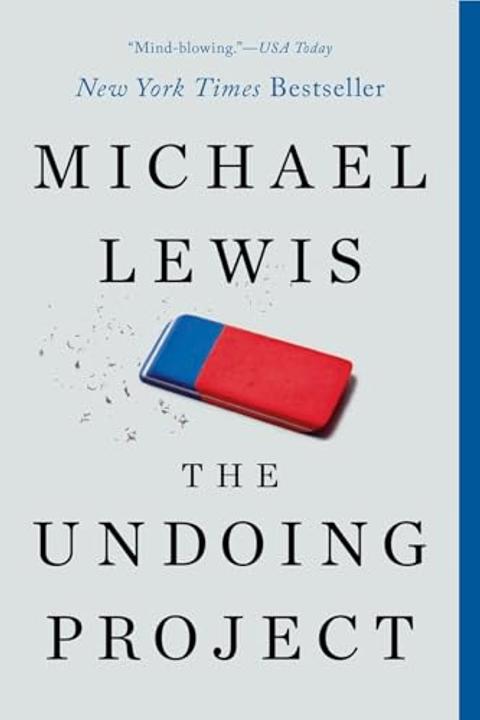
The Undoing Project: A Friendship That Changed Our Minds
by Michael Lewis
Why read this book
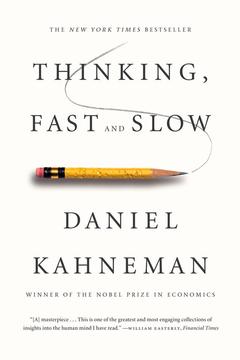
- It's the human story behind Thinking, Fast and Slow. If you've met System 1 and System 2 as abstractions, this is where they were born, and where you meet the two people who found them.
- The ideas land harder as narrative. Heuristics, biases, and prospect theory are easier to remember when you watch two minds discover them in real time, arguing in a shared office.
- It's a rare honest portrait of intellectual collaboration: how two opposite temperaments produced work neither could have done alone, and how the same closeness eventually frayed under fame and envy.
- Michael Lewis is a master storyteller, so a book about cognitive psychology reads like one of his sports or finance narratives.
In one sentence
Michael Lewis's account of the partnership between Daniel Kahneman and Amos Tversky — the two psychologists who exposed the systematic errors in human judgment and, in the process, invented behavioral economics — told as the story of a friendship that produced extraordinary ideas before slowly coming apart.
Key takeaways
- The mind runs on heuristics — mental shortcuts that usually work but fail in predictable ways. Kahneman and Tversky named three: representativeness (judging by how well something fits a stereotype), availability (judging frequency by how easily examples come to mind), and anchoring (latching onto an initial number even when it's irrelevant).
- These aren't random mistakes. The errors are systematic, which is the whole point: if you can predict the bias, you can study it, and you can sometimes design around it.
- Prospect theory replaced the economist's "rational utility" with how people actually decide: against a reference point, weighing gains and losses asymmetrically rather than judging final wealth in the abstract.
- Loss aversion is the engine. Losses hurt more than equivalent gains please, so people take irrational risks to avoid a sure loss and play it too safe to protect a sure gain.
- People don't choose between things; they choose between descriptions of things. The same option framed as a gain or a loss flips the decision — framing isn't noise around the choice, it often is the choice.
- The collaboration itself was the engine of the ideas. Amos was sharp, confident, combative; Danny was anxious, self-doubting, endlessly inventive. Neither alone would have produced the work; the friction between them was the method.
- The partnership eventually frayed. Tversky drew most of the public credit and prizes, Kahneman felt erased and envious, and the closeness that powered the work curdled. The Nobel that vindicated their ideas came in 2002, after Tversky had died.
- The deepest takeaway is humility about your own mind: the same shortcuts that make you fast and functional also make you reliably, invisibly wrong.
Summary
The Undoing Project is two stories braided together. One is intellectual: how two Israeli psychologists demolished the assumption, then central to economics, that people are rational calculators of their own self-interest. The other is personal: how the friendship that produced those ideas worked, and why it didn't last.
Daniel Kahneman and Amos Tversky were almost opposites. Kahneman was a Holocaust survivor, perpetually doubting, quick to dismantle his own ideas. Tversky was brash, certain, the most brilliant person most people had ever met. Lewis spends real time on each man's life before they meet, because the collaboration only makes sense once you understand how unlike they were. Put in a room together, they spent entire days talking and laughing, finishing each other's thoughts, and the work that came out carried both names with no way to tell who contributed what.
The ideas themselves are a steady dismantling of the rational mind. People judge probability by representativeness, mistaking a vivid stereotype for a likelihood. They judge frequency by availability, treating whatever comes easily to mind as common. They anchor on arbitrary numbers. They ignore regression to the mean and so misread talent, luck, and the world. Each of these is a heuristic — a shortcut that usually serves you and occasionally betrays you in a way you can predict. That predictability is what made it science rather than a list of human foibles.
The capstone is prospect theory, the work that won the Nobel. Classical economics said people weigh outcomes by expected utility. Kahneman and Tversky showed they don't. People evaluate against a reference point, code outcomes as gains or losses, and feel losses far more sharply than equivalent gains. So the same decision flips depending on how it's framed, because "people did not choose between things. They chose between descriptions of things." That single move — replacing the rational actor with a real, biased, reference-dependent one — is the foundation of behavioral economics.
The friendship is the part that gives the book its weight. As the ideas made them famous, the credit fell unevenly. Tversky collected the prizes and the spotlight; Kahneman, who often did the harder emotional work of generating ideas, felt himself disappearing into Tversky's shadow. Envy crept in, the closeness strained, and they drifted toward a break. They were reconciling when Tversky was diagnosed with terminal cancer. He died in 1996; the Nobel came in 2002, to Kahneman alone, for work the prize committee understood to belong to both. The book pairs naturally with Thinking, Fast and Slow, which Kahneman wrote a decade later: Lewis gives you the people and the relationship, Kahneman gives you the finished theory.
Reflections
The idea that sticks isn't any single bias, it's that the errors are systematic. Random mistakes you can't do much with; predictable ones you can study, and that move — from "people are irrational" to "people are irrational in specific, repeatable ways" — is what turned a pile of observations into a science. Loss aversion is the one I catch myself in most: the pull to protect a sure thing or chase back a loss is stronger than any spreadsheet says it should be.
The other thread worth keeping is about collaboration. The book is quietly honest that the same intensity that made the partnership generative also made it fragile, and that credit, once an idea has two parents and one name on the prize, is almost impossible to split fairly.
It pairs cleanly with Thinking, Fast and Slow — this is the human prequel to that framework, and reading them together is better than either alone. The rating is a 7 for me: a genuinely good story about genuinely important ideas, though it occasionally lingers on biography where I wanted more of the ideas.
“"When they made decisions, people did not seek to maximize utility. They sought to minimize regret."”
— Michael Lewis
Who should read this
- Anyone who read Thinking, Fast and Slow and wanted the story behind it — the people, the friendship, the messy human process that produced those clean ideas.
- Readers curious about behavioral economics but put off by textbooks; this is the field as narrative.
- People interested in creative collaboration: what makes two very different minds productive together, and what eventually pulls them apart.
- Skip it if you want a practical how-to. This is biography and intellectual history, not a manual for de-biasing your decisions.
Favorite quotes
- "When they made decisions, people did not seek to maximize utility. They sought to minimize regret."
- "People did not choose between things. They chose between descriptions of things."
- "When someone tells you something, don't ask yourself if it is true, ask yourself what it may be true of."
- "Man's inability to see the power of regression to the mean leaves him blind to the nature of the world around him."
- "When you are a pessimist and the bad thing happens, you live it twice, Amos."
FAQ
What is The Undoing Project about?
It's Michael Lewis's account of the friendship and collaboration between psychologists Daniel Kahneman and Amos Tversky, whose work on heuristics and biases overturned the assumption that people make rational decisions and laid the foundation for behavioral economics.
Who were Kahneman and Tversky?
Two Israeli psychologists who worked together for decades. Kahneman was self-doubting and inventive, Tversky brilliant and combative; together they produced work neither could have done alone. Kahneman won the Nobel Prize in Economics in 2002 for their joint work, after Tversky's death.
What is prospect theory?
Their alternative to rational-choice economics: people don't weigh outcomes by expected utility but evaluate gains and losses against a reference point, feeling losses more sharply than equivalent gains. It's the work that won the Nobel.
What is loss aversion?
The finding that losses loom larger than equivalent gains — a loss hurts roughly twice as much as a same-sized gain feels good — which makes people take risks to avoid losses and play too safe to protect gains.
What are the three main heuristics in the book?
Representativeness (judging by how well something matches a stereotype), availability (judging frequency by how easily examples come to mind), and anchoring (latching onto an arbitrary starting number).
How does it relate to Thinking, Fast and Slow?
It's the backstory. Lewis tells the human story of the two men and their partnership; Kahneman's own Thinking, Fast and Slow lays out the finished theory a decade later. They pair well — read this for the people, that for the framework.
Is The Undoing Project worth reading?
Yes if you want the ideas as a story and care about the human side of how they were discovered. Less so if you want a practical guide to better decisions.
Detailed Notes
Click to expand the full detailed notes →
Detailed Notes
Click to expand the full detailed notes →
- Heuristics and biases: the mind uses mental shortcuts that usually work and fail predictably. Three core ones: representativeness, availability, anchoring. The predictability of the failures is what made it science.
- Representativeness: people judge probability by how well something fits a stereotype rather than by actual base rates. "The world's not just a stage. It's a casino."
- Availability: people estimate how common or likely something is by how easily examples come to mind, which is why vivid, recent, or dramatic events feel more probable than they are.
- Anchoring: an arbitrary initial number drags later estimates toward it, even when everyone knows it's irrelevant.
- Regression to the mean: "Man's inability to see the power of regression to the mean leaves him blind to the nature of the world around him." We misread luck as skill and praise/punishment as causal.
- Prospect theory: replaces expected-utility rationality with reference-dependent choice. People code outcomes as gains or losses from a starting point, not as final states of wealth.
- Loss aversion: losses loom larger than equivalent gains; the asymmetry (a loss feels about twice as bad as a same-sized gain feels good) drives risk-taking to avoid losses and risk-aversion to protect gains.
- Framing: "People did not choose between things. They chose between descriptions of things." The same option framed as gain vs. loss flips the decision.
- The partnership: opposite temperaments — Danny anxious and self-doubting, Amos confident and combative — produced joint work no one could disentangle. The friction was the method, and entire days were spent talking and laughing.
- The fraying: as fame and credit fell unevenly toward Tversky, envy and strain crept in. Reconciliation was underway when Tversky was diagnosed with terminal cancer; he died in 1996.
- The legacy: Kahneman won the Nobel in Economics in 2002 for work the committee understood to belong to both men. The book is the human backstory to Thinking, Fast and Slow.
- Anchor quote: "When they made decisions, people did not seek to maximize utility. They sought to minimize regret."