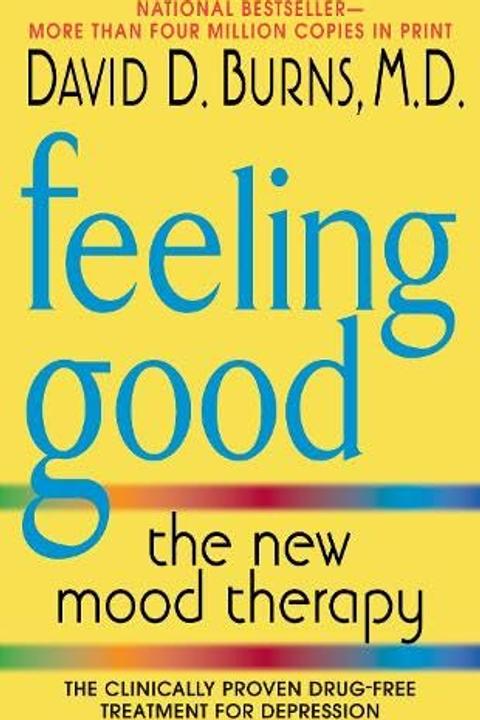
Feeling Good: The New Mood Therapy
by David D. Burns
Why read this book
- It lays out the core CBT idea in plain language: feelings follow thoughts, so the thought is where you can intervene.
- The list of ten cognitive distortions is a practical vocabulary for spotting where your own thinking goes wrong.
- The techniques (writing thoughts down, testing them, answering them) are concrete and repeatable, not just theory.
- It's one of the most widely recommended self-help books in clinical psychology, so it's worth knowing the original rather than a secondhand version.
In one sentence
David Burns's popular guide to cognitive behavioral therapy, built on the idea that your thoughts cause your feelings, so changing distorted thinking can change how you feel.
Key takeaways
- The core idea: thoughts cause feelings. You don't react to events directly; you react to your interpretation of them, and a distorted interpretation produces an outsized emotional response. Change the thought and the feeling tends to follow.
- The ten cognitive distortions are the heart of the book — the recurring errors that show up in negative thinking:
- All-or-nothing thinking: seeing things in black-and-white categories, where anything short of perfect counts as failure.
- Overgeneralization: treating a single negative event as a never-ending pattern ("this always happens to me").
- Mental filter: picking out one negative detail and dwelling on it until your whole view darkens.
- Discounting the positive: rejecting good experiences by insisting they "don't count," so a negative belief stays intact.
- Jumping to conclusions: reading negatives into a situation without evidence — either mind reading (assuming what others think) or fortune telling (predicting things will turn out badly).
- Magnification (and minimization): blowing your own errors or others' strengths out of proportion, while shrinking your own good points.
- Emotional reasoning: taking your feelings as evidence of fact ("I feel like a failure, so I must be one").
- Should statements: motivating yourself with "shoulds," "musts," and "oughts," which mostly produce guilt and pressure.
- Labeling: attaching a fixed global label to yourself ("I'm a loser") instead of describing the specific event.
- Personalization: holding yourself responsible for things you didn't fully cause, the root of much guilt.
- The main technique is to write the negative automatic thought down, name which distortion it contains, and write a more realistic response — moving the thought from your head onto paper where you can examine it.
- "Shoulds" get singled out: rigid should/must/ought rules aimed at yourself and others are a reliable source of guilt, anger, and frustration.
- Burns argues you can do a lot of this work yourself with worksheets, and frames it as a skill you practice rather than a one-time insight.
- The approach is presented as an alternative or complement to medication, not a replacement for professional care in serious cases.
Summary
Feeling Good translates Aaron Beck's cognitive therapy into a self-help book the general reader can actually use. Burns, a psychiatrist, builds the whole thing on one premise: your feelings come from your thoughts, not directly from events. When you feel depressed, anxious, or worthless, those feelings are downstream of specific thoughts you're having about what happened. If the thoughts are distorted, the feelings they produce are too.
The most useful part of the book is the catalog of ten cognitive distortions. These are the common ways thinking bends away from reality: all-or-nothing thinking, overgeneralization, the mental filter, discounting the positive, jumping to conclusions, magnification, emotional reasoning, should statements, labeling, and personalization. Once you have names for them, you can start catching them in your own automatic thoughts. That naming is the first move in the method.
The technique that runs through the book is to externalize and test your thinking. You write down the upsetting automatic thought, identify which distortion or distortions it contains, and then write a fair, realistic response to it. Doing this on paper turns a vague bad feeling into a specific claim you can examine, argue with, and often deflate. Burns spends particular time on "should statements," which he treats as a major engine of guilt and self-pressure, and on labeling, where a single mistake gets converted into a verdict about your whole self.
Burns presents this as a learnable skill rather than a one-time realization. The book includes worksheets, mood scales, and exercises meant to be done repeatedly, and it leans toward the position that many people can make real progress on their own thinking. It also addresses medication and where drug treatment fits, while making clear that severe depression and suicidal thinking call for professional help. The framing throughout is practical: here is the error, here is how to spot it, here is what to write instead.
Reflections
The premise that thoughts come before feelings is one of those ideas that sounds simple and is harder to actually catch yourself doing in the moment.
What makes the book more than a slogan is the list of ten distortions, because it turns a vague "I feel terrible" into a specific, nameable error you can point at.
The "should statements" idea stands out at the idea level: a lot of self-pressure seems to run on rigid internal rules, and noticing that they're rules rather than facts looks like a useful move.
Worth holding lightly though, since it's a clinical method and the honest version is that for anything serious it points you toward a professional, not just a worksheet.
“"You feel the way you do right now because of the thoughts you are thinking at this moment."”
— David D. Burns
Who should read this
- Anyone curious about the basics of cognitive behavioral therapy and how it actually works in practice.
- People who notice they spiral into harsh self-talk and want a concrete vocabulary and method for interrupting it.
- Readers who like worksheets and exercises rather than pure theory.
- This is a clinical self-help book, not a substitute for treatment. Anyone dealing with severe depression, anxiety, or thoughts of self-harm should see a qualified professional rather than rely on a book.
Favorite quotes
- "You feel the way you do right now because of the thoughts you are thinking at this moment."
- "Depression is not an emotional disorder at all! ... The moment before you experience any feeling, you must first have a thought."
- "Your feelings are not facts."
- "The first principle of cognitive therapy is that all your moods are created by your 'cognitions,' or thoughts."
FAQ
What is Feeling Good by David Burns about?
It's a self-help introduction to cognitive behavioral therapy that argues your thoughts create your moods, and teaches techniques for identifying and correcting distorted thinking.
What are the ten cognitive distortions in Feeling Good?
All-or-nothing thinking, overgeneralization, mental filter, discounting the positive, jumping to conclusions, magnification, emotional reasoning, should statements, labeling, and personalization.
What is the main idea of Feeling Good?
That feelings follow thoughts rather than events, so by changing distorted automatic thoughts you can change how you feel.
Does Feeling Good actually work?
It's one of the most recommended books in clinical psychology and the techniques come from cognitive therapy, which has substantial research support. It is not a replacement for professional treatment, especially in serious cases.
What is a "should statement" in Feeling Good?
Motivating yourself with rigid "shoulds," "musts," and "oughts," which Burns identifies as a common source of guilt, pressure, and frustration.
Is Feeling Good worth reading?
Yes if you want a clear, practical introduction to CBT and a usable vocabulary for spotting your own distorted thinking. Treat it as a complement to, not a substitute for, professional care when needed.
Detailed Notes
Click to expand the full detailed notes →
Detailed Notes
Click to expand the full detailed notes →
- Core premise: feelings come from thoughts, not directly from events. The thought happens first, then the emotion follows from it.
- Why it matters: if a feeling is being produced by a distorted thought, you can change the feeling by correcting the thought.
- Automatic thoughts: the negative thoughts that arise fast and unbidden in upsetting moments; the method starts by catching and writing them down.
- The ten cognitive distortions:
- All-or-nothing thinking: black-and-white categories; less than perfect equals failure.
- Overgeneralization: one bad event becomes a never-ending pattern.
- Mental filter: fixating on a single negative and letting it color everything.
- Discounting the positive: insisting good experiences "don't count."
- Jumping to conclusions: mind reading (assuming others' negative views) and fortune telling (predicting bad outcomes) without evidence.
- Magnification and minimization: exaggerating your errors or others' strengths, shrinking your own good qualities.
- Emotional reasoning: treating feelings as facts ("I feel it, so it's true").
- Should statements: "should," "must," "ought" rules that generate guilt and pressure.
- Labeling: a global self-label ("I'm a loser") instead of describing the specific event.
- Personalization: taking responsibility for things you didn't fully cause; a major source of guilt.
- The main technique: write the automatic thought, name the distortion(s) in it, then write a realistic response. Getting it on paper makes it examinable.
- Should statements, singled out: rigid internal "shoulds" aimed at yourself and others are a reliable engine of guilt, anger, and frustration.
- Self-help framing: Burns presents this as a practiced skill with worksheets and mood scales, not a one-time insight.
- On medication and care: the book addresses where drug treatment fits and is clear that severe depression and suicidal thinking call for professional help.
- Anchor quote: "You feel the way you do right now because of the thoughts you are thinking at this moment."