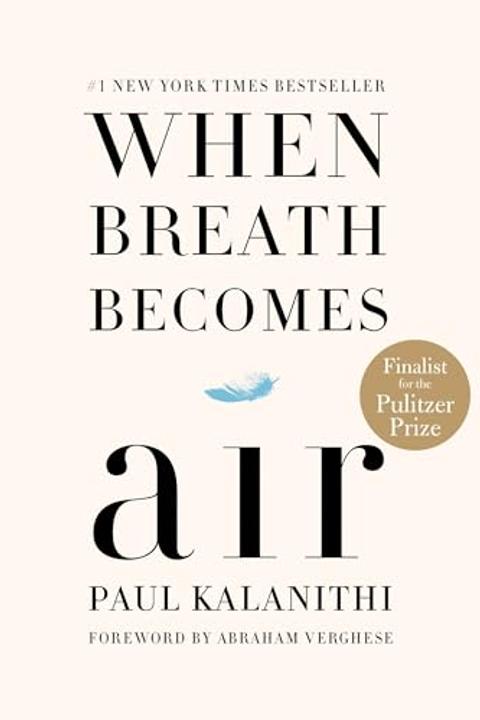
When Breath Becomes Air
by Paul Kalanithi
Why read this book
- It's written from inside the experience it describes. Kalanithi was a doctor who spent his career at the edge of life and death, then had to live it from the other side of the bed.
- The prose is unusually good for a memoir written under a deadline this literal. He studied literature before medicine, and it shows.
- It sits with the hard question directly: when your time is uncertain and likely short, how do you decide what to do with it? He doesn't offer a tidy answer, which is part of why it lands.
- The epilogue, written by his wife Lucy after his death, gives you the part Paul couldn't write himself, and it's some of the most affecting writing in the book.
In one sentence
A neurosurgeon's memoir, written as he was dying of lung cancer, about what makes a life worth living once the future you planned for has been taken away.
Key takeaways
- Facing death sharpens the question of what makes a life meaningful. Kalanithi spent his career around mortality, but his own diagnosis forced him to ask what was actually worth doing with the time he had left, rather than treating the question abstractly.
- The shift from doctor to patient changes everything. He had delivered terminal diagnoses to others for years. Receiving one himself, and sitting on the patient side of the same conversations, reframed what he thought he understood about medicine and care.
- Identity comes apart when the future you planned for is taken. So much of who he was had been built on the years of training ahead and the surgeon he was about to become. The diagnosis didn't just threaten his life, it dissolved the story he had been living toward.
- Meaning can be found in continuing to live and create, not just in waiting. He chose to keep operating while he could, to have a daughter with Lucy, and to write this book, treating the remaining time as life to be used rather than a sentence to be served.
- Medicine has limits, and presence matters where cures run out. As both surgeon and patient, he saw that the doctor's job isn't only to fix the body but to help a person face what's happening to them. When there's nothing left to cure, being present is its own form of care.
- Literature and science were two ways of asking the same question. He came to medicine through a love of books and a search for what makes life meaningful, and the memoir braids both: the writer trying to find words for what the scientist was living through.
- The book is unfinished on purpose, in a sense. He died before he could complete it, and that incompleteness is part of its honesty. It doesn't resolve into a lesson because his life didn't get to.
Summary
When Breath Becomes Air is a memoir by Paul Kalanithi, a neurosurgeon who was diagnosed with stage IV lung cancer at 36, near the end of ten years of training. He had spent his career operating on the brain, the organ that holds identity and meaning, and had come to medicine in the first place through literature and a question he couldn't shake: what makes a human life meaningful? The diagnosis turned that question from something he studied into something he had to answer for himself.
The book is in two parts. The first traces his path into medicine, from an English degree and a fascination with the relationship between biology, morality, and meaning, into neurosurgery, where life-and-death decisions were daily and the stakes were a person's selfhood, not just their survival. The second part begins with the diagnosis and follows him as he moves from the doctor's side of the conversation to the patient's, trying to figure out how to live when the timeline he'd built his life around is suddenly gone.
What gives the book its weight is that he keeps choosing to live rather than wait. He returns to the operating room while his body allows it. He and his wife Lucy decide to have a child, knowing he likely won't see her grow up. He writes, racing a clock he can feel. The question he keeps circling isn't how to avoid death, which he can't, but how to spend the uncertain time he has, and the answer he arrives at is less a formula than a way of holding the question honestly.
Kalanithi died in March 2015 before the book was finished. His wife Lucy, also a physician, wrote the epilogue, describing his final days, his death surrounded by family, and what the writing meant to him. The book closes with a passage written to his infant daughter, Cady. Because it's unfinished, it doesn't tie off into a neat conclusion, and that's part of its power. It reads as a life caught mid-sentence.
It's a short book and an emotionally heavy one. Some readers will find the medical and literary register dense; most find it the opposite, a rare case of a writer with the training to describe death from both sides and the time, barely, to do it.
Reflections
The part that stays at the surface level is the move from doctor to patient. Kalanithi spent years delivering the kind of news he then received, and the book is partly about how little that vantage prepared him for the other side of it. That gap, between understanding something professionally and living it, seems like the real subject.
The other thread worth sitting with is the choice to keep building a life, having a daughter, returning to surgery, finishing a book, while knowing the clock was short. It reframes the time you have as something to use rather than something running out.
Whether the book reads as profound or simply unbearably sad is probably the open question, and likely it's both. Worth confirming on a read.
“"You can't ever reach perfection, but you can believe in an asymptote toward which you are ceaselessly striving."”
— Paul Kalanithi
Who should read this
- Anyone in medicine or considering it, especially people drawn to the question of what care means when a cure isn't possible.
- Readers facing illness or loss, their own or a loved one's, who want company in the questions rather than a self-help framework.
- People who like memoir that's also good writing, and who don't need a book to resolve into a lesson.
- Skip it if you're looking for practical advice or an uplifting recovery arc. This isn't that. It's an honest account of a young person dying, and it stays with the difficulty instead of resolving it.
Favorite quotes
- "You can't ever reach perfection, but you can believe in an asymptote toward which you are ceaselessly striving."
- "The main message of Jesus, I believed, is that mercy trumps justice every time."
- "Human knowledge is never contained in one person. It grows from the relationships we create between each other and the world, and still it is never complete."
FAQ
What is When Breath Becomes Air about?
It's a memoir by neurosurgeon Paul Kalanithi, written after he was diagnosed with terminal lung cancer at 36, about facing his own death and trying to answer what makes a life meaningful when the future he planned for is gone.
What is the main message of When Breath Becomes Air?
That meaning doesn't come from avoiding death but from how you choose to live with the uncertain time you have, and that the question of what's worth doing becomes clearer, not easier, in the face of mortality.
Did Paul Kalanithi finish the book before he died?
No. He died in March 2015 before completing it. His wife, Lucy Kalanithi, a physician herself, wrote the epilogue describing his final days and death.
Is When Breath Becomes Air a true story?
Yes. It's a memoir of Kalanithi's own life, his path into neurosurgery, his stage IV lung cancer diagnosis, and his last years, written largely during his illness.
What kind of cancer did Paul Kalanithi have?
Stage IV non-small-cell lung cancer, diagnosed when he was 36 and near the end of his neurosurgical residency.
Who is Cady in When Breath Becomes Air?
Cady is Paul and Lucy Kalanithi's daughter, born during his illness. The book ends with a passage he wrote directly to her.
Detailed Notes
Click to expand the full detailed notes →
Detailed Notes
Click to expand the full detailed notes →
Structure: a memoir in two parts, bracketed by a foreword (by Abraham Verghese) and an epilogue written by Lucy Kalanithi after Paul's death. Part one is his path into medicine; part two begins with the diagnosis. Below are the main threads and what each covers.
- The title — taken from a poem by Baron Brooke Fulke Greville used as the epigraph: "You that seek what life is in death, / Now find it air that once was breath." Death and breath, the literal and the literary, run through the whole book.
- Into medicine — Kalanithi came to medicine from literature, with a question about what makes life meaningful where biology, morality, and language meet. He chose neurosurgery because it sat at the intersection of life, death, and identity.
- The work of neurosurgery — operating on the brain meant decisions that affected not just whether a patient lived but who they would be afterward; he writes about the moral weight of that, and about learning to deliver hard news.
- The diagnosis — at 36, near the end of a decade of training, he's diagnosed with stage IV lung cancer. The future he had built everything toward collapses in an afternoon.
- Doctor becomes patient — the same conversations he'd led now happen to him from the other chair. He writes about how differently they feel, and what he'd misunderstood about being on the receiving end.
- Identity and the lost future — much of who he was had been defined by the surgeon he was about to become. The diagnosis forces him to rebuild a sense of self without the timeline that anchored it.
- Choosing to keep living — rather than wait, he returns to the operating room while he's able, and he and Lucy decide to have a child, their daughter Cady. The book itself is part of that choice, written against the clock.
- The limits of medicine — as both surgeon and patient, he sees that the doctor's role isn't only to cure; when a cure isn't possible, the job becomes helping a person face what's happening, and presence becomes the care that's left.
- The letter to Cady — the book ends with a passage written directly to his infant daughter, telling her what her existence meant to a dying man.
- The epilogue — Lucy Kalanithi finishes the book Paul couldn't, describing his decline, his death at home surrounded by family in March 2015, and what the writing meant to him in his final months.
About the book and author: Paul Kalanithi (1977–2015) was an American neurosurgeon and writer who held degrees in English literature and human biology before training in neurological surgery at Stanford. He was diagnosed with stage IV lung cancer in 2013 and died in March 2015 at age 37. When Breath Becomes Air was published posthumously in January 2016 by Random House, with a foreword by Abraham Verghese and an epilogue by his wife, Lucy Kalanithi. It became a number one New York Times bestseller and was a finalist for the 2017 Pulitzer Prize in biography or autobiography.