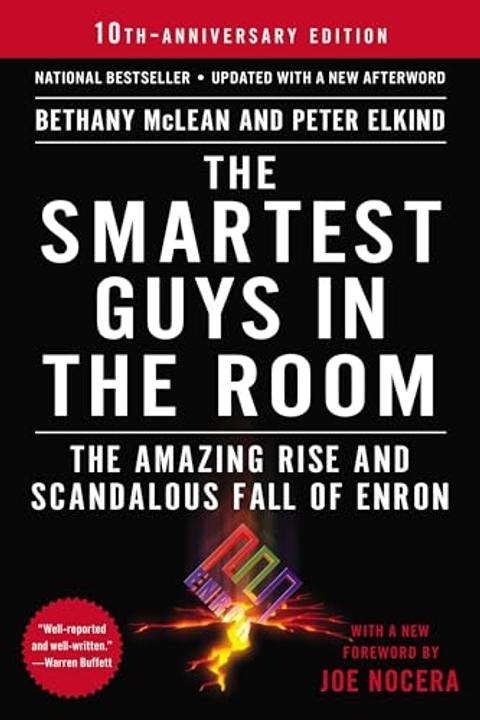
The Smartest Guys in the Room: The Amazing Rise and Scandalous Fall of Enron
by Bethany McLean & Peter Elkind
Why read this book
- It's the definitive narrative account of Enron, built from hundreds of interviews, internal documents, and performance reviews, not a simplified after-the-fact morality tale.
- It shows exactly how mark-to-market accounting and off-balance-sheet entities work, in plain language, which makes it one of the best accessible explainers of how a numbers-fueled fraud actually operates.
- It's as much a study of culture and incentives as it is of accounting, the rank-and-yank system and the "smartest guys in the room" mentality did as much damage as any single transaction.
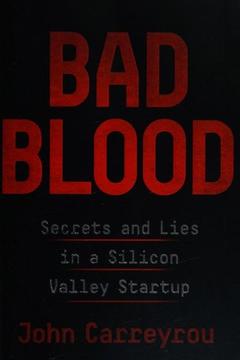
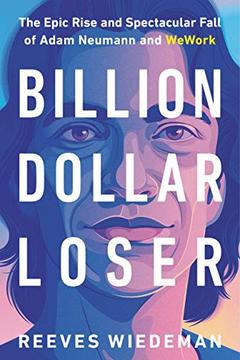
- It pairs well with the site's other corporate-fraud notes — Bad Blood (Theranos) and Billion Dollar Loser (WeWork) — as a third data point in the same pattern: charismatic leadership, opaque numbers, and a story that outran the business underneath it.
In one sentence
Bethany McLean and Peter Elkind's definitive account of how Enron's culture of arrogance, an accounting model built on fiction, and a performance system that rewarded short-term wins over honesty turned the seventh-largest company in America into the biggest bankruptcy in U.S. history.
Key takeaways
- Mark-to-market accounting let Enron book the entire projected future value of a long-term deal as current-quarter profit, the moment the ink dried. That meant earnings could be high even when no cash had actually come in, and once a quarter's numbers depended on the next deal, the company couldn't stop doing deals.
- Andy Fastow's special purpose entities (LJM, the Raptors) were built to move debt and losing assets off Enron's balance sheet while keeping de facto control. They let Enron look financially healthy on paper while taking on far more risk than investors could see.
- The "smartest guys in the room" culture, prized for its raw intellectual confidence under Skilling, treated dissent as weakness and complexity as a moat. Outsiders who couldn't follow the numbers were dismissed as not smart enough to get it, rather than treated as asking a fair question.
- Rank-and-yank, the forced performance review system, fired the bottom 15% of employees every six months regardless of the team's overall performance. It rewarded internal competition and short-term number-hitting over collaboration or long-term judgment.
- Wall Street analysts and most financial journalists missed the story for years, partly because Enron's statements were genuinely opaque, and partly because nobody wanted to be the one to ask the obvious question first. Bethany McLean's 2001 Fortune article, "Is Enron Overpriced?", was one of the first to ask it publicly.
- Sherron Watkins' internal memo to Ken Lay warned the company could "implode in a wave of accounting scandals" months before the collapse. The warning went up the chain and was effectively neutralized rather than acted on.
- Enron's bankruptcy, filed in December 2001, was at the time the largest in U.S. history. Arthur Andersen, its auditor, collapsed soon after, and the case became a template for the next decade of corporate governance reform, including Sarbanes-Oxley.
- The authors are explicit that this wasn't one rogue CFO: "Those who want to blame all of Enron's woes on the greedy former CFO claim that Enron was a good business brought down by Andy Fastow. But that was never true." The business itself didn't work, and the accounting was built to hide that fact.
Summary
The Smartest Guys in the Room traces Enron from its 1985 formation as a pipeline company through its reinvention under Jeffrey Skilling as an energy trading and "asset-light" powerhouse, to its collapse into bankruptcy in December 2001. McLean and Elkind, both financial journalists, build the story from the inside out: internal memos, performance reviews, calendars, and interviews with the people who worked there, rather than from the trial record alone.
The center of the book is the mechanics of the fraud, and the authors are careful to show it wasn't one trick. Mark-to-market accounting let Enron recognize the entire estimated future profit of a multi-year contract immediately, turning speculative projections into reported earnings. That created constant pressure to do bigger deals to keep the next quarter's numbers up, because cash wasn't actually coming in at the rate earnings implied. CFO Andy Fastow's special purpose entities, most notoriously LJM and the Raptors, were built to absorb Enron's worst-performing assets and debt off the books, often using Enron's own stock as collateral in a way that meant the risk never really left the company. The book's "duck" analogy captures the spirit of the whole exercise: dress up a dog to meet the technical rules for what counts as a duck, get the accountants to sign off, and call it done, even though everyone in the room knows what they're actually looking at.
But the authors argue the accounting was a symptom, not the disease. The deeper story is culture. Skilling built Enron around the idea that the smartest people in the room should win, and built a performance review system, rank-and-yank, that fired the bottom-ranked 15% of employees twice a year. That bred a workforce optimized for looking good on paper over a six-month horizon, not for raising hard questions about whether the underlying business made money. Ken Lay, the chairman, comes across less as an architect of the fraud and more as someone who wanted the praise of running a celebrated company without doing the work of understanding how it actually made its money.
The book is also a study in how the failure was missed, or avoided, by everyone whose job was to catch it. Wall Street analysts kept "buy" ratings on the stock because their firms wanted Enron's investment banking business. Arthur Andersen, the auditor, signed off on entities its own staff sometimes flagged internally. Bethany McLean's own 2001 Fortune piece, "Is Enron Overpriced?", was one of the first mainstream challenges, prompted simply by not being able to figure out how the company made its money. Inside the company, Sherron Watkins raised the alarm directly to Ken Lay in August 2001, warning Enron could "implode in a wave of accounting scandals." The memo went up the chain and produced a cursory internal review, not a course correction. By the fall of 2001, the off-balance-sheet entities started unwinding, the stock collapsed, and Enron filed for bankruptcy that December, then the largest corporate bankruptcy in U.S. history. Arthur Andersen, convicted of obstruction of justice over document shredding, didn't survive the fallout either.
Reflections
What stands out about Enron, set against Theranos and WeWork, is how little it actually required deception from outsiders. Theranos hid a technology that didn't work. WeWork sold a growth story that didn't match its unit economics.
Enron mostly told the truth, technically, the accounting was disclosed, the entities had names and SEC filings, and Wall Street still missed it for years. That's the more uncomfortable lesson: a story can be hiding in plain sight if no one with leverage wants to be the one to ask "wait, how does this actually make money."
McLean's Fortune article is the case study in how cheap that question is to ask and how rare it apparently was to ask it.
The rank-and-yank system is the other piece worth sitting with, it's a reminder that an incentive structure doesn't need anyone to be malicious to produce fraud; it just needs to reward the appearance of winning over the work of being right, consistently, for long enough.
“"The tale of Enron is a story of human weakness, of hubris and greed and rampant self-delusion; of ambition run amok; of a grand experiment in the deregulated world; of a business model that didn't work; and of smart people who believed their next gamble would cover their last disaster — and who couldn't admit they were wrong."”
— Bethany McLean & Peter Elkind
Who should read this
- Anyone who wants to actually understand how mark-to-market accounting and off-balance-sheet entities can be used to manufacture fictional earnings, explained in plain language rather than jargon.
- Founders, executives, and board members interested in how incentive design (rank-and-yank, stock-based comp, internal competition) can quietly produce the exact behavior it was meant to prevent.
- Readers of the site's other corporate-fraud notes, Bad Blood and Billion Dollar Loser, looking for the canonical case the genre is built on; the three together trace a recognizable pattern across three very different industries.
- Skip it if you want a quick takeaway rather than a full reconstruction; this is a dense, reported narrative, not a short cautionary anecdote.
Favorite quotes
- "The tale of Enron is a story of human weakness, of hubris and greed and rampant self-delusion; of ambition run amok; of a grand experiment in the deregulated world; of a business model that didn't work; and of smart people who believed their next gamble would cover their last disaster — and who couldn't admit they were wrong."
- "Those who want to blame all of Enron's woes on the greedy former CFO claim that Enron was a good business brought down by Andy Fastow. But that was never true."
- "Everything was perception; nothing was real."
- "Never, ever do the easy wrong instead of the harder right."
- "No company can prosper over the long term if every employee is a free agent, motivated solely by greed, no matter how smart he is."
FAQ
What was the main fraud at Enron, according to The Smartest Guys in the Room?
There wasn't a single fraud. Mark-to-market accounting let Enron book speculative future profits as current earnings, and Andy Fastow's off-balance-sheet special purpose entities (like LJM and the Raptors) hid the resulting debt and losses, keeping the stock price propped up while risk quietly accumulated.
Who was responsible — Skilling, Lay, or Fastow?
The authors push back on pinning it entirely on Fastow. Skilling built the culture and the accounting philosophy that made the fraud possible; Lay enabled it through inattention and a desire for prestige without scrutiny; Fastow executed the specific mechanisms. The book's argument is that the business itself didn't work, and the accounting existed to obscure that.
What is mark-to-market accounting, in this context?
A method that lets a company recognize the entire estimated future value of a long-term contract as profit immediately, rather than as the cash actually arrives. Enron used it aggressively, which created constant pressure to keep signing new deals to sustain reported earnings.
What was rank-and-yank?
Enron's forced-ranking performance review system, which fired the bottom 15% of employees roughly every six months. It rewarded short-term, individually visible wins and discouraged the kind of internal dissent or caution that might have slowed the company down.
Did anyone try to warn Enron before it collapsed?
Yes. Sherron Watkins, a vice president, wrote directly to Ken Lay in August 2001 warning the company could "implode in a wave of accounting scandals." Bethany McLean's own March 2001 Fortune article, "Is Enron Overpriced?", was one of the first public challenges to the company's opaque financials.
How did the collapse happen?
Through 2001, the off-balance-sheet entities began unwinding as Enron's stock price (which collateralized them) fell. Confidence cratered, credit dried up, and Enron filed for bankruptcy in December 2001, then the largest in U.S. corporate history. Its auditor, Arthur Andersen, was convicted of obstruction of justice over document shredding and ceased operating soon after.
Is it worth reading if you already know the Enron story?
Yes. The value is in the texture, the internal memos, the performance reviews, the meeting-room dynamics, that show how the fraud was a function of culture and incentives, not just a few bad actors signing bad paperwork.
Detailed Notes
Click to expand the full detailed notes →
Detailed Notes
Click to expand the full detailed notes →
- The business model shift: Enron started as a regulated pipeline company, then under Jeffrey Skilling reinvented itself as an "asset-light" energy trading firm, more interested in trading contracts on future energy prices than in owning physical infrastructure.
- Mark-to-market accounting: lets a company book the entire estimated future profit of a long-term contract as earnings the moment the deal is signed, rather than as cash is actually realized. Enron applied this aggressively across its trading business, which meant reported earnings could outrun actual cash flow by a wide margin.
- The "duck" analogy: the book's own illustration of how Enron's accounting worked in spirit — take something that doesn't meet the standard (a dog), dress it up to technically satisfy the accounting rule (paint it like a duck), get the accountants to sign off, and call it compliant, even though everyone involved knows what they're really looking at.
- Andy Fastow and the special purpose entities: Fastow, as CFO, created LJM and the Raptors, off-balance-sheet entities that absorbed Enron's underperforming assets and debt, often collateralized with Enron's own stock. This let Enron's reported balance sheet look far healthier than the underlying risk actually was, and let Fastow personally profit from managing them.
- The culture of arrogance: Skilling prized raw intellectual confidence and treated complexity as a competitive advantage rather than a risk. Dissent or confusion from outsiders, including analysts and journalists, was framed as a failure to understand, not a fair challenge.
- Rank-and-yank: the Performance Review Committee process that forced managers to rank employees and fire the bottom 15% twice a year, regardless of how the broader team or company was performing. It optimized for visible short-term wins and discouraged the kind of caution or dissent that might have surfaced problems earlier.
- Wall Street's blind spot: analysts largely kept "buy" ratings on Enron because their banks wanted Enron's investment banking fees, not because the fundamentals were clear. Several credit analysts are quoted candidly admitting they couldn't actually model the business.
- Bethany McLean's "Is Enron Overpriced?" (Fortune, March 2001): one of the first mainstream challenges to Enron's stock price, built on the simple observation that nobody could clearly explain how the company made its money.
- Sherron Watkins' warning: in an August 2001 memo to Ken Lay, Watkins wrote that she was "incredibly nervous that we will implode in a wave of accounting scandals." The memo triggered a limited internal review rather than a real course correction.
- The collapse: through late 2001, falling stock price undercut the collateral backing the off-balance-sheet entities, triggering a credit crisis. Enron filed for Chapter 11 bankruptcy in December 2001, the largest corporate bankruptcy in U.S. history at the time.
- Aftermath: Arthur Andersen, Enron's auditor, was convicted of obstruction of justice for shredding documents and effectively ceased to exist as a firm. The scandal was a major driver behind the Sarbanes-Oxley Act of 2002, which overhauled corporate financial disclosure and auditor independence rules.
- The authors' core argument: "Those who want to blame all of Enron's woes on the greedy former CFO claim that Enron was a good business brought down by Andy Fastow. But that was never true." The underlying business model often didn't generate the returns it claimed; the accounting existed to paper over that gap, not to hide an otherwise sound company.
- Anchor quote: "The tale of Enron is a story of human weakness, of hubris and greed and rampant self-delusion; of ambition run amok; of a grand experiment in the deregulated world; of a business model that didn't work; and of smart people who believed their next gamble would cover their last disaster — and who couldn't admit they were wrong."