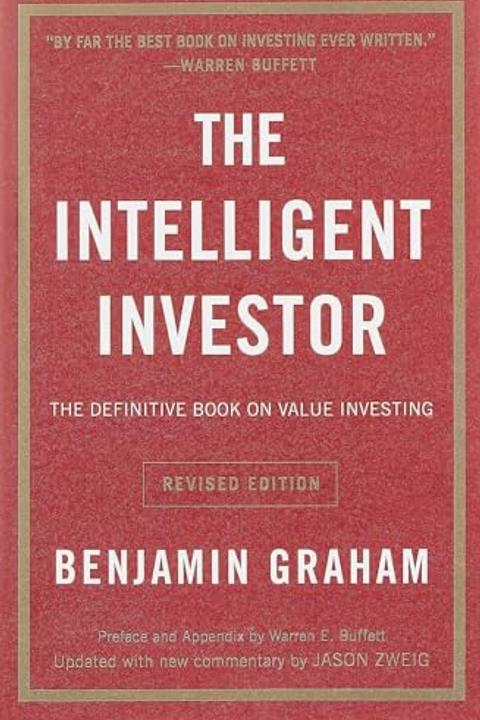
The Intelligent Investor: The Definitive Book on Value Investing
by Benjamin Graham
Why read this book
- It's the original source for value investing, the framework that produced Warren Buffett, who studied directly under Graham at Columbia and called it the best investing book ever written.
- Two ideas alone, Mr. Market and the margin of safety, are enough to reframe how you think about risk and price for the rest of your investing life.
- It's the antidote to every "beat the market with this one trick" pitch — Graham's whole point is that temperament beats intelligence, and discipline beats prediction.
- It pairs naturally with The Psychology of Money: Housel's book is the behavioral case, Graham's is the analytical foundation underneath it.
In one sentence
Benjamin Graham's foundational case that successful investing is about discipline and temperament, not forecasting — buy with a margin of safety below intrinsic value, treat market swings as opportunities rather than verdicts, and you protect yourself from your own worst enemy.
Key takeaways
- Investing is not speculating. Graham's definition: "An investment operation is one which, upon thorough analysis, promises safety of principal and an adequate return. Operations not meeting these requirements are speculative." If you can't articulate the analysis and the safety, you're gambling.
- Mr. Market is your manic-depressive business partner. Imagine you own a stake in a private business and a partner named Mr. Market shows up every day quoting a price to buy you out or sell you more — sometimes euphoric, sometimes despairing. You are free to ignore him. His mood is an opportunity, not an instruction.
- The margin of safety is the central concept of investment. Buy only when price is meaningfully below your conservative estimate of intrinsic value. That gap is your buffer against bad luck, bad analysis, and the unknowable future.
- Price is what you pay; value is what you own. The market quote and the intrinsic worth of a business are two different things that only occasionally agree. The discipline is acting on value, not on price.
- Know which kind of investor you are. The defensive (passive) investor prioritizes avoiding serious mistakes and freedom from effort; the enterprising (active) investor is willing to put in real time and care for the chance of above-average results. Most people overestimate which one they are.
- Your worst enemy is yourself. The market doesn't ruin investors; their own fear, greed, and impatience do. Graham's framework is as much about controlling temperament as about analyzing securities.
- The future is uncertain, and that's the point. "The function of the margin of safety is, in essence, that of rendering unnecessary an accurate estimate of the future." You don't need to predict; you need to leave room to be wrong.
- Be a realist. "The intelligent investor is a realist who sells to optimists and buys from pessimists." Crowd extremes are where mispricing lives.
Summary
The Intelligent Investor, first published in 1949 and revised across several editions, is Benjamin Graham's distillation of value investing for the ordinary person. Graham — a professor at Columbia Business School and Warren Buffett's mentor — opens with a distinction that organizes the whole book: the difference between investing and speculating. An investment, in his definition, promises safety of principal and an adequate return after thorough analysis; everything else is speculation. Most people who think they are investing are, by this standard, speculating without admitting it.
The book's most famous contribution is the parable of Mr. Market. Imagine you co-own a business with a partner, Mr. Market, who is emotionally unstable. Every day he names a price at which he'll buy your share or sell you his, and his price swings with his mood — wildly optimistic one day, gripped by despair the next. The lesson is that the market exists to serve you, not to instruct you. You are never obligated to trade on his quote. When he's euphoric you can sell to him; when he's panicked you can buy from him; and most of the time you can simply ignore him and let the underlying business do its work. This reframing — treating volatility as opportunity rather than as a verdict on your judgment — is the psychological core of the book.
The analytical core is the margin of safety, which Graham calls the central concept of investment and to which he devotes the final chapter. The idea is to buy a security only when its market price sits well below a conservative estimate of its intrinsic value. That gap protects you when your analysis is off or the world surprises you, which it will. As Graham puts it, the margin of safety renders unnecessary an accurate estimate of the future — a profound move, because it shifts the goal from prediction (which is unreliable) to protection (which is controllable). Price and value are not the same thing, and the investor's job is to act on the second while the crowd reacts to the first.
Graham also splits readers into two archetypes. The defensive investor wants to avoid serious mistakes and minimize effort; for them he prescribes a simple, diversified, low-maintenance approach — broad diversification, quality, a sane stock/bond split. The enterprising investor is willing to do the work of finding securities that are both sound and underpriced, and earns the chance of better returns by that effort. Crucially, Graham warns that the enterprising path requires genuine discipline, not just enthusiasm; half-hearted activity is worse than honest passivity. Throughout, his deepest theme is temperament: the investor's chief problem, and worst enemy, is likely to be himself. The book is dated in its specific numbers and dense in places, but its principles have aged better than almost anything else written about money.
Reflections
The two ideas that survive outside the book entirely are Mr. Market and the margin of safety, and it's striking how much psychological work they do. Mr. Market reframes volatility from a threat into a service: the daily price quote isn't a verdict on your judgment, it's just an offer you're free to decline. That single reframe defuses most of the panic that wrecks ordinary investors. The margin of safety is even deeper, because it quietly concedes that prediction doesn't work and builds the entire method around being wrong gracefully — you don't need to forecast the future if you've left enough room to absorb being mistaken. That's a more honest stance than almost any "system" sold since.
What's interesting is how well Graham's thesis lines up with the modern behavioral money literature. Housel's claim that doing well with money is mostly about behavior is essentially Graham's "your worst enemy is yourself," restated for a general audience seventy years later. Graham got there first, and from the analytical side rather than the storytelling side.
The book's weakness is real, though: it's dense, the specific examples are decades stale, and the line-by-line security analysis hasn't aged the way the principles have. The right move is probably Buffett's — read the prefaces, Chapter 8, and Chapter 20 closely, and treat the rest as a reference shelf. The ideas are foundational enough that nearly every later money book is, in some sense, a footnote to them.
“"The investor's chief problem — and even his worst enemy — is likely to be himself."”
— Benjamin Graham
Who should read this
- Anyone who wants the foundational, first-principles version of value investing rather than a secondhand summary of it.
- Readers who've enjoyed the behavioral angle of The Psychology of Money and want the analytical framework that sits underneath it.
- DIY investors deciding between an active and a passive approach who want Graham's honest account of what each actually demands.
- Skip the dense edition-specific chapters if you just want the core ideas — read the prefaces, Chapter 8, and Chapter 20, as Buffett recommends, and treat the rest as reference. Pair it with the modern Jason Zweig commentary if the 20th-century examples feel remote.
Favorite quotes
- "The investor's chief problem — and even his worst enemy — is likely to be himself."
- "An investment operation is one which, upon thorough analysis, promises safety of principal and an adequate return. Operations not meeting these requirements are speculative."
- "The intelligent investor is a realist who sells to optimists and buys from pessimists."
- "Confronted with a like challenge to distill the secret of sound investment into three words, we venture the motto, MARGIN OF SAFETY."
- "The function of the margin of safety is, in essence, that of rendering unnecessary an accurate estimate of the future."
FAQ
What is the main idea of The Intelligent Investor?
That successful investing is about discipline and temperament, not forecasting. You buy securities for less than their intrinsic value (a margin of safety), treat market swings as opportunities rather than commands, and protect yourself from your own emotions.
What is Mr. Market in The Intelligent Investor?
A parable. Imagine a business partner, Mr. Market, who quotes you a price every day to buy or sell your share, and whose price lurches with his mood. The point is that the market serves you, it doesn't instruct you — you can ignore his quotes or exploit his extremes, but you should never let them dictate your view of value.
What is the margin of safety?
Graham's central concept: buying a security only when its price is comfortably below a conservative estimate of its intrinsic value. That gap is your buffer against errors and bad luck, and it makes precise prediction of the future unnecessary.
What's the difference between the defensive and enterprising investor?
The defensive (passive) investor prioritizes avoiding mistakes and minimizing effort, and follows a simple diversified plan. The enterprising (active) investor is willing to do significant research to find sound, underpriced securities. Graham warns the active path demands real discipline, not just interest.
Did The Intelligent Investor influence Warren Buffett?
Yes. Graham was Buffett's professor at Columbia and his mentor. Buffett calls it "by far the best book on investing ever written" and says Chapters 8 and 20 have been the bedrock of his investing for more than 60 years.
What's the difference between investing and speculating, according to Graham?
Investing, by his definition, promises safety of principal and an adequate return after thorough analysis. Anything that doesn't meet that standard is speculation — and Graham's point is that many people speculate while believing they're investing.
Is The Intelligent Investor still worth reading today?
Yes for the principles, which are timeless. Some specifics — particular stocks, prices, and 20th-century examples — are dated, so pair it with modern commentary, but Mr. Market and the margin of safety remain as relevant as ever.
Detailed Notes
Click to expand the full detailed notes →
Detailed Notes
Click to expand the full detailed notes →
- Investing vs. speculating (the opening distinction): Graham's definition is the spine of the book — "An investment operation is one which, upon thorough analysis, promises safety of principal and an adequate return. Operations not meeting these requirements are speculative." The honest investor knows which one they're doing and never confuses the two.
- Intrinsic value vs. price: The market quote and the underlying worth of a business are distinct. Price fluctuates on emotion and short-term news; intrinsic value derives from the business's fundamentals. The investor's discipline is to estimate value conservatively and act on it, not on the quote.
- Mr. Market (Chapter 8 — "The Investor and Market Fluctuations"): The manic-depressive business partner who offers a price every day. He's there to serve you, not guide you. Exploit his pessimism by buying, his euphoria by selling, and ignore him the rest of the time. One of the two chapters Buffett calls most important.
- The margin of safety (Chapter 20 — "Margin of Safety as the Central Concept of Investment"): Buy only well below intrinsic value. The buffer protects against analytical error and bad luck and "render[s] unnecessary an accurate estimate of the future." Graham boils the secret of sound investment down to three words: margin of safety. The second of Buffett's two essential chapters.
- The defensive investor (passive): Prioritizes avoiding serious mistakes and freedom from effort. Graham's prescription: broad diversification, quality holdings, a sane and stable split between stocks and bonds, dollar-cost-averaging discipline, and minimal trading. Suited to most people who admit they won't do the work.
- The enterprising investor (active): Willing to devote real time and care to finding securities that are both sound and underpriced. Earns the chance of above-average returns by that effort — but Graham warns the path demands genuine discipline; half-effort activity underperforms honest passivity.
- Temperament over intellect: The recurring theme that "the investor's chief problem — and even his worst enemy — is likely to be himself." Emotional control, not IQ or forecasting skill, separates good investors from bad ones.
- The contrarian stance: "The intelligent investor is a realist who sells to optimists and buys from pessimists." Crowd extremes are where mispricing concentrates, so discipline means moving against sentiment rather than with it.
- Graham and Buffett (the lineage): Graham taught Buffett at Columbia and mentored him; Buffett later named his son Howard Graham Buffett in part for him. Buffett's verdict — "by far the best book on investing ever written," with Chapters 8 and 20 as its bedrock — is the clearest signal of the book's standing as the value-investing foundation.
- Anchor quote: "Confronted with a like challenge to distill the secret of sound investment into three words, we venture the motto, MARGIN OF SAFETY."