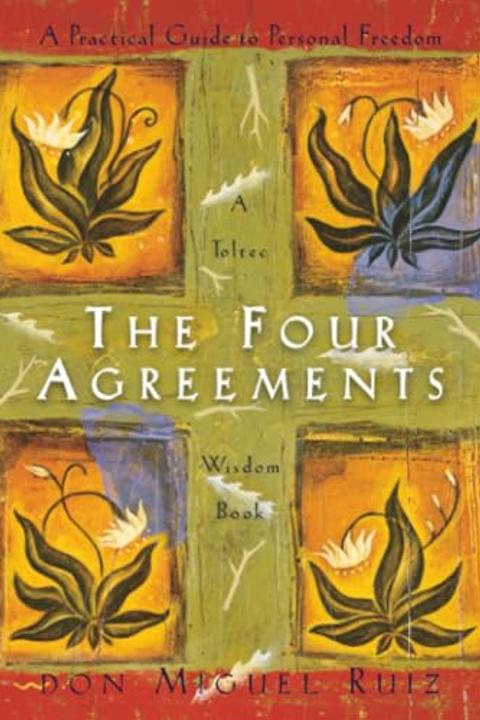
The Four Agreements: A Practical Guide to Personal Freedom
by Don Miguel Ruiz
Why read this book
- It compresses a whole philosophy of self-mastery into four memorable rules you can actually carry around in your head.
- The second agreement alone — don't take anything personally — is one of the most quietly liberating ideas in self-help, and the book makes the case for it cleanly.
- The framing of "domestication" gives you a vocabulary for noticing the beliefs you never chose, which is the first step to questioning them.
- It's short, plainspoken, and non-technical, so the core ideas land in a single sitting.
In one sentence
Don Miguel Ruiz's distillation of Toltec wisdom into four simple agreements to make with yourself — be impeccable with your word, don't take anything personally, don't make assumptions, and always do your best — as a way to escape the limiting beliefs we absorb unconsciously and reclaim personal freedom.
Key takeaways
- Be impeccable with your word. Speak with integrity, say only what you mean, and don't use words against yourself or to gossip about others. Ruiz treats the word as the most powerful tool you have — it can free you or enslave you.
- Don't take anything personally. What other people say and do reflects their own dream, their own conditioning, not the truth about you. Taking nothing personally makes you immune to needless suffering.
- Don't make assumptions. Have the courage to ask questions and to say what you really want. Most drama and misunderstanding comes from assuming we know what others think and then believing the story we invented.
- Always do your best. Your best changes from moment to moment — it's different when you're healthy versus tired or sick — so the agreement isn't about a fixed standard, it's about showing up fully without self-judgment. Doing your best is what stops the inner critic, because you can't reproach yourself for an honest effort.
- Domestication: from childhood we're trained, like animals, through reward and punishment to adopt other people's beliefs. We absorb a whole belief system we never chose and eventually enforce it on ourselves — Ruiz calls us "autodomesticated."
- The dream of the planet: society's collective dream — its rules, religion, culture, language — is handed to us before we're born, and we learn to dream it without noticing.
- The mitote: the Toltecs called the fog of the mind a mitote, a thousand voices talking at once, the noise of all our beliefs and agreements that keeps us from seeing what we really are.
- The four agreements are deliberately simple but hard, because each one means breaking thousands of older agreements you made unconsciously and have defended ever since.
Summary
The Four Agreements presents a code of conduct drawn from ancient Toltec wisdom, written by Don Miguel Ruiz, a Mexican author from a family of healers (curanderos). The book's premise is that we are not born with our beliefs — we are "domesticated" into them. As children, through a system of reward and punishment, we agree to the version of reality handed to us by family, school, religion, and culture. Ruiz calls this collective inheritance the dream of the planet, and the personal version of it the dream we each live inside. The problem is that we made thousands of these agreements without ever consciously choosing them, and many of them are based on fear and lead to suffering.
The accumulated noise of all those beliefs is what the Toltecs called the mitote — a fog in the mind, a thousand voices talking at once, none of them agreeing. The book's project is to cut through that fog by replacing the old unconscious agreements with four new ones, chosen deliberately. Each agreement is short enough to remember and demanding enough to take a lifetime to live.
The first agreement, be impeccable with your word, is the foundation. Ruiz treats language as the sharpest tool humans have — capable of building or destroying, both for others and for yourself. Impeccability means using it in the direction of truth and love, and refusing to turn it against yourself. The second, don't take anything personally, follows: because everyone lives in their own dream, what they say and do is about them, not you. The third, don't make assumptions, attacks the habit of inventing stories about what others think and then suffering over fictions; the antidote is the courage to ask and to speak plainly.
The fourth agreement, always do your best, holds the other three together. Your best fluctuates — it's not the same on a strong day as on an exhausted one — so the agreement is about full effort rather than a fixed bar. Done honestly, it disarms the inner judge: if you genuinely did your best, there's nothing to punish yourself for. The book is more an invitation than a system, light on argument and heavy on repetition and reassurance, but the four agreements are sticky and the second and third in particular are unusually practical for a book in the spiritual-self-help lane.
Reflections
The strongest agreement is the second one, because it does the most work for the least effort: most of the sting we feel from other people dissolves once you accept that their behavior is about their dream, not your worth. It's not a license to ignore feedback, but it's a good filter for the difference between information and noise.
The third agreement pairs naturally with it — the cost of an unspoken assumption is usually higher than the small discomfort of just asking. The "domestication" framing is the book's most useful concept, because it names the thing self-help usually skips: that you didn't author most of your beliefs.
The book's weakness is that it asserts more than it argues, and the Toltec packaging is more flavor than mechanism. But the four rules are right, they're easy to remember, and being easy to remember is most of what makes a rule usable.
“"Be impeccable with your word. Don't take anything personally. Don't make assumptions. Always do your best."”
— Don Miguel Ruiz
Who should read this
- Anyone who takes criticism hard or replays conversations afterward, and wants a clean mental tool for not absorbing other people's behavior.
- People drawn to plainspoken, non-religious spirituality who want philosophy distilled into something they can remember and use.
- Readers at a transition point who suspect their assumptions and inherited beliefs are running their life on autopilot.
- Skip it if you want rigorous argument, evidence, or psychological depth; the book is intentionally simple and reads as wisdom-literature, not science.
Favorite quotes
- "Be impeccable with your word. Don't take anything personally. Don't make assumptions. Always do your best."
- "Speak with integrity. Say only what you mean. Avoid using the word to speak against yourself or to gossip about others. Use the power of your word in the direction of truth and love."
- "Nothing other people do is because of you. It is because of themselves."
- "There is a huge amount of freedom that comes to you when you take nothing personally."
- "Find the courage to ask questions and to express what you really want. Communicate with others as clearly as you can to avoid misunderstandings, sadness and drama."
- "We are so well trained that we are our own domesticator. We are an autodomesticated animal."
- "Humans punish themselves endlessly for not being what they believe they should be."
FAQ
What are the four agreements in the book?
Be impeccable with your word; don't take anything personally; don't make assumptions; always do your best. They are framed as agreements you make with yourself to replace the unconscious, fear-based agreements you adopted growing up.
What does "be impeccable with your word" mean?
Speak with integrity, say only what you mean, and avoid using language against yourself or to gossip about others. Ruiz treats the word as the most powerful tool you have — it can free you or enslave you depending on how you use it.
What is the main idea of The Four Agreements?
That most human suffering comes from beliefs we absorbed unconsciously, and that consciously living by four simple agreements can break that conditioning and lead to personal freedom.
What does "domestication" mean in The Four Agreements?
It's Ruiz's term for how we're trained from childhood — through reward and punishment, the same way animals are — to adopt other people's beliefs until we enforce that belief system on ourselves.
What is the dream of the planet?
Ruiz's name for society's collective dream — its rules, religion, culture, and language — which is handed to us before we're born and which we learn to live inside without questioning.
What is the mitote?
A Toltec term Ruiz uses for the fog of the mind: a thousand voices talking at once, the noise of all the beliefs and agreements that keep us from seeing who we really are.
Is The Four Agreements worth reading?
Yes if you want a short, memorable code for self-mastery, especially the ideas of not taking things personally and not making assumptions. Less so if you want evidence-based argument or psychological depth.
Detailed Notes
Click to expand the full detailed notes →
Detailed Notes
Click to expand the full detailed notes →
- Domestication and the dream of the planet: Society's collective dream — its religion, law, culture, and language — is created before we're born and handed to us as reality. We're "domesticated" into it as children through reward and punishment, the same system used on animals: do what adults want and you get attention; deviate and you risk rejection. We absorb a belief system we never consciously chose, and eventually enforce it on ourselves. "We are so well trained that we are our own domesticator. We are an autodomesticated animal." The accumulated noise of all those beliefs is the mitote — the fog of the mind, a thousand voices talking at once — which keeps us from seeing what we really are. (Note: the well-known "fifth agreement," be skeptical but learn to listen, comes from a later book and is not part of this one.)
- First agreement — Be impeccable with your word: The foundation of all four. "Impeccable" derives from the Latin for "without sin," so to be impeccable with your word is to use it without turning it against yourself or others. "Speak with integrity. Say only what you mean. Avoid using the word to speak against yourself or to gossip about others. Use the power of your word in the direction of truth and love." Ruiz frames the word as the most powerful tool humans have — it can build or destroy, free you or enslave you — which is why this agreement underpins the rest.
- Second agreement — Don't take anything personally: Because everyone lives in their own dream, shaped by their own domestication, what they say and do reflects them, not you. "Nothing other people do is because of you. It is because of themselves." Even direct insults run on the other person's agreements, not your reality. The payoff is immunity to a huge amount of needless suffering: "There is a huge amount of freedom that comes to you when you take nothing personally."
- Third agreement — Don't make assumptions: We invent stories about what others think and feel, believe those stories, and then suffer over fictions. The remedy is courage and clear communication: "Find the courage to ask questions and to express what you really want. Communicate with others as clearly as you can to avoid misunderstandings, sadness and drama." Ruiz pairs this closely with the second agreement — most personal drama is built from an assumption taken personally.
- Fourth agreement — Always do your best: The agreement that protects the other three from becoming weapons of self-judgment. Your best is not fixed — it changes from moment to moment, different when you're healthy than when you're tired or sick — so this is about full, honest effort rather than a standard you fall short of. Done sincerely, it silences the inner judge, because there's nothing to punish yourself for if you genuinely did your best. It counters the habit Ruiz names directly: "Humans punish themselves endlessly for not being what they believe they should be."
- Anchor quote: "Be impeccable with your word. Don't take anything personally. Don't make assumptions. Always do your best."