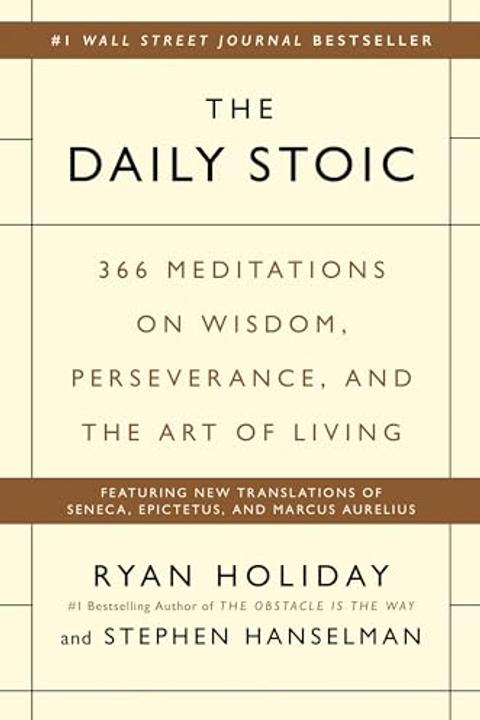
The Daily Stoic
by Ryan Holiday & Stephen Hanselman
Why read this book
- The daily format makes Stoicism a habit instead of a book you finish and forget.
- It's a clean on-ramp to Marcus, Seneca, and Epictetus without reading them cover to cover.
- The recurring theme (control what you can, ignore the rest) is one of the most useful mental tools there is.
- Good as a re-read; you'll get different lines depending on what you're dealing with that week.
In one sentence
A year of daily Stoic meditations (one per day, from Marcus Aurelius, Seneca, and Epictetus) organized around control, desire, and guarding your mind.
Key takeaways
- The Stoic core: separate what you control (your judgments, choices, effort) from what you don't (outcomes, other people, reputation), and put your energy only on the first.
- Freedom comes from removing desire, not satisfying it. As Epictetus frames it, you can be wealthy by wanting everything you already have.
- Guard your mind like you guard your body. We'd never let a stranger shove us around physically, yet we hand our attention to anyone (social media, the news, other people's moods).
- Other people don't make you stressed or jealous; the cause is your own judgment. "They're just the target."
- Who you spend time with shapes you. Keep asking whether the people around you are making you better.
Summary
The Daily Stoic takes the three big Stoics — Marcus Aurelius, Seneca, Epictetus — and breaks their ideas into 366 short daily readings, one for each day of the year, grouped into monthly themes. Each entry is a quote, a page of plain-English reflection, and usually a small action.
The throughline is the dichotomy of control: almost everything that troubles us is a reaction to things outside our control, and the Stoic move is to redirect attention to the only thing that is in our control, our own judgment and choices. From there the recurring themes follow: freedom through fewer desires, guarding your attention, accepting mortality, and choosing who you let influence you.
The format is the point. Read straight through, it's a bit repetitive. Read one a day, it becomes a daily reset, which is how most people use it and why it's stayed popular.
Reflections
I use this as a daily reset more than a book I "finished." The entries on guarding your attention are the ones that land for me, probably because that's where I lose the most ground. Read straight through it gets repetitive. One a day, it works.
“"There are two ways to be wealthy — to get everything you want or to want everything you have."”
— Ryan Holiday & Stephen Hanselman
Who should read this
- Anyone who wants a daily, low-effort practice rather than another book to finish.
- Newcomers to Stoicism who want a guided path into Marcus, Seneca, and Epictetus.
- Skip if you want deep scholarship; this is applied, not academic.
Favorite quotes
- "There are two ways to be wealthy — to get everything you want or to want everything you have."
- "If a person gave away your body to some passerby, you'd be furious. Yet you hand over your mind to anyone who comes along."
- "We can't blame other people for making us feel stressed or frustrated… The cause is within us. They're just the target."
- "You are not your body and hair-style, but your capacity for choosing well. If your choices are beautiful, so too will you be."
- "Even what we get for free has a cost, if only in what we pay to store it — in our garages and in our minds."
FAQ
What is The Daily Stoic about?
366 daily Stoic meditations on control, desire, and the mind, drawn from Marcus Aurelius, Seneca, and Epictetus.
How do you read The Daily Stoic?
One entry per day, matched to the date; each has a quote, a short reflection, and an action.
What is the main Stoic idea in it?
The dichotomy of control: focus only on what you control (your judgments and choices) and let go of the rest.
Is it worth reading?
Yes, especially as a daily habit rather than a straight-through read.
Detailed Notes
The recurring ideas, pulled from the daily entries:
- The dichotomy of control — spend energy only on what's yours: your judgments and choices. Let go of the rest.
- Freedom by subtracting desire — want what you already have, and you're already free.
- Guard your attention the way you'd guard your body — what you let in shapes you.
- Other people aren't the cause of your stress, only the target — the disturbance lives in your judgment of them.
- Who you spend time with shapes you — choose your circle deliberately.
- Memento mori — keep death in view and the small stuff stays small.
Format: 366 daily entries across 12 monthly themes — one short passage, reflection, and prompt per day.