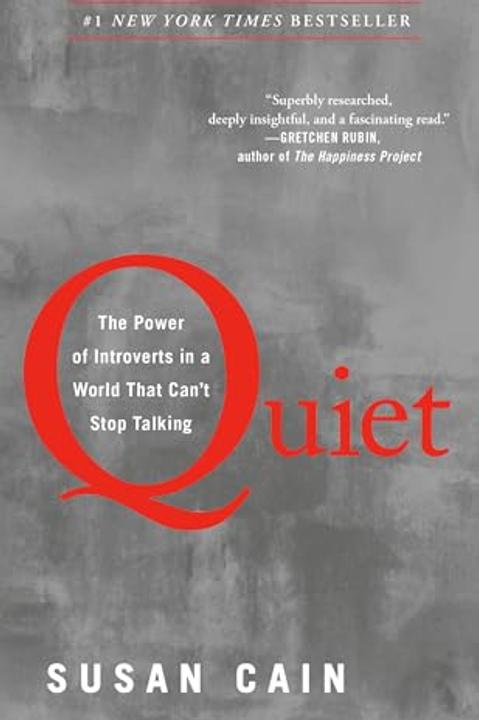
Quiet: The Power of Introverts in a World That Can't Stop Talking
by Susan Cain
Why read this book
- It names something most people feel but can't articulate: that modern schools and offices are built for one personality type, and quietly penalize the other.
- It cleanly separates introversion from shyness, which dissolves a lot of confusion and self-blame for people who've conflated the two their whole lives.
- It's grounded in real research — Kagan's temperament studies, Brian Little's Free Trait Theory — rather than pop-psychology vibes, so the claims hold up.
- It's genuinely useful for the other half too: managers, teachers, and parents of introverts get a concrete model for how to stop wasting quiet people's strengths.
In one sentence
Susan Cain's argument that Western culture systematically overvalues extroversion, and that introverts — with their gifts for deep focus, listening, and solitary creativity — are a quiet, underrated half of the population we'd be wise to stop trying to fix.
Key takeaways
- The Extrovert Ideal is cultural, not natural. Western society treats being bold, gregarious, and quick to speak as the default "ideal self," and that bias is baked into open offices, group projects, and brainstorming sessions — not a law of human nature.
- Introversion is not shyness. Shyness is fear of social judgment; introversion is a preference for lower-stimulation environments. You can be a calm, confident introvert or an anxious, shy extrovert — they're different axes.
- Temperament is partly biological and shows up early. Jerome Kagan's research found that "high-reactive" infants — who startle and fuss at novelty — tend to become more inward, careful adults, while "low-reactive" babies tend toward extroversion.
- Introverts bring real, distinct strengths: sustained focus, careful listening, deliberate (less impulsive) decision-making, and a capacity for creative work done alone.
- Solitude is a precondition for certain kinds of creativity, not a deficiency. "Solitude is a catalyst for innovation." Group settings and constant collaboration can actively suppress original thinking.
- Group brainstorming and open-plan offices often hurt more than they help — social loafing, production blocking, and the pressure to conform all degrade the output that the format is supposed to improve.
- You can act out of character for what matters. Brian Little's Free Trait Theory: introverts can "play" extroverts in service of "core personal projects" — work or people they care deeply about.
- But pseudo-extroversion has a cost, so you need restorative niches: deliberate pockets of solitude and quiet that let you recover from acting out of character before you burn out.
- Raising and teaching introverted kids well means working with their temperament — gradual exposure, respect for their need to observe before joining — not shaming them into performing as extroverts.
Summary
Quiet opens by naming a bias most of us never notice we're swimming in: the Extrovert Ideal. Cain argues that sometime in the early twentieth century, America shifted from a "Culture of Character" — which prized inner virtue, restraint, and seriousness — to a "Culture of Personality" that rewarded charm, charisma, and the ability to sell yourself. Dale Carnegie is the patron saint of this turn. The result is a world that equates being talkative with being capable, and treats quietness as a problem to be corrected, even though, as Cain puts it, "there's zero correlation between being the best talker and having the best ideas."
The middle of the book digs into where temperament comes from. Cain walks through Jerome Kagan's decades-long studies, which found that a baby's reactivity to new stimuli predicts adult temperament: the roughly 20% of infants who are "high-reactive" — intensely responsive to novelty — tend to grow into more sensitive, vigilant, inward adults, while "low-reactive" babies lean extroverted. Crucially, biology isn't destiny; it sets a range, not a fixed point. Along the way Cain carefully separates introversion from shyness — introverts simply prefer less stimulation, while shyness is about fear of disapproval — a distinction that reframes a lot of people's self-understanding.
From there the book makes its positive case for what introverts offer. They're built for deep, sustained focus and for the kind of creativity that happens in solitude — "solitude is a catalyst for innovation." They tend to listen more than they broadcast, and to decide deliberately rather than impulsively. Cain turns a skeptical eye on the institutions that ignore all this: open-plan offices and mandatory group brainstorming, she argues, often suppress good ideas through conformity pressure and constant interruption, despite being sold as engines of collaboration.
The final stretch is practical. Drawing on Brian Little's Free Trait Theory, Cain explains that introverts can convincingly act out of character — become "pseudo-extroverts" — in pursuit of "core personal projects," the work and relationships they genuinely care about. The catch is that acting out of character is depleting, so it has to be balanced with "restorative niches": planned solitude that lets you return to yourself. She closes with guidance for parents and teachers of quiet kids, arguing the goal isn't to convert them but to help them thrive on their own terms. Her summary image: "Everyone shines, given the right lighting."
Reflections
The strongest move in the book is the introversion-vs-shyness split, because it reframes a category error a lot of people carry around. If you've always assumed being drained by a party means you're afraid of people, the distinction lands like a small correction to your own operating manual: it's a stimulation preference, not a fear.
From there, the Extrovert Ideal becomes hard to unsee — the open office, the "let's whiteboard it as a group," the implicit grading of students on participation. Cain's most defensible claim is the narrow one: certain kinds of deep and creative work require solitude, and the institutions built around constant collaboration are quietly taxing exactly the people best at that work.
The Free Trait Theory section is where the book is most useful rather than just validating, because it resists the easy conclusion ("just be yourself") and admits the real trade: you can act out of character for things you care about, but it costs you, so you have to schedule the recovery.
Where I'd push back is the temptation to treat introvert/extrovert as a clean binary when it's really a spectrum with a lot of ambiverts in the middle, and the risk that "I'm an introvert" becomes a permission slip to avoid hard but worthwhile social effort. The honest reading is that Cain isn't arguing introverts are better — she's arguing they're different and underused, which is the more interesting and more defensible claim.
“"There's zero correlation between being the best talker and having the best ideas."”
— Susan Cain
Who should read this
- Introverts who've spent years feeling like there's something to fix about being quiet, reserved, or drained by socializing.
- Managers, founders, and team leads who run open offices and brainstorms and want to know why their quietest people may be their most underused.
- Teachers and parents of children who hang back, observe before joining, and prefer one close friend to a big group.
- Extroverts who want to understand and get more out of the introverts they work and live with.
- Skip it if you already have a sophisticated, research-grounded model of temperament; the core argument is well-known enough now that the book can feel like it's confirming what you believe.
Favorite quotes
- "There's zero correlation between being the best talker and having the best ideas."
- "Solitude is a catalyst for innovation."
- "Shyness is the fear of social disapproval or humiliation, while introversion is a preference for environments that are not overstimulating."
- "Love is essential, gregariousness is optional."
- "Spend your free time the way you like, not the way you think you're supposed to."
- "The secret to life is to put yourself in the right lighting. For some, it's a Broadway spotlight; for others, a lamplit desk."
- "Everyone shines, given the right lighting."
FAQ
What is the main idea of Quiet by Susan Cain?
That Western culture overvalues extroversion (the "Extrovert Ideal") and undervalues introverts, even though introverts contribute distinctive strengths — deep focus, careful listening, deliberate judgment, and creativity born of solitude.
What is the difference between introversion and shyness?
They're not the same. Shyness is fear of social disapproval or humiliation; introversion is a preference for quieter, less stimulating environments. A person can be a confident introvert or a shy extrovert.
What is the Extrovert Ideal?
Cain's term for the cultural assumption that the ideal person is bold, sociable, and quick to speak. She traces it to a twentieth-century shift from a "Culture of Character" to a "Culture of Personality."
What is high-reactive vs. low-reactive temperament?
From Jerome Kagan's research: about 20% of infants are "high-reactive," responding intensely to new sights and sounds, and they tend to become more introverted, cautious adults. "Low-reactive" babies tend toward extroversion. It suggests a biological basis for temperament.
What are restorative niches?
Deliberate pockets of solitude and quiet that let introverts recover after spending energy acting like extroverts. They're the counterbalance that keeps "acting out of character" from leading to burnout.
What is Free Trait Theory in Quiet?
Brian Little's idea that we're born with fixed traits but can act outside them to advance "core personal projects" — work and people we care deeply about. It's how an introvert can convincingly play an extrovert when it matters.
Does Quiet say group brainstorming and open offices are bad?
Largely yes. Cain argues that group brainstorming often produces fewer and worse ideas than people working alone, and that open-plan offices and constant collaboration can suppress the focused, original thinking they're meant to create.
Is Quiet worth reading?
Yes, especially if you're an introvert or work with them. The argument is well-researched and validating, though its central thesis has become widely known since the book's release.
Detailed Notes
Click to expand the full detailed notes →
Detailed Notes
Click to expand the full detailed notes →
- Part One — The Extrovert Ideal: Cain traces how American culture moved from a "Culture of Character" (inner virtue, restraint, seriousness) to a "Culture of Personality" (charm, charisma, self-presentation), with Dale Carnegie as the emblem of the shift. The result is the Extrovert Ideal: the unexamined belief that the best way to be is bold, gregarious, and quick to speak. She shows how this bias is institutionalized in business culture, schools, and especially in the worship of group collaboration — and lands the core line: "there's zero correlation between being the best talker and having the best ideas." This is also where the critique of group brainstorming and open-plan offices lives: conformity pressure, social loafing, and constant interruption tend to degrade the very creativity these formats promise.
- Part Two — Your Biology, Your Self? The science section. Jerome Kagan's longitudinal work shows that "high-reactive" infants (roughly 20%, intensely responsive to novelty) tend to become inward, vigilant adults, while "low-reactive" babies lean extroverted — evidence that temperament has deep biological roots while still leaving room for environment and choice. Cain carefully separates introversion from shyness: "shyness is the fear of social disapproval or humiliation, while introversion is a preference for environments that are not overstimulating." She develops the idea of the optimal level of arousal — everyone has a "sweet spot" of stimulation, and introverts simply reach theirs at lower levels — which is why "the secret to life is to put yourself in the right lighting."
- Part Three — Do All Cultures Have an Extrovert Ideal? A comparative turn. Cain contrasts Western, especially American, extroversion-worship with cultural traditions (she draws notably on Asian and Asian-American examples) that place higher value on quiet, restraint, and listening. The point is to denaturalize the Extrovert Ideal: it's a cultural inheritance, not a universal truth about which temperament is superior.
- Part Four — How to Love, How to Work: The practical payoff. Brian Little's Free Trait Theory explains how introverts can act out of character — become "pseudo-extroverts" — in service of "core personal projects," the work and people they care most about. The essential counterweight is the "restorative niche": planned solitude that lets you recover from the effort of performing, so acting out of character doesn't lead to burnout ("a free trait strategy can be effective when used judiciously, but disastrous if overdone"). Cain applies this to relationships ("love is essential, gregariousness is optional") and to raising and teaching introverted children — advocating acceptance, gradual exposure, and respect for a child's need to observe before joining, rather than pressure to perform as an extrovert.
- Closing image: "Everyone shines, given the right lighting" — the book's compressed thesis: the goal isn't to fix introverts or convert them, but to build lives, offices, and classrooms where quiet strengths get the conditions they need.