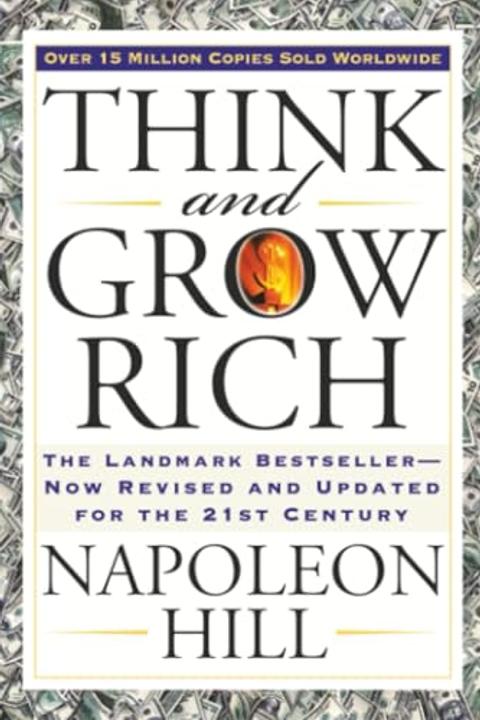
Think and Grow Rich
by Napoleon Hill
Why read this book
- It's one of the original self-help books, and a lot of later "mindset and money" writing traces back to it, so it's worth knowing the source.
- The core moves (a specific written goal, a fixed deadline, persistence past failure) are practical and have held up better than the mystical packaging around them.
- The "definite chief aim" idea, deciding exactly what you want before anything else, is a useful planning prompt on its own.
- It's short, blunt, and very quotable, even where you disagree with it.
- Reading it shows you how dated some of it is, which helps you separate the durable advice from the 1937 pseudo-science.
In one sentence
Napoleon Hill's 1937 claim that wealth starts in the mind, built on a definite burning desire and 13 principles he says he distilled from studying successful people.
Key takeaways
- Thoughts are things. Hill's central claim is that a definite, emotionalized thought is the starting point of every fortune, and that the mind, more than circumstance, sets the ceiling. Useful as a frame for goal-setting, weaker as a literal mechanism.
- The definite chief aim. Before anything else, decide exactly what you want, write it down, fix a deadline, and name what you'll give in return. Vague wanting doesn't move; a specific target does.
- Desire is principle one. Not idle wishing but a burning, single-minded want that crowds out alternatives. Hill treats this as the fuel for everything that follows.
- Faith. Belief that the goal is reachable, which Hill says you build through repetition rather than wait to feel. The idea is that confidence is trained, not inherited.
- Autosuggestion. Repeating your written goal aloud, with feeling, to feed it into the subconscious. Strip the mysticism and it's close to deliberate self-talk and priming.
- Specialized knowledge. General knowledge doesn't pay; knowledge organized toward a specific aim does. You don't have to hold it all yourself, you can hire or partner for it.
- Imagination. The workshop where plans get formed. Hill splits it into "synthetic" (recombining what exists) and "creative" (new ideas).
- Organized planning. Turn desire into concrete, written plans, and expect to revise them when they fail. He pairs this with leadership and getting the right people around you.
- Decision. Successful people decide quickly and change their minds slowly; indecision and letting other people's opinions run you is, in his telling, a main cause of failure.
- Persistence. The one most failures lack. Hill frames it as sustained effort that outlasts repeated, temporary defeat, and says most people quit right before the turn.
- The Mastermind. A coordinated group of people working toward a definite aim in a spirit of harmony. Hill calls this the most important principle for anyone aiming high, since no one gets there alone.
- The honest caveats: the "sex transmutation" chapter, the séance-style "Invisible Counselors," and the constant teasing of a never-quite-stated "secret" are products of 1937 and read as such today.
Summary
Think and Grow Rich came out in 1937, in the middle of the Depression, and it's built on a simple, repeated claim: wealth begins as a thought. Hill says he spent about 25 years studying more than 500 successful people, including Andrew Carnegie (who he credits with commissioning the study), Henry Ford, and Thomas Edison, and that he distilled what they had in common into 13 principles anyone could follow. The book's signature line, "whatever the mind can conceive and believe, it can achieve," sums up the bet.
The starting point is desire and what he calls a definite chief aim. Hill is insistent that wanting to be successful in general does nothing. You have to decide exactly what you want, write it down, set a deadline, and state what you'll give in return, then read it aloud daily until it's lodged in your subconscious. From there the principles stack: faith (belief, trained through repetition), autosuggestion (feeding the goal to the subconscious), specialized knowledge (organized toward the aim, not general), imagination, organized planning, decision, and persistence. The last principle, the Mastermind, is the one he rates highest: a coordinated group pulling in the same direction, on the theory that nobody reaches a big goal alone.
The honest problem with the book is that the durable advice is wrapped in a lot of 1937 packaging that hasn't aged well. Hill keeps promising a "secret" he never plainly states, builds in a chapter on "sex transmutation," and describes a routine where he holds imaginary cabinet meetings with dead historical figures he calls his "Invisible Counselors." There's also a thinness to the evidence: the famous claim of studying 500 men is mostly unsourced, and several of the success stories are more parable than case study. Read literally, the "thoughts become things" mechanism is closer to magical thinking than psychology.
Read as a goal-setting and self-discipline manual, though, a fair amount survives. Write the goal down. Make it specific. Put a date on it. Decide fast, revise plans when they fail, and don't quit at the first defeat. Surround yourself with people aiming at the same thing. None of that is original anymore, partly because this book helped make it common. That's the case for reading it: not as gospel, but as the origin point most modern "mindset and money" advice is downstream of, with the dated parts left in plain view.
Reflections
The part that holds up is unglamorous: decide exactly what you want, write it down, put a date on it, and don't quit the first few times it fails.
Hill wraps that in a lot of 1937 mysticism (a "secret" he won't name, imaginary meetings with dead presidents, "thoughts become things" taken literally), and it's easy to roll your eyes at. But the planning core is sound, and you can see why so much later mindset-and-money writing pulls from it.
The honest read is to take the definite-chief-aim and persistence ideas, leave the magical-thinking mechanism, and notice that the specificity is what does the work, not the wishing.
“"Whatever the mind can conceive and believe, it can achieve."”
— Napoleon Hill
Who should read this
- People curious about where the modern self-help and "mindset" genre came from, who want the source rather than the paraphrase.
- Anyone who responds to a clear, motivating push to define a specific goal, write it down, and stick a deadline on it.
- Founders and self-employed people who like the persistence-and-decisiveness framing and can ignore the mystical chapters.
- Skip it if pseudo-scientific claims about thoughts shaping reality put you off, or if you want evidence-based modern psychology. For that, something like Dweck's Mindset or Duckworth's Grit is a better fit.
Favorite quotes
- "Whatever the mind can conceive and believe, it can achieve."
- "Desire is the starting point of all achievement, not a hope, not a wish, but a keen pulsating desire which transcends everything."
- "A quitter never wins and a winner never quits."
- "The starting point of all achievement is desire. Keep this constantly in mind. Weak desire brings weak results."
FAQ
What are the 13 principles of Think and Grow Rich?
Desire, Faith, Autosuggestion, Specialized Knowledge, Imagination, Organized Planning, Decision, Persistence, the Mastermind, the subconscious mind, the brain, the sixth sense, and (in Hill's framing) sex transmutation. The first nine are the ones most people quote and use.
What is the main idea of Think and Grow Rich?
That wealth and achievement start in the mind: a definite, burning desire backed by a written goal, faith, persistence, and a supportive group of people (the Mastermind) is what turns a thought into a result.
Is Think and Grow Rich worth reading?
It depends. As the origin of much modern self-help it's worth knowing, and the goal-setting and persistence advice holds up. The 1937 mysticism and weak evidence mean it's better treated as a motivational classic than a how-to manual.
What is the "definite chief aim" in Think and Grow Rich?
Hill's term for deciding exactly what you want, writing it down with a deadline and what you'll give in return, then repeating it daily so it sinks into your subconscious. He treats it as the first step before any of the other principles.
What is the "secret" in Think and Grow Rich?
Hill deliberately never states it plainly, saying readers must recognize it for themselves. Most readers take it to be the "thoughts become things" idea: that a definite, emotionalized desire, held with faith and persistence, is what produces wealth.
Is Think and Grow Rich based on real research?
Hill claims it came from about 25 years studying more than 500 successful people commissioned by Andrew Carnegie, but the study is largely unsourced and several anecdotes read as parables. Treat the "research" framing with skepticism.
Detailed Notes
Click to expand the full detailed notes →
Detailed Notes
Click to expand the full detailed notes →
- The thesis: "thoughts are things" — Hill argues a definite, emotionalized thought is the seed of every fortune, and that the mind sets the ceiling more than circumstance does. Strong as a goal-setting frame, weak as a literal mechanism.
- The origin claim: roughly 25 years studying 500+ successful people (Carnegie, Ford, Edison among them), supposedly commissioned by Andrew Carnegie. Mostly unsourced; treat as motivation, not data.
- The definite chief aim: decide exactly what you want, write it down, set a deadline, state what you'll give in return, and read it aloud daily. The specificity is the active ingredient.
- Principle 1 — Desire: a burning, single-minded want, not a wish. Hill's "fuel" for everything else.
- Principle 2 — Faith: belief the goal is reachable, built through repetition rather than waited for. Close to trained confidence.
- Principle 3 — Autosuggestion: repeating the written goal with feeling to feed the subconscious. Strip the mysticism and it's deliberate self-talk and priming.
- Principle 4 — Specialized Knowledge: general knowledge doesn't pay; knowledge organized toward a specific aim does. You can hire or partner for what you lack.
- Principle 5 — Imagination: the "workshop" where plans form. Split into synthetic (recombining the existing) and creative (new ideas).
- Principle 6 — Organized Planning: turn desire into written, concrete plans; expect to revise when they fail. Paired with leadership and assembling the right people.
- Principle 7 — Decision: decide quickly, change slowly. Indecision and being run by others' opinions is, in his telling, a top cause of failure.
- Principle 8 — Persistence: sustained effort that outlasts repeated, temporary defeat. The trait Hill says most failures are missing, often quitting right before the turn.
- Principle 9 — The Mastermind: a coordinated group working toward a shared aim in harmony. Hill rates this highest; the premise is that nobody big gets there alone.
- The dated chapters: "sex transmutation" (redirecting drive into work), the "Invisible Counselors" (imaginary meetings with dead historical figures), and the never-quite-stated "secret." Products of 1937; read accordingly.
- The honest verdict: durable goal-setting and persistence advice wrapped in pseudo-scientific packaging. Worth reading as the source of the genre, not as a literal guide to how reality works.
- Anchor quotes: "Whatever the mind can conceive and believe, it can achieve." And: "A quitter never wins and a winner never quits."