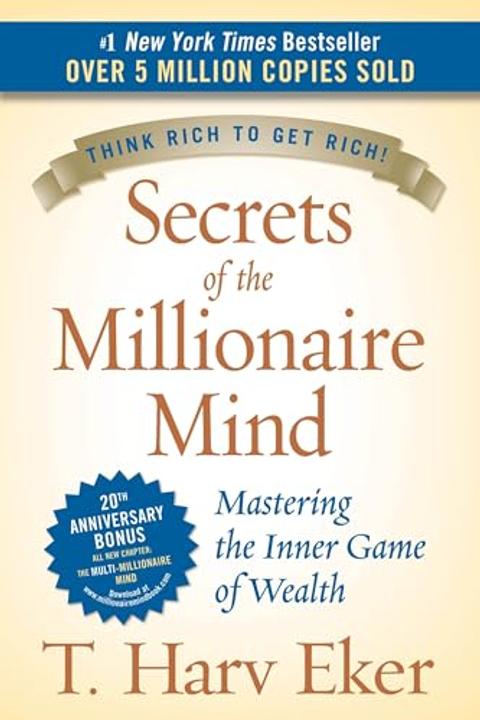
Secrets of the Millionaire Mind
by T. Harv Eker
Why read this book
- The "money blueprint / financial thermostat" metaphor is genuinely sticky and explains why people who win the lottery often end up broke.
- It's mindset, not tactics — a useful complement to the how-to money books.
- The 17 Wealth Files are concrete contrasts you can self-audit against.
- Short and blunt; you'll finish it.
In one sentence
Eker's argument that your income is set by a subconscious "money blueprint," and that you can reset it by adopting 17 specific ways rich people think and act.
Key takeaways
- You have a subconscious "money blueprint" set early in life. Your results (income, net worth, saving) reveal where the thermostat is set. Change the results permanently and you have to reset the thermostat, not just push harder.
- Wealth File #1: "I create my life" vs "life happens to me." Eker's whole system starts with refusing the victim frame.
- The three "victim clues" to kill: blaming, justifying, and complaining. He challenges readers to go seven full days without complaining, out loud or in their head.
- Rich people commit to being rich; poor people want to be rich. Wanting without commitment is the gap.
- "Comfortable" is a trap goal: aim for comfortable and you likely won't get rich; aim for rich and you'll probably end up comfortable.
Summary
Eker's premise is that money is downstream of mindset. Everyone, he argues, carries a "money blueprint" — a set of subconscious beliefs about wealth absorbed mostly in childhood — and that blueprint acts like a thermostat. Earn above your setting and you'll unconsciously sabotage your way back down; that's his explanation for lottery winners going broke and high earners staying broke.
The fix is to reset the thermostat, and the back half of the book is 17 "Wealth Files" — specific contrasts between how rich and poor people think. The foundational one is whether you believe you create your life or life happens to you. From there: commitment versus wanting, playing to win versus playing not to lose, and a hard line against the three victim habits of blaming, justifying, and complaining.
It's a mindset book, not a tactics book, and it's repetitive and a bit infomercial-ish in places (there are literal "declarations" you say with your hand on your heart). But the central metaphor earns its keep.
Reflections
The hand-on-heart declarations are a lot, and the infomercial tone nearly lost me. But the "financial thermostat" idea is sticky, and the seven-day no-complaining challenge is a concrete thing you can actually try. I rate the core idea higher than the packaging.
“"Rich people believe 'I create my life.' Poor people believe 'Life happens to me.'"”
— T. Harv Eker
Who should read this
- People who earn fine but can't seem to keep or grow money, and suspect the problem is between their ears.
- Readers who like mindset books (Think and Grow Rich, Psychology of Money) and want the blunt version.
- Skip if you want practical investing or budgeting tactics; this is the inner game only.
Favorite quotes
- "Rich people believe 'I create my life.' Poor people believe 'Life happens to me.'"
- "If your goal is to be comfortable, chances are you'll never get rich. But if your goal is to be rich, chances are you'll end up mighty comfortable."
- "Rich people are committed to being rich. Poor people want to be rich."
- "There is no such thing as a really rich victim!"
- "No thought lives in your head rent-free. Each thought you have will either be an investment or a cost."
- "The only way to change your level of financial success permanently is to reset your financial thermostat."
FAQ
What is Secrets of the Millionaire Mind about?
How your subconscious "money blueprint" sets your wealth, and 17 ways to think more like the rich ("Wealth Files").
What is the money blueprint?
Your subconscious beliefs about money, set early in life, that act like a thermostat returning you to a set level of wealth.
What are the Wealth Files?
17 contrasts between how rich and poor/middle-class people think and act, starting with "I create my life" vs "life happens to me."
Is it worth reading?
Yes for the mindset framing; pair it with a tactical money book.
Detailed Notes
- The money blueprint / "financial thermostat": your results reveal your set point — lasting change means resetting it, not just trying harder.
- Wealth File #1: "I create my life" vs "life happens to me" — ownership over victimhood.
- The three victim clues to kill: blaming, justifying, and complaining (Eker's seven-day no-complaint challenge targets exactly these).
- Other wealth files: commit to being rich vs merely wanting it; play to win vs play not to lose; and "comfortable" treated as a trap goal.