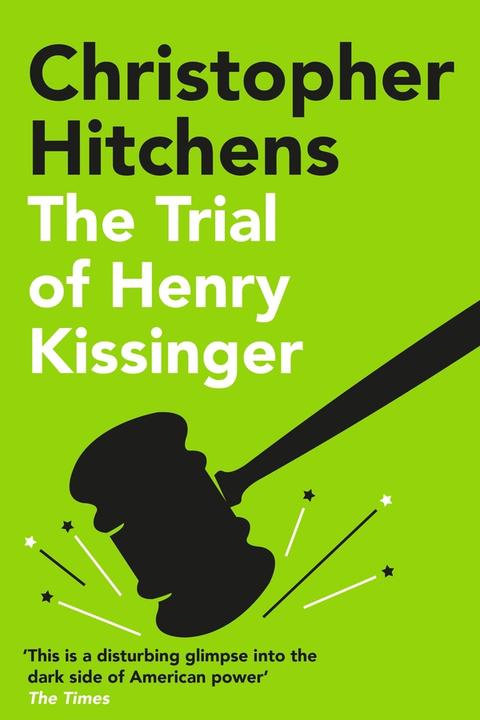
The Trial of Henry Kissinger
by Christopher Hitchens
Why read this book
- A short, sharply written entry point into the costs of Cold War interventionism.
- Read it as a reason to investigate further rather than as a complete biography or a finished legal judgment.
- Particularly useful if foreign-policy language such as “stability” and “credibility” has started to feel too abstract.
In one sentence
A concise, forceful prosecution of Henry Kissinger's Cold War record that connects policy decisions to their human cost, while leaving legal and causal questions open.
Key takeaways
1. Hitchens writes a prosecution, not a rounded life of Kissinger
The book's power comes from its narrowness. It builds cases around Indochina, Bangladesh, Chile, Cyprus, and East Timor, then asks whether the conduct warrants prosecution. That makes it vivid and fast. It also means the reader has to supply some of the context the book deliberately leaves aside.
2. The later documentary record supports serious scrutiny
Declassified material does not turn every allegation into a legally proven count. It does document choices that make innocent misunderstanding hard to argue: covert action in Chile, secret bombing in Cambodia, knowledge of atrocities in East Pakistan, and U.S. support around Indonesia's invasion of East Timor.
3. Historical responsibility is not the same question as criminal liability
Kissinger was never tried or convicted for the allegations in this book. A serious critique of Hitchens is that he moves too quickly from grave policy and consequence to individual criminal liability. That calls for precision about his role in each case; it does not end questions about what officials knew and chose.
4. “It was complicated” is context, not a conclusion
The Cold War problems were real: North Vietnamese sanctuaries, Pakistan's role in the opening to China, and the possibility of a Greek-Turkish war. The question is whether those problems justified secrecy, support, or inaction once the costs to people on the ground were visible.
Summary
Christopher Hitchens's The Trial of Henry Kissinger is a short, polemical indictment of Kissinger's role in U.S. policy from Indochina to East Timor.
It names people, documents, decisions, and victims instead of presenting diplomacy only as a contest among statesmen.
Hitchens argues for prosecution, not a balanced account of Kissinger's career.
Read it as the beginning of a longer inquiry.
Test its charges against primary records, competing interpretations, and the difference between moral responsibility and legal proof.
Reflections
I listened to the audiobook and found it difficult to dismiss. It is well-written, well-supported, and not especially long. What stayed with me was Hitchens's insistence that familiar foreign-policy language be judged against the people who lived with its consequences.
I did not come away thinking the book had closed every case. I wanted the counterargument: what did officials think they were preventing, what leverage did they actually have, and which alternatives were available? Hitchens is strongest when he makes those questions unavoidable. The book is weaker when the structure of a prosecution makes the answer sound more settled than the historical and legal record permits.
““A good liar must have a good memory: Kissinger is a stupendous liar with a remarkable memory.””
— Christopher Hitchens
Who should read this
Read it if
- You want a concise, unsettling challenge to the benevolent story of great-power intervention.
- You are willing to follow links, read primary documents, and keep your certainty proportional to the evidence.
- You want a book that forces strategic language to answer for human consequences.
Pair it with something else if
- You want a comprehensive Kissinger biography or a neutral diplomatic history.
- You want a rigorous legal treatise on jurisdiction and command responsibility.
- You are looking for a simple answer to whether different U.S. choices would certainly have produced a better outcome.
FAQ
What is The Trial of Henry Kissinger about?
Hitchens builds an indictment-style case that Kissinger should have faced prosecution for conduct connected to Indochina, Bangladesh, Chile, Cyprus, and East Timor. It is a political and moral polemic, not a conventional biography.
Was Henry Kissinger ever tried for the charges in the book?
No. Hitchens argues that prosecution was warranted; no court convicted Kissinger on those allegations.
Do later releases support Hitchens's account?
They strengthen or clarify several factual parts of it. Official records document secret bombing decisions, covert efforts in Chile, Washington's awareness of the Dacca dissent, and the Ford–Kissinger discussion with Suharto before East Timor's invasion. They do not eliminate the need to distinguish policy responsibility from a criminal case against one person.
Does the book prove that the United States caused every outcome it describes?
No. The record supports serious questions about U.S. choices, knowledge, leverage, and support. It does not justify flattening local actors, allies, adversaries, and U.S. officials into a single-cause story.
What should I read after this?
Gary J. Bass's The Blood Telegram is the natural follow-up on Bangladesh. Thomas A. Schwartz's Henry Kissinger and American Power offers a fuller political biography, while Martin S. Indyk's Master of the Game examines Kissinger's Middle East diplomacy.
Detailed Notes
Click to expand the full detailed notes →
Detailed Notes
Click to expand the full detailed notes →
Core concepts
A prosecutor's brief gains focus by narrowing the record
Hitchens has already decided which episodes matter most. The book is arranged as a charge sheet: a place, a policy, a chain of documents, and an accusation. That structure works well in audio because it moves quickly.
A prosecutor's brief does not distribute attention evenly. It does not have to linger over the opening to China, détente, arms control, or Kissinger's Middle East shuttle diplomacy. Those achievements belong in a full assessment. They do not cancel the allegations in this book. They are why the book should be introduced as a polemic rather than as the whole record.
The records are stronger evidence than a single casualty figure
The most useful discussion follows individual decisions and the information available to officials. A single casualty figure cannot explain who knew what or which choices they made.
In Cambodia, the official Foreign Relations of the United States record documents Kissinger briefing Richard Nixon on B-52 options; a later editorial note describes the decision to keep the operation secret. The administration offered a strategic rationale: North Vietnamese and Viet Cong sanctuaries in Cambodia. A fair account has to state that rationale. It also has to ask what secrecy did to democratic scrutiny and what costs officials accepted in pursuit of the objective.
Accounts of Chile sometimes reduce the episode to a slogan. The documents already establish serious conduct. In 1970, the Special Review Group discussed action to prevent Salvador Allende's confirmation. A November memorandum from Kissinger records later covert support for political, media, and private-sector opponents. That is different from saying the CIA planned and carried out the September 1973 coup itself. An unsupported stronger claim would weaken an otherwise serious indictment.
In the 1971 crisis in what was then East Pakistan, the Rogers–Kissinger call on the Dacca dissent shows that reporting about Pakistan's repression was reaching senior officials. The administration had a strategic reason for caution: Pakistan was a channel to Beijing. That rationale does not settle whether its response was defensible. It identifies the trade-off officials believed they were making.
East Timor is the most direct of the later records. The December 6, 1975 meeting record records President Gerald Ford and Kissinger discussing Indonesian action with President Suharto, including the problem of U.S.-made weapons. The Timor-Leste truth commission later found U.S. political and military support fundamental to the invasion and occupation, while assigning primary responsibility for atrocities to Indonesia's military and security forces. U.S. support and leverage are part of the record, as are the Indonesian forces that committed the crimes.
Cyprus is where I would be especially careful with Hitchens. The declassified record shows a volatile crisis involving a Greek-junta-backed coup, Turkish intervention, and American concern about Greece, Turkey, Britain, Cyprus, and the Soviet Union. It certainly gives a reader grounds to scrutinize U.S. choices. It does not let me state Hitchens's larger allegation of a knowing conspiracy around murder and partition as settled fact without doing substantially more work.
The legal case asks more than the history alone can establish
Hitchens's central claim is uncompromising: Kissinger should face prosecution. That claim goes beyond what the documents alone can establish. International-law scholar Michael P. Scharf's review of the book argues that a persuasive moral condemnation is not the same as a viable criminal prosecution.
Responsibility was shared. Nixon and Ford were presidents. Military officers, intelligence agencies, allies, local governments, armed groups, and other U.S. officials made choices. Kissinger was not a bystander: he had unusual influence and was deeply involved in several of these decisions. His role still has to be shown case by case. He cannot be treated as the single author of everything associated with American power.
The record cannot show that non-intervention would automatically have produced peace, democracy, or a lower death toll. It can show what Washington knew, what pressure it could have applied, what assistance it could have withheld, and which diplomatic options it declined to pursue. Those questions keep the focus on choices rather than fantasies of perfect control.
Why I still think the book is worth reading
After listening, I was more interested in how much the United States and the wider Western world have intervened abroad. I also wondered whether other decisions might have been less damaging. I do not have a clean counter-history in mind. I am less willing to accept “strategic necessity” as the final answer.
Hitchens asks readers to follow responsibility through documents, institutions, alliances, and consequences rather than settle for a vague feeling of guilt about the past. The follow-up work is to use that standard without collapsing into a one-man explanation or treating a political indictment as a verdict.
For a wider frame, I would pair this with Thomas A. Schwartz's Henry Kissinger and American Power and Martin S. Indyk's Master of the Game. Schwartz puts Kissinger back inside the institutions and politics that shaped his power, while Indyk takes his Middle East diplomacy seriously. Both add context that Hitchens leaves out. They make a simple answer less satisfying.
For other angles on power and war, I also have notes on 1984, All Quiet on the Western Front, and The Lessons of History. They are not counterarguments to Hitchens. They are useful reminders that political power, war, and historical explanation can look very different depending on the form of the book.
Sources and further reading
- Christopher Hitchens, The Trial of Henry Kissinger (Verso, 2001).
- U.S. Department of State, Foreign Relations of the United States: Cambodia, Chile, and Bangladesh.
- National Security Archive, Ford–Kissinger–Suharto memorandum and Timor-Leste truth commission findings.
- Michael P. Scharf, "Statesman or War Criminal?".
- Gary J. Bass, The Blood Telegram (2013); Thomas A. Schwartz, Henry Kissinger and American Power (2020); Martin S. Indyk, Master of the Game (2021).
Chapter notes
This book note's detailed discussion appears in the Core concepts section above.