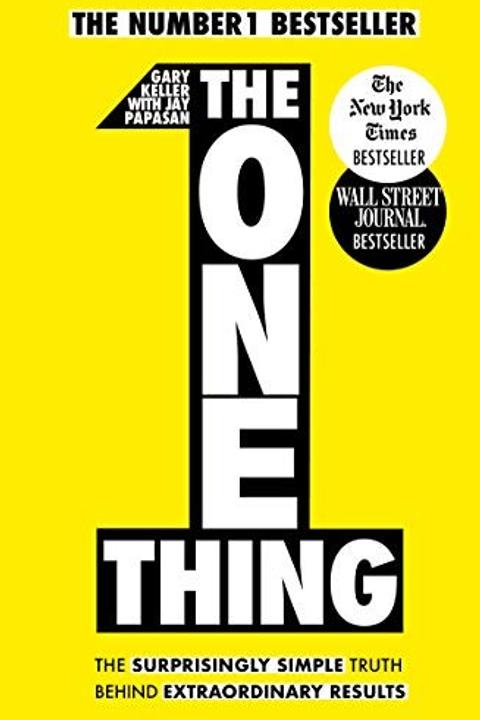
The ONE Thing: The Surprisingly Simple Truth Behind Extraordinary Results
by Gary Keller & Jay Papasan
Why read this book
- It gives you one repeatable question, the Focusing Question, that you can apply to almost any goal or messy to-do list.
- The domino-effect framing is a clean mental model for why sequential focus beats spreading yourself thin.
- It directly attacks multitasking and the idea that everything on your list matters equally, which is where most productivity systems quietly fail.
- It's short, repetitive, and practical, so the core method sticks after one read.
In one sentence
Gary Keller and Jay Papasan's argument that extraordinary results come from narrowing your focus to a single highest-leverage task and protecting time for it, instead of trying to do everything at once.
Key takeaways
- The Focusing Question is the whole method: "What's the ONE thing I can do such that by doing it everything else becomes easier or unnecessary?" Ask it of your life, your year, your week, and your day, and let the answers narrow down.
- The domino effect: success is built sequentially, one task knocking over the next. A small first domino can topple progressively larger ones, so the leverage comes from lining them up and starting, not from doing many at once.
- Go small. Instead of a longer to-do list, you want a shorter one focused on what matters most. Extraordinary results come from narrowing focus, not widening effort.
- Extreme Pareto: the 80/20 rule isn't the finish line, it's the starting point. Keep applying it — the vital few of the vital few — until you're down to a single task.
- Time-block the ONE Thing. Reserve a protected block (the book suggests around four hours) for your most important work, early, before the day's reactive demands take over. Then block time to protect that block.
- Multitasking is a lie. Switching between tasks carries a cost; you're not doing two things at once, you're toggling and paying for it each time.
- Willpower isn't always on call. It runs down over the day like a battery, so do your most important work when your willpower is highest rather than assuming you can summon it on demand.
- "Success is sequential, not simultaneous." You get to a big outcome by doing the right thing first, then the next right thing, not by chasing everything in parallel.
Summary
The ONE Thing argues that the path to extraordinary results is subtraction, not addition. Keller, a real estate entrepreneur, and Papasan frame the whole book around a single tool: the Focusing Question. Ask "what's the ONE thing I can do such that by doing it everything else will be easier or unnecessary?" and the answer points you at your highest-leverage move. Ask it at every timescale, from your life goals down to your next hour, and you get a chain of priorities that all point in the same direction.
The mental model underneath is the domino effect. Progress compounds sequentially: line up the right tasks and the first one makes the next easier, which makes the one after that easier still. A small first domino can eventually knock over much larger ones. The takeaway is that you don't need to do many things at once. You need to do the right thing first, then let momentum build.
A big chunk of the book is spent clearing away the beliefs that block focus, which Keller calls the lies. The two that do the most damage are "everything matters equally" and "multitasking works." Both push you toward a long list and constant task-switching, which feels productive and quietly isn't. He also pushes back on relying on willpower (it depletes through the day) and on chasing a perfectly balanced life (Keller argues for deliberate counterbalancing instead, going all-in on what matters and accepting the trade-offs).
The practical core is going small and time-blocking. Going small means resisting the urge to widen your effort and instead narrowing to the single task that matters most. Time-blocking means putting that task on the calendar as a protected, recurring block, ideally early, and then defending it from interruptions. The book is repetitive by design and light on nuance, but the method is simple enough to actually use, which is most of its value.
Reflections
The Focusing Question is the part worth keeping, because it survives outside the book. Most to-do lists treat every item as equally urgent, and the question is a quick way to break that tie: of all this, which one thing makes the rest easier or unnecessary?
The domino framing is a nice picture of why that works, though in practice the hard part isn't believing in focus, it's defending the time block when the day starts pulling at you. The lie that lands hardest is multitasking, since it's the one most people are sure they're good at.
The book's weakness is the same as its strength: one idea, repeated a lot. The idea is right, so the repetition is forgivable.
“"What's the ONE Thing you can do such that by doing it everything else will be easier or unnecessary?"”
— Gary Keller & Jay Papasan
Who should read this
- Anyone drowning in a long to-do list who suspects the problem is too many priorities, not too little effort.
- Founders, freelancers, and makers who control their own calendar and could time-block deep work but don't.
- People who keep trying to multitask their way through the day and feel busy but not productive.
- Skip it if you already practice ruthless prioritization and protected deep-work blocks; the core idea fits in a long article, and the book repeats it heavily.
Favorite quotes
- "What's the ONE Thing you can do such that by doing it everything else will be easier or unnecessary?"
- "Success is built sequentially. It's one thing at a time."
- "Multitasking is a lie."
- "Extraordinary results are directly determined by how narrow you can make your focus."
FAQ
What is the Focusing Question in The ONE Thing?
It's the book's central tool: "What's the ONE thing I can do such that by doing it everything else will be easier or unnecessary?" You ask it at every level, from life goals to the current day, to find your single highest-leverage task.
What is the main idea of The ONE Thing?
That extraordinary results come from narrowing your focus to one highest-priority task at a time and protecting time for it, rather than spreading effort across many things.
What is the domino effect in the book?
The idea that success is sequential. Lining up the right tasks lets a small first action topple progressively larger ones, so momentum compounds when you start with the right ONE Thing.
What are the six lies between you and success?
Keller lists: everything matters equally, multitasking, a disciplined life, willpower is always on will-call, a balanced life, and big is bad. Each is a belief that pulls you away from focus.
How does time-blocking work in The ONE Thing?
You reserve a protected block of time, the book suggests around four hours, for your most important work, schedule it early before reactive demands pile up, and then block time to defend that block from interruptions.
Is The ONE Thing worth reading?
Yes if you struggle with prioritization or deep-work focus. The method is genuinely useful, though the book is repetitive once you've grasped the core question.
Detailed Notes
Click to expand the full detailed notes →
Detailed Notes
Click to expand the full detailed notes →
- The Focusing Question: "What's the ONE thing I can do such that by doing it everything else will be easier or unnecessary?" Apply it across timescales — life, year, month, week, day — to build a chain of aligned priorities.
- The domino effect: success is sequential. The right first task makes the next easier; a small domino can topple progressively larger ones. Momentum comes from starting and ordering, not from volume.
- Go small: not a longer list, a shorter one. Narrow focus to the single task that matters most. "Extraordinary results are directly determined by how narrow you can make your focus."
- Extreme Pareto: the 80/20 rule is the starting point, not the end. Keep narrowing — the 20% of the 20% — until one task remains.
- Time-blocking: reserve a protected block (around four hours) for the ONE Thing, schedule it early before reactive work takes over, then block time to protect that block.
- The six lies: everything matters equally, multitasking, a disciplined life, willpower is always on will-call, a balanced life, big is bad. Each pulls you off focus.
- Multitasking: "Multitasking is a lie." Task-switching carries a real cost; you toggle and pay for it each time, rather than doing two things at once.
- Willpower: it depletes through the day like a battery. Do the most important work when willpower is highest instead of assuming you can summon it on demand.
- Counterbalance over balance: Keller argues a perfectly balanced life is a myth; go all-in on what matters and counterbalance deliberately, accepting the trade-offs.
- Anchor quote: "Success is built sequentially. It's one thing at a time."