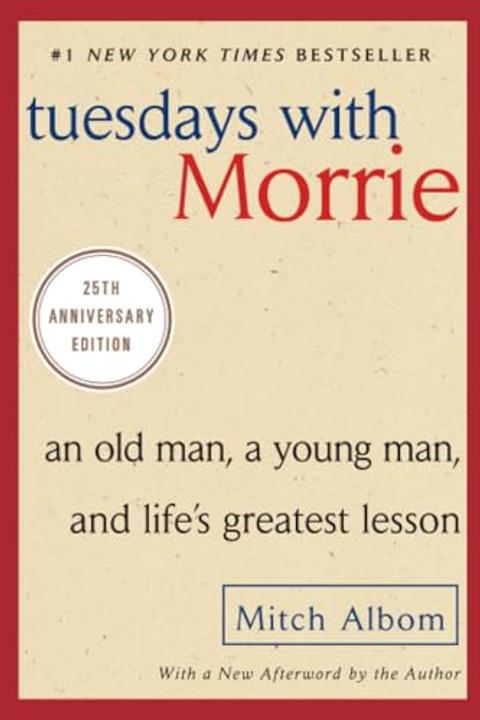
Tuesdays with Morrie: An Old Man, a Young Man, and Life's Greatest Lesson
by Mitch Albom
Why read this book
- It's short and reads in a sitting or two, but the ideas stay with you longer than the page count suggests.
- The lessons come from a dying man with nothing left to sell you, which makes the plain advice about love and meaning land differently than it would in a typical self-help book.
- It reframes mortality as a tool for living rather than something to avoid thinking about, and does it without getting morbid.
- Morrie's voice is warm and specific, not preachy, so the big questions about love, work, and money feel like a conversation rather than a sermon.
In one sentence
A memoir about the fourteen Tuesdays Mitch Albom spent with his dying former professor, Morrie Schwartz, who used his final months with ALS to teach one last class on how to live.
Key takeaways
- Love is the thing that lasts. Morrie's central line, borrowed from his poet friend Levine, is "Love each other or perish." When everything else falls away, the relationships are what remain.
- Learn to accept death and you can finally live fully. Morrie argues that once you make peace with the fact that you'll die, you stop wasting time and start paying attention to what matters.
- Money and status won't substitute for love. Morrie watched people chase wealth and recognition as stand-ins for affection, and concluded the substitution never works.
- Build your own culture instead of accepting the one handed to you. He believed most people absorb values from media and consumerism without questioning them, and that you can choose better ones.
- Forgive yourself and forgive others, and don't wait to do it. Morrie's regret was the things left unsaid and unresolved with people he loved.
- Stay emotionally open. His practice was to let himself fully feel an emotion — grief, fear, loneliness — and then let it go, rather than numbing it.
- Give and you get more back than you put in. Morrie found that devoting himself to people and community returned more meaning than any purchase could.
- Aging isn't only decline; there's growth in it. He refused to envy the young, saying he had already been their age and had learned things since that he wouldn't trade back.
Summary
Tuesdays with Morrie is a memoir by sportswriter Mitch Albom about his old sociology professor, Morrie Schwartz. Years after graduating from Brandeis and losing touch, Albom saw Morrie on a Nightline interview with Ted Koppel and learned his former teacher was dying of ALS, a disease that gradually paralyzes the body while leaving the mind intact. Albom reconnected, and what started as a single visit became a standing Tuesday appointment.
Over fourteen Tuesdays, Morrie delivered what Albom calls a final thesis, one last class with a class size of one. There were no textbooks and no grades. The subject was the meaning of life, and Morrie taught it from a reclining chair as his body failed week by week. Each Tuesday took up a theme: the world, feeling sorry for yourself, regrets, death, family, money, love, marriage, forgiveness, and aging.
The throughline is that a culture built around money, achievement, and youth points people at the wrong targets. Morrie's counter-argument is that love and human connection are the only things that hold up at the end, and that facing your own death is the fastest way to figure that out. He was warm and funny about it, not grim, and he kept teaching even as he lost the ability to feed himself.
Albom frames his own life against Morrie's lessons. He had built a career chasing deadlines and money and had drifted from the things Morrie was pointing at. The book is partly Morrie's wisdom and partly Albom realizing, in real time, how far he had wandered from it. Morrie died in November 1995, and Albom wrote the book in part to pay off his professor's medical bills.
It's a simple book, and some readers find the lessons familiar rather than revelatory. That's a fair read. But the power is less in the novelty of the advice and more in the source: a man saying these things while actively dying, with no incentive left except to pass on what he learned.
Reflections
The idea that sticks at the surface level is using death as a lens for priorities, not as something to push out of view. "Once you learn how to die, you learn how to live" is the kind of line that's easy to nod at and hard to actually run your week by. The money point also seems worth sitting with: Morrie's claim isn't that money is bad, it's that people use it as a stand-in for love and connection, and the swap doesn't pay off. Whether the book earns its reputation or just restates familiar truths in a moving package is the open question for me. Worth confirming on a read.
“"Once you learn how to die, you learn how to live."”
— Mitch Albom
Who should read this
- Anyone going through a loss, or sitting with a hard question about how they're spending their life.
- Readers who want a short, emotionally direct book rather than a tactical framework.
- People who liked the idea of a memento mori practice but want it in story form instead of philosophy.
- Skip it if you want new or contrarian ideas. The lessons are intentionally simple and you've likely heard versions of them before. The value is in how they're delivered, not how novel they are.
Favorite quotes
- "Once you learn how to die, you learn how to live."
- "So many people walk around with a meaningless life. They seem half-asleep, even when they're busy doing things they think are important. This is because they're chasing the wrong things."
- "Love each other or perish."
- "The truth is, once you learn how to die, you learn how to live."
- "Death ends a life, not a relationship."
FAQ
What is the main lesson of Tuesdays with Morrie?
That love and relationships are what give life meaning, and that accepting your own death is the way to start living fully instead of chasing money, status, and other substitutes.
What are Morrie's life lessons?
Love each other or perish; accept death and you'll live more fully; money and status won't replace love; build your own culture; forgive yourself and others; stay emotionally open; give to your community; and find the growth in aging rather than envying youth.
What disease did Morrie have?
ALS, amyotrophic lateral sclerosis, also known as Lou Gehrig's disease, which progressively paralyzes the body while the mind stays sharp.
Is Tuesdays with Morrie a true story?
Yes. It's a memoir of the real Tuesday visits Mitch Albom made to his former Brandeis professor, Morrie Schwartz, before Morrie's death in November 1995.
How many Tuesdays did Mitch spend with Morrie?
Fourteen, each visit organized around a different theme about living and dying.
Why did Mitch Albom write Tuesdays with Morrie?
To record Morrie's lessons and, in part, to help pay off his old professor's medical bills.
Detailed Notes
Click to expand the full detailed notes →
Detailed Notes
Click to expand the full detailed notes →
Structure: a memoir built around fourteen weekly Tuesday visits, each anchored to a theme. Framed by Albom's own life and his reconnection with Morrie after seeing him on Nightline. Below are the recurring Tuesday topics and what Morrie said about each.
- The world — let yourself feel others' pain instead of staying detached; staying open to people is the point, even when it costs you.
- Feeling sorry for yourself — Morrie allowed himself a short cry most mornings, then stopped and moved on. Grieve the loss, but don't live there.
- Regrets — our culture keeps us too busy to ask whether we're living the life we want; he urged confronting the big questions before it's too late.
- Death — "Once you learn how to die, you learn how to live." Accepting mortality is what frees you to set real priorities.
- Family — without family, he said, you have no safe ground to stand on; love and looking after each other is the foundation everything else rests on.
- Emotions — the practice of detachment: let yourself feel an emotion completely, then release it, rather than numbing or avoiding it.
- The fear of aging — don't envy the young; aging is growth, not just decay, and you can't be wise at twenty in the way you can at seventy.
- Money — wealth and power are no substitute for tenderness; offering people your time and yourself gives back more than any purchase.
- How love goes on — "Death ends a life, not a relationship." The people we love stay with us after they're gone.
- Marriage — his rules of thumb: respect each other, know how to compromise, talk openly, and share a common set of values.
- Our culture — most people accept a culture built on consumption and achievement without questioning it; you can and should build your own values instead.
- Forgiveness — forgive yourself and forgive others, and don't wait. His regret was the pride that left things unsaid with people he loved.
- The perfect day — asked what he'd do with one healthy day, Morrie described something ordinary: friends, a walk, a good meal, dancing. A quiet argument that the meaningful life is a simple one.
- Saying goodbye — the visits end with Morrie's decline and death; the recurring takeaway is "Love each other or perish."
About the book and author: Mitch Albom is an American sportswriter, columnist, and author. Tuesdays with Morrie was published in 1997 by Doubleday and is based on his visits with Morrie Schwartz, a sociology professor at Brandeis University who died of ALS in November 1995. The book became one of the best-selling memoirs of all time, spending more than four years on the New York Times bestseller list, and was adapted into a 1999 television film.