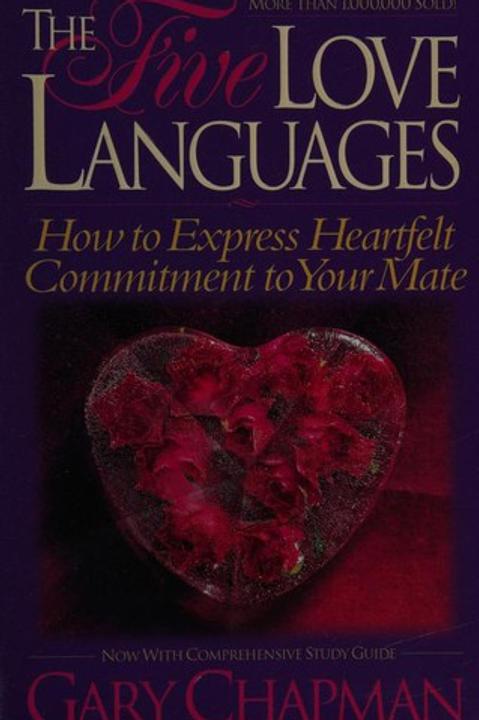
The 5 Love Languages
by Gary Chapman
Why read this book
- It gives you a simple shared vocabulary for a problem most couples feel but can't name: doing a lot for someone and still being told they don't feel loved.
- The core idea is genuinely portable. It applies to partners, kids, friends, and coworkers, not just romance.
- It's short, plainly written, and you can apply the main idea the same day you read it.
- The "love tank" metaphor is sticky and easy to use as shorthand in an actual relationship.
In one sentence
Gary Chapman's argument that people express and receive love in five different "languages," and that most relationship friction comes from speaking a language your partner doesn't.
Key takeaways
- The five love languages are: words of affirmation, quality time, receiving gifts, acts of service, and physical touch. Most people lean strongly on one.
- People tend to give love in their own primary language, which is why effort gets missed. You can work hard at love in a language your partner doesn't speak.
- Each person has a metaphorical "love tank." When it's empty, the relationship runs on fumes; when it's full, conflict gets easier to handle.
- Your primary love language is usually whatever you most often request, or whatever hurts most when it's absent. That's a clue worth paying attention to.
- The "in love" rush fades. Chapman frames lasting love as a choice and a learned skill, not a feeling you wait around to return.
- Love can be expressed even when you don't feel like it, and Chapman argues that the action often comes before the emotion rather than after it.
- Within a language there are "dialects." Quality time for one person means undivided conversation; for another it means doing an activity side by side.
- Learning a new love language is uncomfortable at first, like any second language, but it's a skill you can deliberately build.
Summary
Chapman's premise is that love isn't one thing. People express and receive it in five primary ways: words of affirmation, quality time, receiving gifts, acts of service, and physical touch. Most of us have one that matters far more than the rest, and we usually don't realize the others matter less to us than to the person we're with.
The recurring problem he describes is a mismatch. One partner keeps doing favors and chores (acts of service) while the other is quietly starving for words or touch. Both people are trying. Both feel unappreciated. Neither is speaking the language the other actually hears. Chapman's fix is to identify your partner's primary language and deliberately speak it, even when it isn't natural for you.
Running underneath the framework is a claim about love itself. The early infatuation stage, the "in love" feeling, has a shelf life. What replaces it isn't a weaker version of the same feeling but a decision: choosing to meet your partner's emotional need on purpose. Chapman leans on the image of an emotional "love tank" that needs refilling, and argues the action of loving can come first, with the feeling following behind.
The book is built from Chapman's decades as a marriage counselor, so it moves through real-sounding couple scenarios and ends each language with practical ways to express it. It's light on data and heavy on anecdote, which is both its appeal and its main limitation. The useful part isn't the science, it's the shared language a couple gets for naming what's been going wrong.
Reflections
The useful idea here is the mismatch, not the taxonomy. You can pour real effort into a relationship and have it land as nothing, because you're giving in your own language instead of the other person's. Whether there are exactly five categories matters less than the reframe: love is a skill you practice on someone else's terms, and "I tried hard" isn't the same as "they felt it." The "love tank" metaphor is the part that seems most likely to actually stick in a real conversation.
“"We must be willing to learn our spouse's primary love language if we are to be effective communicators of love."”
— Gary Chapman
Who should read this
- Couples who feel like they're both trying hard and still missing each other.
- Anyone who keeps hearing "you don't make me feel loved" despite real effort, and wants a frame for why.
- Parents, friends, or managers curious about applying the idea beyond romantic relationships.
- Skip it if you want rigorous research. This is a counselor's framework, not a study, and the prose is repetitive once you've got the core idea.
Favorite quotes
- "We must be willing to learn our spouse's primary love language if we are to be effective communicators of love."
- "Love is something you do for someone else, not something you do for yourself."
- "At the heart of mankind's existence is the desire to be intimate and to be loved by another."
FAQ
What are the 5 love languages?
Words of affirmation, quality time, receiving gifts, acts of service, and physical touch. Chapman's idea is that each person has one that matters most to them.
How do I find my love language?
Notice what you ask for most, what you complain about missing, and what you naturally do for others. Chapman also offers a quiz, but those three signals usually point to the same answer.
What is the main idea of The 5 Love Languages?
People give and receive love in five different ways, and relationships struggle when partners speak different languages without realizing it.
Can two people have the same love language?
Yes, and it can make things easier, though "dialects" within a language still differ, so you can share a primary language and still need to learn the specifics.
Does The 5 Love Languages only apply to couples?
No. Chapman has extended the framework to children, teens, friends, and the workplace, since the underlying idea isn't specific to romance.
Is The 5 Love Languages worth reading?
If you want a simple, shared vocabulary for talking about love and effort with a partner, yes. If you want evidence-based relationship science, look elsewhere.
Detailed Notes
Click to expand the full detailed notes →
Detailed Notes
Click to expand the full detailed notes →
The framework: five primary love languages — words of affirmation (verbal appreciation and encouragement), quality time (undivided attention, real conversation, shared activities), receiving gifts (thoughtful tokens that signal "I was thinking of you"), acts of service (doing things you know your partner would like done), and physical touch (from small contact to intimacy). Most people have one primary language plus a secondary one.
The core mechanism: people default to giving love in their own primary language, so effort gets lost in translation. A partner whose language is acts of service keeps doing chores; a partner whose language is words feels unloved despite a clean house. Identifying the other person's primary language, then speaking it on purpose, is the whole move.
The "love tank": Chapman uses an emotional tank that depletes and refills. A full tank makes a relationship resilient; an empty one makes ordinary friction feel like proof the love is gone. Speaking the right language is how you keep the tank full.
On the "in love" stage: the infatuation high is temporary by design. What sustains a relationship afterward is treated as a deliberate choice rather than a returning feeling — the action of loving can precede the emotion. Finding your own language: watch what you request most, what hurts most in its absence, and how you instinctively express love to others. Dialects matter too: two people can share a language and still need to learn each other's specific version of it.