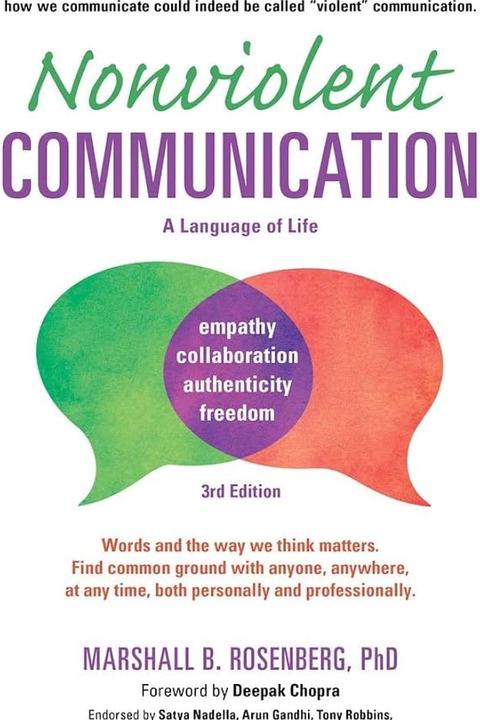
Nonviolent Communication: Life-Changing Tools for Healthy Relationships
by Marshall B. Rosenberg
In one sentence
Nonviolent Communication (NVC) is a practical framework for expressing yourself honestly, listening with empathy, and resolving conflict by focusing on feelings and needs rather than judgments, blame, or demands.
Key takeaways
- Every interaction can improve when you separate observation from evaluation.
- Feelings come from your needs, not from other people’s actions.
- Judgments, criticism, and “should” language disconnect us from ourselves and others.
- Empathy means listening for what someone is observing, feeling, needing, and requesting—no matter how messy their words are.
- Requests must be specific, positive, and actionable to be effective.
- Anger is a signal of unmet needs; blame blocks our ability to learn from it.
- Conflict shifts when all parties’ needs are heard, not negotiated as compromises.
- Self-empathy and translating “have to” into “choose to” are essential for living intentionally.
The Four Components of NVC
- Observations – What you see/hear without evaluation or judgment.
- Feelings – Emotions stimulated by what you observe.
- Needs – Universal human needs behind those feelings.
- Requests – Specific, doable actions that could enrich life.
Two Parts of NVC
- Expressing honestly (your own observations, feelings, needs, requests)
- Receiving empathically (hearing others’ observations, feelings, needs, requests)
Communication Patterns That Block Compassion
- Moralistic judgments
- Comparisons
- Denial of responsibility
- Demands (explicit or implied)
Skills for Self-Expression
- Distinguish feelings from thoughts
- Use positive action language
- Make requests, not demands
- Replace “have to” with “choose to”
- Translate self-judgments into unmet needs
Empathic Listening Tools
- Give empathy before advice
- Reflect/guess feelings and needs
- Avoid one-upping, consoling, story-telling, correcting
- Paraphrase only to deepen connection
Dealing With Anger
- Stop and breathe.
- Identify judgmental thoughts.
- Connect with unmet needs.
- Express feelings and needs (and often empathize first).
Conflict Resolution Steps
- Express your needs.
- Seek the other person’s real needs.
- Verify mutual understanding.
- Offer empathy until both people feel heard.
- Move to strategies expressed in present-tense, positive action language.
Protective vs. Punitive Use of Force
- Protective force = prevent harm.
- Punitive force = make people suffer to change behavior (which rarely works).
Summary
Nonviolent Communication lays out a simple yet profound process for speaking and listening in a way that deepens connection. Instead of reacting with blame, criticism, or defensiveness, NVC teaches you to slow down, get curious, and see the person behind the behavior. It replaces judgment with clarity, and replaces punishment with responsibility.
The framework revolves around four components—observation, feeling, need, request. When you express yourself clearly through these four steps, you avoid the traps that typically escalate conflict. NVC also emphasizes the importance of hearing those same components in others, even when they show up as anger, sarcasm, or withdrawal.
A major theme of the book is reclaiming responsibility for your inner life. Other people may trigger your emotions, but they are never the cause—your unmet needs are. This shift allows you to express yourself without blame and listen without taking things personally.
Beyond interpersonal communication, NVC applies equally to self-talk, anger, parenting, conflict resolution, negotiation, and leadership. It offers a path out of guilt, shame, and obligation and toward action motivated by genuine choice. Ultimately, the book is about learning to relate—from the heart—even when things are hard.
Reflections
This book feels like a manual for staying grounded and clear-minded during emotional moments. The biggest shift for me is how often I confuse “what I see” with “my interpretation of what I see.” Just separating those two already defuses a ton of tension.
The idea that feelings come from unmet needs—not from other people—hits hard. It puts responsibility back on me, but in a liberating way. I can actually work with my needs; I can’t work with blaming others.
The “requests vs. demands” distinction shows up everywhere, especially in relationships. When I make a vague or emotional request, I shouldn’t be surprised when the other person hears pressure instead of openness. The simple prompt “Would you be willing to…?” is a game changer.
Self-empathy is another part I didn’t expect to be so powerful. Translating “I should” and “I have to” into “I choose to… because I want…” exposes the real motives behind choices—and sometimes those motives are ugly (approval, guilt, fear). Seeing that clearly is uncomfortable but useful.
The anger chapter is the one I’ll come back to most. Using anger as a signal instead of a weapon—or a shame spiral—is a healthier way to process conflict.
Overall, NVC is less about communication and more about emotional hygiene. It’s a system for being more honest with yourself and kinder with others, without becoming passive or indirect.
Who should read this
- Anyone who regularly finds themselves in recurring conflicts—at home, work, or relationships.
- People who want to communicate assertively without being aggressive.
- Managers, coaches, and leaders who depend on clear, compassionate communication.
- Couples who want to break out of reactive patterns.
- Anyone working on emotional intelligence, self-regulation, or interpersonal skills.
- Parents or caregivers who want to guide without punishment or guilt.
Favorite quotes
- We observe without evaluating so others don’t hear criticism instead of clarity.
- Feelings come from our needs, not from other people’s actions.
- Judgments are tragic expressions of unmet needs.
- “Should” is one of the most violent words we use on ourselves.
- We’re dangerous when we’re not conscious of our responsibility for our feelings.
- A “no” is not rejection—it’s an expression of a need.
- Empathy is listening with your whole being, not giving advice.
- Behind intimidating messages are people appealing to us to meet their needs.
- Anger is a wake-up call to unmet needs, not an excuse to punish.
- Depression is often the reward for being “good” in the eyes of others.
- The clearer we are about what we want, the more likely we’ll get it.
- Punishment may change behavior, but never for the reasons we want.
- We can never meet our own needs at the expense of others.
- Appreciation is “This is what you did… this was the need it met… this is how I felt.”
- Empathy allows us to hear the feelings expressed even through silence.
- The most dangerous behaviors come from doing things because we’re “supposed to.”
- Every message—no matter how painful—is a request for understanding.
- We need empathy to give empathy.
- When we mourn in NVC, we connect with the needs behind our regret.
- A conversation comes alive when needs are spoken honestly.
FAQ
Is this book worth reading?
Yes—if you want practical tools to communicate better, especially in emotionally charged situations. It transforms both how you speak and how you listen.
What’s the main lesson of NVC?
That conflicts dissolve when people feel understood at the level of needs, not judgments. When feelings and needs are clear, solutions emerge naturally.
Is this book relevant for relationships?
Extremely. Many couples use NVC as a shared language to move away from blame (“you never…”) and toward clarity (“when X happens, I feel Y because I need Z”). It builds intimacy.
What makes NVC different from typical communication advice?
Most communication frameworks focus on being assertive or persuasive. NVC focuses on connection—on creating conditions where both sides feel heard and willing to collaborate.
Is NVC too “soft” for real-world conflict?
No. The framework is used in business, mediation, and even high-stakes negotiations. It’s not passive—it’s precise.
Is this book similar to Difficult Conversations or Crucial Conversations?
Yes in spirit, but NVC goes deeper into emotions, self-responsibility, and the psychology of needs. It’s more foundational.
How do I start using NVC?
Start with the four steps: observation, feeling, need, request. Practice with low-stakes situations first. Build the habit of asking yourself, “What need is alive in me right now?”
Is NVC still relevant today?
More than ever. In a world where knee-jerk reactions, online arguments, and workplace stress are the norm, a structured approach to empathy and clarity is invaluable.
Detailed Notes
Click to expand the full detailed notes →
Detailed Notes
Click to expand the full detailed notes →
Core Framework
- Four components: observations, feelings, needs, requests.
- Two parts: expressing honestly + receiving empathically.
1. Giving From the Heart
- NVC = focus consciousness on observations, feelings, needs, requests.
- Express these four pieces clearly; receive them empathically from others.
2. Communication That Blocks Compassion
- Moralistic judgments, comparisons, and denial of responsibility alienate us.
- “Have to,” “should,” blame, and demands diminish compassion.
- Replace judgment with expressions of needs.
- Responsibility language: move from “have to” → “choose to.”
- Demands = threat of blame/punishment; block connection.
3. Observing Without Evaluating
- Separate observation from evaluation.
- Evaluations lead to defensiveness.
- Use time-specific observations (“When you arrived 15 minutes late…”).
- Avoid exaggerations like always/never when used judgmentally.
4. Identifying and Expressing Feelings
- Express vulnerability to resolve conflict.
- Distinguish feelings from thoughts (“I feel like…” ≠ a feeling).
- Don’t confuse interpretations (“ignored,” “misunderstood”) with feelings.
- Build a vocabulary of actual emotions.
5. Taking Responsibility for Our Feelings
- Others may trigger but never cause our feelings.
- Four options when hearing negative messages:
- Blame ourselves
- Blame others
- Sense our own feelings & needs
- Sense others’ feelings & needs
- Needs behind feelings: autonomy, integrity, interdependence, play, etc.
- Emotional stages: slavery → obnoxiousness → liberation.
6. Requesting That Which Would Enrich Life
- Use positive, concrete action language.
- Requests must be specific and tied to needs.
- Ask for reflections to ensure clarity.
- Requests sound like demands if rejection triggers guilt or judgment.
7. Receiving Empathically
- Presence = emptying the mind; no advising, correcting, dismissing.
- Listen for the other person’s observation, feeling, need, request.
- Paraphrase only to deepen understanding.
- Empathy first—solutions later.
- When too distressed to empathize, give yourself empathy first.
8. The Power of Empathy
- Harder to empathize with those in power.
- Listening for needs revives dead conversations.
- Interrupt with empathy when a conversation goes lifeless.
- Empathize with silence too.
9. Connecting Compassionately With Ourselves
- Self-judgment (“should”) creates shame and blocks growth.
- Translate judgments into unmet needs.
- NVC mourning + self-forgiveness.
- “Don’t do anything that isn’t play.”
- Replace “have to” with “choose to… because I want…”
- Notice motivations: approval, guilt, shame, duty vs. genuine desire.
10. Expressing Anger Fully
- Separate stimulus from cause.
- Anger = unmet need + judgmental thinking.
- Use anger as a wake-up call.
- Four steps:
- Stop/breathe
- Identify judgments
- Connect with needs
- Express feelings + needs
- Empathize before expressing anger so others can hear you.
11. Conflict Resolution & Mediation
- Goal = meet everyone’s needs, not compromise.
- Steps: express needs → seek their needs → verify → empathize → propose strategies.
- Needs = universal; strategies = specific actions.
- Keep language present and positive.
- Translate “no” into “need preventing a yes.”
- Empathy before solutions, especially when pain is present.
12. Protective Use of Force
- Protective = prevent injury; punitive = make people suffer.
- Punishment often leads to resentment, not learning.
- Focus on needs, not guilt or shame.
13. Internal Conflicts
- Use NVC internally to navigate depression, self-blame, conflicting needs.
- Translate inner voices into observations, feelings, needs, requests.
- Gratitude dissolves resentment.
14. Expressing Appreciation
- Compliments are often judgments; NVC appreciation is celebration.
- Three components: action, need met, feeling.
- People hunger for genuine appreciation.
- Noticing what works nurtures connection.
You might also like.

The Culture Code by Daniel Coyle
Daniel Coyle
How to Win Friends & Influence People by Dale Carnegie
Dale Carnegie
Never Split the Difference Summary
Chris Voss

How to Win Friends & Influence People in the Digital Age by Dale Carnegie & Associates
Dale Carnegie & Associates

Love & Respect
Dr. Emerson Eggerichs

Men Are From Mars, Women Are From Venus
John Gray