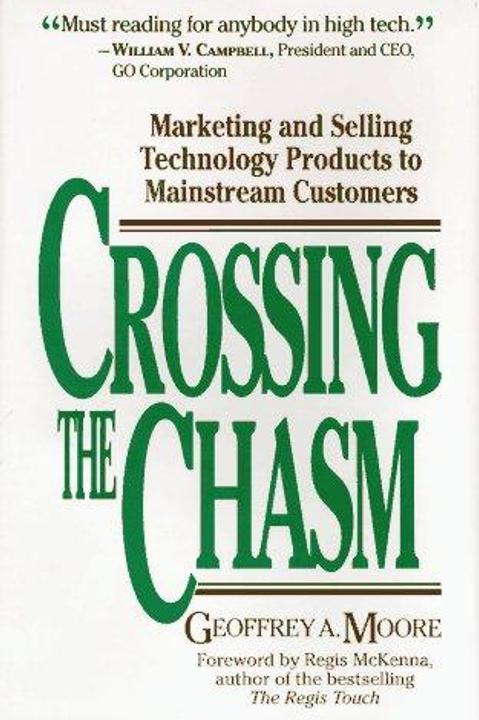
Crossing the Chasm by Geoffrey Moore: Summary & Notes
by Geoffrey Moore
In one sentence
There's a chasm between the visionaries who buy your product first and the pragmatic majority who decide if it ever becomes a real business — and crossing it takes a completely different strategy than getting to the chasm's edge did.
Key takeaways
- The chasm is the gap between visionary early adopters and pragmatic mainstream buyers — most high-tech products die trying to cross it, not before reaching it
- There are five types of technology adopters — innovators, early adopters, early majority, late majority, laggards — and each buys for a different reason
- Early adopters want a change agent to get ahead of competitors; the early majority wants a productivity improvement — evolution, not revolution
- The D-Day strategy: pick one narrow beachhead segment, concentrate overwhelming force there, and dominate it completely before expanding — "big fish, small pond"
- Pragmatists buy whole products, not core products — you have to surround the disruptive core with everything needed to solve the customer's problem end-to-end
- Pragmatists won't buy until they can compare you to a market alternative and a product alternative — positioning means winning that comparison, not avoiding it
Summary
Crossing the Chasm is the foundational book on early-stage B2B go-to-market, and one I rated 8/10 after reading it in 2020.
Geoffrey Moore's core argument is that the jump from early adopters to the mainstream market isn't a smooth curve, it's a gap most companies fall into and never climb out of.
The framework for getting across, picking one narrow beachhead and dominating it completely before expanding, is the most useful mental model I've read for thinking about where to focus early.
It's dense and written for an enterprise-software era, but the segmentation logic holds up.
Reflections
The idea that's stuck with me most isn't the chasm itself, it's the insistence that you have to pick one beachhead and go all-in on it. Moore's line that winning a couple of customers across five or ten segments creates no word-of-mouth, but winning four or five customers in one segment does, is a genuinely useful filter whenever a go-to-market plan starts sprawling across too many segments at once.
I also think the distinction between what early adopters want (a change agent, a competitive jump) and what the early majority wants (a productivity improvement, evolution not revolution) is underrated. It explains why a product that visionary customers love can completely stall out with pragmatists for reasons that have nothing to do with the product being worse.
Where it shows its age a bit is the assumption of a single, clearly bounded market category you're trying to dominate — that maps cleanly onto enterprise software in the 90s and 2000s, less cleanly onto some of what gets built now. But the underlying discipline, segment ruthlessly instead of chasing sales wherever they appear, is still the right instinct.
Who should read this
- B2B founders trying to figure out their first real beachhead market
- Marketers doing early-stage go-to-market or category positioning
- Product managers deciding what a "whole product" needs to include for mainstream buyers
- Anyone whose product has visionary fans but is struggling to cross into the mainstream
Favorite quotes
"The point of greatest peril in the development of a high-tech market lies in making the transition from an early market dominated by a few visionary customers to a mainstream market dominated by a large block of customers who are predominantly pragmatists in orientation."
"A successful crossing is how high-tech fortunes are made; failure in the attempt is how they are lost."
"The only right strategy: big fish, small pond. Segment. Segment. Segment."
"The correct goal isn't to make products easier to sell — it's to make them easier to buy."
FAQ
What is "the chasm" in Crossing the Chasm?
The chasm is the gap between an early market, made up of a small number of visionary early adopters, and the mainstream market, made up of pragmatists who buy very differently. Geoffrey Moore argues this gap is wide enough and different enough in buying behavior that most high-tech products fail trying to cross it, even after succeeding with early adopters.
What are the five types of technology adopters?
Innovators pursue new technology aggressively for its own sake. Early adopters buy into new concepts early but aren't technologists themselves. The early majority is practical and wants proven productivity gains. The late majority shares those concerns plus discomfort with handling technology on their own. Laggards want nothing to do with new technology at all.
What is the bowling pin (beachhead) strategy in Crossing the Chasm?
Moore's answer to crossing the chasm is a D-Day-style invasion: instead of spreading effort across many market segments, pick one narrow, well-defined niche and concentrate overwhelming resources there until you dominate it completely. That first segment becomes the beachhead — a reference base and word-of-mouth engine you use to knock over adjacent segments, one after another, like bowling pins.
What is a "whole product" in Crossing the Chasm?
It's everything a pragmatist customer needs to actually solve their problem end-to-end, not just the core disruptive product itself. Early market visionaries will assemble the missing pieces themselves to get ahead of competitors. Mainstream pragmatists won't — they wait for the whole product to exist before they buy, so vendors have to build or partner their way to completeness first.
How is Crossing the Chasm different from The Innovator's Dilemma?
They look at the same disruption from opposite sides of the table. Crossing the Chasm is a go-to-market and marketing strategy book for challengers trying to move a new product from visionary buyers into the mainstream. The Innovator's Dilemma is about incumbents, and why successful companies fail when a disruptive technology emerges beneath their existing customers' needs. One is a playbook for crossing the gap; the other explains why the companies on the far side of it get blindsided.
Is Crossing the Chasm still relevant today?
The core segmentation logic holds up well: pick a narrow beachhead, dominate it, expand from there, and treat pragmatist buyers as needing whole products and credible competitive comparisons before they'll buy. The examples are dated to the enterprise software era it was written in, but the underlying discipline about focus versus spreading thin across too many segments is still the right instinct for early-stage go-to-market.
Detailed Notes
Click to expand the full detailed notes →
Detailed Notes
Click to expand the full detailed notes →
Part I: Discovering the Chasm
The point of greatest peril in the development of a high-tech market lies in making the transition from an early market dominated by a few visionary customers to a mainstream market dominated by a large block of customers who are predominantly pragmatists in orientation.
The gap between these two markets, all too frequently ignored, is in fact so significant as to warrant being called a chasm, and crossing this chasm must be the primary focus of any long-term high-tech marketing plan. A successful crossing is how high-tech fortunes are made; failure in the attempt is how they are lost.
One of the most important lessons about crossing the chasm is that the task ultimately requires achieving an unusual degree of company unity during the crossing period.
Chapter 1 — The High-Tech Marketing Illusion
Moore lays out five groups of technology adopters:
- Innovators pursue new technology products aggressively.
- Early adopters buy into new product concepts very early, but unlike innovators, they aren't technologists.
- The early majority share some of the early adopter's ability to relate to technology, but are driven by a strong sense of practicality.
- The late majority shares the early majority's concerns, plus one more: they aren't comfortable with their own ability to handle a technology product.
- The laggards simply don't want anything to do with new technology.
The High-Tech Marketing Model says to work the curve left to right: focus first on innovators, grow that segment, then move to early adopters, and so on. Use each "captured" group as a reference base for launching into the next group. Maintain momentum to create a bandwagon effect.
What the early adopter is buying is a change agent — being first to implement change gets them a jump on competition. By contrast, the early majority wants a productivity improvement for existing operations. They want evolution, not revolution.
Chapter 2 — High-Tech Marketing Enlightenment
Marketing: taking actions to create, grow, maintain, or defend markets. A market is a set of actual or potential customers, for a given set of products or services, who have a common set of needs, and who reference each other when making a buying decision. If two people buy the same product for the same reason but can't reference each other, they aren't part of the same market.
Between visionaries and pragmatists there is a great, largely ignored chasm — and that gap is the central problem the rest of the book is trying to solve.
Part II: Crossing the Chasm
Chapter 3 — The D-Day Analogy
The strategy: replicate D-Day. Target a very specific niche market where you can dominate from the outset, drive competitors out of that niche, and use it as a base for broader operations. Concentrate overwhelming force on a highly focused target. The key to the "Normandy advantage" is focusing an overabundance of support into a confined market niche — the more tightly bound the niche, the easier it is to create and introduce messages, and the faster they travel by word of mouth.
The consequences of being sales-driven, rather than market-driven, during the chasm period are fatal. Winning a couple of customers in five to ten different segments creates no word-of-mouth effect, but winning four or five customers in one segment does. Pragmatist customers want to buy from market leaders — to be seen as a leader, you typically need 50%+ of new sales at the start of a market, and as little as 30-35% later on.
The only right strategy: big fish, small pond. Segment. Segment. Segment.
Chapter 4 — Target the Point of Attack
Target a segment that, by virtue of its other connections, creates an entry point into adjacent segments — the beachhead has to be chosen not just for its own size, but for what it opens up next.
Chapter 5 — Assemble the Invasion Force
"Wiring the marketplace" means creating, for a given target customer and application, a marketplace where your product is the only reasonable buying choice. This requires understanding what a "whole product" consists of.
Pragmatists evaluate and buy whole products. Early markets will piece together the whole product themselves, to get a jump on competitors — mainstream markets will not. You have to surround your disruptive core product with a whole product that solves the target customer's problem end-to-end, working backward from their actual use case.
Chapter 6 — Define the Battle
Pragmatists are loath to buy until they can compare — competition is a fundamental condition for purchase. Position your product within an already-credible buying category, as the indisputably correct choice within it.
Moore recommends using two reference competitors: the "market alternative" (what the customer has bought for years) and the "product alternative" (another company using the same disruptive innovation). The correct goal isn't to make products easier to sell — it's to make them easier to buy.