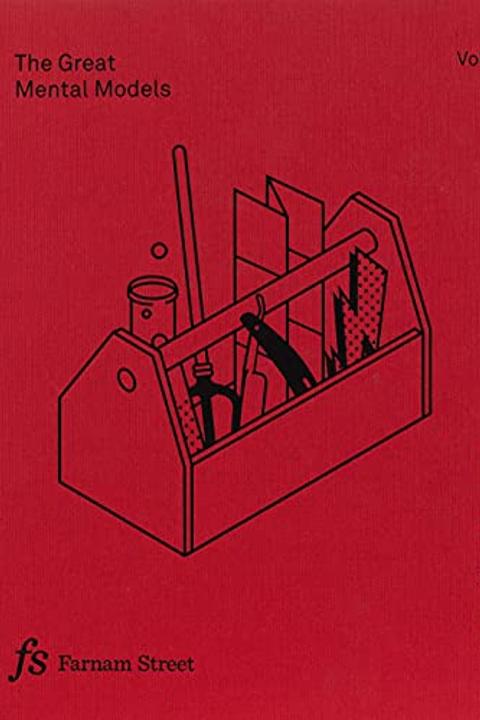
The Great Mental Models: General Thinking Concepts (Volume 1)
by Shane Parrish & Rhiannon Beaubien
Why read this book
- It hands you a small, transferable toolkit of thinking concepts that apply across almost any domain, instead of advice that only works in one field.
- The latticework framing — borrowed from Charlie Munger — is a clean argument for why generalists who reach across disciplines often out-reason narrow specialists.
- Each model is short, vivid, and example-driven, so the ideas are easy to recall and actually use when a real decision lands in front of you.
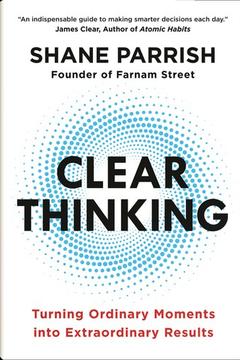
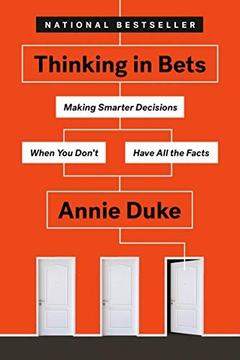
- It pairs naturally with the rest of a decision-making library: it's the structural overview, while books like Thinking in Bets and Clear Thinking go deep on individual pieces.
In one sentence
Shane Parrish and Rhiannon Beaubien's argument that better decisions come from carrying a latticework of nine general-purpose thinking tools — drawn from many disciplines — rather than viewing every problem through a single specialty.
Key takeaways
- A mental model is a representation of how something works — a simplification you carry in your head to reason about the world. The quality of your decisions is downstream of the quality of those models.
- A latticework beats single-discipline thinking. Drawing reliable concepts from many fields and letting them interact gives you more angles on a problem than any one specialty can.
- The map is not the territory. Every model, map, and abstraction is a reduction of reality captured at a moment in time; useful, but never the thing itself, and it must be updated against what's actually there.
- Circle of competence. Know the boundary of what you genuinely understand. Inside it you can act with confidence; outside it, slow down, ask, and defer — building the circle takes curiosity, monitoring, and feedback over years.
- First principles thinking. Break a problem down to its fundamental truths and reason up from there, instead of reasoning by analogy or inherited assumptions. It removes the blinders and makes more options visible.
- Thought experiments and second-order thinking. Imagine consequences before they happen, and ask "and then what?" — trace effects past the first obvious one, because the second- and third-order effects are where the real consequences live.
- Probabilistic thinking and inversion. Estimate the odds and update them rather than treating the future as certain; and approach problems backward — ask how you'd guarantee failure, then avoid that.
- The razors. Occam's razor: prefer the simplest explanation that fits. Hanlon's razor: don't attribute to malice what is adequately explained by carelessness or ignorance. Both are quick filters that save you from overcomplicating people and events.
Summary
The Great Mental Models opens with a simple premise: you can't reason well about a world you can't represent accurately, and the representations you carry — your mental models — are what your thinking is built from. Parrish, the founder of Farnam Street, and Beaubien borrow Charlie Munger's image of a latticework: a series of points that connect to and reinforce each other. Rather than viewing every problem through the lens of one profession, you assemble reliable concepts from many disciplines and let them interlock. Volume 1 covers the nine most general of these.
The first two models are about the limits of any model. "The map is not the territory" warns that abstractions are reductions of something more complex, frozen at a moment in time; they guide you but should never be mistaken for reality, and they need updating when the ground changes. The "circle of competence" is its companion: know the edge of what you actually understand, act decisively inside it, and stay humble and curious outside it. Together they keep you honest about both your tools and your expertise.
The middle models are engines for generating better answers. First principles thinking strips a problem down to its fundamental truths and rebuilds from there, freeing you from inherited assumptions. Thought experiments let you run consequences in your imagination before committing. Second-order thinking pushes you past the first obvious effect to ask "and then what?" — the lesson the book illustrates with cobra-bounty and similar stories where the immediate fix created a worse downstream problem. Probabilistic thinking replaces false certainty with calibrated estimates you revise as evidence arrives.
The last three are sharpening tools. Inversion flips a problem around — instead of asking how to succeed, ask how you'd guarantee failure, then steer away from it. Occam's razor favors the simplest explanation that accounts for the facts. Hanlon's razor reminds you that stupidity, carelessness, or ignorance usually explains behavior better than malice. None of the nine is novel on its own; the book's contribution is packaging them as a portable, mutually reinforcing toolkit, with enough vivid examples that they stick.
Reflections
The strongest idea here isn't any single model — it's the latticework argument that breadth, used deliberately, is its own kind of expertise. Most thinking errors come from forcing a problem into the one frame you happen to know best; carrying nine general tools gives you more than one way in.
The two I find most load-bearing are second-order thinking and inversion, because they're cheap to apply and catch the failures that confident first-order reasoning misses: the obvious fix that backfires, and the path to disaster you could have just avoided.
The map-is-not-the-territory reminder is the humble note running under all of it — every model on the list is itself a map, useful only as long as you keep checking it against the ground.
The book's limitation is depth: each concept gets a vivid introduction, not a deep treatment, so it works best as the index to a larger shelf rather than the final word on any one idea.
“"The quality of our thinking is largely influenced by the mental models in our heads."”
— Shane Parrish & Rhiannon Beaubien
Who should read this
- Anyone who wants a structured starting map of general-purpose thinking tools before diving deeper into any one of them.
- Generalists, founders, and operators who make decisions across unfamiliar domains and need transferable ways to reason rather than domain-specific rules.
- Readers building a decision-making and clear-thinking library who want the overview volume that ties the individual ideas together.
- Skip it if you're already fluent in first principles, base rates, inversion, and second-order effects; the value here is breadth and packaging, not depth on any single model.
Favorite quotes
- "The quality of our thinking is largely influenced by the mental models in our heads."
- "A mental model is simply a representation of how something works."
- "There are three key practices needed in order to build and maintain a circle of competence: curiosity and a desire to learn, monitoring, and feedback."
- "Thinking through first principles is a way of taking off the blinders. Most things suddenly seem more possible."
FAQ
What is The Great Mental Models Volume 1 about?
It's the first volume in Shane Parrish and Rhiannon Beaubien's series, presenting nine general-purpose thinking concepts that apply across disciplines and help you make clearer decisions.
What is a mental model?
A representation of how something works — a simplification you hold in your head to understand and reason about the world. The book argues the quality of your thinking depends on the quality of these models.
What is the latticework idea?
Borrowed from Charlie Munger, it's the practice of drawing reliable concepts from many fields and letting them connect and reinforce each other, instead of viewing every problem through a single specialty.
What are the nine models in Volume 1?
The map is not the territory, circle of competence, first principles thinking, thought experiment, second-order thinking, probabilistic thinking, inversion, Occam's razor, and Hanlon's razor.
What is second-order thinking?
Looking past the first, obvious consequence of a decision to ask "and then what?" — tracing the effects of the effects, where the real and often unintended consequences show up.
Is The Great Mental Models worth reading?
Yes if you want a clear, transferable overview of general thinking tools. The ideas aren't individually new, but the packaging and examples make them easy to recall and apply.
Detailed Notes
Click to expand the full detailed notes →
Detailed Notes
Click to expand the full detailed notes →
- What a mental model is: "A mental model is simply a representation of how something works." It's a simplification you use to interact with a world too complex to grasp directly. "The quality of our thinking is largely influenced by the mental models in our heads."
- The latticework (why breadth wins): From Munger — a lattice is a series of connecting, reinforcing points. Drawing reliable concepts from many disciplines and letting them interact gives more angles on a problem than any single specialty. The models compound as they interlock.
- The map is not the territory: Every map, model, and abstraction is a reduction of something more complex, captured at a moment in time. Useful for navigating, but never reality itself; must be tested against the ground and updated.
- Circle of competence: Know the boundary of what you genuinely understand. Act with confidence inside it; slow down, ask, and defer outside it. Built over years through "curiosity and a desire to learn, monitoring, and feedback."
- First principles thinking: Break a problem down to its fundamental truths and reason up, rather than reasoning by analogy or inherited assumption. "Thinking through first principles is a way of taking off the blinders. Most things suddenly seem more possible."
- Thought experiment: Run consequences in imagination before committing in reality — a way to test ideas, explore impossibilities, and reason about situations you can't (or shouldn't) try directly.
- Second-order thinking: Ask "and then what?" Trace effects past the first obvious one. The book's cobra-bounty-style examples show how a first-order fix can create a worse downstream problem because no one thought at the second level.
- Probabilistic thinking: Replace false certainty with calibrated estimates of likelihood, and update them as evidence arrives. Think in odds and base rates rather than binary will-it-or-won't-it.
- Inversion: Approach the problem backward. Instead of how to succeed, ask how you'd guarantee failure — then avoid those things. Flipping the frame surfaces obstacles the forward view hides.
- Occam's razor: Prefer the simplest explanation that accounts for the facts. Simpler explanations are more likely to be true and easier to act on; don't multiply complexity without need.
- Hanlon's razor: Don't attribute to malice what is adequately explained by carelessness, ignorance, or incompetence. A quick filter that defuses conflict and keeps you from inventing villains.
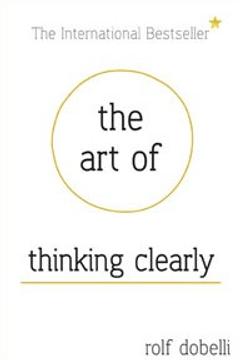
- Cluster fit: sits alongside the site's decision-making and clear-thinking notes — Clear Thinking, The Art of Thinking Clearly, Thinking in Bets, and the cognitive-bias material — as the structural overview that the others fill in.
- Anchor quote: "The quality of our thinking is largely influenced by the mental models in our heads."