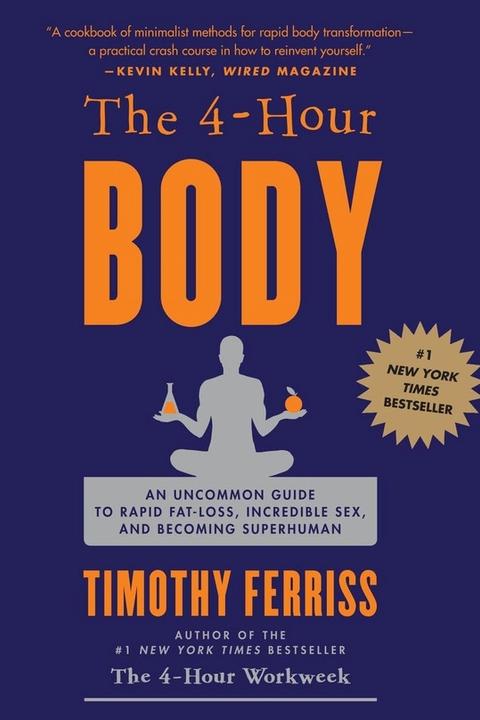
The 4-Hour Body: An Uncommon Guide to Rapid Fat-Loss, Incredible Sex, and Becoming Superhuman
by Tim Ferriss
In one sentence
A highly tactical “choose-your-own-adventure” manual for rapidly redesigning your body—fat, muscle, strength, sex, sleep, and longevity—by using the minimum effective dose, aggressive self-tracking, and short, repeatable experiments.
Key takeaways
- Think buffet, not textbook: pick one appearance goal and one performance goal, then cherry-pick only the chapters you need.
- Focus on the minimum effective dose (MED)—the smallest dose of diet, training, or supplements that triggers the desired change.
- Fat-loss is mostly diet, not exercise: roughly 60% diet, 30% exercise, 10% drugs/supps in Tim’s case studies.
- Systematic tracking, games, and competition beat vague intention; measuring anything (photos, inches, food) changes behavior.
- The Slow-Carb Diet (5 rules + weekly cheat day) is built for simplicity and adherence, not perfection.
- For muscle and strength, brief, brutally hard sets to true failure plus lots of rest can outperform high-volume training.
- Simple levers—cold exposure, sleep tweaks, smart supplementation, and hormone-friendly habits—can significantly improve performance, sex drive, and well-being.
- Treat everything as an experiment: question causality, protect against your own biases, and use short cycles to test what actually works.
Summary
The book is a giant toolkit for hacking the body. Instead of one linear program, Ferriss offers a buffet of protocols—fat-loss, muscle gain, strength, sex, sleep, injury repair, endurance, and longevity—and tells you explicitly not to read it cover to cover. You choose your goal, then follow the minimum chapters needed to reach it.
At the core is the idea of the minimum effective dose (MED): do the least necessary to trigger a hormonal or mechanical cascade, whether that’s burning fat, building muscle, or increasing testosterone. Exercise is reframed as a precise, outcome-driven intervention—different from “recreation,” which is just for fun. Ferriss also emphasizes that most success comes from diet and tracking, not heroic amounts of gym time.
For fat-loss, the flagship tool is the Slow-Carb Diet: avoid white carbs, eat the same few protein–legume–vegetable meals repeatedly, don’t drink calories, avoid fruit, and take one aggressive cheat day per week. Around this, he layers advanced “damage control” tactics—like lemon juice, cinnamon, and cheat-day movement—to minimize fat gain while preserving the psychological and metabolic benefits of overfeeding.
On the performance side, he presents ultra-minimal muscle and strength programs like Occam’s Protocol and the Effortless Superhuman sprint/strength template. These rely on slow, heavy sets to absolute failure, tiny exercise menus, and long recovery periods, plus high protein and smart supplementation. Elsewhere, he dives into sex (a 15-minute, goalless orgasm practice), sleep hacking (REM ratios, temperature, and pre-bed macros), injury prevention (movement screens and four key exercises), running and ultraendurance, and even long-term health via creatine cycles, intermittent fasting, and blood donation.
Threaded through everything is a skeptical, experimental mindset. Ferriss constantly warns against confusing correlation and causation, urges you to question studies and gurus, and insists that you measure, test, and iterate. The promise is not just a better body, but a new identity: someone who can reinvent their physical reality by treating themselves as a test lab.
Reflections
This book has aged way better than it has any right to. Given how long ago it was written, it’s kind of wild how much of it is still relevant—or even more relevant now. Every time I go back to it, I’ll stumble on something I’d completely forgotten and think, “Oh right, this is in here too.”
The Slow-Carb Diet is something I’ve used on and off for years, with different levels of strictness, and it just works for me. Simple meals, clear rules, built-in cheat day—it’s one of the few “diets” where I feel great, not deprived. Pair that with 30g of protein within 30 minutes of waking, which I’ve also used for years, and you get a really solid base: my energy is better, cravings are lower, and it’s one of those small habits that quietly changes everything else.
The fasting/protein-cycling stuff was genuinely ahead of its time. A lot of what’s popular now—intermittent fasting protocols, alternate-day restriction, time-restricted eating—was already being explored here in a very practical way. Same with creatine: there’s now more and more evidence backing what Tim was hinting at—creatine as not just a strength supplement, but a general health and brain-health lever.
The Total Immersion swimming section basically rewired how I swim. Switching from “thrash harder” to “balance, roll, and glide” meant I could suddenly swim 1–3 km with very little specific training, just off general fitness. That’s a huge, tangible shift from a few technical cues. Similarly, the running mechanics chapter helped me train for and run a marathon without wrecking myself—thinking about lean/fall/catch, cadence, and landing under my center of mass was a big upgrade from “just run more.”
A bunch of the measurement ideas have also aged well. DEXA scans are still the gold standard for body comp. Glucose monitors have become trendy for performance and nutrition, but Tim was already self-experimenting with blood sugar, timing, and food composition in a way that looks very current now. The general pattern—measure something, make a small intervention, watch the data—has held up incredibly well.
Overall, this is a book I see as a reference manual, not a one-and-done read. You don’t “finish” it. You go back to it when you want to train differently, troubleshoot fat-loss, tweak sleep, approach a race, or re-think how you’re eating. Pick a specific problem, re-read the relevant section, steal a protocol, and run a four-week experiment. That’s where the value is.
Who should read this
- People who want rapid, visible changes in fat-loss, muscle gain, or strength without living in the gym.
- Tinkerers and experimenters who enjoy treating their body like a lab and tracking results.
- Busy professionals who need simple, repeatable diet and training rules, not elaborate meal plans.
- Anyone stuck in a plateau who’s tried “more effort” and is ready to try better leverage instead.
- People curious about hacking sleep, sex, hormones, or endurance with practical experiments instead of vague advice.
- Readers who like skeptical, data-driven approaches and are comfortable running their own experiments rather than following a one-size-fits-all plan.
Favorite quotes
- Recreation is for fun. Exercise is for producing changes. Don’t confuse the two.
- The minimum effective dose is the smallest dose that will produce a desired outcome.
- No consistent tracking = no awareness = no behavioral change.
- Seeing progress in changing numbers makes the repetitive fascinating.
- Use competitive drive, guilt, and fear of humiliation to your advantage. Embrace the stick; the carrot is overrated.
- It’s not what you put in your mouth that matters, it’s what makes it to your bloodstream.
- Eat the same few meals over and over again. Simplicity beats variety for fat-loss.
- For fastest fat-loss, minimize your blood sugar bumps above 100 to no more than two per day.
- The easiest thing you can do to decrease glucose spikes is slow down.
- If you’ve never vomited from doing a set of barbell curls, then you’ve never experienced outright hard work.
- Failure is not your last hard rep; it’s pushing like you have a gun to your head and still not moving the weight.
- The last repetition, the point of failure, is the rep that matters. The rest are just a warm-up.
- Strength training cannot interfere with the practice of your sport; lift heavy but not hard.
- Do as little as needed, not as much as possible.
- The most likely cause of injury is not weakness or tightness, but imbalance.
- Call it quits if needed and come back stronger the next workout.
- It’s never too late to reinvent yourself.
- The best way to predict the future is to invent it.
FAQ
Is this book worth reading if I’m only interested in fat-loss?
Yes. The Slow-Carb Diet, “Ground Zero,” and the “Damage Control” sections give you a complete fat-loss system: simple food rules, a weekly cheat day, behavior change tools, and advanced tricks like cold exposure and blood sugar control. You can ignore the rest and still get a full program.
How is The 4-Hour Body different from other fitness books?
Instead of one program, it’s a collection of high-yield experiments organized by goal. The focus is on minimum effective dose, measurement, and skepticism—less “here’s the one true way” and more “here are protocols that produced extreme results, now test them on yourself.”
Do I have to follow the Slow-Carb Diet exactly for it to work?
The core results come from following the five rules: avoid white carbs, repeat simple protein–legume–veg meals, don’t drink calories, avoid fruit, and take one cheat day per week. There’s wiggle room on spices, specific foods, and advanced hacks, but the tighter you are on those core rules, the faster you’ll see change.
Is the weekly cheat day really necessary?
In this system, yes. The cheat day isn’t just psychological relief; it’s also there to prevent metabolic slowdown and maintain thyroid output during sustained caloric restriction. The book pairs cheat days with movement and supplements to minimize fat gain while still getting the metabolic benefits.
Is Occam’s Protocol safe and effective for beginners?
Occam’s is intense but minimal: one set to failure per exercise, very slow reps, and lots of rest between sessions. For true beginners, the main risks are ego and form. With good technique, modest starting loads, and enough food, it can be a very efficient way to build muscle without living in the gym.
How extreme are the supplement and drug recommendations?
The book covers everything from basic minerals (potassium, magnesium, calcium) and fermented foods to more aggressive stacks like PAGG, CQ, creatine, and hormone-focused protocols. The spirit is experimental, not prescriptive: you’re encouraged to test cautiously, track results, and consult a doctor before anything serious.
Is the sex advice just gimmicky, or actually useful?
The 15-minute orgasm practice sounds sensational, but the underlying principles—goalless attention, clear communication, precise structure, and a safe container—are very grounded. It’s less about a trick and more about building a consistent practice that improves sensitivity, trust, and connection.
How does this book handle sleep compared to typical “sleep hygiene” tips?
Instead of generic advice, it focuses on manipulating REM and deep sleep percentages with specific interventions: temperature, supplements, pre-bed macros, light devices, and even timed mid-night awakenings. It’s much more experimental and data-driven than the usual “sleep more” message.
Is The 4-Hour Body still relevant with newer science available?
Some details and doses may be outdated or refined by newer research, but the big ideas—minimum effective dose, skeptical experimentation, the power of tracking, slow-carb simplicity, and hormonal thinking—are still highly relevant. It’s best read as a playbook of experiments, not settled dogma.
Can I use this book if my main sport is running or something specific like that?
Yes. There are dedicated sections on running form, ultraendurance, and strength for speed, all built on the premise that strength work and mechanics can massively improve endurance and recovery. The key is to ensure your strength training doesn’t interfere with your sport: lift heavy but not to failure, and keep total work low.
Detailed Notes
Click to expand the full detailed notes →
Detailed Notes
Click to expand the full detailed notes →
Start Here & Meta-Rules
- Think of the book as a buffet, not a linear read.
- Start by choosing:
- One appearance goal (e.g., rapid fat-loss, rapid muscle gain).
- One performance goal (e.g., rapid strength gain, total well-being).
- Suggested reading tracks:
- Rapid fat-loss – Fundamentals, Ground Zero, Slow-Carb Diet I & II, Building the Perfect Posterior (~98 pages).
- Rapid muscle gain – Fundamentals, Ground Zero, From Geek to Freak, Occam’s Protocol I & II.
- Rapid strength gain – Fundamentals, Ground Zero, Effortless Superhuman, Pre-Hab.
- Rapid well-being – Fundamentals, Ground Zero, Improving Sex, Perfecting Sleep, Reversing Injuries (~143 pages).
- Rules for reading:
- Skip dense science if needed.
- Be skeptical but don’t let skepticism become an excuse for inaction.
- Enjoy the process.
Fundamentals: Minimum Effective Dose & Causality
- MED = smallest dose needed to trigger desired outcome (fat-loss cascade, local/systemic muscle growth).
- 80 seconds of tension cited as a key “button” for muscle growth.
- Rough fat-loss contribution ratio: 60% diet, 10% drugs/supps, 30% exercise.
- Exercise = precise MED of movements for target change; recreation = fun.
- Causality checkpoints:
- Could causality be reversed? (e.g., sprinters already lean/muscular)
- Are we confusing absence vs presence? (vegetables vs meat removal)
- Is a specific demographic driving the result? (e.g., yoga participants with better diet)
- Embrace cycling, not constant balance.
- Rule: it’s what enters the bloodstream and hormonal responses (to carbs, protein, fat) that matter.
Ground Zero: Motivation, Tracking, and Behavior
- People are bad at following advice because:
- Their reason isn’t strong enough (no Harajuku Moment).
- They lack reminders and tracking.
- Consistent tracking, even without expertise, often beats world-class training.
- Tools:
- Pre-plan a week of meals, buy ingredients, follow strictly.
- Best body comp tools: DEXA, BodPod, ultrasound.
- Take circumference measurements (upper arms, waist, hips, legs) and total as Total Inches (TI).
- Estimate BF% visually, then schedule objective testing.
- Four behavior hacks:
- Make it conscious (photos, logs).
- Make it a game (numbers to beat).
- Make it competitive (friend challenges).
- Make it small and temporary (tiny starting steps).
- Specific prompts:
- Shock yourself with underwear photos and place them visibly.
- Photograph everything you eat for 3–5 days (with hand for scale).
- Recruit at least one person for friendly competition (TI or BF%).
- Measure again and again; the author repeats the TI instructions to drive compliance.
- Start with at least two steps before moving on.
Slow-Carb Diet: Rules, Food, and Mistakes
Rules
- Avoid white carbs and anything that can be white (except post-workout window).
- Eat the same few meals repeatedly built from:
- Proteins: eggs, chicken, beef, fish, pork.
- Legumes: lentils, black beans, pinto/red beans, soybeans.
- Veg: spinach, mixed cruciferous veg, sauerkraut/kimchi, asparagus, peas, broccoli, green beans.
- Don’t drink calories.
- Don’t eat fruit (tomatoes & limited avocado allowed).
- Take one day off per week and binge.
Example Meals & Shopping
- Breakfast: egg whites + whole egg, beans, mixed veg.
- Lunch out: beef, beans, veg, guacamole (Mexican restaurant).
- Dinner: beef/pork, lentils/beans, mixed veg.
- Shopping list includes cheap eggs, beef, pork, chicken, frozen veg, peas, spinach, beans, asparagus.
Supplements
- Baseline suggestions: potassium (~4,700 mg), calcium (~1,000 mg), magnesium (~400 mg) for a healthy 25-year-old male.
Practical Issues & Fixes
- Gas from beans: go organic, soak, or use canned and rinse (removing oligosaccharides).
- Bland taste: balsamic vinegar, garlic powder, spices.
- Texture issues: fake mashed potatoes (mashed beans/cauliflower with oil, seasoning, and optional parmesan).
- Snacks: carrots if absolutely necessary.
Common Mistakes
- Not eating within 30–60 minutes of waking (especially protein timing).
- Not getting enough protein overall, especially at breakfast (target ~40% of breakfast from protein).
- Not drinking enough water.
- Overestimating willingness to cook.
- Overeating domino foods like nuts and hummus.
- Overusing sweeteners (even “natural” ones).
- Going to the gym too often.
Cheat Days & Damage Control
Goals
- Put as much “crap” into muscle or out of the body as possible, leaving little for fat storage.
Principle #1: Insulin Control
- First meal of cheat day: high protein and legumes, ~300–500 calories.
- Small dose of fructose (e.g., grapefruit juice) before the first junk meal.
- Use AGG/PAGG around cheat meals to increase insulin sensitivity and reduce insulin release.
- Consume citric juices (lime, lemon, citrus kombucha) with meals.
Principle #2: Gastric Emptying
- Use caffeine and yerba mate (theobromine/theophylline) at heavy meals.
- Greens supplements like Athletic Greens support digestion without caffeine.
Principle #3: Muscular Contractions
- 60–90-second bouts of air squats, wall presses, and band pulls before/after meals.
- Aim for 30–50 reps per movement to help partition calories into muscle.
CQ, Gut Flora, and PAGG
- Cissus quadrangularis: at high intake (~2.4 g, 3x/day), Tim saw fat-loss and mild anabolic effects (~7.2 g/day total).
- Gut flora:
- Avoid Splenda.
- Use fermented foods (unsweetened yogurt, kombucha, sauerkraut, kimchi).
- Probiotics and prebiotics encouraged.
- Tim’s habit: five forkfuls of sauerkraut in the morning; kimchi in many meals.
PAGG Stack
- Policosanol, alpha-lipoic acid, decaf green tea extract (EGCG), garlic extract.
- Schedule:
- AGG before breakfast, lunch, and dinner.
- PAG before bed (no green tea).
- Use 6 days/week; take 1 full day off; 1 off-week every ~2 months.
- Emphasis on adequate B vitamins and medical supervision if needed.
- ALA helps store carbs in muscle/liver instead of fat.
Ice Age Revisited: Cold Exposure Protocols
- Four starting points:
- Ice pack on back of neck/upper traps for 20–30 minutes (evenings).
- 500 ml ice water immediately upon waking; breakfast 20–30 minutes later.
- 5–10-minute cold showers (hot → soap → cold rinse).
- 20-minute shiver-inducing ice baths (optionally with cayenne + protein 30 minutes before).
- Effects:
- Shivering burns fatty acids for heat; may recruit GLUT-4 and build lean mass.
- Even mild cold exposure may boost adiponectin and glucose uptake.
- BAT thermogenesis offers non-shivering calorie expenditure.
- Acute cold improves immunity and may help depression (e.g., 68°F showers for 2–3 minutes).
- Visible result: improved body composition and conditioning.
Advanced Carb & Glucose Management
- Food absorption is slower than expected; most foods peak glucose at 1.5–2.5 hours.
- Fats blunt glucose spikes better than lean protein.
- Fructose lowers glucose but doesn’t necessarily equate to more fat-loss.
- Vinegar didn’t lower Tim’s glycemic response; lemon juice did (about 10% reduction with 3 tbsp fresh lemon).
- Cinnamon (1.5 tsp of Saigon/Cassia) significantly reduces glucose; use freshly ground, learn species, and avoid overdosing.
- Meal behaviors:
- Slow eating: 30-minute minimum for meals.
- Eat in thirds with 5-minute breaks.
- Use water and iced tea with lemon; smaller portions and more chewing help.
- Target: ≤2 spikes above 100 mg/dL per day for best fat-loss; under 90 mg/dL is even better but socially difficult.
Bodybuilding: Cutting Template
- For a 200 lb male at 10–12% BF, adjust protein by 1 oz per 10 lbs of lean mass (minimum 4 oz per meal).
- Options:
- Whey + nuts/peanut butter.
- White fish + nuts/peanut butter.
- Turkey/chicken + nuts/peanut butter.
- Fattier red meat/fish/dark poultry + oil.
- Five whole eggs (hard-boiled works well).
- Unlimited low-carb veg at each meal.
- One cheat meal every 7–10 days.
- Training: super-high-intensity, one body part/day, daily cardio (30–40 minutes); then transition to no-carb to get <8% BF.
Mass Gain, Kettlebells, and Abs
Three-Day Program
- Day 1 & 3: high-rep kettlebell swings + myotatic crunches.
- Day 2: incline DB presses, Yates rows, heavy reverse drag curls.
- Kettlebell swing technique: wide stance, hip hinge, shoulders back/down, hip “snap.”
Critical Ass A/B Workouts
- Workout A: heavy front squat to press, one-arm/leg row, walking lunges, push-ups, kettlebell swings.
- Workout B: single-leg RDL, eccentric chin-ups, single-leg hamstring curls on Swiss ball, planks, reverse hypers.
- Perform each sequence 2–4 times; activate glutes first.
Abs
- Myotatic crunch: BOSU/Swiss ball, arms overhead, slow 4-second descent, 2-second stretch, 2-second contraction; then add weight after hitting 10 reps.
- Cat vomit: on all fours, full exhale, strong abdominal draw-in for 8–12 seconds, then one breath cycle and repeat for 10 reps.
Occam’s Protocol: Lifting, Feeding, and Supplements
Lifting Rules
- One set to failure, 5/5 cadence, 7+ reps (upper body) or 10+ (legs).
- 2–10 exercises per workout, including main compound pressing, pulling, and leg movements.
- No pausing at top/bottom; 3 minutes rest between exercises.
- Increase weight by at least 10 lbs when hitting target reps.
- Fight through failure for a few seconds, then lower slowly.
- Adjust rest days: start with 2 days between A/B, then 3, then 4 as plateaus appear.
- Most failures are from insufficient calorie/protein intake.
Feeding
- Protein target: ≥1.25 g per lb of lean mass (e.g., 190 lb → 237.5 g).
- Two styles:
- Big meals spaced through day.
- Frequent smaller meals and shakes/bars.
- Example schedules show frequent protein hits (bars, shakes, high-protein meals throughout the day).
Occam’s Supplements
- CQ and ALA (to limit fat gain).
- L-glutamine: 80 g/day for 5 days (10 g every 2 hours) for gut support; optional 10–30 g post-workout.
- Creatine monohydrate: ~3.5 g upon waking and before bed (around 5–6 g in solution to account for loss) for 28 days.
Sex: 15-Minute Orgasm Practice
- Emphasis on:
- Goallessness.
- A safe time container (exactly 15 minutes).
- Light touch and singular focus.
- Steps:
- Explain the practice and remove expectations (no need to please or do anything after).
- Position: woman on back, supported neck, butterfly legs.
- Set timer, find upper-quadrant point of highest sensation, stroke lightly.
- Tips:
- Light contact (two sheets of paper).
- No “show”; she doesn’t have to act or vocalize.
- Avoid chatter; use directional, not evaluative, questions.
- Encourage relaxation and breathing, especially with strong contractions.
- After five rule-following sessions, you can optionally integrate penetration or cunnilingus variations.
Testosterone Protocols
- Tim’s changes: total T from ~245 to ~653 then ~835 ng/dL; bioavailable from 150 to 294; estradiol halved.
- Long-term:
- Fermented cod liver + butter oil (AM/PM).
- Vitamin D3 (3,000–5,000 IU twice daily until blood levels ~55 ng/mL).
- Cold showers/baths (AM/PM).
- Brazil nuts (3 AM, 3 PM).
- Short-term:
- Night-before cholesterol loading (800+ mg).
- Four hours before: Brazil nuts, almonds, and cod/butter capsules.
- Consider SHBG, LH, and other hormone markers.
- High-fat “anabolic” shakes on workout days only, within slow-carb framework.
Sleep Optimization
- Discoveries:
- Good sleep correlates with higher REM % and adequate deep sleep.
- Brief mid-night awakening can increase REM %.
- Huperzine-A increases REM but is used sparingly.
- Too much wine near bedtime hurts deep sleep.
- California poppy improves deep-wave sleep.
- Almond butter (plus optional flax oil) reduces low-blood-sugar morning grogginess.
- Tools: cooler room, big fat/protein pre-bed meal, light devices, nervous system taxing via iso-lateral movements, cold baths, humidifier, NightWave, half military crawl position.
Reversing Injuries & Pre-Hab
- Sample exercises:
- Static back.
- Static extension on elbows.
- Shoulder bridge with pillow.
- Active bridges.
- Supine groin hold in tower.
- Air bench.
- FMS-based self-assessment with five movements.
- Gray Cook’s “Critical Four”: Chop & Lift, TGU, 2SDL, 1SDL.
- Scheduling: first week 2–3 sessions, then 2x/week for weeks 2–6 with 2:5 strong:weak sets, then optional long-term maintenance.
Running Faster, Farther, and Ultraendurance
- Vertical jump flaws: poor shoulder drive, arm pullback at apex, too-wide stance, tight hip flexors.
- Hamstring pull prevention: glute-ham raises, hip extension strength work.
- Key exercises: reverse hypers, regular hypers, swings, sled dragging, hip thrusts.
- Ultraendurance:
- First 4 weeks focus on mobility and glutes.
- Use intervals, CrossFit-style conditioning, and time trials.
- No long runs >13.1 miles; often ≤10K.
- Watch HR recovery; stop sessions if recovery is too slow.
- Use tools like GMaps Pedometer or wheel for measuring distance.
Effortless Superhuman & Bench-Press Phases
- Training: 3x/week, bench/push-ups + heavy deadlifts (to knees, dropping bar) + plyometrics + core.
- Rule: <10 seconds time under tension to limit lactic acid.
- Use ASR algorithm for conditioning benchmarks (e.g., 4.2 m/s minimum conditioning speed).
- Sprint plan: no runs >70 m; strength training shouldn’t compete with sport practice.
- Rule of 10 reps per lift per workout; never to failure; leave reps “in the bank.”
Bench Phases
- Phase I: 12-week mass gain with weekly weight gain and 200+ g protein daily.
- Phase II: dumbbell pressing instead of barbell to retain power while resetting.
- Phase III: return to barbell bench for new strength peak.
- Science suggests 4–6 weeks to reset homeostasis.
Swimming & Longevity
Swimming
- Focus on shoulder roll, horizontal body, side-swimming concept.
- Head aligned with spine; eyes down.
- Hand enters water with fingers down, arm extends far and low.
- Aim for longer stroke length, fewer strokes per lap.
- Breathing:
- Start with every other stroke.
- Progress to every third stroke to alternate sides.
- Exhale fully underwater.
Longevity
- Creatine cycles for potential brain protection.
- Fasting patterns: Fast-5 and ADCR for health and body composition.
- Protein cycling once per week to mimic caloric restriction effects.
- Blood donation/ phlebotomy to lower iron and reduce cardiovascular and cancer risk.
Testing & Closing Thoughts
- Use www.fourhourbody.com/bloodtests to decode labs.
- Three rules of testing:
- If you can’t act on it or enjoy it, don’t test it.
- Take the same tests at the same time for consistency.
- Re-test any alarming result before making big changes.
- Final exercise: write down the physical things you’ve resigned yourself to being bad at; then ask what you’d want to be exceptional at if you couldn’t fail. That list becomes a blueprint for reinventing your body and your life.