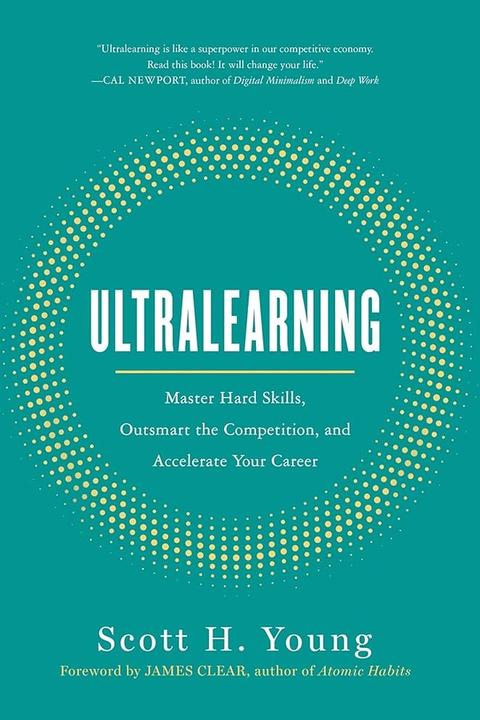
Ultralearning: Accelerate Your Career, Master Hard Skills and Outsmart the Competition
by Scott Young
In one sentence
Ultralearning is a self-directed, intense approach to mastering hard skills quickly by mapping the territory (metalearning), focusing deeply, practicing directly, drilling weaknesses, testing yourself, seeking sharp feedback, retaining what you learn, building intuition, and constantly experimenting.
Key takeaways
- Ultralearning is self-directed and intense: you own the project, design the curriculum, and push yourself harder than any class or boss ever will.
- The 9 principles (Metalearning, Focus, Directness, Drill, Retrieval, Feedback, Retention, Intuition, Experimentation) are a playbook for learning almost anything faster and deeper.
- Direct practice in the real context (doing the thing itself) beats vague preparation, passive study, or endlessly reading about a skill.
- You make the biggest gains by attacking your weakest points with targeted drills, while cycling back regularly to full, direct practice.
- Testing yourself (retrieval) and spacing your learning sessions are far more powerful than re-reading or passive review, even though they feel harder.
- Feedback is essential but dangerous: it helps only when it’s informative and specific, not when it feeds your ego or identity.
- To actually keep what you learn, you need spacing, proceduralization, overlearning, and sometimes mnemonics, plus a plan for maintenance or relearning.
- As you approach mastery, progress depends less on following others and more on experimentation, constraints, and developing your own style.
Summary
Ultralearning is Scott Young’s term for a specific kind of learning project: self-directed, aggressive, and oriented toward hard skills that actually matter in real life. The book begins by contrasting passive, credential-focused education with people who design their own intense learning projects—like learning languages by speaking from day one or completing unofficial “degrees” faster and cheaper than traditional schooling. These ultralearners are not necessarily the most talented; they’re the ones who are bold, obsessive, and willing to optimize their learning like a craft.
Young argues that ultralearning matters for both career and life. Professionally, learning hard skills quickly can do more for your career than years of mediocre effort. It helps you accelerate where you are, transition to a new field, or create a hidden advantage in a competitive environment. Personally, it gives you a way to finally tackle the instruments, languages, and crafts you’ve always dreamed of, and it stretches your self-conception: doing hard things changes how you see yourself.
At the core of the book are nine principles distilled from ultralearners’ projects: Metalearning (understanding how to learn what you’re learning), Focus, Directness, Drill, Retrieval, Feedback, Retention, Intuition, and Experimentation. Each principle has its own chapter, showing how to apply it in practice. You learn to research the map before you start, sharpen your ability to concentrate, tie learning directly to the context where you’ll use it, break skills into subskills, test yourself aggressively, seek feedback without letting it wreck your motivation, deliberately retain knowledge, dig deep for real understanding, and experiment beyond your comfort zone.
Young also shows how to design and execute your first ultralearning project: do metalearning research, plan your schedule, execute, review, and then decide whether to maintain, relearn, or push toward mastery. He contrasts ultralearning with low-intensity habits and formal education, showing when each approach makes sense. Finally, he explores how to foster ultralearning in children, schools, and organizations by setting inspiring goals, using competition carefully, and making learning a priority rather than a side effect of “real work.”
Overall, the book is both a manifesto and a manual: it tries to convince you that intense, self-directed learning is possible for you (not just “geniuses”), and then gives you a structured set of principles and tactics to make that happen.
Reflections
This book is basically a structured permission slip to take learning way more seriously than school ever did—but on your own terms. The key shift for me is that learning isn’t just something that happens in the background of a job or course; it can be the project. The idea of ultralearning reframes big, scary goals (new career, language, craft) into things you can tackle systematically.
The most useful idea is directness. It’s painfully easy to hide behind books, videos, and “prep” instead of doing the real thing. Young calls this out clearly: if you want to speak a language, you have to speak; if you want to code products, you have to build; if you want to do public speaking, you have to get on a stage. Directness is uncomfortable, but that’s exactly why it creates a competitive advantage.
The second big shift is drilling weaknesses instead of endlessly practicing what already feels good. The concept of rate-determining steps and the direct–then–drill cycle is super practical: do the real thing, notice what breaks, isolate that piece, drill it hard, then go back to the real thing. The specific drills (time slicing, cognitive components, magnifying glass) give you concrete ways to do this instead of just “try harder.”
I also really like the way he frames retrieval and retention. The research stories—students who think re-reading will help them, but who learn more from testing themselves even when it feels worse—help explain why so much studying feels productive but doesn’t stick. It’s a good reminder to close the book and see what I can recall, to use question-based notes, and to build spaced review into any serious learning project.
On the softer side, the parts on feedback and experimentation are quietly empowering. Feedback is something most of us fear, but Young shows that the type of feedback and how we process it matters more than the raw praise or criticism. And the experimentation principle is a nice antidote to perfectionism: you don’t need the perfect method; you need a bias toward trying things, measuring your learning rate, and adjusting.
Overall, the book nudges me toward designing learning in projects instead of wishful “I should read more about X” intentions: define a concrete outcome, timebox it, research 10% upfront, then go hard. It also makes it very clear that feeling confused, strained, and a bit overwhelmed is not a sign that you’re failing—it’s basically the price of admission for real growth.
Who should read this
- People who want to switch careers or level up quickly in their current role by mastering new, hard skills.
- Self-directed learners who have already tried lots of books/courses and want a more aggressive, results-focused system.
- Students who feel that formal education is too slow, indirect, or theoretical and want to learn in ways that actually transfer to real life.
- Creators, entrepreneurs, and professionals who want to compound their skills over time and build unique combinations of abilities.
- Parents, educators, and managers curious about how to foster intense, self-driven learning in kids, classrooms, or teams.
Favorite quotes
- “Ultralearning: a strategy for acquiring skills and knowledge that is both self-directed and intense.”
- Learning is only useful when it’s connected to action; you can know every fact about an industry and still lack real-world expertise without practice.
- The best ultralearners blend practical reasons for learning with a genuine excitement or curiosity about the skill itself.
- “What matters is the intensity, initiative, and commitment to effective learning, not the particulars of your timetable.”
- Metalearning boils down to three questions: Why are you learning? What exactly do you need to know? How will you learn it?
- “Start by learning how to learn the subject or skill you want to tackle. First draw a map.”
- Procrastination often shrinks once you survive the first few minutes of discomfort.
- Directness is the habit of learning in the same context you plan to use the skill, instead of hoping classroom knowledge will transfer.
- “The easiest way to learn directly is to simply spend a lot of time doing the thing you want to become good at.”
- Drills are about finding the rate-determining step in your performance and attacking it ruthlessly.
- “Testing isn’t simply a way of assessing knowledge but a way of creating it.”
- Retrieval feels harder than re-reading, but that difficulty is exactly why it works.
- Feedback is powerful when it’s informative and specific, and harmful when it targets your identity or ego.
- “Memory is the residue of thought.”
- Spacing, proceduralization, overlearning, and mnemonics are different ways of saying the same thing: don’t fill a leaky bucket.
- Intuition comes from struggling with hard problems, proving things to yourself, and refusing to fool yourself about what you really understand.
- The Feynman Technique is a way of exposing the “illusion of explanatory depth” by trying to teach what you claim to know.
- As you approach mastery, experimentation becomes the main game: trying new resources, techniques, and styles to push past plateaus.
- “A hungry person can eat only so much food. A lonely person can have only so much companionship. Curiosity doesn’t work this way. The more one learns, the greater the craving to learn more.”
FAQ
Is Ultralearning worth reading?
Yes. If you care about learning anything hard—new career skills, languages, creative crafts—this book gives you a practical framework instead of vague motivation. It’s especially valuable if you’re already self-directed but want a more systematic, research-backed way to design learning projects.
Who is this book for?
It’s for anyone who wants to learn faster and better than traditional schooling allows. That includes students, professionals, entrepreneurs, and self-taught creators who feel stuck at an intermediate level and want to push themselves deliberately.
How is Ultralearning different from generic productivity or study tips?
Instead of scattered hacks, Young organizes learning around nine core principles—metalearning, focus, directness, drill, retrieval, feedback, retention, intuition, experimentation. The book is less about “how to get motivated” and more about how to structure entire projects so that you’re practicing the right things in the right way.
Do I need to go “full-time” to be an ultralearner?
No. Young explicitly says there are three main ways to apply ultralearning: part-time projects, learning sabbaticals, and reimagining existing efforts. The key is intensity and smart strategy, not quitting your job and studying all day.
What are the main lessons of Ultralearning?
The big ideas: do upfront metalearning; focus deeply; practice in the real context (directness); drill your weaknesses; test yourself instead of re-reading; seek sharp yet useful feedback; use spacing, overlearning, and proceduralization to retain; build intuition through struggle and explanation; and experiment aggressively as you get more advanced.
Is Ultralearning still relevant in a world of AI and online courses?
Arguably more than ever. With infinite content and tools, the bottleneck is no longer information, but how you structure your efforts. Ultralearning gives you a way to turn courses, tutorials, and AI tools into outcomes rather than passive consumption.
Is this book similar to Deep Work or Peak?
It overlaps. Deep Work focuses on concentration; Peak dives into deliberate practice and expert performance. Ultralearning sits in between, blending focus, deliberate practice, and self-designed projects into a single framework for learning hard things quickly.
Can I use Ultralearning alongside formal education?
Yes. You can treat your classes as raw material and overlay ultralearning principles: build projects around course content, use retrieval instead of just re-reading, design drills for your weak spots, and seek better feedback. It’s a way to make school actually work for you.
How do I know if my ultralearning project is working?
Use metafeedback: track your learning rate with concrete metrics (scores, error rates, vocabulary learned, audience reactions, etc.). If progress stalls, adjust your strategy—change drills, increase directness, tweak your schedule, or experiment with new methods.
Detailed Notes
Click to expand the full detailed notes →
Detailed Notes
Click to expand the full detailed notes →
Core Concepts – The 9 Principles of Ultralearning
The 9 Principles of Ultralearning
- 1. Metalearning: First Draw a Map
- Learn how to learn your chosen subject. Do short-term research using “Why, What, How”: clarify your motivation (instrumental vs intrinsic), list concepts/facts/procedures, and pick resources and methods (benchmarking + Emphasize/Exclude). Invest ~10% of your project time in this research, and keep updating it as you go.
- 2. Focus: Sharpen Your Knife
- Cultivate the ability to start, sustain, and optimize focus. Tackle procrastination by recognizing it and pushing through the first few unpleasant minutes. Protect your attention from environmental distractions, task-choice distractions, and mental clutter. Adjust your arousal level (energy) to match the difficulty: high arousal for simple, narrow tasks; lower, calmer arousal for complex, creative work.
- 3. Directness: Go Straight Ahead
- Learn by doing the thing you actually want to do. Avoid purely indirect approaches (only classes/books/apps) that never match the real context. Directness helps solve the transfer problem: learning in the context where you’ll use the skill makes it far more likely you can apply it later. Use project-based learning, immersion, realistic simulations (“flight simulators”), and the “overkill” approach (set a challenge harder than you strictly need).
- 4. Drill: Attack Your Weakest Point
- Identify the rate-determining step in your performance and drill it aggressively. Cycle: direct practice → analyze weaknesses → isolate a subskill → drill → return to direct practice to integrate and test transfer. Use tactics like time slicing, drilling cognitive components, copycatting (copy what you don’t want to practice so you can focus on what you do), the magnifying glass method (spend disproportionate time on one subskill), and prerequisite chaining (start too hard, then backfill prerequisites as needed).
- 5. Retrieval: Test to Learn
- Memory is strengthened more by trying to recall than by re-reading. Experiments show that free recall beats repeated review, even though students feel like reviewing works better. Difficult retrieval (free recall, delayed testing) leads to better retention, as long as recall still succeeds. Use flash cards, free recall summaries, question-based note-taking (question-book method), self-generated challenges, and closed-book learning to force retrieval.
- 6. Feedback: Don’t Dodge the Punches
- Feedback is powerful but tricky: in many studies, feedback actually harms performance ~38% of the time. Feedback that targets the person (“you’re so smart/lazy”) usually hurts learning; feedback that gives specific information about what you did and how to fix it helps. Distinguish:
- Outcome feedback – overall result (pass/fail, score).
- Informational feedback – what you did wrong.
- Corrective feedback – what you did wrong and how to fix it.
- Use tactics like noise cancellation (separate signal from noise), hitting the difficulty sweet spot (avoid too-positive or too-negative environments), metafeedback (track your learning rate and strategy effectiveness), and high-intensity, rapid feedback (more cycles, faster).
- 7. Retention: Don’t Fill a Leaky Bucket
- Forgetting happens through decay, interference (old vs new memories), and missing cues. To keep skills:
- Use spacing (don’t cram; spread practice over time, use refresher projects).
- Push knowledge toward proceduralization (automatic skills like typing or biking).
- Use overlearning (practice beyond “just correct,” especially for core skills).
- Use mnemonics (like keyword method and memory palaces) as a bridge for specific, hard-to-remember facts, while recognizing they’re not always suited for fully fluent performance.
- Forgetting happens through decay, interference (old vs new memories), and missing cues. To keep skills:
- 8. Intuition: Dig Deep Before Building Up
- Intuition comes from effortful struggle and deep engagement, not shortcuts. Use rules like:
- Don’t give up quickly; use a “struggle timer” to sit with hard problems longer.
- Prove things to understand them—re-derive results yourself.
- Always start with concrete examples to anchor abstract concepts.
- Don’t fool yourself: ask “dumb” questions, use the Feynman Technique (explain concepts as if teaching someone else, and notice where your understanding breaks).
- Intuition comes from effortful struggle and deep engagement, not shortcuts. Use rules like:
- 9. Experimentation: Explore Outside Your Comfort Zone
- As you get better, improvement depends on experimentation: pushing into new methods, techniques, and styles. Learning becomes a process of unlearning old habits and discovering better ways. Experiment with:
- Resources (different books, classes, methods).
- Techniques (subskills and approaches within the domain).
- Style (your personal way of doing things).
- Use tactics like copy-then-create, side-by-side method comparisons, adding constraints, combining unrelated skills into a hybrid “superpower,” and exploring extremes. This ties closely to a growth mindset—believing your abilities can be improved.
- As you get better, improvement depends on experimentation: pushing into new methods, techniques, and styles. Learning becomes a process of unlearning old habits and discovering better ways. Experiment with:
Ultralearning Project Framework (From “Your First Ultralearning Project”)
- Step 1: Do Your Research – Clarify topic and scope, direct practice activities, primary resources, benchmarks (how others learned), and backup materials/drills.
- Step 2: Schedule Your Time – Decide how much time, when you’ll learn, project length, and put everything on a calendar. Use shorter spaced chunks for memory, longer chunks for tasks with long warm-up times (writing, coding).
- Step 3: Execute Your Plan – Learn while staying alert to misalignment with the principles (Are you focused? Direct? Drilling weaknesses?).
- Step 4: Review Your Results – Afterward, analyze what worked, what didn’t, and what you’d change next time.
- Step 5: Maintain, Relearn, or Master – Decide whether to keep skills via low-level maintenance, let them fade and accept relearning later, or double down into mastery with further projects.
Foreword
- Ultralearners aren’t just absorbing knowledge—they are committed to putting that knowledge to use.
- Learning can become disconnected from real skill if it’s only about soaking up facts.
- You can know every fact about an industry and still lack real-world expertise because you haven’t practiced the craft.
Chapter I – Can You Get an MIT Education Without Going to MIT?
- Benny Lewis’s language approach:
- Start speaking from day one.
- Don’t be afraid to talk to strangers.
- Use a phrasebook to get started; leave formal study for later.
- Use visual mnemonics to memorize vocabulary.
- What stands out is less the methods and more the boldness: he dives straight into conversations and sets seemingly impossible challenges.
- Contrast: the timid learner worrying about mistakes and insufficient vocabulary vs Lewis’s fearlessness.
- Ultralearners’ shared traits:
- Work alone, often for months or years.
- Interests tend toward obsession.
- Aggressively optimize strategies (debating interleaving, leech thresholds, keyword mnemonics, etc.).
- Care deeply about learning itself.
- Motivation pushes them into intense projects, often at the expense of credentials or conformity.
Chapter II – Why Ultralearning Matters
- Definition: Ultralearning is a strategy for acquiring skills and knowledge that is self-directed and intense.
- Reasons to ultralearn:
- Work: rapidly learning hard skills can have more impact than years of mediocre on-the-job striving.
- Helps you change careers, take on new challenges, or accelerate progress.
- Personal life:
- Many people dream of playing an instrument, speaking a language, cooking, writing, photography, etc.
- Deep satisfaction comes from realizing your potential and overcoming limiting beliefs.
- Work: rapidly learning hard skills can have more impact than years of mediocre on-the-job striving.
- Three main cases where ultralearning applies:
- Accelerating your current career.
- Transitioning to a new career.
- Cultivating a hidden advantage in a competitive world.
- Ultralearning can augment other skills and assets you already have.
- The best ultralearners blend practical reasons with inspiration/excitement.
- There’s an added benefit: doing hard things stretches your self-conception.
- Professional success wasn’t usually the main motivation; it was:
- A compelling vision.
- Curiosity.
- The challenge itself.
Putting Talent Aside & Finding Time
- Concern: “How will I find time for intensive learning with work/school/family?”
- In practice, this is usually solvable. Three main ways to fit ultralearning in:
- New part-time projects.
- Learning sabbaticals.
- Reimagining existing learning efforts.
- What matters is intensity, initiative, and commitment to effective learning, not having a perfect schedule.
- Core claim: The ability to acquire hard skills effectively and efficiently is immensely valuable.
Chapter III – How to Become an Ultralearner
- Example of deliberate self-improvement in public speaking:
- Took improv classes to become more spontaneous and trust what’s in his head.
- Learned to avoid stammering or freezing by delivering without hesitation.
- After bombing outside Toastmasters, he learned to talk to his audience before going on stage to understand their language and emotions and adjust the speech on the fly.
- Mentor Gendler: “Make me care.”
- The audience doesn’t automatically care about you—you must make them care.
The Nine Principles (Overview)
- MetaLearning – First Draw a Map
- Learn how to learn the subject or skill.
- Do good research and leverage past competencies.
- Focus – Sharpen Your Knife
- Cultivate concentration; carve out focused time blocks.
- Directness – Go Straight Ahead
- Learn by doing the real thing, not convenient proxies.
- Drill – Attack Your Weakest Point
- Identify weak points; break complex skills into parts; master them and reassemble.
- Retrieval – Test to Learn
- Testing creates knowledge; practice active recall early and often.
- Feedback – Don’t Dodge the Punches
- Feedback is uncomfortable; extract signal from noise without letting ego interfere.
- Retention – Don’t Fill a Leaky Bucket
- Understand forgetting; build systems to remember for the long term.
- Intuition – Dig Deep Before Building Up
- Develop intuition through play and exploration; avoid shallow tricks.
- Experimentation – Explore Outside Your Comfort Zone
- Push boundaries; try new methods, techniques, and styles.
Chapter IV – Principle 1: Metalearning – First Draw a Map
- Metalearning: learning about learning—understanding how to learn your chosen subject.
- Two time scales:
- Short-term: targeted research before and during a project.
- Long-term: each ultralearning project enlarges your general metalearning skill set (methods, resource gathering, motivation management).
Why / What / How Framework
- Why? – Understand your motivation.
- Instrumental vs intrinsic projects.
- For instrumental projects, research whether the skill will actually help you reach your goal.
- Use expert interviews: talk to people who have already achieved what you want.
- What? – Analyze the knowledge/abilities required.
- Draw three columns: Concepts, Facts, Procedures.
- Concepts: ideas you must understand flexibly.
- Facts: things to memorize.
- Procedures: actions to practice.
- Example: language learning – vocabulary = facts; pronunciation = procedure.
- Underline the most challenging items to spot bottlenecks.
- Draw three columns: Concepts, Facts, Procedures.
- How? – Decide on resources, environment, and methods.
- Benchmarking:
- Find common ways people learn the skill (syllabi, tutorials, expert recommendations).
- Build a default curriculum from what already works for others.
- Emphasize/Exclude Method:
- Emphasize areas aligned with your goals (e.g., pronunciation for travel; app development details over theory).
- Exclude or delay topics that don’t serve the goal (e.g., Chinese characters before speaking).
- Benchmarking:
The 10 Percent Rule & Ongoing Research
- Invest ~10% of your total expected learning time into metalearning research before starting.
- Metalearning is not one-off:
- Continuously compare marginal benefit of more research vs direct learning.
- If research feels more valuable than recent “doing,” keep researching a bit longer.
Long-Term Metalearning
- Each project improves:
- Learning methods.
- Resource gathering.
- Time and motivation management.
- Success in one project builds confidence to approach the next with less doubt and procrastination.
Chapter V – Principle 2: Focus – Sharpen Your Knife
- Deep focus is nearly ubiquitous in great intellectual achievements.
- Focus struggles fall into three types:
- Failing to start (procrastination).
- Failing to sustain focus (distraction).
- Failing to create the right kind of focus (arousal mismatch).
Problem 1: Procrastination (Failing to Start)
- We procrastinate due to cravings for alternatives and aversion to the task.
- Most unpleasantness is concentrated in the first few minutes of starting.
- Crutch: convince yourself to get through a few minutes of maximal unpleasantness before taking a break.
- Eventually, use a calendar to carve out specific hours in advance—and actually follow it.
Problem 2: Distraction (Failing to Sustain Focus)
- Flow vs deliberate practice:
- Flow is enjoyable but may not match the demands of deliberate practice (which needs monitoring, feedback, error correction).
- Don’t obsess over flow; it appears sometimes, but isn’t required for learning.
- Spacing and session length: 50–60 minutes is often a good length for many learning tasks.
Three Sources of Distraction
- Environment
- Phone, internet, TV, games, noise, missing materials.
- People often tell themselves they “focus better” with music, but it might simply make avoidance easier.
- Task
- Some activities are harder to focus on (e.g., reading vs video) even with identical content.
- Choose learning tools partly based on how easy they are to focus on.
- Mind
- Negative emotions, restlessness, daydreaming.
- Clear, calm mind is best; unresolved life issues can undermine learning.
- Arousal matters:
- Low arousal = sleepy.
- High arousal = jittery, easily distracted.
- Simple tasks benefit from high arousal and narrow focus.
- Complex tasks often need relaxed, more diffuse focus.
Problem 3: Right Kind of Focus
- High arousal → narrow, brittle focus (good for simple/concentrated tasks).
- Lower arousal → broader, more creative focus (good for complex problem-solving).
- Ideas sometimes emerge after effort when you relax, but only if you’ve focused long enough beforehand.
Improving Focus
- You can improve focus with practice, even if discipline in one area doesn’t automatically transfer to all areas.
- Treat focus as a skill you train via:
- Structuring environment.
- Choosing appropriate tasks.
- Managing arousal and emotions.
Chapter VI – Principle 3: Directness – Go Straight Ahead
- Directness: learning tied closely to the situation or context where you’ll use it.
- Common problem: building the wrong skills portfolio. Examples:
- Want to speak a language but mainly use apps instead of conversations.
- Want to work on large collaborative software but mostly code isolated scripts.
- Want to be a great speaker but only read books on communication.
- Traditional, indirect learning:
- Master formulas before seeing real problems.
- Memorize vocabulary from lists without usage.
- Solve highly artificial problems that never appear again.
The Transfer Problem
- Transfer = using knowledge learned in one context in another.
- Research shows:
- Even high-achieving students often can’t apply classroom knowledge to slightly altered real-world problems.
- Haskell’s insight: transfer is harder when knowledge is limited; as knowledge grows, it becomes more flexible.
- Young’s hypothesis: most formal learning is too indirect, which cripples transfer.
How Directness Helps
- Reduce Need for Far Transfer
- Learn in the actual or close-to-actual context where you’ll use the skill.
- Improve Transfer
- Real-life situations share subtle details with each other, but not with artificial classrooms.
- Real contexts teach hidden details that transfer better to new real situations.
- Principle: build knowledge outward from a real situation, rather than stockpiling theory and hoping it applies later.
How Ultralearners Use Directness
- Simplest: learn by doing as much as possible.
- When direct practice isn’t feasible (piloting, surgery), use simulations approximating cognitive demands.
- Focus on cognitive features (decisions, cues, knowledge retrieval), not superficial details (room, clothes).
Tactics for Directness
- Project-Based Learning
- Organize learning around producing something.
- Guarantees you at least learn how to produce that thing.
- Immersive Learning
- Surround yourself with the target environment.
- Increases volume of practice and range of situations.
- Language example: immersion in a country; open-source communities for coding.
- Flight Simulator Method
- Create realistic simulations when real practice is impossible or risky.
- Make sure cognitive demands resemble the real thing (e.g., Skype conversation vs flash cards for language).
- Overkill Approach
- Set a challenge above your required level (e.g., language exams, big performance).
- The environment’s demands are so high you’re unlikely to miss key lessons.
- First weeks can be a shock, but then become normal.
- Habit: always ask, “Where and how will this knowledge show up in reality?”
Chapter VII – Principle 4: Drill – Attack Your Weakest Point
- Using Franklin and others as examples, drills isolate a rate-determining step in learning.
- Strategy:
- Start with direct practice.
- Analyze performance; identify weak components.
- Design drills targeting those components specifically.
- Return to direct practice to integrate and test.
- Early in learning, cycle direct–drill–direct more quickly.
Designing Drills – Key Questions
- When and what to drill?
- Which aspect, if improved, yields the greatest overall improvement for the least effort?
- Designing effective drills is tricky: they must train the real difficulty without stripping away everything that makes it hard.
- Drills are often uncomfortable and require strong motivation.
Drill Tactics
- Time Slicing
- Isolate a small temporal slice of a longer sequence and repeat it.
- Example: repeating key phrases in early language learning.
- Cognitive Components
- Drill one cognitive aspect (grammar, pronunciation, vocabulary) while minimizing others.
- Example: Mandarin tone drills with recordings.
- Copycat
- Copy everything except the one part you want to practice.
- Reduces cognitive burden and lets you focus on the subskill (e.g., argument ordering in an essay).
- Magnifying Glass Method
- Spend much more time on one component than usual.
- Example: spending 10x more time on research when writing articles.
- Prerequisite Chaining
- Start with a skill that’s beyond your current prerequisites.
- When you fail, go back one step to learn the missing prerequisite, then try again.
- Frustrating but efficient—avoids wasting time on subskills that don’t drive performance.
Mindful Drilling
- Drills without context are mind-numbing.
- People avoid drills or only drill what already feels comfortable.
- Effective drilling requires:
- Looking honestly at weaknesses.
- Comfort with intense, sometimes unpleasant effort.
- Pattern: mentally strenuous activities give greater learning benefits than easy ones.
Chapter VIII – Principle 5: Retrieval – Test to Learn
- William James: “It pays better to wait and recollect by an effort from within, than to look at the book again.”
Testing Effect & Research
- Study by Karpicke & Blunt:
- Four groups: single review, repeated review, free recall, concept mapping.
- Students predicted repeated review would work best, free recall worst.
- Actual result: free recall outperformed all others.
- Paradox: Why don’t students use retrieval more?
- Our judgments of learning (JOLs) are based on how easy studying feels.
- Easy, smooth tasks feel like better learning; struggle feels like worse learning.
- Immediately after study, passive review may outperform retrieval, reinforcing the illusion.
- Another reason: students don’t feel they know the material well enough to test themselves.
Desirable Difficulty
- More difficult retrieval → better learning, as long as retrieval is successful.
- Free recall > cued recall > recognition for long-term retention.
- Slight delay before testing beats immediate testing.
- Too much delay → information is lost and retrieval fails (difficulty becomes undesirable).
Forward-Testing Effect
- Retrieval not only improves past learning but prepares the mind to learn new information more effectively.
What Should Be Retrieved?
- Direct practice forces retrieval of what naturally appears in real tasks.
- But direct practice alone might miss helpful knowledge that isn’t strictly necessary to complete tasks.
- If knowledge isn’t in your head, you can’t recognize when to use it.
Retrieval Tactics
- Flash Cards
- Great for paired associations (question → answer).
- Limited to that specific retrieval format.
- Free Recall
- After reading or a lecture, write everything you remember on a blank sheet.
- Question-Book Method
- Take notes as questions rather than statements.
- One big question per section forces you to identify and rephrase main ideas.
- Later, answer those questions from memory.
- Self-Generated Challenges
- For skills (programming, etc.), create practice challenges as you learn.
- Use these later to test your ability to apply concepts.
- Closed-Book Learning
- Turn any activity (like concept mapping) into retrieval by doing it without looking at the text.
Chapter IX – Principle 6: Feedback – Don’t Dodge the Punches
- Feedback is one of the most consistent tools ultralearners use.
Can Feedback Backfire?
- Meta-analysis: feedback usually helps, but in ~38% of cases it hurts performance.
- Kluger & DeNisi:
- Feedback helps when it provides useful information about how to improve.
- Feedback aimed at ego or identity often backfires.
- Praise such as “You’re so smart” can be harmful; negative labels can also damage learning.
- Even informative feedback can be misused: people may reject it, lower standards, or give up.
Two Concerns for Ultralearners
- Overreacting to non-informative feedback (positive or negative).
- Motivational impact: overly negative or overly positive feedback can both lower motivation.
- Fear of feedback is often worse than the feedback itself.
- Sometimes the best move is to jump into a hard environment and adjust later if it’s too harsh.
Types of Feedback
- Outcome Feedback – Are you doing it wrong overall?
- Score, grade, stock price, etc.
- Informational Feedback – What are you doing wrong?
- Signals something is off but doesn’t say how to fix it.
- Example: confused face from a language partner; compiler error messages.
- Corrective Feedback – How can you fix it?
- Tells you what’s wrong and how to improve.
- Often requires a teacher, coach, or expert (or very good materials).
- Can be unreliable if the “expert” is wrong.
- Be careful “upgrading” feedback types when it’s not possible—forcing granular or corrective feedback can backfire.
Feedback Tactics
- Noise Cancellation
- Separate signal from noise (random variation).
- Example: for blog writing, track percentage of readers who reach the end, not just raw traffic.
- Difficulty Sweet Spot
- Avoid environments that always make you feel great or terrible.
- Use feedback that gives a realistic sense of progress.
- Metafeedback
- Feedback about your learning strategy, not performance.
- Track learning rate: Elo rating in chess, mock test scores, vocabulary learned, error counts.
- If learning stalls, experiment with new methods.
- High-Intensity, Rapid Feedback
- Increase frequency and volume of feedback cycles.
- Particularly useful when default learning has very little feedback.
- Over time, regular feedback becomes less emotionally threatening and more like a tool.
Chapter X – Principle 7: Retention – Don’t Fill a Leaky Bucket
- Memory quote: “Memory is the residue of thought.” – Daniel Willingham.
- Scrabble example: high-level players memorize huge lists of words, showing an intense commitment to practice.
Why We Forget
- Decay – memories fade over time.
- Interference – overlapping memories interfere:
- Proactive: old information makes new learning harder.
- Retroactive: new learning suppresses old memories.
- Forgotten Cues – memory is there but inaccessible because the right cue is missing.
Two Retention Problems
- During a project: how to keep early-learned material from being lost by the end.
- After a project: how to avoid losing the skill years later.
Memory Mechanisms
- Spacing
- Don’t cram if you care about long-term retention.
- Spaced practice lowers short-term performance but boosts long-term retention.
- Can be done via:
- Printed lists + mental rehearsal (as in Richards’s word memorization).
- Semiregular practice sessions (e.g., weekly then monthly language conversations).
- Refresher projects for complex skills.
- Proceduralization
- Procedural skills (e.g., biking) are stored differently and are more robust than declarative facts.
- Many skills move from declarative → procedural with practice (e.g., typewriting).
- Aim to push important skills into automaticity.
- Overlearning
- Practicing beyond the point of adequate performance extends retention.
- Overlearning effects may be short-term alone, but combined with spacing and proceduralization they can have longer impact.
- Two approaches:
- Core practice: keep refining core elements, often via extensive, immersive work.
- Advanced practice: work at a higher level so that lower-level skills are overlearned.
- Mnemonics
- Hyperspecific systems that convert abstract info into vivid images or spatial maps.
- Example: keyword method for foreign vocabulary.
- Two downsides:
- Impressive systems require large upfront investment for sometimes limited real-world value.
- Recall via mnemonics can be slower and less automatic, limiting fluency.
- Best used as a bridge for difficult info, not the final state of memory.
- Overall: active recall, spaced rehearsal, and intense practice are central to winning the war against forgetting.
Chapter XI – Principle 8: Intuition – Dig Deep Before Building Up
How to Build Intuition
- Rule 1: Don’t Give Up on Hard Problems Easily
- Use a “struggle timer” (e.g., 10 extra minutes) before giving up or looking at the answer.
- Rule 2: Prove Things to Understand Them
- Like Feynman: re-create results mentally instead of just following them.
- Understanding comes from generating the argument or proof yourself.
- Rule 3: Always Start with a Concrete Example
- Walk through abstract material with your own example.
- Ties into levels-of-processing: how you think about information matters more than time spent.
- Rule 4: Don’t Fool Yourself
- Feynman’s aphorism: you’re the easiest person to fool.
- Ask lots of “dumb” questions to uncover gaps.
The Feynman Technique
- Steps:
- Write the concept/problem at the top of a page.
- Explain it as if teaching a beginner.
- If it’s a problem, explain how to solve it and why the solution makes sense.
- When you get stuck, return to references to fill gaps.
- Purpose: dispel the illusion of explanatory depth.
Applications
- Things You Don’t Understand at All
- Use the book in hand; go back and forth to clarify.
- Problems You Can’t Solve
- Go step-by-step alongside your explanation, not just summarize.
- Expanding Intuition
- For crucial ideas, generate intuitive examples, analogies, and visualizations.
- Imagine writing a magazine article that makes the idea obvious.
- Intuition isn’t magic: it’s the result of merging tenacious practice and play.
Chapter XII – Principle 9: Experimentation – Explore Outside Your Comfort Zone
- Edison: “I know several thousand things that won’t work.”
- Early in learning, following others’ examples is enough.
- As skills develop:
- Fewer people can teach you.
- Fewer peers at your level.
- You diverge from others’ paths.
- Mastery often involves unlearning, choosing the best solutions (clean, efficient, low-headache), and originality.
Why Experimentation Matters
- After basics, abilities tend to stagnate without experimentation.
- Creativity and originality in many fields require experimenting with new approaches.
Three Types of Experimentation
- Experimenting with Learning Resources
- Try different books, classes, and methods.
- But match experimentation with real work: pick a resource, apply it rigorously for a set period, then evaluate.
- Experimenting with Technique
- As options expand, question “What should I learn next?”
- Pick a subtopic, learn it aggressively, then decide whether to continue or pivot.
- Experimenting with Style
- Later, the question becomes, “How do I want to do this?”
- Many skills allow multiple styles; explore them to find your own.
- There’s a tension between exploring options and concentrating effort.
- Resolve it by cycling: explore a new avenue → then buckle down and learn it deeply → repeat.
Mindset of Experimentation
- Similar to growth mindset (Dweck):
- Fixed mindset: traits are innate; no point trying.
- Growth mindset: abilities can improve; effort matters.
- These mindsets become self-fulfilling.
- Experimentation requires believing you can improve.
Experimentation Tactics
- Copy, Then Create
- Start by copying an example you admire.
- This forces you to deconstruct it and understand why it works, then you deviate.
- Compare Methods Side-by-Side
- Apply a quasi-scientific method: change one variable at a time to see what works better.
- Introduce New Constraints
- Constraints force new solutions and disrupt old routines.
- In design, constraints often lead to the best innovations.
- Hybrid Superpower
- Combine two unrelated skills to create a unique strength.
- Explore the Extremes
- Complex domains have many dimensions; extremes often reveal interesting applications.
- Pushing to an extreme in one dimension can help you discover new possibilities, even if you later return to moderation.
- Overall: learning itself is experimentation—both in how you practice and how you design your learning process.
Chapter XIII – Your First Ultralearning Project
“The beginning is always today.” – Mary Shelley
Step 1: Do Your Research
- Metalearning research is the first step.
- Ultralearning “packing checklist”:
- Topic and approximate scope.
- Direct practice activities.
- Primary resources.
- Benchmarks (how others learned successfully).
- Backup materials and drills.
Step 2: Schedule Your Time
- Reasons to plan schedule ahead:
- Prioritizes learning in your calendar.
- Protects against moment-to-moment temptation to switch to easier activities.
- Decisions:
- How much time you’ll commit (e.g., full-time vs a few hours/week).
- When you’ll learn (times of day that fit your schedule).
- Project length (shorter commitments are easier to stick with).
- Scheduling all hours in advance has logistical and psychological benefits.
- Optimization:
- Short, spaced chunks better for memory.
- Longer blocks better for tasks with long ramp-up (writing, coding).
Step 3: Execute Your Plan
- Execute while monitoring alignment with the principles:
- METALEARNING: Have you done sufficient research? Talked to successful learners? Used ~10% of time for prep?
- FOCUS: Are you actually focused or multitasking? How long till you get into good flow? How long can you sustain it?
- DIRECTNESS: Are you practicing in the way you’ll use the skill? What mental processes are missing?
- DRILL: Are you targeting your weakest points? What’s the rate-limiting step?
- (Similar reflective questions apply for Retrieval, Feedback, Retention, Intuition, Experimentation.)
Step 4: Review Your Results
- After finishing or pausing:
- What went right?
- What went wrong?
- What should you do differently next time?
Step 5: Maintain, Relearn, or Master
- Without a plan, most knowledge decays. Options:
- Maintenance
- Enough practice to sustain skill without aiming for new levels.
- Habitual, possibly minimal practice.
- Forgetting follows an exponential decay curve (Ebbinghaus); later refreshers can be less frequent.
- Relearning
- Let skills fade and relearn later if needed.
- For many skills, relearning costs are smaller than constant maintenance.
- Mastery
- Dive deeper via continued practice or another ultralearning project.
Alternatives to Ultralearning
- Low-Intensity Habits
- Good when learning is spontaneous, frustration is low, and the process is rewarding.
- Examples:
- Conversational language level leading to travel and daily use.
- Programming at work where the job drives ongoing learning.
- Habits work well when learning is mostly accumulation.
- Ultralearning suits situations requiring unlearning and intense skill restructuring.
- Formal, Structured Education
- Some aspects are indirect and ineffective; others (design/art schools, team projects) can function like apprenticeships.
Chapter XIV – An Unconventional Education
How to Raise an Ultralearner (Polgár Example)
- Start Early
- Education begins by age three; specialization by age six.
- Children’s brains are more plastic, especially for music and languages.
- Specialize
- The Polgár sisters learned many subjects but focused on chess.
- From ages 4–5: chess 5–6 hours per day.
- Make Practice into Play
- All subjects framed as play.
- When distracted, the girls weren’t punished; they were allowed to wander mentally while seeking solutions.
- Use Positive Reinforcement
- Failure, suffering, and fear decrease achievement.
- Positive experiences (wins) create desire to repeat behaviors.
- Negative experiences (constant losses, confusion) sap enthusiasm.
- László calibrated difficulty so they were challenged but could still win enough to enjoy it.
- Avoid Coercion
- Self-discipline, motivation, and commitment must come from within.
- Parents also built strong infrastructure (massive database of matches, textbooks, tutors).
Fostering Ultralearning in Home, School, Workplace
- Create an Inspiring Goal
- Let people design their own goals.
- Look for natural interests and encourage those sparks.
- Be Careful with Competition
- Early self-confidence increases enthusiasm.
- People need to feel they could be good at something.
- Competition helps when you have natural aptitude; can hurt when you’re behind.
- For those behind, make projects unique so comparisons are less direct.
- Make Learning a Priority
- Outside school, learning is often seen as an incidental by-product of work.
- Organizations usually offer passive workshops rather than intense learning projects.
- Ultralearning suggests fusion projects—do real work that is also designed to teach something new.
- Instead of always assigning tasks to the best person, sometimes assign them to someone who will need to stretch.
- A good environment has employees spending most time within competency and some portion on stretch projects.
Curiosity and Conclusion
- Curiosity behaves differently than hunger or loneliness: the more you satisfy it, the more it grows.
- Immediate, accurate, intense feedback is often what separates ultralearning from conventional learning.
- Ericsson’s research: immediate feedback is essential for reaching expert performance; without it, skills stagnate.
- Even outcome feedback, without detailed information, can be helpful.
- Outcome feedback helps by:
- Providing a motivational benchmark.
- Showing relative merits of different methods.
- Being in demanding situations provokes more aggressive learning.