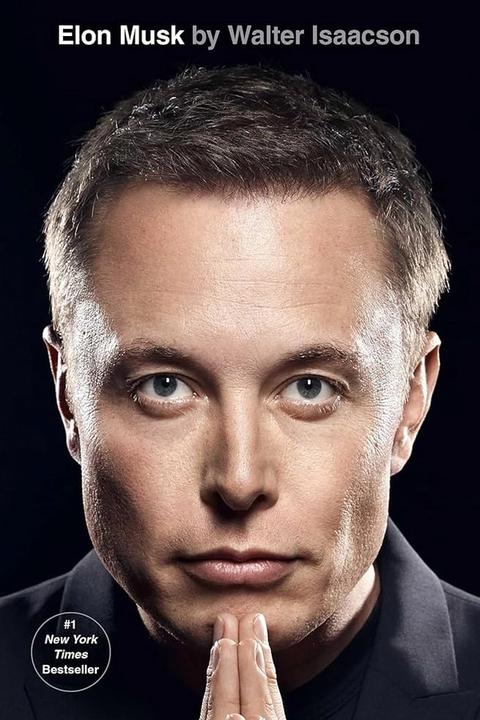
Elon Musk
by Walter Isaacson
In one sentence
A driven, often ruthless engineer-CEO, Elon Musk uses first-principles thinking, insane urgency, and a mission to change humanity’s future (internet, sustainable energy, and space) to build world-changing companies—while leaving a trail of broken timelines, burnt-out teams, and personal chaos.
Key takeaways
- Musk orients his life around three “things that will truly affect humanity”: the internet, sustainable energy, and space travel—and backs that up by continually betting his entire fortune on them.
- His core superpower is first-principles thinking: question every requirement, drill down to raw materials and physics, then rebuild systems cheaper, simpler, and more efficient.
- He treats engineering and manufacturing as inseparable; the real product is “the machine that builds the machine,” not just the car, rocket, or robot you see at the end.
- He runs companies with a “maniacal sense of urgency,” using impossible deadlines, brutal feedback, and small hardcore teams—and accepts high risk, high failure, and high human cost as the price.
- He obsessively drives down cost by questioning specs, in-sourcing components, and inventing cheaper alternatives, using tools like the “idiot index” and fixed-price contracts.
- He oscillates between visionary mission focus (multi-planetary life, AI safety, sustainable energy) and open-loop behavior—Twitter fights, ruthless layoffs, and personal flameouts that damage him and his companies.
- He believes excellence > headcount: a small number of exceptional, driven, loyal engineers in-person can outperform thousands of “pretty good” people.
- His success and dysfunction are tightly woven; it’s unclear whether a “kinder, gentler” Musk could have pulled off reusable rockets, mainstream EVs, and global satellite internet.
Summary
This biography follows Elon Musk from his bookish childhood in Pretoria through his defining ventures: Zip2, X.com/PayPal, SpaceX, Tesla, SolarCity, Neuralink, Starlink, and the chaotic Twitter takeover. It shows how an introverted kid who hid in sci-fi novels and libraries grew into a founder obsessed with bending physics, manufacturing, and capital to his will. His life is structured around a simple mission: the internet to empower people, sustainable energy to avoid climate and resource collapse, and space travel to make humanity multi-planetary.
A major throughline is Musk’s engineering mindset. He doesn’t just want to design products—he wants to redesign the factories, contracts, and incentive structures that produce them. From early days tinkering with BMW transmissions to questioning $250,000 valves and $3 million rocket subsystems, he repeatedly attacks costs and complexity using first principles. He builds companies where design, engineering, and manufacturing sit side by side, and where managers are expected to be hands-on, not PowerPoint generals.
The book also shows Musk as a relentlessly risk-seeking operator. He regularly amplifies risk rather than mitigating it: plowing almost all his Zip2 proceeds into X.com, betting his PayPal money on both Tesla and SpaceX at once, and pushing rockets to launch and factories to ramp with timelines everyone else calls impossible. His philosophy: burn the boats so retreat isn’t an option, then pull rabbits out of hats until it works—or you die.
Alongside the engineering heroics is a pattern of chaos. Musk sets unrealistic deadlines, gives cutting feedback, triggers “production hell,” and pushes teams to burnout. He’s ousted from PayPal, nearly bankrupt in 2008, and later throws Twitter into a brutal three-round layoff and culture overhaul. Friends and family talk about him going “open-loop,” losing feedback and fixating on fights, especially online. His personal life is turbulent, from accumulating and then divesting his mansions to juggling relationships, children, and public controversies.
In later years, the book zooms into Musk’s newest frontiers: autonomous driving, humanoid robots, brain-computer interfaces, global satellite internet, and AGI via X.AI. He applies the same playbook: define a clear metric (cost per ton to orbit, miles per intervention, photons used vs. collected), then grind teams toward it with urgency. By the end, the biography leaves you with an unresolved question: can you separate Musk’s achievements from his flaws—or are the rockets, EVs, and AI breakthroughs inseparable from the damage he causes?
Reflections
What stands out is how early the throughline was visible: kid in Pretoria hiding in sci-fi books → physics + business at Penn → obsessing over rockets, EVs, and solar in the 90s, long before any of that was mainstream. The mission isn’t a PR invention; it’s been there for decades.
The real takeaway for me isn’t “be like Elon” (I don’t want that life), but the rigor of his operating system. Question every requirement, delete before optimizing, and only automate once the process is clean—that’s gold for any product, startup, or even personal systems. Same with the idiot index and the obsession with factories and cost. It’s a reminder that real leverage is in the underlying machine, not just the shiny output.
But the book also makes it painfully clear what the cost looks like: long stretches of nonstop pain, open-loop spirals, and collateral damage to people around him. The Twitter chapter, especially, reads like a case study in raw power plus minimal empathy—blitzing layoffs, pulling forward deal closings to cut payouts, running everything at “hardcore” levels. You can respect the clarity of his decisions and still question whether the human toll is worth it.
I find the Polytopia framework both insightful and a bit chilling. Treating life like a finite-turn strategy game explains his willingness to double down, take huge risks, and not care much about short-term pain—his or anyone else’s. It’s an effective frame for building massive things; it’s a less great frame for relationships and long-term well-being.
The book does a good job of not simplifying him into hero or villain. You get the rockets, Starlink, EVs, and AI advances—and you also get the ego, the impulsive tweets, the overhyped projects, and the burnout. The hard question it leaves me with: how much of his output is inseparable from his flaws? Could someone with more emotional balance have done something similar—or is that wishful thinking?
Who should read this
- Founders, engineers, and product people who want to understand how a mission-driven, first-principles operator actually runs companies day-to-day.
- Anyone interested in the history of SpaceX, Tesla, PayPal, Starlink, Neuralink, and the Twitter/X takeover.
- Students of leadership who want an unvarnished look at both the power and damage of extreme intensity.
- People curious about how big bets in rockets, EVs, autonomy, and AI are actually made and executed, not just pitched.
- Fans or critics of Musk who want a more nuanced view than Twitter hot takes.
Favorite quotes
- “I thought about the things that will truly affect humanity. I came up with three: the internet, sustainable energy, and space travel.”
- “A maniacal sense of urgency is our operating principle.”
- Physics doesn’t care about hurt feelings; it only cares whether you got the rocket right.
- “Most PhDs are irrelevant. The number that actually move the needle is almost none.”
- On cost and inefficiency: if the ratio of finished-product cost to raw materials—the idiot index—is high, you’re an idiot.
- “Step one should be to question the requirements. Make them less wrong and dumb, because all requirements are somewhat wrong and dumb.”
- “If you let a few turns slide, you will never get to Mars.” (Polytopia as life philosophy.)
- “Awesome products grow with word of mouth. Don’t worry about sales tactics.”
- “I never wanted to be a CEO, but I learned that you could not truly be the chief technology or product officer unless you were the CEO.”
- “It’s not the product that leads to success. It’s the ability to make the product efficiently. It’s about building the machine that builds the machine.”
- “Possessions kind of weigh you down. They’re an attack vector.”
- “Are you not entertained? Is that not why you are here?” (His Gladiator line about making life interesting and edgy.)
- “I’m a big believer that a small number of exceptional people who are highly motivated can do better than a large number of people who are pretty good and moderately motivated.”
- “Video games without a score are boring. So we’ll track miles between interventions as our score.” (On Full Self-Driving metrics.)
- “Never ask your troops to do something you’re not willing to do.”
- “It’s okay to be wrong. Just don’t be confident and wrong.”
- “The only rules are the ones dictated by the laws of physics. Everything else is a recommendation.”
- “Sometimes great innovators are risk-seeking man-children who resist potty training. They can be reckless and toxic—and crazy enough to think they can change the world.”
FAQ
Is this book worth reading if I already follow Musk in the news?
Yes. The news gives you fragments and scandals; the book gives you continuity. You see the same patterns—first-principles thinking, insane urgency, ruthless cost-cutting, and open-loop behavior—repeating across PayPal, SpaceX, Tesla, and Twitter. It also shows how his personal history, relationships, and inner narrative drive his decisions.
What are the main lessons from this biography?
The big lessons: define a mission that genuinely matters, use first principles to question every assumption, obsess over cost and manufacturing, and accept that big bets require high risk and high pain tolerance. The counter-lesson is just as important: unchecked intensity, lack of empathy, and constant crisis mode eventually damage people, systems, and sometimes the mission itself.
How does Elon Musk actually operate his companies?
He runs them through metrics, algorithms, and proximity. Metrics: cost per ton to orbit, miles per intervention, photons used vs. collected. Algorithms: question requirements, delete parts, simplify, speed up, then automate. Proximity: live on the factory floor or launch site, keep design and engineering close to manufacturing, and do skip-levels with front-line workers. All of that is wrapped in extreme deadlines and “hardcore” expectations.
Is the book hagiography or criticism?
It’s neither pure praise nor pure takedown. The book openly admires Musk’s achievements and engineering brilliance, but it also documents his cruelty, reckless risk-taking, Twitter chaos, and personal damage. It leans into the uncomfortable idea that his strengths and flaws are tightly linked, and it doesn’t pretend that you can easily have one without the other.
How does Musk think about risk compared to other entrepreneurs?
Most founders try to mitigate risk: control variables, de-risk before scaling. Musk often amplifies risk—burning the boats so there’s no way back, betting most of his net worth on new ventures, and setting impossible timelines. He’d rather be at the edge of survival, pulling rabbits out of hats, than moving cautiously. That works spectacularly when it works—and is brutal when it doesn’t.
What’s unique about Musk’s approach to engineering and manufacturing?
He refuses to separate design, engineering, and the factory. The product is the factory. He questions specs, attacks cost with the idiot index, in-sources where suppliers overcharge, and even borrows tricks from toys and Legos for precision and speed. He also forces managers to be hands-on, believing you can’t lead a cavalry if you can’t ride a horse.
How does the book portray Musk’s leadership style at Twitter?
At Twitter, you see the sharpest version of his “hardcore” philosophy: surprise deal timing to cut payouts, three brutal rounds of layoffs, demands for in-office work, and a ruthless focus on retaining only “excellent, trustworthy, driven” engineers. It’s a case study in speed and cost-cutting at the expense of psychological safety, institutional knowledge, and trust.
Is the book still relevant as Musk moves into AI and new ventures?
Yes, because the pattern repeats. At X.AI and in his broader AI ambitions, he applies the same playbook: set a mission (“maximum truth-seeking AI”), define a metric, recruit hardcore talent, and push them with impossible goals. Understanding the pattern helps you predict how he’ll approach new frontiers, whether that’s AGI, robots, or whatever comes next.
How does the book connect Musk’s love of sci-fi to his real-world projects?
Sci-fi isn’t just flavor; it’s a blueprint. Hitchhiker’s Guide, Asimov, Iain Banks, and others shaped his desire to expand into space, build brain-computer interfaces, and use AI to understand the universe. Starship, Neuralink, Optimus, and X.AI all feel like attempts to drag sci-fi concepts into reality, with real rockets, code, and factories behind them.
What’s the biggest open question the book leaves you with?
The book ends on a tension: would a more restrained, emotionally balanced Musk have achieved as much—or is the messy, unfiltered version inseparable from the breakthroughs? It doesn’t answer that for you. Instead, it leaves you weighing the rockets, EVs, and AI against the human cost and asking what kind of builders we actually want shaping the future.
Detailed Notes
Click to expand the full detailed notes →
Detailed Notes
Click to expand the full detailed notes →
Big Ideas & Operating Principles
Mission & Life Vision
- Three levers that “truly affect humanity”: internet, sustainable energy, space travel.
- Mission-first, business-later: start from a mission (e.g., Mars colonization, sustainable energy) and backfill the financial model.
- Maximum impact lens: ask, “What moves the needle for civilization?” then commit fully.
First-Principles Thinking & Cost
- Idiot Index: ratio of finished-product cost to raw materials; a high ratio means design/manufacturing inefficiency and an opportunity to radically cut cost.
- Question every requirement: know who wrote each spec, question it, and assume “all requirements are somewhat wrong and dumb.”
- In-source wherever possible: build valves, actuators, and other components in-house if external quotes are insane.
- Use non-aerospace, non-automotive parts: adapt cheap, proven components (e.g., car-wash valves, bathroom latches, commercial AC units).
The Algorithm (Product & Manufacturing)
- Question every requirement. Attach each to a named person; question even those from very smart people (including Musk).
- Delete any part or process you can. If you don’t add back 10%, you didn’t delete enough.
- Simplify and optimize. Only after deletion—don’t streamline something that shouldn’t exist.
- Accelerate cycle time. Speed things up, but only once the design is simplified.
- Automate last. Avoid automating flawed processes; fix and simplify first.
Corollaries:
- Technical managers must be hands-on (code, install, build).
- Beware camaraderie that prevents candid criticism.
- It’s okay to be wrong; it’s not okay to be confidently wrong.
- Never ask people to do what you’re unwilling to do.
- Do skip-levels; talk directly to front-line workers.
- Hire for attitude; skills can be taught.
- “A maniacal sense of urgency is our operating principle.”
- Only the laws of physics are real rules; everything else is a recommendation.
Design, Engineering, & Manufacturing Integration
- Design + engineering + manufacturing in one space: so builders can immediately confront designers with “Why did you make it this way?”
- Design is not veneer: aesthetics and engineering are one system, like Jobs and Ive at Apple.
- “The machine that builds the machine”: the factory is the real product; efficiency at scale is the ultimate advantage.
- Gigapress & Lego mindset: giant castings + ultra-precise, interchangeable parts, inspired by toy manufacturing.
Risk, Urgency, and Failure
- Amplify risk: burn the boats, floor the McLaren, commit most of your net worth, then figure it out.
- Unrealistic deadlines: used as a forcing function—motivating but often demoralizing when physically impossible.
- Iterate by blowing things up: prototype fast, test, fail, and fix; success is how fast you find and fix problems, not how well you avoid them.
- Fixed-price, outcome-based contracts: get paid for milestones delivered, not hours billed; rewards results over waste.
People & Culture
- Small, hardcore teams: a few exceptional, driven people beat large groups of “pretty good” people.
- In-person > remote: he believes co-location intensifies idea flow, speed, and accountability.
- Excellence, trustworthiness, drive: the three filters for who stays; loyalty and “hardcore” work ethic are non-negotiable.
- Psychological safety vs. urgency: he sees “psychological safety” as an enemy of speed and progress.
Polytopia Life Lessons (How He Frames Life)
- Empathy is not an asset in business (in his view).
- Play life like a strategy game: optimize every turn, double down, don’t fear losing.
- Be proactive and set the strategy; don’t only react.
- Pick your battles; don’t swipe back at everyone.
- Unplugging is important in theory—but he rarely does it.
Technology Bets & Frontiers
- SpaceX: reusable rockets, Starlink, stainless-steel Starship; extreme cost-down via first principles.
- Tesla: integrated design + manufacturing, Autopilot/Full Self-Driving with neural networks trained on millions of human-driving clips, Robotaxi vision.
- Neuralink: high-bandwidth brain-computer interface inspired by science fiction, especially Iain Banks.
- Optimus (Tesla Bot): humanoid robot for physical labor, built on Tesla’s AI + manufacturing stack.
- X.AI: “maximum truth-seeking AI” aimed at reasoning about the universe and preserving human consciousness.
3: Life With Father — Pretoria, the 1980s
- Reading was Musk’s psychological retreat.
- He would immerse himself in books for entire afternoons and nights, sometimes nine hours straight.
- At other people’s houses, he disappeared into their libraries.
- On trips into town, he would wander off to bookstores and be found sitting on the floor, lost in a book.
4: The Seeker — Pretoria, the 1980s
- The science fiction book that most influenced his early years was Douglas Adams’s The Hitchhiker’s Guide to the Galaxy.
7: Queen’s — Kingston, Ontario, 1990–1991
- Musk later said the most important thing he learned at Queen’s was “how to work collaboratively with smart people and make use of the Socratic method to achieve commonality of purpose.”
- This collaborative skill was only partly honed; future colleagues would notice its limits.
Latin American debt & Scotiabank
- Musk researched Latin American debt for Professor Nicholson.
- In 1989, U.S. Treasury secretary Nicholas Brady packaged billions of bad loans into tradable securities called “Brady Bonds,” backed by the U.S. government.
- Musk believed these bonds would always be worth 50 cents on the dollar, but some traded around 20 cents.
- He figured Scotiabank could make billions buying them cheaply and called Goldman Sachs to confirm availability.
- Nicholson says Scotiabank handled the situation using its own better methods, and Musk came away thinking the bank was dumber than it was.
- Nicholson thinks this “healthy disrespect” for finance gave Musk the audacity to later start what became PayPal.
Lesson about working for others
- Musk learned he did not like or excel at working for other people.
- It wasn’t in his nature to be deferential or assume others knew more than he did.
8: Penn — Philadelphia, 1992–1994
Physics, rockets, and Mars
- Musk and his friend Ren talked about applying physics to rockets and Mars.
- Musk regularly discussed building a rocket that could go to Mars; Ren assumed it was fantasy.
Electric cars
- Musk focused heavily on electric cars, reading battery papers during lunch on the campus lawn.
- California’s mandate that 10% of vehicles be electric by 2003 inspired him: “I want to go make that happen.”
Solar power
- Musk became convinced that solar was the best path to sustainable energy.
- His senior paper, “The Importance of Being Solar,” argued society would be forced to focus on renewables as fossil fuels dwindled.
- He proposed a “power station of the future” with a satellite concentrating sunlight onto solar panels and beaming power back via microwaves.
- He got a 98, with the professor noting the final figure “comes out of the blue.”
Social side
- At Penn, Musk developed a love of partying that pulled him out of his lonely shell.
- Adeo Ressi, a fun-loving friend, started an environmental paper and attempted a “Revolution” major using it as his thesis.
9: Go West — Silicon Valley, 1994–1995
Wall Street vs. Silicon Valley
- In the 1990s, ambitious students were pulled either to Wall Street or Silicon Valley.
- Musk received lucrative Wall Street internship offers but wasn’t interested in finance.
- He felt bankers and lawyers didn’t contribute much to society and disliked business-class peers.
King of the road (Cars & hardware mindset)
- 1980s trend: cars and computers became sealed appliances; fewer people tinkered.
- Musk was different: he liked hardware as well as software.
- He had a feel for battery cells, capacitors, engines, fuel pumps, etc., along with coding.
BMW tinkering
- Musk owned a twenty-year-old BMW 300i in Philadelphia.
- He spent Saturdays scrounging junkyards for parts to soup it up.
- He upgraded a four-speed transmission to a five-speed using a lift, shims, and some grinding.
- The result: the car “was really able to haul ass.”
The internet wave & Stanford decision
- Musk planned to study materials science at Stanford, researching ultracapacitors for EVs.
- He worried he’d spend years getting a PhD only to conclude capacitors weren’t feasible.
- He felt most PhDs are irrelevant; very few move the needle.
- He had already formulated his life vision: three things that would truly affect humanity— the internet, sustainable energy, and space travel.
10: Zip2 — Palo Alto, 1995–1999
CEO vs. product
- Musk: “I never wanted to be a CEO,” but learned you can’t truly be chief product or tech officer unless you are the CEO.
Direct-to-consumer instinct
- As a true product person, he wanted to sell directly to consumers without middlemen.
The millionaire moment
- In January 1999, Compaq bought Zip2 for $307 million in cash.
- Elon and Kimbal had split their 12% stake 60–40; Elon (age 27) got $22 million; Kimbal got $15 million.
- Elon’s bank account jumped from ~$5,000 to ~$22,005,000.
- They gave their father $300,000 and their mother $1 million.
- Elon bought an 1,800-square-foot condo and a $1 million McLaren F1, the fastest production car.
- He later worried the car made him look like an “imperialist brat,” but said he wasn’t consciously aware of his values changing.
12: X.com — Palo Alto, 1999–2000
All-in-one bank concept
- After Zip2, Musk studied the banking system, convinced it was ripe for disruption.
- He founded X.com in March 1999 with ex-Scotiabank colleague Harris Fricker.
- He invested $12 million of his own money, leaving about $4 million for himself.
- X.com aimed to be a one-stop financial platform: banking, digital purchases, checking, credit cards, investments, loans.
- Key insight: money is just entries in a database; transactions should be secure and real-time.
Control, conflict, and investors
- Musk’s controlling interest meant he prevailed in disputes, and Fricker (plus most employees) quit.
- Michael Moritz at Sequoia invested and helped secure partnerships with Barclay’s and a Colorado community bank for mutual funds, a bank charter, and FDIC insurance.
- At 28, Musk had become a startup celebrity.
Insane deadlines & launch
- Musk often set insane deadlines and prowled the office, sleeping under his desk.
- For X.com’s public launch, he forced a Thanksgiving weekend deadline, causing resentment but eventual success.
- When the product went live, the team marched to an ATM, pulled cash with an X.com debit card, and celebrated.
Max Levchin, Peter Thiel & PayPal
- Confinity (Thiel & Levchin) built competing person-to-person payments (PayPal).
- After negotiations, X.com and Confinity merged ~50–50 under X.com’s corporate entity.
- Musk became chairman and soon CEO again after ousting Harris.
- The combined service was branded PayPal and grew rapidly.
Org design
- Musk removed the separate engineering department and paired engineers directly with product managers.
- He believed separating design from engineering created dysfunction; designers had to feel the pain of hard-to-build ideas.
- He preferred engineer-led teams, a philosophy he’d later push at Tesla, SpaceX, and Twitter.
13: The Coup — PayPal, September 2000
Risk seeker vs. risk mitigators
- Musk was pushed out again—this time from PayPal.
- Colleagues noted his relentless style and risk-seeking instinct.
- Roelof Botha contrasted him with typical entrepreneurs: they mitigate risk; Musk amplifies it and “burns the boats.”
- His McLaren crash became a metaphor: floor it and see how fast it goes.
- Thiel, in contrast, focused on limiting risk.
PayPal sale
- PayPal went public in early 2002 and was acquired by eBay for $1.5 billion.
- Musk’s payout was around $250 million.
14: Mars — SpaceX, 2001
Flying & intensity
- Post-PayPal, Musk bought a single-engine turboprop and crammed 50 training hours into two weeks to get his pilot’s license.
- He failed his first IFR test, then passed on the second try.
- He then bought an Aero L-39 Albatros, a Soviet Bloc military jet.
Mission-first mindset
- Reid Hoffman initially couldn’t see how sending rockets to Mars was a business.
- He later realized Musk starts with a mission, then backfills finances, making him a “force of nature.”
15: Rocket Man — SpaceX, 2002
First principles & idiot index
- Musk used first principles on rocket costs, creating an “idiot index”: finished product cost vs. raw materials.
- Rockets had a huge idiot index; finished rockets cost at least 50x raw materials.
- He saw an opportunity in building cheaper rockets for smaller satellites.
Key metric
- He focused on cost per pound of payload to orbit, optimizing thrust, reducing mass, and enabling reusability.
SpaceX founding & timelines
- Space Exploration Technologies (SpaceX) was incorporated in May 2002.
- Initially called SET, later rebranded SpaceX.
- Early goals: first rocket launch by September 2003; unmanned mission to Mars by 2010.
- It continued his tradition of wildly unrealistic timelines that would end up merely very late.
17: Revving Up — SpaceX, 2002
- Musk laid out the factory so design, engineering, and manufacturing sat together.
- He wanted assembly-line workers to easily grab designers/engineers and ask, “Why the fuck did you make it this way?”
- Analogy: if your own hand is on the stove, you move it fast; if it’s someone else’s, it takes longer.
18: Musk’s Rules for Rocket-Building — SpaceX, 2002–2003
Question every cost
- Musk was laser-focused on cost, motivated both by his own capital at risk and his Mars colonization goal.
- He challenged aerospace suppliers’ prices (often 10x auto industry equivalents).
- He pushed to manufacture many components in-house.
Examples
- Valve quoted at $250,000: SpaceX built it themselves for a fraction.
- Actuator quoted at $120,000: Musk said it’s no more complex than a garage door opener; engineer built it for $5,000.
- Another engineer adapted a car-wash valve to mix rocket fuel.
Question every specification
- Rocket components were subject to hundreds of specs, especially from military/NASA.
- Musk made engineers question all specs, not follow them religiously.
- He demanded to know who (which person) created a requirement, not just which department.
Insane deadlines
- He set unrealistic deadlines even when unnecessary (e.g., building test stands for engines not yet built).
- “A maniacal sense of urgency is our operating principle.”
- Mueller noted the tradeoff: aggressive yet plausible schedules motivate; physically impossible ones demoralize—Musk’s biggest weakness.
Learn by failing
- Musk favored iterative design: prototype, test, blow up, revise, repeat.
- Success metric: how fast you find and fix problems, not how well you avoid them.
Fixed-price contracts
- SpaceX’s success helped shift NASA from cost-plus contracts to fixed-price, milestone-based contracts.
- Under cost-plus, contractors were reimbursed costs plus profit; under fixed-price, they risk their own capital and control design within broad parameters.
- Musk: fixed-price rewards results, not waste.
23: Two Strikes — Kwaj, 2006–2007
Second launch attempt
- After the first Falcon 1 failure, SpaceX became more cautious.
- They carefully tested and recorded details of hundreds of components.
- Musk did not try to remove all risk; that would make the rockets as costly and slow as traditional contractors.
Cost tracking
- He demanded charts listing each component, its raw material cost, supplier cost, and responsible engineer.
- In meetings, Musk sometimes knew the numbers better than presenters, making reviews brutal but effective.
- Costs came down.
24: The SWAT Team — Tesla, 2006–2008
- Antonio Gracias, speaking Spanish with factory workers, learned how to improve processes.
- Worker-driven changes (e.g., smaller nickel vats) helped troubled factories turn profitable.
- His big lesson: success is not just the product; it’s the ability to make the product efficiently.
- “It’s about building the machine that builds the machine”—a principle Musk adopted.
25: Taking the Wheel — Tesla, 2007–2008
- Musk opposed outsourcing Tesla assembly, clashing with Martin Eberhard and others.
- He used blunt, harsh lines like “That’s just the stupidest thing I’ve ever heard,” similar to Jobs, Gates, and Bezos.
- Such “brutal honesty” could be offensive and stifling but sometimes also created teams of A-players who avoided fuzzy thinking.
30: The Fourth Launch — Kwaj, August–September 2008
PayPal mafia lifeline
- Musk had budgeted for three Falcon 1 launches; all had failed.
- Tesla was also in crisis; Musk faced personal bankruptcy.
- Former PayPal colleagues (Thiel, Levchin, etc.) came to the rescue via Founders Fund.
- Thiel put in $20 million, partly to “patch things up” from the PayPal saga.
- The investment after the third failure allowed Musk to fund a fourth launch.
Karma
- Musk likened his PayPal ouster to Caesar being stabbed in the Senate.
- He chose not to attack the coup leaders, which later paid off when Founders Fund saved SpaceX.
- “Karma may be real,” he said.
Historic success
- Falcon 1 became the first privately built rocket to reach orbit from the ground.
- SpaceX, with ~500 employees, designed and built the system themselves (vs. Boeing’s ~50,000).
31: Saving Tesla — December 2008
Daimler lifeline
- Daimler’s executives test-drove a Smart car fitted with Tesla tech; the car “hauled ass” and could even do wheelies.
- Daimler contracted Tesla for battery packs and powertrains and then invested $50 million in May 2009.
- Musk: without Daimler’s investment, Tesla would have died.
32: The Model S — Tesla, 2009
- Musk put engineers and designers in the same room.
- Vision: designers who think like engineers, engineers who think like designers.
- Echoing Jobs/Ive, design at Tesla was about the fundamental soul of a product, not veneer.
33: Private Space — SpaceX, 2009–2010
- Cost-plus contracts had made aerospace flabby; components often cost 30x automotive equivalents.
- Musk pushed his team to source from non-aerospace suppliers.
- Example: NASA’s $1,500 latches vs. SpaceX’s $30 bathroom-stall-based latch.
- A $3 million rocket payload cooling system was replaced by modified commercial AC units.
- Launchpad for Falcon 9 cost one-tenth of comparable Delta IV pads.
- SpaceX was not just privatizing space; it was radically altering its cost structure.
36: Manufacturing — Tesla, 2010–2013 (Fremont)
- Globalization and cost-cutting had offshored US manufacturing; companies lost daily contact with factory improvements.
- Between 2000 and 2010, the US lost a third of its manufacturing jobs.
- Musk (unlike Jobs) applied OCD-level obsession not just to product design but to underlying science, engineering, and manufacturing.
- Larry Ellison compared both Jobs and Musk as having beneficial OCD.
37: Musk and Bezos — SpaceX, 2013–2014
- Bezos, like Musk, devoured sci-fi as a kid (Asimov, Heinlein, etc.).
- Bezos’s motto: gradatim ferociter (“Step by step, ferociously”)—more methodical than Musk’s surge-and-sprint style.
41: The Launch of Autopilot — Tesla, 2014–2016
Full Self-Driving vision
- Musk’s grand vision was full autonomy: cars driving themselves on highways and city streets with no human intervention.
- He believed this would transform daily life and make Tesla the world’s most valuable company.
- He made wildly optimistic timing predictions that turned out to be absurdly early.
43: The Boring Company — 2016
- Boring was overhyped relative to its impact.
- It built a 1.7-mile tunnel in Las Vegas to shuttle riders in Teslas through the convention center and airport area.
- Talks with other cities stalled; by 2023, no major additional projects had begun.
45: Descent into the Dark — 2017 (Giga Nevada Hell)
- Tesla struggled to hit 5,000 Model 3s per week; it was at half that rate by end of 2017.
- Musk moved himself to the factory floors and led an all-in surge, working 24/7.
- This personal surge approach became a defining pattern across his companies.
Production algorithm lessons
- Step one: question requirements; they’re always somewhat wrong and dumb.
- Delete parts/processes before automating; only automate at the end of design.
46: Fremont Factory Hell — Tesla, 2018
The algorithm (full version)
- Question every requirement; attach it to a specific person; question even Musk’s own requirements. Make them less dumb.
- Delete any part or process you can; if you don’t add back at least 10%, you didn’t delete enough.
- Simplify and optimize only after deletion.
- Accelerate cycle time after the first three steps.
- Automate last; Musk regrets automating too early at Nevada and Fremont.
Corollaries
- Technical managers must be hands-on (coding, installations, etc.).
- Comradery is dangerous when it blocks candid feedback.
- It’s okay to be wrong, but not confidently wrong.
- Never ask people to do what you won’t.
- Do skip-levels, meeting with levels below managers.
- Hire for attitude; skills can be taught.
- A maniacal sense of urgency is the operating principle.
- Only physics is a real rule; everything else is a recommendation.
47: Open-Loop Warning — 2018
- Musk’s friends described his crises as going “open-loop”—acting without feedback, like a bullet.
- Kimbal and others used “open-loop warning” when Musk’s behavior lacked iterative feedback or outcome awareness.
- The phrase reappeared during the Twitter acquisition years later.
51: Cybertruck — Tesla, 2018–2019
Steel and cross-company synergies
- Charles Kuehmann, VP of materials engineering at Tesla and SpaceX, developed an ultra-hard, cold-rolled stainless steel alloy.
- It was strong and cheap enough for both trucks and rockets.
- Shared engineering across companies was a key Musk advantage.
52: Starlink — SpaceX, 2015–2018
Internet in low-Earth orbit
- Global internet revenue ~ $1 trillion/year; serving 3% could yield $30 billion, more than NASA’s budget.
- This financial potential helped justify Starlink as a Mars-funding mechanism.
- Starlink satellites orbit ~340 miles high to reduce latency vs. geosynchronous orbits at 22,000 miles.
- Lower altitude means more satellites are needed; target: a megaconstellation of ~40,000 satellites.
53: Starship — SpaceX, 2018–2019
Stainless steel benefits
- Musk had a tactile feel for materials from childhood time in his father’s engineering office.
- Stainless steel’s strength increases ~50% at very cold temperatures, ideal for supercooled fuel.
- High melting point reduces need for heat shields on parts of Starship, lowering weight.
Go to the source
- Musk sought input directly from welders doing the work, not just executives.
- He asked how thin tank walls could be; workers said 4.8 mm, nervous at 4 mm.
- This reflected his rule: get as close to the source as possible for information.
Starbase & reading
- At Starbase, his coffee table includes Churchill’s WWII history, The Onion’s Our Dumb Century, and Asimov’s Foundation.
55: Giga Texas — Tesla, 2020–2021
Gigapress
- Gigapress machines inject molten aluminum into molds to cast large chassis parts in ~80 seconds, replacing 100+ welded/riveted components.
- Musk admired toy industry precision and speed; toys must be made quickly, cheaply, flawlessly, and on time for Christmas.
Lego inspiration
- He urged teams to study Lego: pieces are precise within ~10 microns and perfectly interchangeable.
- “Precision is not expensive; it’s mostly about caring.”
56: Family Life — 2020 (Homes)
- Musk became sensitive to backlash against billionaires and the optics of wealth.
- He felt it unproductive and unseemly to cash out and spend lavishly.
Selling possessions
- In early 2020, he decided to sell almost all physical possessions, including houses.
- He tweeted: “Will own no house.”
- To Joe Rogan, he said possessions weigh you down and are an attack vector, especially for “billionaire” criticism.
Move to Texas
- After selling his California homes, he moved to Texas.
- Lived in a small tract house in Boca Chica rented from SpaceX; spent time at Ken Howery’s Austin house.
- After the Wall Street Journal revealed his residence, he stopped staying at Howery’s due to security concerns (people entering when he wasn’t there).
57: Full Throttle — SpaceX, 2020
NASA vs. Boeing
- NASA awarded crewed-flight contracts to both SpaceX and Boeing (Boeing got ~40% more funding).
- By 2020, SpaceX successfully launched astronauts; Boeing had yet to dock an unmanned test flight.
Celebration
- Musk, Kimbal, Grimes, Luke Nosek, and others celebrated at a resort south of Cape Canaveral.
- Kimbal shouted, “My brother has just sent astronauts up into space!”
58: Bezos vs. Musk, Round 2 — SpaceX, 2021
- Both Bezos and Musk disrupt industries with passion and force of will, and both are abrupt, quick to call things stupid, and enraged by doubters.
- Both prioritize futuristic vision over short-term profits.
- Bezos: methodical, “step by step, ferociously.”
- Musk: pushes insane deadlines, takes more risks.
Metrics obsession
- Musk drives innovation by setting clear metrics (cost per ton to orbit, miles per Autopilot intervention, photons collected vs. used for Starlink).
- These metrics force creative thinking about efficiency.
59: Starship Surge — SpaceX, July 2021
Idiot index applied again
- Musk continued using the idiot index for components; a high ratio indicated design or manufacturing inefficiency.
Feedback style
- After harsh feedback to an engineer (Hughes), Musk said he tries to give hardcore but mostly accurate feedback, criticizing actions, not people.
- He emphasized the importance of feedback loops and improving from mistakes.
- “Physics does not care about hurt feelings. It cares about whether you got the rocket right.”
60: Solar Surge — Summer 2021
- Musk called Jim Dow to discuss solar roof strategy from his small Boca Chica house.
- He told Dow: don’t focus on sales tactics (a mistake he felt his cousins made).
- Goal: build an awesome solar roof that’s easy to install; word of mouth will grow it.
61: Nights Out — Summer 2021 (Saturday Night Live)
- On SNL, Musk joked: “I reinvented electric cars and I’m sending people to Mars in a rocket ship. Did you think I was also going to be a chill, normal dude?”
- He leaned into his awkwardness, making it part of the charm.
- He frequented hot club Zero Bond.
63: Raptor Shake-up — SpaceX, 2021
- Musk favors two types of lieutenants: the high-energy “Red Bulls” (like Mark Juncosa) and calm “Spocks” (like Jake McKenzie).
- Juncosa is charismatic in a goofy, hard-ass way; he can tell people their idea sucks without enraging them. Musk calls him his Mark Antony.
1337 engine
- Musk sometimes tackles hard problems by designing future versions (e.g., 1337 engine) to force bold thinking.
- After a month of focusing on the 1337 engine, he pivoted the team back to a leaner Raptor 2.
64: Optimus Is Born — Tesla, August 2021
- Musk vetoed the idea of swappable batteries for Optimus.
- “Many a fool has gone down the swappable battery path, usually because they have a lousy battery.”
- Tesla previously explored swappable packs; Musk insisted on bigger packs that can run 16 hours instead.
65: Neuralink — 2017–2020
Human-computer interfaces
- Progress in digital tech often hinges on better human-computer interfaces.
- J. C. R. Licklider’s “Man-Computer Symbiosis” showed how humans and computers can think together via displays.
Sci-fi inspiration & people
- Neuralink was inspired by sci-fi, especially Iain Banks’s Culture novels.
- Musk recruited Shivon Zilis, who grew up near Toronto, loved Ray Kurzweil’s The Age of Spiritual Machines, studied at Yale, and worked in AI startups and OpenAI.
67: Money — 2021–2022
- Musk described 2007 onward as “nonstop pain,” feeling like a gun to his head: make Tesla work, pull rabbit after rabbit out of the hat.
- Constant survival mode takes a toll.
- Ironically, when survival mode eased, he found it harder to get motivated every day.
69: Politics — 2020–2022 (Libertarian Circle & Polytopia)
- Musk spent time with a libertarian tech circle (including Joe Lonsdale).
Polytopia Life Lessons
- Empathy is not an asset (in Musk’s framing); Kimbal feels his empathy hurts him in business.
- Play life like a game; Musk’s strategy mindset mirrors Polytopia.
- Do not fear losing; the pain fades after many losses, enabling risk-taking.
- Be proactive; reactive gameplay (and behavior at work) limits success.
- Optimize every turn; life has finite turns like a strategy game—you must use them well to reach goals like Mars.
- Double down; Musk always pushes the edge and reinvests everything to grow.
- Pick your battles; don’t swipe back at every attacker, or you’ll run out of resources (a lesson he struggles to apply on Twitter).
- Unplug at times; multiple people (Kimbal, Zilis, Grimes) deleted Polytopia because it consumed their lives. Musk briefly deleted it, then reinstalled, saying it took too many brain cycles and even appeared in his dreams.
71: Bill Gates — 2022
- Gates visited Musk and argued that batteries wouldn’t power large semitrucks and solar wouldn’t be a major climate solution.
- Gates said he “knew something Musk didn’t” in this area, based on his view of the numbers.
72: Active Investor — Twitter, January–April 2022
- Musk thinks life should be interesting and edgy.
- He quotes Gladiator: “Are you not entertained? Is that not why you are here?”
- He formulated a business case for Twitter: quintuple revenue to $26B by 2028, shift revenue mix from 90% ads to 45%, add subscriptions, data licensing, and payments (micro-payments for content, like WeChat).
73: “I made an offer” — Twitter, April 2022
- He viewed Twitter as underperforming and mismanaged.
- He believed the deal structure and timing could save hundreds of millions.
76: Starbase Shake-up — SpaceX, 2022
- Juncosa, with wild hair/eyes, exudes a high-energy field and can be blunt yet likable.
- Musk and Juncosa felt Starbase leaders (Bill Riley, Sam Patel) weren’t tough enough or direct enough.
- Shotwell agreed Sam Patel worked hard but couldn’t give Elon bad news. Musk called them “chickens” for avoiding hard conversations.
78: Uncertainty — Twitter, July–September 2022
The terminator
- Banker Steel noted Musk doesn’t ask which option a banker recommends; he asks detailed questions and makes his own decision.
79: Optimus Unveiled — Tesla, September 2022
- Phil Duan, an ML expert on Autopilot, joined Tesla in 2017.
- He worked months without a day off leading to Autonomy Day in 2019, burned out, quit, then got bored and begged to return after nine months.
- He preferred being burned out at Tesla to being bored elsewhere.
80: Robotaxi — Tesla, 2022
All in on autonomy
- Designing a car with no steering wheel or pedals posed safety and edge-case challenges.
- Musk dug into details: doors closing themselves, gated communities, parking garages, maybe even arms that push buttons or take tickets—before deciding to exclude some complex locations.
$25,000 car and flexibility
- Musk is stubborn and reality-distorting, but he can change his mind when arguments accumulate.
- He recalibrated on issues like steering wheels, showing he can reverse decisions.
81: “Let that sink in” — Twitter, October 26–27, 2022
- Musk recoiled at “psychological safety,” seeing it as the enemy of urgency and orbital velocity.
- He preferred “hardcore” as a defining value.
- Discomfort was a weapon against complacency.
- Vacations, work-life balance, and “mental rest” days were not his thing.
82: The Takeover — Twitter, Thursday, October 27, 2022
Closing strategy
- The deal was scheduled to close Friday, October 28, triggering severance and option vesting for leadership.
- Musk and his team plotted a Thursday night “fast close” to fire CEO Parag Agrawal and other executives “for cause” before vesting.
- Musk calculated a ~$200 million difference between closing Thursday vs. Friday and believed misrepresentation by management justified the move.
- He fired most top executives and later, many HR managers.
83: The Three Musketeers — Twitter, October 26–30, 2022
James, Andrew, Ross
- James Musk, Dhaval Shroff, and Andrew Musk, plus Ross Nordeen, formed a core analysis unit assessing ~2,000 Twitter engineers—skills, productivity, attitude.
- Their job: determine who should stay.
Code graders & team dynamics
- Ben (a senior engineer) argued that teams matter, not just individuals; cohesive teams outperform isolated stars.
- Dhaval agreed, noting his Autopilot team’s in-person collaboration.
- Ben advocated for hybrid work: he needed focus time away from constant interruptions.
Layoffs timing
- James sent Musk a list of best engineers on October 30.
- Musk wanted immediate layoffs to avoid bonuses/option grants due November 1.
- HR warned about fines and legal risks; they delayed mass firings to November 3.
- About half the company was cut; some teams lost ~90%, and HR was mostly fired.
- This was round one of three layoff waves.
86: Blue Checks — Twitter, November 2–10, 2022
- Product manager Esther Crawford was central in this phase.
- Musk’s insistence on in-person work was tied both to idea flow and his own work ethic.
- He claimed people are far more productive in person due to better communication.
87: All In — Twitter, November 10–18, 2022
Small, exceptional teams
- Musk: a small number of exceptional, highly motivated people can outperform a large number of pretty good, moderately motivated people.
Three filters
- Engineers who stay must be excellent, trustworthy, and driven.
- First round of cuts filtered for excellence; next filtered for trustworthiness/loyalty.
Hardcore drive
- Musk scorned successful people who take vacations.
- He wanted people who were “hardcore” and all in.
88: Hardcore — Twitter, November 18–30, 2022
Engineering-led teams
- After further layoffs, Musk met with a dozen top coders to discuss product issues (e.g., video uploads).
- He wanted Twitter teams led by engineers, not designers or product managers.
Workforce reduction
- After three rounds, ~75% of Twitter’s workforce was cut—from just under 8,000 to just over 2,000 by mid-December.
Apple
- Larry Ellison advised Musk not to fight Apple.
- Apple was a key advertiser and controlled the App Store, critical for Twitter’s survival.
92: Christmas Capers — December 2022
- Shutdown of a data center in Sacramento caused outages, including during a Ron DeSantis Twitter Spaces.
- Musk later admitted the shutdown was a mistake; redundancy hadn’t accounted for 70,000 hard-coded references to Sacramento.
- He acknowledged ongoing issues from that decision.
- For a movie night, Musk picked Demolition Man—an action film about a risk-loving cop whose intensity causes collateral damage.
93: AI for Cars — Tesla, 2022–2023
From rules to neural networks
- Earlier Autopilot used rules-based logic with C++ code to interpret visual inputs.
- Shroff’s neural network planner project shifted to learning from millions of human-driving examples.
- Human labelers graded clips; only high-quality behavior (like a five-star Uber driver) was used to train the system.
Metrics: miles per intervention
- Musk set miles between human interventions as the main metric and demanded it as the first slide of meetings.
- He likened it to a video game score: watching the score rise each day is motivating.
Scale advantage
- Neural networks only started working well after ~1 million clips; got really good after ~1.5 million.
- Tesla’s ~2 million-car fleet generated billions of frames per day, giving it an edge over competitors.
94: AI for Humans — X.AI, 2023
X.AI founding
- Musk founded X.AI, recruiting Igor Babuschkin from DeepMind as chief engineer.
- X.AI initially shared space with Twitter but was spun out to attract talent with equity and founder status.
Tesla vs. OpenAI capabilities
- Musk felt he lagged OpenAI in chatbots but led in real-world AI via Tesla and Optimus.
- He believed AGI requires both language and physical-world competence, where Tesla’s stack is strong.
Three goals for X.AI
- Build an AI that writes code, auto-completing tasks across languages.
- Build a chatbot competitor to GPT with political neutrality.
- Build a “maximum truth-seeking AI” that reasons, pursues truth, and takes on big tasks (e.g., “Build a better rocket engine”).
Long-term vision
- Musk imagined an AI that cares about understanding the universe and therefore preserving humanity as an “interesting part of the universe.”
- This echoed Hitchhiker’s Guide’s supercomputer searching for the “Answer to The Ultimate Question of Life, the Universe, and Everything.”
95: The Starship Launch — SpaceX, April 2023
- Beethoven’s “Ode to Joy” played in the background.
Character and achievement intertwined
- The narrative raises whether Musk’s bad behavior, recklessness, and callousness can be excused by his epic feats.
- The answer is no—but it’s important to see how his strengths and flaws are woven together.
- You can’t easily remove the dark threads without risking the whole cloth.
- The book invokes Shakespeare: even the best people are “molded out of faults.”
Core question
- Would a restrained Musk accomplish as much as an unbound Musk?
- Are rockets to orbit and the EV transition possible without accepting all aspects of him?
- Great innovators may be risk-seeking man-children—reckless, toxic, and crazy enough to think they can change the world.