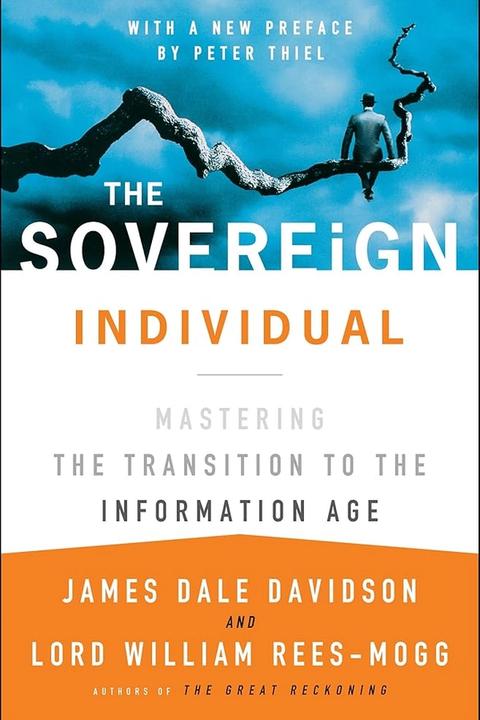
The Sovereign Individual: Mastering the Transition to the Information Age
by James Dale Davidson & Lord William Rees-Mogg
In one sentence
A roadmap for how individuals can thrive as nation-states weaken, technology decentralizes power, and society transitions into the Information Age.
Key takeaways
- The shift from industrial to information economies will radically redistribute power from governments to individuals.
- Violence, taxation, and governance will become increasingly “privatized” or decentralized through technology.
- Citizenship—once tied to geography—will become fluid, competitive, and driven by market dynamics.
- Information-age elites will be highly mobile, capital-rich, and able to choose jurisdictions that compete for their presence.
- Moral norms and institutions won’t adapt as fast as technology, causing friction, breakdowns, and power struggles.
- The future rewards individuals who stay adaptable, international, self-directed, and digitally competent.
- The biggest opportunities come from new niches created by exponential tech shifts and others’ failure to adapt.
Summary
The Sovereign Individual argues that humanity is entering one of the largest transformations in history: a shift from the Industrial Age to the Information Age. Just as the Agricultural and Industrial revolutions rewired power structures, this new era will decentralize authority and empower individuals in unprecedented ways. The authors lay out how digital technology erodes the traditional nation-state’s ability to enforce laws, collect taxes, and control citizens.
A central theme is the weakening of government monopolies. In the past, states controlled people largely through violence and taxation, made possible because individuals were tied to physical locations. But as wealth becomes digitized and people become economically mobile, governments will lose their leverage. As their power erodes, they will attempt to compensate through surveillance, regulation, and moralistic rhetoric.
The authors describe the rise of a new elite: highly skilled, globally mobile individuals who use digital tools to earn income anywhere and store wealth in jurisdictions they choose strategically. They become “sovereign” not by overthrowing governments but by slipping beyond their reach. This is a world where competition among jurisdictions replaces centralized control, and people select the rules they want to live under—much like choosing a service provider.
The book acknowledges that these transitions are chaotic. Old institutions fail faster than new ones emerge. Moral norms lag behind technology; societies experience unrest, resentment, and political extremism. But for adaptable individuals, the shift opens up extraordinary opportunities to live more freely, keep more of what they earn, and shape their own destiny in ways unimaginable in the 20th century.
Ultimately, the book is a guide for navigating this transition: understand the forces reshaping the world, abandon outdated assumptions about government and citizenship, and position yourself to thrive as power fragments and individuals reclaim autonomy.
Reflections
This book has one of the highest “idea-density to future impact” ratios I’ve ever come across. Even years after reading it, I keep returning to the core idea: technology rewires power, and most people underestimate how fast this happens until it’s already over.
A few things hit hard:
- The idea that violence and taxation rely on geography—and that digital mobility breaks this—is still underrated today.
- It made me think differently about career choices: you want skills that travel with you, income streams not tied to a single state, and leverage that doesn’t depend on permission.
- The “moral lag” point is everywhere right now—politics feels chaotic because institutions can’t keep up with technology.
- It reframed the Internet for me: not as a place to consume, but as a platform for sovereignty, mobility, and independence.
Some elements feel extreme or overly deterministic, but the mental models are incredibly useful. Even if the exact predictions don’t land, the directional insight is spot-on: more decentralization, more individual power, more optionality.
Who should read this
- Entrepreneurs who want to understand long-term geopolitical and technological trends.
- Anyone curious about how the world will change as governments lose control.
- Digital nomads or remote workers thinking about global mobility.
- Investors looking for macro frameworks beyond the typical finance world.
- People building online income streams or location-independent careers.
- Anyone who senses that old systems are breaking and wants a map of what comes next.
Favorite quotes
- The difference between ordinary people and “warriors” is that warriors treat everything as a challenge, not as fate.
- The best decision-makers aren’t defined by what they know, but by their hunger to know more.
- Most failing businesses aren’t doomed by lack of knowledge but by defending what they think they know.
- Great individuals focus obsessively on the small, boring details that compound into greatness.
- In the Information Age, power shifts from large institutions to agile individuals.
- Mobility becomes the ultimate tool of freedom.
- Taxation becomes a product citizens can choose, not a mandate they must obey.
- States will fight to preserve their power long after they’ve lost the ability to enforce it.
- The future belongs to those who adapt faster than institutions can regulate.
- Freedom expands when control becomes too expensive to enforce.
- The most dangerous thing during transitions is clinging to old assumptions.
- Fortunes are made in the gaps where others haven’t noticed the rules have changed yet.
- The individual becomes the new locus of sovereignty.
FAQ
Is The Sovereign Individual worth reading?
Yes—especially if you're interested in macro trends, technology, or personal autonomy. The ideas are bold, sometimes extreme, but incredibly thought-provoking.
What is the main message of the book?
That the Information Age will dismantle traditional nation-states and empower individuals to live more freely and independently.
Who is this book for?
Entrepreneurs, digital nomads, investors, futurists, and anyone who wants to understand how technology reshapes global power.
Is this book still relevant today?
More than ever. Many predictions about digital work, crypto-like assets, surveillance, and political fragmentation have aged remarkably well.
Is it similar to The Fourth Turning or Taleb’s work?
Yes—like The Fourth Turning, it deals with societal cycles, and like Taleb, it emphasizes power laws, unintended consequences, and decentralization.
Does the book predict cryptocurrency?
It doesn’t name Bitcoin specifically, but it predicts digital, cryptographically-secure money that erodes state power.
Is the book political?
It’s more structural than ideological. The authors discuss power, incentives, and historical cycles rather than promoting a party or agenda.
Is it too pessimistic?
Parts feel dark, but the core is optimistic: individuals gain more freedom, governments lose power, and new opportunities emerge.
Detailed Notes
Click to expand the full detailed notes →
Detailed Notes
Click to expand the full detailed notes →
Core Concepts (Key Ideas of the Book)
- The Transition to the Information Age – A global shift eroding government power and empowering individuals.
- The Decline of the Nation-State – Traditional states lose control as mobility, crypto-like assets, and digital labor expand.
- The Rise of the Sovereign Individual – Highly mobile, skilled individuals who opt out of high-tax, high-control jurisdictions.
- Geography Becomes Optional – Work, wealth, and identity detach from location; states must compete for citizens.
- Privatization of Violence & Security – Digital infrastructure reduces the need for state-monopolized coercion.
- Moral & Institutional Lag – Old norms clash with new incentives, creating instability and political shifts.
- Opportunity in Chaos – New fortunes emerge in niches others fear, misunderstand, or ignore.
CHAPTER 1 — The Transition of the Year 2000
The Fourth Stage of Human Society
- Human history has moved through three economic stages:
(1) hunter-gatherer → (2) agricultural → (3) industrial → (4) information societies. - Microprocessing will “subvert and destroy the nation-state” faster than most expect.
- Returns to large-scale violence fall; returns to small-scale violence rise → more random crime, more organized crime.
- Political authority erodes because the logic of violence changes; civic myths of the 20th-century state are collapsing.
- Collapse of morality in Western governments is a symptom of an exhausted system.
History Repeats Itself
- When technology separates old institutions from new economic forces, moral standards shift and elites lose legitimacy.
- Parallels with late-medieval Church: a dominant institution grown senile and no longer believed.
The Information Revolution
- Coercion becomes less relevant; efficiency becomes the main organizing force.
- Provinces and cities that uphold property rights cheaply will become viable sovereignties.
- A new realm arises: cyberspace, where economic activity is immune to physical violence.
- The “cognitive elite” gain unprecedented global mobility.
Prometheus Unbound — The Rise of the Sovereign Individual
- The Information Revolution liberates individuals to create their own work and capture the full benefits.
- Ideas become the main source of wealth; merit is rewarded wherever it appears.
- Financial success includes structuring your life for autonomy (“escape velocity”).
- Governments will be forced to treat citizens like customers, not subjects.
Beyond Politics — The End of Nations
- The nation-state will devolve like an unwieldy conglomerate.
- Unable to fund commitments, states resort to debasing currency—but inflation becomes impossible once cybermoney emerges.
- Local power centers reassert themselves; sovereignty fragments.
- The middle-skilled classes in rich countries become the core of neo-Luddite backlash.
- “Bandwidth trumps borders”: new jurisdictions form via affinity groups, not geography.
Merchant Republics of Cyberspace
- Non-territorial, wealthy associations—similar to Knights Templar—gain sovereignty-like powers.
- Merchant guilds and private communities re-emerge as semisovereign entities.
Violence as the Master Variable
- Understanding society requires understanding how violence pays.
- Predatory violence historically paid well; the Information Age reduces its payoff.
- Key intellectual influences: William Playfair, Frederic Lane.
Forecasting and the Hazards of Prediction
- Most future predictions fail due to lack of nerve or imagination.
- Despite uncertainty, incentives allow reliable long-term forecasts about behavior.
- Megapolitical transitions are rarely seen while happening.
CHAPTER 2 — Megapolitical Transformations in Historic Perspective
Blind Spots and Taboos
- Societies forbid thinking about their own end; this ensures transitions are invisible in real time.
- Conventional information sources will not warn you about structural change.
Learning from Rome
- Major collapses often appear as minor surface changes during the transition.
- People resist imagining that deep structures can dissolve.
Incentives and Forecasting
- Forecasting succeeds when it identifies how costs and rewards shift.
- Major transitions arise from changes in megapolitical variables, especially violence.
Major & Minor Megapolitical Transitions (Key Rules)
- Transitions unfold long before they’re recognized.
- Beginnings often coincide with falling incomes.
- Old values clash with new ones.
- Transitions antiquate existing moral frameworks.
- They are seldom popular and often chaotic.
- Technology accelerates history → less adaptive time than ever.
Four Variables That Shape Violence
- Topography — seas resist monopoly; cyberspace mirrors this.
- Climate — catalyzed agriculture; climate shifts destabilize societies.
- Microbes — immunities determined conquests; demographics shaped tolerance for death in war.
- Technology — the largest force; shifts the offense-defense balance.
Offense vs. Defense
- When offensive power rises: large governments dominate.
- When defense rises: fragmentation increases.
Equality and Weapons
- Cheap, usable weapons → equality (e.g., American farmer with rifle).
- Medieval weapons → extreme inequality (knight vs. peasant).
Economies of Scale in Violence
- Higher returns to large-scale violence → large states.
- Lower returns → fragmentation, local authorities.
Dispersal of Technology
- Hoarded tech → centralized power.
- Widely dispersed tech → sovereign fragmentation.
CHAPTER 3 — East of Eden (The Agricultural Revolution)
Agriculture: The First Great Revolution
- Farming took millennia to spread; society shifted slowly.
- Agriculture produced stationary capital → targets for theft and coercion.
Property and Violence
- Farming created private property but also created the conditions for organized theft.
- Specialization in violence begins; disputes and crime proliferate.
- Farming made both crime and government profitable.
CHAPTER 4 — The Last Days of Politics
Moral Decay as a Leading Indicator
- Corruption precedes megashifts in power.
- Disdain for political elites mirrors late-medieval disdain for church leaders.
A Secular Reformation
- Widespread contempt for governments reflects deep structural failure.
- Political systems are seen as incompetent and irrelevant.
Nation-State as an Exhausted Institution
- Returns to violence have fallen; the nation-state is now anachronistic.
- Gunpowder + printing ended the church’s monopoly.
- Information technology ends the state’s monopoly.
Downsizing the State (Like the Church Circa 1500)
- The nation-state is “impoverished, grasping, extravagant” and a drag on growth.
Industrial Revolution Began Earlier Than Textbooks Claim
- Printing press was first mass-production machine.
- Mass production and division of labor were well established by 1500.
- The real Industrial Revolution was a megapolitical transition, not merely rising incomes.
Parallel to Today
- Politics is now as saturated as religion was in the late Middle Ages.
- The Information Revolution will break the state monopoly just as gunpowder broke the church.
CHAPTER 5 — The Life and Death of the Nation-State
Democracy and Nationalism as Resource Strategies
- Berlin Wall (1989) marked the end of the Industrial Age and the decline of the nation-state.
- The nation-state required supermonopoly taxation to survive.
The Welfare State as Predatory
- Western welfare states rely on extracting global output from productive minorities.
- High-skill individuals will want escape routes; states resist letting them go.
States as Rare Historical Exceptions
- States require very specific megapolitical conditions (rising returns to violence) to survive.
- Industrialism created those conditions; the Information Age destroys them.
Magnitude > Efficiency
- Large states won because they could mobilize sheer volume of resources.
- Efficiency mattered less than brute scale.
Democracy as Government Controlled by Employees
- Democratic governments behave like employee-run monopolies:
- High costs
- Resistance to downsizing
- Chronic deficits
- Services with no relation to customer preference
- Transfer payments created “pseudo employees” who reliably vote for continued extraction.
Why Customers Could Not Control Government
- Dispersed taxpayers cannot coordinate to resist extraction.
- Elites could resist, but democracy empowered the masses against them.
- Democratic legitimacy enabled larger resource grabs.
Nationalism as a Mobilization Tool
- Nationalism lowered the cost of mobilizing mass armies.
- It was invented to solve bureaucratic and military problems.
End of Mass Democracy
- As returns to violence fall, the foundations democracy rested on disappear.
- Welfare states will face crises as promises deflate and credit runs out.
CHAPTER 6 — The Megapolitics of the Information Age
Efficiency Over Power
- Information technology blunts the dagger of violence.
- Assets can now be created outside the reach of coercion.
Complexity and Distributed Systems
- Complex systems evolve without central authority.
- Markets and digital networks depend on dispersed capabilities.
Why Unions Rose — and Why They Will Die
Industrial Age conditions that empowered unions:
- High natural-resource dependence
- Large-scale factories
- Few competitors
- Massive capital requirements
- Huge workforces in a few firms
- Blue-collar dominance
- Sequential assembly lines
- Standardized, non-variable work
Information Age reverses every one of these:
- Mobility of people/capital
- Small firm size
- Many competitors
- Low startup capital
- Dispersed employment
- Short product cycles
- Non-sequential, networked work
- Variable output → variable income
Hyper-Individualized Work
- Microprocessing creates “intelligent tools” → automation replaces unskilled labor.
- One individual can act through dozens or thousands of digital agents.
- Individuals can retaliate digitally even after death → reshapes logic of violence.
Government as Protection Racket
- Government mixes protection and extortion.
- Historically, a local monopoly minimized violence costs.
- In cyberspace, monopoly becomes impossible → sovereignty unbundles.
Non-territorial Governance
- Political theorists foresee “government à la carte.”
- Bandwidth undermines territorial boundaries.
The Law of the Telecosm
- As bandwidth grows exponentially, borders lose meaning.
- Patriotism becomes less useful; global affinity replaces national identity.
The Fifth Stage of Violence Organization
- Lane’s four historical stages → we now enter a fifth:
cyberspace competition with no territorial monopoly.
Competition Without Anarchy
- Cyberspace creates protection without territorial violence.
- Transactions will migrate to jurisdictions offering best protection at lowest cost.
- Sovereignty becomes a commercial service.
Virtual War
- Cyberspace allows individuals or small firms to rival nation-states in cyberwar capability.
- Large-scale systems are vulnerable; cyberspace is resilient.
Chapter 7 – Cybercommerce, Cybercash & the Death of Seigniorage
Core idea:
The Information Age creates a new, mostly untaxable digital economic zone—cybercommerce—where encrypted money (“cybercash”) and mobile capital undermine nation-states’ power to tax, inflate, and control.
Key concepts:
- True cybercommerce stage
- Transactions move fully onto the Net, outside traditional jurisdiction.
- Payments are made in cybercurrency, stored in cyberbanks, invested via cyberbrokerages.
- Many transactions slip outside normal taxation; extraterritorial regulatory power collapses.
- Microsurgery & global markets for skill
- Skills (like top-level microsurgery) are unevenly distributed: 1/3 fail, 1/3 adequate, 1/3 excellent.
- In an information-rich world, patients (or their digital agents) can quickly compare outcome stats globally.
- The best surgeons get a much larger share of the global market, doing more operations remotely.
- This is a template for many fields: elite talent goes global, mid-tier talent is squeezed into residual local markets.
- Black magic of compound interest & tax drag
- Paying $5,000/year in tax for 40 years at a 10% return costs you around $2.2M of lost wealth.
- At 20% returns, that’s ~$44M in lost wealth—taxes function as a huge negative compounding force.
- For high earners in high-tax countries, lifetime tax losses often exceed everything they’ve accumulated.
- From monopoly to competition in “protection”
- Historically, states had a monopoly on “protection services,” often low quality and overpriced.
- With coercive power monopolized, governments could ruthlessly raise taxes on anyone able to pay.
- Cybercommerce introduces competition: you can route activity through friendlier jurisdictions.
- Encryption as the great enabler
- Strong encryption protects transactions and assets at virtually zero marginal cost.
- For “$55 instead of $55 million,” you can get better protection of your assets than in any previous era.
- This undermines the state’s ability to see, tax, or seize.
- Death of seigniorage
- Historically, rulers profited by controlling money: coinage, then print money, then inflation.
- The Information Age introduces cybermoney, which:
- Is likely denationalized, potentially gold-linked or tied to other hard assets.
- Can be instantly shifted out of any depreciating national currency.
- This kills the state’s ability to silently expropriate via inflation (i.e., seigniorage).
- Cybercash basics
- You pay for almost any online transaction at the moment of purchase with cybercash.
- Money becomes fluid across borders, not tied to any state’s paper.
- Governments that rely on inflating their currency lose their favorite stealth tax.
- Barter becomes more practical
- Digital money reduces frictions across Hayek’s “continuum of liquidity.”
- You can denominate value in whatever you want—gold, services, non-national units.
- Barter-like exchanges become smoother because the system can match and price them digitally.
- No counterfeiting, better stores of value
- High-value transactions migrate to private, digital, and possibly gold-linked money, not government paper.
- Gold’s long-term constancy vs. fiat currencies is used as proof that depreciation is not “inevitable.”
- End of inflation as we know it
- Digital, hard money removes inflation as a hidden tax.
- Issuers of new private money will charge an explicit fee (e.g., ~1%/year) instead of stealing via inflation.
- Compared to 2.7–99% inflation, this fee is a massive improvement for savers.
- Transition crisis & higher interest rates
- Governments lose tax/inflation revenue but keep giant welfare and pension promises.
- This leads to a fiscal crisis, a one-time spike in real interest rates, and deleveraging.
- To compete with cybercurrencies, some states may:
- Offer higher real yields.
- Tighten credit.
- Even remonetize gold to keep their currencies attractive.
- Yield gap in early stages
- Cybermoney may pay lower interest and charge explicit fees.
- National currencies might initially yield more—but at the cost of inflation and political risk.
- Gold likely appreciates in deflationary adjustments as liquidity tightens.
- Investor control over capital
- As government redistribution collapses, capital shifts to able investors and entrepreneurs, not politicians.
- Hundreds of billions move into the hands of Sovereign Individuals who deploy resources more productively.
Chapter 8 – The End of Egalitarian Economics
Core idea:
The Information Age destroys the economic basis for egalitarian, nation-state-driven redistribution and massively increases earning disparities based on talent and mobility.
Key concepts:
- World without jobs (as we know them)
- Location matters less; digital markets matter more.
- Organizations tied to geography—governments, unions, localized professions—lose importance.
- Superstar effects across fields
- Earnings distributions increasingly resemble sports and opera:
- A few at the top earn outsized returns.
- Middle talent earns much less as they compete globally.
- Earnings distributions increasingly resemble sports and opera:
- Shifting locational advantages
- No more “rising returns to violence” → no big advantage in living under highly militarized states.
- High taxes and heavy regulation in advanced welfare states make them unattractive to global talent.
- Poorer or previously underdeveloped jurisdictions gain relatively more by opening up and competing.
- Government as the key non-exportable factor
- Olson’s point: poor countries couldn’t import competent government.
- Colonial empires once exported governance, but technology made empire too costly and resistance cheaper.
- Now, instead of importing good government, jurisdictions compete to attract mobile capital and talent.
- Commercialized sovereignty
- Sovereignties become more like competitive service providers than monopolistic rulers.
- Policies must please high-value residents/customers, not just voting blocs or transfer recipients.
- The old logic—subsidize undesirable outcomes, punish success—is unsustainable under jurisdictional competition.
- Death watch for nation-states
- Large, indebted welfare states are especially fragile.
- Countries like Canada, Belgium, Italy, with high debts and separatist movements, are early candidates for fragmentation.
- Regions with rising incomes and lower debt may stay coherent longer.
- No customs house in cyberspace
- Information cannot be blocked like physical goods; protectionism becomes less effective.
- Small regions no longer need big political unions to access markets.
- Price anomalies disappear
- Information flow kills local price bubbles; people shop and compare across borders.
- Remote services help arbitrage insurance, financial products, and complex offerings.
- Cities and viability
- Cities matter if their core residents are richer than their periphery.
- Global hubs like London, Paris, Buenos Aires may endure; weaker second-tier cities hollow out.
- Hollywood & synthesis over memorization
- Memorization becomes a low-value skill; synthesis and creative application matter more.
- Culture and soft power (“Hollywood,” English, global media) drive alignments beyond borders.
Chapter 9 – Nationalism, Reaction, and the New Luddites
Core idea:
As nation-states weaken, there will be a fierce, often reactionary backlash from those who lose out—fueling nationalism, hostility to globalization, and neo-Luddite attacks on technology.
Key concepts:
- Nationalism as a modern construct
- Loyalty to “nation” is historically recent; older loyalties were to tribe, religion, empire, or local rulers.
- Nationalism is an “imagined community” whose foundations are eroding with the Information Age.
- The Great Transformation
- The shift away from the nation-state paradigm will trigger crisis, not smooth reform.
- Old beliefs about “nation” and political entitlement clash with new economic realities.
- Expected nationalist reaction
- Losers of the transition: those with middling skills, declining incomes, and high expectations of state support.
- Their reaction includes:
- Opposition to globalization, free trade, foreign ownership.
- Hostility to immigration.
- Resentment of information elites and capital flight.
- Attempts to halt regional and individual secession.
- Neo-Luddites
- Technology becomes the villain: blamed for job loss, inequality, and cultural disruption.
- Attacks on information tech mirror historical Luddite attacks on machinery.
- Where reaction is strongest
- Rich countries with strong welfare states and large “left-behind” populations.
- Especially middle-class groups with credentials but declining market value—not the very poor, not the true elite.
- Collapse of the welfare-state bargain
- People who grew up expecting government redistribution continue demanding it even when it’s no longer viable.
- Long, painful learning curve as populations realize they can’t force high earners to stay and pay.
- Nationalism vs. genetic/kinship logic
- Nationalism hijacks kinship instincts (family, tribe) but applies them to groups so large that actual genetic relatedness is negligible.
- Sacrifice for such huge “in-groups” has almost no effect on your real kin’s survival—it's a misfiring of ancient instincts.
- Language and fragmentation
- Language both builds and fractures states (e.g., Czech vs. German in Prague).
- Multilingual states like Belgium and Canada are especially prone to separatism.
- Internet and rock & roll English
- The Net and global media weaken localized national identities, shifting commerce and culture into English.
- New affinities: online communities and interest groups instead of national tribes.
- Bogus kinship and nationalism’s tricks
- States use family language: “motherland,” “our people,” “brothers and sisters.”
- This taps deep psychological drives but is often used to justify sacrifice and obedience.
- Exiting the nation-state
- Information elites will domicile income, assets, and residence in different jurisdictions.
- Citizenship becomes an increasingly bad deal compared to being a mobile, negotiating “customer.”
- Most political agendas become reactionary
- Right, left, environmental, socialist—many will defend the nation-state because it’s the platform for political power.
- Nationalist content swells inside almost all political programs.
Chapter 10 – The Twilight of Democracy
Core idea:
Democracy thrived under Industrial Age conditions because it maximized the state’s ability to mobilize resources. As that logic fades, democracy becomes less viable and more extractive, and governance shifts toward competitive, contractual, non-democratic forms.
Key concepts:
- Democracy as the “fraternal twin of Communism”
- Both are mechanisms to aggregate resources for large-scale state projects (especially military).
- Democracy was more effective than Communism at enriching the state, because it tolerated private ownership and capitalist productivity.
- Efficiency where it counted—for the state
- Welfare democracies can be more efficient than state socialism at generating taxable surpluses.
- But compared to laissez-faire enclaves like colonial Hong Kong, they’re still highly inefficient for individuals.
- Hong Kong as a model
- No democracy, but:
- Very low taxes.
- High growth.
- Residents keep ~85% of the gains from growth.
- Defended externally, so no need for large military or heavy taxation.
- No democracy, but:
- End of mass democracy
- Democracy is the political expression of mass production and mass society.
- As mass production gives way to information industries and niche markets, mass democracy loses its megapolitical rationale.
- Fragmented, privatized jurisdictions
- Examples like Agulhas Bay Free Zone and Central Aguirre Zona Franca:
- Private companies administer law, security, and commercial rules.
- Local taxes and regulations are largely suspended.
- Disputes go to international arbitration, not national courts.
- These are prototypes for future private city-states and free zones.
- Examples like Agulhas Bay Free Zone and Central Aguirre Zona Franca:
- Performance-based politics (thought experiment)
- Paying legislators on commission (e.g., tied to growth of after-tax per capita income) would radically change incentives.
- This idea hints at governance as a service rather than a political career.
- Megapolitics over opinion
- Institutional change is driven more by technology and cost/benefit shifts than by voters’ preferences.
- Feudalism gave way to the nation-state not because of ideas alone, but because of changes in the tools of violence, communication, and production.
- Similarly, the Information Age will obsolete The Prince–style statecraft.
- Firms under pressure
- Coase’s question—“Why are there firms?”—is answered by transaction and information costs.
- As those drop, firms lose their reason to exist; markets handle more coordination.
- Expect:
- More independent contractors.
- Short-lived or virtual firms.
- Less lifetime “employment,” more project- and contract-based work.
- No “rule by corporations”
- As information tech enables global price discovery and competition, corporations themselves are under assault.
- Most large firms struggle to survive in a world of global, low-friction markets.
- Infrastructure privatization
- With digital tolling and congestion pricing, roads, airports, etc., can be privatized and efficiently priced.
- This adds real GDP and reduces waste from mispriced “public goods.”
Chapter 11 – Morality and Crime in the “Natural Economy” of the Information Age
Core idea:
As nation-states weaken and their monopolies break down, we’ll see both rising organized crime and a renewed premium on personal morality, reputation, and trustworthiness—especially in anonymous digital environments.
Key concepts:
- End of era = peak corruption
- As old systems decay, elites mix public office with private criminality.
- Social ethos disintegrates; rules are honored in the breach.
- Breakdown of monopolies → rise of competitors
- Governments are “protection rackets with legitimacy.”
- When their monopoly weakens, organized crime, gangs, and cartels fill vacuum areas.
- Information glut → higher value of judgment
- Three main reasons:
- Too much information → demand for brevity → oversimplification and misunderstanding.
- Paradigms change faster → old mental models break quicker.
- Tribalization and fragmentation stunt discourse and thinking.
- Three main reasons:
- Moral ecology and economic success
- Strong, shared morality (self-reliance, honesty, responsibility, high savings) correlates with development.
- Examples: Jews, Quakers, Puritans, Mormons.
- Quaker business ethics (trustworthiness, fair value, modest living) were both moral and highly profitable.
- Cycle: poverty → wealth → luxury → decadence
- Adam Ferguson’s sociological cycle: success erodes the very virtues that created it.
- Prosperity tends to undermine discipline and shared morality.
- Requirements for a “good” social morality
- Strong but not rigid; dynamic but not relativist.
- Encourages survival and cooperation, not murderous competition.
- Tolerant, adaptable, economically efficient.
- Widely shared and deeply held, often anchored in religion.
- Lockean core
- Universal moral minimalism:
- Don’t kill.
- Don’t steal.
- Protect life, liberty, and estate.
- Strong states often become the main violators of life and property (wars, expropriation).
- Universal moral minimalism:
- Distorted moralities
- Both rigid fundamentalism and shallow political correctness damage social cohesion.
- Overconfident, self-righteous moralism can be as destabilizing as pure relativism.
- Moral regression
- Despite scientific progress, we may have regressed morally compared to older traditions.
- Modern elites often lack deep moral and religious formation.
- Family & moral formation
- Stable families transmit moral codes; fractured families plus weak religion → confused moral baseline.
- Reputation in the cybereconomy
- Honesty becomes a critical economic asset.
- Digital anonymity means identity and reputation are carried via cryptographic keys and verified histories.
- Redistribution and global aid as moral mistake
- Foreign aid and interventions often:
- Distort local incentives.
- Encourage overpopulation beyond local carrying capacity.
- Foster cultural relativism and undermine necessary adaptation.
- Foreign aid and interventions often:
- Needed morality for the Information Age
- Must support:
- Individual responsibility.
- Respect for property and contracts.
- Tolerance.
- Adaptation and long-term thinking.
- It becomes a crucial foundation for digital, decentralized prosperity.
- Must support:
Afterword – Devolution & the Law of Diminishing Returns
Core idea:
Human history has tended toward complexity and centralization, but the Information Age reverses this; bloated systems (like large nation-states) will collapse, and smaller, coherent, historically grounded structures will thrive.
Key concepts:
- Complexity has historically increased, but now:
- Centralization shows diminishing returns.
- Overgrown systems “bloat and rot,” then collapse.
- Information technology enables:
- Smaller, more coherent units.
- Fragmented sovereignty.
- Exit as a primary strategy (“Of all 36 ways to get out of trouble, the best is—leave”).
- Practical implication:
- Redeploy capital and self toward jurisdictions where you’re a customer, not a subject.
- Negotiate tax and legal relationships where the price of governance matches its value to you.
Appendix – Resources for Achieving Independence
Core idea:
The book ends not just with theory but with concrete pointers to offshore finance, trusts, and structures enabling sovereignty in practice.
Key concepts:
- Offshore financial infrastructure
- Brokerage and investment banking through offshore firms (e.g., Lines Overseas Management).
- Offshore trusts and corporate services (e.g., St. George’s Trust):
- Asset protection.
- Estate planning.
- Overcoming political risk, exchange controls, forced heirship.
- Maintaining control while shielding assets.
- Emphasis on:
- Multi-jurisdictional setups (residence, banking, entity incorporation all separated).
- Long-term, conservative asset protection over speculative risk.
- The need for both boldness and caution in building and preserving wealth.