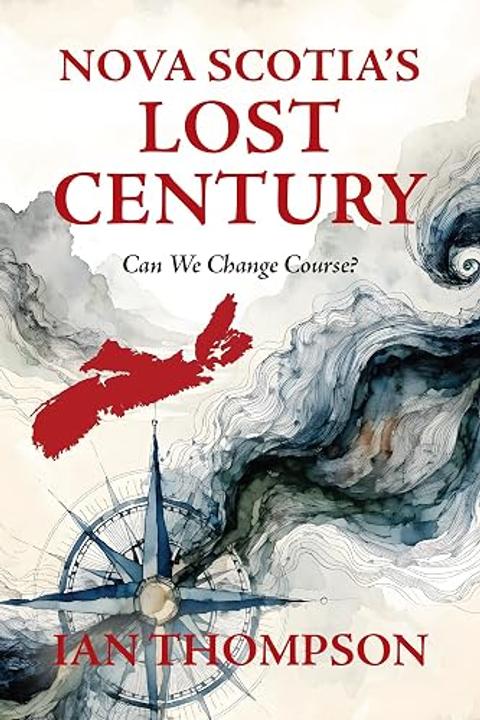
Nova Scotia's Lost Century
by Ian Thompson
Why read this book
- It connects Nova Scotia's economic history with the choices we face about investment, talent and growth.
- Its account of paddling success offers a useful example of how a community can develop lasting excellence.
- It makes an affirmative case for the province's future, while leaving plenty of questions worth investigating.
In one sentence
Ian Thompson argues that Nova Scotia can leave a century of relative decline behind by expecting more of itself and building a more ambitious economy around the ocean.
Key takeaways
- Expectations influence what people attempt. Thompson wants Nova Scotians to regard success as something they can create here.
- Cheema's paddling record connects confidence with access to strong techniques, sustained improvement and a willingness to change established practices.
- Thompson sees provincial decline as a combination of outside disadvantages and choices made at home. His history moves between federal policy, local decisions and public attitudes.
- Major projects can create capabilities beyond the project itself, through suppliers, training and research institutions.
- Public campaigns can help people see an economic project as something they have a stake in. That is separate from proving a campaign changed a procurement decision.
- The ocean opportunity includes science, instruments, software and services, as well as fisheries and natural resources.
- My main question after reading was how to turn that ambition into a repeatable process: what should we do, who should do it, and how will we know it worked?
Summary
Thompson presents Nova Scotia as a province that once traded confidently with the world, lost economic ground, and became too accustomed to decline. He traces that experience through Confederation, industrial change, federal policy, outmigration and decisions by provincial and municipal governments.
He also argues that Nova Scotians sometimes make growth harder themselves. Resistance to change, suspicion of successful people and difficulty approving new businesses recur throughout the book. He contrasts those habits with examples of people and institutions that set higher expectations and succeeded.
The second half turns toward renewal: population growth, business investment, shipbuilding, the province's pandemic response and outstanding hockey players. The conclusion brings these examples together around the ocean. Thompson wants Nova Scotia to become a leading centre of ocean science and technology, attracting people and investment from around the world.
I agree with the sentiment. We should encourage ambition, celebrate success and create more reasons for talented people to build their lives here. I wanted the book to go further in explaining how its successful examples could guide the next set of decisions.
Reflections
I enjoyed reading the book, and I recommend it to Nova Scotians and other Maritimers. We need more people calling for higher expectations, greater confidence and economic opportunity here.
The paddling section stood out because it came closest to describing how excellence develops. Coaches learned abroad, changed training and worked with volunteers to improve facilities. It still left me wanting more detail, but it suggested a process we could learn from.
I also liked reading more of the province's history. At times, I wanted a clearer timeline and stronger connections between the stories. The movement between historical periods, public policy and sporting success made the overall argument harder to follow than it needed to be.
The shipbuilding campaign suggested something worth trying again: rallying people around major economic opportunities. A campaign can help create public enthusiasm even when its influence on the formal selection process is unclear. My full review discusses the competition and that distinction in more detail.
The hockey and COVID sections left me with more questions. What produced the hockey success, and which lessons transfer to other activities? How should we compare the pandemic's health and economic outcomes with other places? I also wanted more assessment of progress since the Ivany report.
I agree that the ocean should be a major focus. The question for me is how we become a leading ocean economy: where our advantages are strongest, what comparable places have achieved and which investments would help our businesses grow. I explored those questions in Where Nova Scotia’s ocean opportunity lies.
My main reservation is that the call for change is more developed than the explanation of how to achieve it. We lose too many people to opportunities elsewhere. I want us to create more success here, and to understand well enough how it happens that we can keep doing it.
Who should read this
- Nova Scotians and other Maritimers interested in the region's history and economic future.
- People involved in business, education, research or public policy who want a more ambitious provincial conversation.
- Readers looking for a starting point for further investigation. This is an argument for change with illustrative stories, rather than a comprehensive economic development plan.
Favorite quotes
- “We sustained unwinnable fights at the expense of opportunities not taken.”
- “We’ve taught aquaculture investors to go elsewhere.”
- “Prosperity comes from innovation, confidence, hard work, risk taking, competitive zeal and ambition.”
FAQ
What is Nova Scotia's Lost Century about?
Ian Thompson examines the province's relative decline and argues that confidence, ambition and ocean industries can help create a more prosperous future.
What is the book's main recommendation?
Thompson wants Nova Scotia to pursue global leadership in ocean science and technology, supported by a stronger provincial commitment to growth.
Is this a chronological history?
It includes substantial history, but moves between historical episodes, policy arguments and contemporary examples of success.
Do I recommend it?
Yes, particularly to Nova Scotians and other Maritimers. I agree with its call for greater ambition, while wanting more detail about how to produce the results it advocates.
Detailed Notes
Click to expand the full detailed notes →
Detailed Notes
Click to expand the full detailed notes →
Core concepts
Excellence can become a local tradition
Cheema is a sprint canoe and kayak club in Waverley, Nova Scotia. Thompson describes success that continued over decades rather than depending on one exceptional athlete. Frank Garner taught fundamentals in team boats before moving paddlers into smaller crews and singles. He visited Hungary to learn from its coaches, and Scott Logan later did the same. Logan pushed for year-round training and full-time coaching; volunteers raised money for the facilities that a later Hungarian coach, Laszlo Latorovszki, said the club needed.
What interested me was the possibility of building that kind of system elsewhere. Encouragement matters, but so do the people, facilities, training and standards that make improvement possible. I would have liked more detail about those arrangements and how they were sustained.
Decline can shape expectations
Thompson's history describes a province losing businesses, people and influence. His concern is that an understandable awareness of past losses can become a habit of expecting little from the future.
How much effort goes into defending what remains, and how much goes into creating something new?
Local decisions have lasting costs
The Halifax redevelopment chapter describes housing demolition and displacement. Thompson uses it to show that decline was not only imposed from elsewhere: local decisions could damage the places and communities they were intended to improve.
His broader discussion of regulation makes a related argument about opportunity costs. Rejecting or delaying an investment also has consequences, even when those consequences are less visible than the risks of approving it.
Large projects can develop skills and institutions
Shipbuilding is more than work inside a shipyard in Thompson's account. He connects it to supplier spending, training and the growth of ocean-related institutions, including COVE.
I would want to know what workers learn, what smaller firms become able to do and whether the resulting capabilities can serve other customers.
Confidence needs something to build on
The book's strongest examples connect ambition with practical resources. Paddlers need training, shipbuilders need skills and facilities, and ocean companies need research, testing and buyers.
Confidence can help people attempt those things. Understanding the mechanisms is what would let us repeat the success.
Chapter notes
Chapter 1: Cheema proves we can be champions
Thompson opens with paddling as an exception to the province's wider record of economic disappointment. He describes a culture in which people believed they could compete with the best and learned the techniques needed to do so. The persistence of that success matters as much as any individual medal.
Chapter 2: Confederation's broken promises
The chapter contrasts Nova Scotia's earlier commercial energy with its experience within Confederation. Thompson discusses representation, trade, transport and the loss of regional businesses. His interpretation emphasizes decisions that favoured larger provinces and weakened the Maritimes' position.
Chapter 3: Halifax the horrible
The wartime and postwar discussion connects Halifax's experience of the Second World War with the distribution of investment afterward. Thompson uses it to continue his argument that national policy did not serve every region equally.
Chapter 4: A slum clearance “own goal”
Thompson describes the demolition of Halifax housing, displacement of residents and the failure to replace accommodation quickly enough. The episode complicates a story that might otherwise place responsibility entirely on Ottawa. Local governments also made choices with long consequences.
Chapter 5: The dead elephant in the room
Outmigration, a weak private economy and dependence on government sit alongside questions about health, education and opportunity. Thompson links prosperity to everyday living conditions, rather than treating economic growth as an abstract number.
Chapter 6: Have nots who wouldn't say “yes”
This chapter ranges across resource development, aquaculture, energy, income support, municipal government and education. Thompson sees repeated reluctance to change arrangements that are delivering poor results.
His proposals include a guaranteed-income trial, fewer barriers between provincial markets and changes to how government delivers services. Education gets particular attention: he wants schools judged by what students learn, and describes a local education company struggling to secure a pilot in its home province.
Chapter 7: Tall poppies and a few brave exceptions
Thompson examines attitudes toward successful people and businesses. The tension is between wanting better economic outcomes and distrusting the people trying to build substantial companies. He argues that large companies bring research spending, export sales and work for smaller suppliers. My essay on big business and competition in Atlantic Canada explores how to encourage that investment while keeping room for new firms.
He also describes the political costs faced by premiers who closed failing operations or changed established practices.
Chapter 8: The great turnaround begins
The book turns toward signs of renewed confidence, population growth and investment. His examples include COVE's shared waterfront facilities, Sandpiper's investment in founders and Protocase's fast custom manufacturing. They show several ways to build businesses here that sell beyond the province. Thompson also revisits earlier warnings that complacency and low expectations could hold the province back.
Chapter 9: Ships start here, again
The shipbuilding campaign is both an economic story and a story about public participation. Thompson describes the work of reaching existing networks, generating enthusiasm and giving people a common project to support.
Thompson recalls employers who worried that an Irving win would make workers harder to hire at existing wages. As deputy minister, he wanted Nova Scotians to gain skills and earn more through more productive work. That tension between an employer's costs and a worker's opportunities was one of the more interesting parts of the account. He also describes the training and marine technology investment associated with shipbuilding.
Chapter 10: COVID-19
Thompson presents the province's response as evidence that Nova Scotians can cooperate and meet a major challenge. He praises health outcomes and Halifax's recovery. For me, the next step is a fuller comparison of outcomes, costs and the conditions that helped produce them.
Chapter 11: Hockey
Exceptional Nova Scotian players provide another example of achievement at the highest level. I wanted more explanation of why that success emerged and what, beyond encouragement, could be applied elsewhere.
Chapter 12: No more playground
The conclusion urges Nova Scotia to see itself as a place of production, research and innovation. Thompson names ocean businesses and institutions already operating here and argues for a much larger ambition.
He places particular weight on talent, technology and risk-taking. The opportunity extends beyond extracting more resources: companies can develop knowledge and products that serve customers around the world.