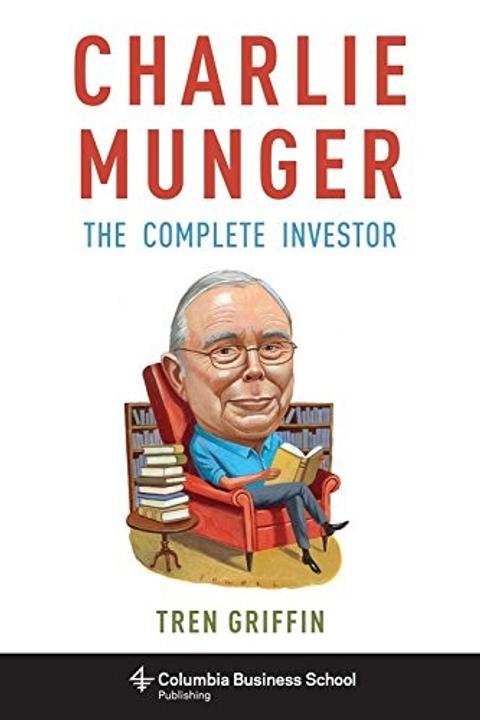
Charlie Munger: The Complete Investor by Tren Griffin: Summary & Notes
by Tren Griffin
In one sentence
Tren Griffin’s organized framework of Charlie Munger’s investing approach — Ben Graham value investing principles, the psychology of misjudgment, and what makes a business worth owning.
Key takeaways
Griffin organizes Munger’s approach around three elements: principles, the right stuff, and variables — built on Ben Graham’s four foundational rules of value investing: treat a stock as ownership of a business, buy with a margin of safety, treat Mr. Market as a servant rather than a master, and stay rational and objective.
The book catalogs 25 documented “tendencies” in the psychology of human misjudgment — from reward-and-punishment superresponse to social proof to the “lollapalooza” effect, where multiple biases compound and the result is bigger than the sum of its parts.
Griffin lays out the traits of “the right stuff” in an investor: patient, disciplined, calm but courageous, reasonably (not overconfidently) intelligent, honest, long-term oriented, studious, and frugal.
Seven variables define the Graham system in practice: intrinsic value, margin of safety, circle of competence, position sizing (a focused ~10 holdings, not hundreds), when to sell (almost never), how much to bet when odds favor you, and whether business quality matters as much as price.
A durable moat has five possible sources: supply-side economies of scale, demand-side network effects, brand, regulation, and patents or IP — and Munger and Buffett generally buy moats rather than try to build them.
Capital allocation is described as an investor’s number one job, which is why the book keeps circling back to a small number of concentrated, high-conviction bets held for a long time rather than broad diversification.
The book draws a clean line between Ben Graham’s analytical, bottom-up value investing and Fama and French’s statistical “value factor” investing — two different questions being asked about the same word, “value.”
Summary
I read this in 2019 and gave it an 8/10.
Tren Griffin isn’t Munger himself here — he’s built his own organized framework around Munger’s investing philosophy, structured as principles, the right stuff, and variables.
Where Poor Charlie’s Almanack is the raw material — Munger’s own speeches and writings on everything from worldly wisdom to old age — this book stays focused on the investing mechanics: the four Ben Graham principles, the psychology of misjudgment, and what actually makes a business defensible.
Reflections
The psychology-of-misjudgment list is the part I come back to most. Twenty-five tendencies is a lot to hold in your head at once, but a handful of them — social proof, doubt-avoidance, incentive-caused bias — show up constantly, not just in investing decisions but in ordinary judgment calls. Having names for them makes it easier to catch yourself mid-mistake.
The four Ben Graham principles are almost deceptively simple written out — own the business, buy with a margin of safety, treat the market’s mood swings as an opportunity rather than a signal, stay rational — and the book’s real value is in how relentlessly it holds those four ideas up against everything else. Most of investing turns out to be discipline in applying a small number of simple ideas, not discovering new ones.
The moat framework (scale, network effects, brand, regulation, patents) is a genuinely useful checklist for thinking about any business, not just one you’re buying stock in. The Wrigley’s-versus-Glotz’s-gum point about brand as an informational shortcut has stuck with me longer than I expected it to.
Who should read this
- Value investors who want Ben Graham’s principles and Munger’s psychology of misjudgment organized into one coherent framework rather than scattered across speeches.
- Anyone who read Poor Charlie’s Almanack and wants the more systematized, investing-specific version — this strips out the general worldly-wisdom material and focuses on the mechanics of picking and holding businesses.
- Investors trying to get more disciplined about position sizing, moats, and when (rarely) to sell.
- Readers who want a primer on the difference between analytical value investing and statistical “value factor” investing before going deeper into either.
Favorite quotes
“The best thing a human being can do is help another human being know more.” — Charlie Munger, Berkshire Annual Meeting, 2010
“Our standard prescription for the know-nothing investor with a long-term time horizon is a no-load index fund.” — Charlie Munger
“The function of the margin of safety is, in essence, that of rendering unnecessary an accurate estimate of the future.”
“Three things ruin people: drugs, liquor, and leverage.” — Charlie Munger
“How do you compete against a true fanatic? You can only try to build the best possible moat and continuously attempt to widen it.” — Charlie Munger, Poor Charlie’s Almanack, 2005
FAQ
How is Charlie Munger: The Complete Investor different from Poor Charlie’s Almanack?
Poor Charlie’s Almanack is the original compiled collection of Munger’s own speeches and writings, covering his broader worldly wisdom — mental models, philosophy, education, even advice on old age. The Complete Investor is Tren Griffin’s own organized analytical framework built specifically around Munger’s investing approach: Ben Graham’s four principles, the psychology of human misjudgment, the right stuff in an investor, and the variables and moats that determine a good investment. If Poor Charlie’s Almanack is the primary source, this is the investing-focused study guide built on top of it.
What are Charlie Munger’s 25 psychological tendencies?
Griffin catalogs 25 documented tendencies in what Munger calls the psychology of human misjudgment — patterns like reward-and-punishment superresponse tendency (misaligned incentives), liking/loving tendency (ignoring the faults of people we love), doubt-avoidance tendency, social-proof tendency (following the herd), deprival superreaction tendency (loss aversion), availability-misweighing tendency, and the lollapalooza tendency, where several biases compound at once and produce an effect much larger than any one alone. The full list runs to 25; the book treats them as a practical checklist for catching your own bad judgment before it costs you money.
What is the Ben Graham value investing system?
It rests on four principles: treat a share of stock as proportional ownership of a real business, not a ticker symbol. Buy at a meaningful discount to intrinsic value so you have a margin of safety. Treat the market’s manic-depressive mood swings (personified as “Mr. Market”) as your servant, not your master — an opportunity to buy low and sell high rather than a signal to follow. And stay rational, objective, and dispassionate rather than getting swept up in sentiment. Warren Buffett and Charlie Munger built Berkshire Hathaway on this foundation.
What makes a durable moat according to Munger?
The book lists five sources of a defensible competitive moat: supply-side economies of scale or scope, demand-side economies of scale (network effects), brand (the informational shortcut a trusted brand gives customers), regulation that limits competition, and patents or other intellectual property. Munger and Buffett’s general approach is to buy businesses that already have a moat and talented management in place, rather than trying to build a moat themselves.
What are the seven variables in the Graham value investing system?
Griffin frames the practical side of value investing as seven questions an investor has to answer: how do you determine intrinsic value, how much margin of safety do you require, what is your circle of competence, how much of any one security should you buy (Munger and Buffett favor a focused portfolio of around ten holdings rather than the “closet indexing” of owning a hundred-plus), when do you sell (almost never — long holding periods are themselves a competitive advantage), how much do you bet when odds are mispriced in your favor, and does business quality matter as much as price.
What is "the right stuff" an investor needs, according to this book?
Griffin lists a set of traits: patient, disciplined, calm but courageous, reasonably intelligent without being overconfident about it (Buffett’s line is that past roughly 120-130 IQ points, you can afford to give the rest away), honest, confident and nonideological, long-term oriented, passionate, studious, collegial, even-tempered, frugal, and risk averse. The book’s point is that temperament matters more than raw intelligence in investing outcomes.
Is Charlie Munger: The Complete Investor worth reading?
I read it in 2019 and rated it 8/10. If you want Munger’s investing philosophy specifically — not his broader worldly wisdom — organized into a clear framework of principles, psychology, and variables, this does that well. It’s a good companion to Poor Charlie’s Almanack rather than a replacement for it.
Detailed Notes
Click to expand the full detailed notes →
Detailed Notes
Click to expand the full detailed notes →
Introduction
“The best thing a human being can do is help another human being know more.” — Charlie Munger, Berkshire Annual Meeting, 2010
Griffin organizes the whole book around three elements: principles, the right stuff, and variables. The principles come straight from Ben Graham’s value investing system — four fundamental rules that Munger and Buffett built their entire approach on:
- Treat a share of stock as a proportional ownership of the business, not a ticker to trade.
- Buy at a significant discount to intrinsic value to create a margin of safety.
- Make a bipolar “Mr. Market” your servant rather than your master.
- Be rational, objective, and dispassionate.
The Basics of the Graham Value Investing System
“Simplicity has a way of improving performance through enabling us to better understand what we are doing.” — Munger & Buffett
“Our standard prescription for the know-nothing investor with a long-term time horizon is a no-load index fund.” — Munger
One of the clearer distinctions the book draws is between gambling and investing. An investment is net-present-value-positive — you’re putting money into something that should be worth more later. Gambling is present-moment consumption with negative long-term expected value. Confusing the two is one of the more common and expensive mistakes investors make.
The Principles of the Graham Value Investing System
The book elaborates on the four principles above. The number one idea, repeated throughout, is to view a stock as ownership of the business — not a number that moves on a screen. Margin of safety gets defined precisely: “a favorable difference between price... and appraised value.” Its function isn’t to make your valuation more precise — it’s the opposite:
“The function of the margin of safety is, in essence, that of rendering unnecessary an accurate estimate of the future.”
On the Mr. Market metaphor — the market as a moody business partner who shows up every day offering to buy or sell at wildly different prices depending on his mood — the operating rule is simple:
“Be fearful when others are greedy, and be greedy when others are fearful.” — Buffett
Worldly Wisdom
“What is elementary, worldly wisdom?... If the facts don’t hang together on a latticework of theory, you don’t have them in a usable form.” — Munger, USC Business School, 1994
The book argues that understanding disciplines outside of finance — biology, psychology, chemistry, physics, history, philosophy, engineering — makes you a better investor, because business problems don’t respect the boundaries between academic departments. Munger’s complaint about most investors is a lack of range, not a lack of diligence within their narrow lane:
“People calculate too much and think too little.” — Munger
The Psychology of Human Misjudgment
This is the section I’ve gone back to most. Griffin catalogs 25 documented tendencies that distort human judgment — not as abstract psychology, but as a practical checklist for catching your own bad decisions before they cost you money. A few of the most useful:
- Reward and Punishment Superresponse Tendency — misaligned incentives (a commission-driven advisor, for instance) reliably cause problems, because people respond to how they’re paid, not to what’s objectively true.
- Liking/Loving Tendency — we ignore the faults of people we love. The practical fix Munger recommends is to deliberately seek out people willing to disagree with you.
- Disliking/Hating Tendency — the flip side: “Avoid evil, particularly if they’re attractive members of the opposite sex.” Munger has been explicit that he refuses to invest in businesses he ethically dislikes, regardless of the numbers.
- Doubt-Avoidance Tendency — the discomfort of uncertainty pushes people to make premature decisions just to end the doubt.
- Inconsistency-Avoidance Tendency — a reluctance to change your mind even after new information contradicts your prior view.
- Deprival Superreaction Tendency (loss aversion) — investors get too conservative chasing gains and too aggressive avoiding losses, the opposite of what a rational risk calculus would suggest.
- Social-Proof Tendency — following the herd, especially under uncertainty, even when the herd is wrong.
- Availability-Misweighing Tendency — “an idea or fact is not worth more merely because it’s easily available to you.” The information you can recall fastest isn’t necessarily the most important information.
- Drug-Misinfluence Tendency — “Three things ruin people: drugs, liquor, and leverage.” — Munger.
- Lollapalooza Tendency — the big one. Extreme confluences of multiple tendencies acting together at once, where the combined output is far greater than the sum of the individual biases.
The book doesn’t stop at these; the full list runs to 25 documented tendencies. But even this subset covers most of the judgment errors that show up repeatedly in investing.
The Right Stuff
Griffin lists the traits Munger and Buffett look for in an investor — and, implicitly, the traits worth building in yourself: patient, disciplined, calm but courageous, reasonably intelligent (without being overconfident about it — “if you have more than 120-130 IQ points, you can afford to give the rest away,” per Buffett), honest, confident and nonideological, long-term oriented, passionate, studious, collegial, sound-tempered, frugal, and risk averse.
“Accumulating the first $100,000 is a bitch.” — Munger
That line is doing more work than it looks like on the page — it’s a statement about the long, unglamorous, compounding-takes-time nature of building wealth this way, which is exactly why long-term orientation and patience are on the list at all.
The Seven Variables in the Graham Value Investing System
The book frames the practical mechanics of value investing as seven variables an investor has to work out:
- How to determine intrinsic value.
- How much margin of safety to require.
- What your circle of competence actually covers.
- How much of any one security to buy — Munger and Buffett favor a focused portfolio, something like ten holdings rather than a hundred-plus, to avoid what the book calls “closet indexing.”
- When to sell — almost never. Long holding periods are themselves treated as a competitive advantage, not just a tax-efficiency trick.
- How much to bet on a mispriced asset — looking for optionality: situations with big potential upside and limited downside.
- Whether business quality should factor into the decision at all — the answer is an emphatic yes:
“It’s far better to buy a wonderful business at a fair price than a fair business at a wonderful price.” — Buffett, articulating the philosophy he and Munger shared
The Right Stuff in a Business (Moats)
Capital allocation skill is described as an investor’s number one job, and moats are the main thing that makes a capital allocation decision durable. The book lists five elements that can create a moat:
- Supply-side economies of scale or scope.
- Demand-side economies of scale — network effects.
- Brand — “the informational advantage of brands is hard to beat,” as Munger put it discussing Wrigley’s gum against a hypothetical unbranded competitor, “Glotz’s gum.”
- Regulation that limits new entrants.
- Patents and other intellectual property.
“How do you compete against a true fanatic? You can only try to build the best possible moat and continuously attempt to widen it.” — Munger, Poor Charlie’s Almanack, 2005
The practical takeaway is that Munger and Buffett generally buy moats rather than build them — they look for businesses that already have a defensible position and talented management already in place, rather than trying to engineer a moat themselves after the fact.
Value Investing vs. Factor Investing
The book closes by distinguishing Ben Graham’s analytical, bottom-up style of value investing from Fama and French’s statistical “value factor” investing. These sound like the same word applied to the same idea, but they’re answering fundamentally different questions — one is about appraising an individual business’s worth, the other is about a statistical correlation observed across a broad universe of stocks sorted by price ratios. Conflating the two leads to sloppy thinking about what “value investing” actually means.