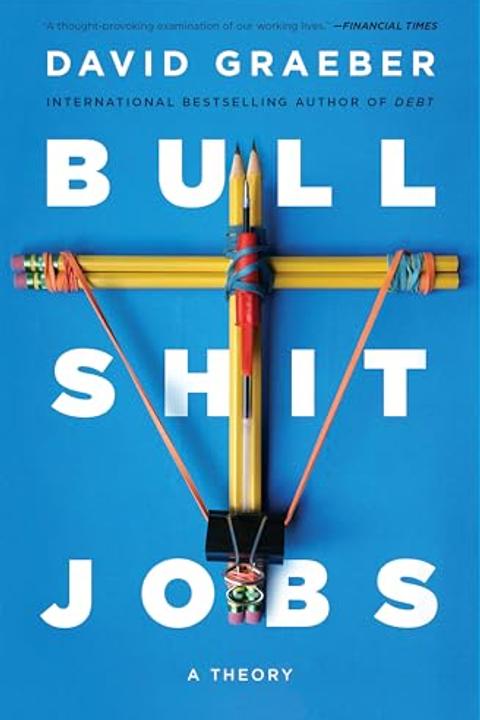
Bullshit Jobs: A Theory
by David Graeber
Why read this book
- It names a widely felt but rarely articulated experience — doing work you privately suspect is useless — and gives it a precise definition and a vocabulary.
- The five-part typology (flunkies, goons, duct-tapers, box-tickers, taskmasters) is a genuinely useful lens for classifying your own and others' work.
- It reframes meaningless work as a moral and psychological problem, not just an efficiency one, which is a sharper and more humane angle than most productivity writing.
- Graeber argues the puzzle is political, not economic — why a profit-driven system tolerates millions of pointless jobs — and that question is more interesting than the complaint that sets it up.
In one sentence
Anthropologist David Graeber's argument that a large share of modern jobs are pointless even to the people doing them, that this inflicts a quiet moral and psychological harm, and that managerial capitalism keeps producing such work for political rather than economic reasons.
Key takeaways
- A bullshit job is defined subjectively and strictly: the worker themselves believes it is pointless, and feels obliged to pretend otherwise. This is distinct from a bad or low-paid job, which may be miserable but is often genuinely useful.
- The work is sorted into five types: flunkies (exist to make someone else look important), goons (exist only because rivals employ them — lobbyists, corporate lawyers, telemarketers), duct-tapers (patch a problem that shouldn't exist), box-tickers (let an organisation claim it does something it doesn't), and taskmasters (manage people who don't need managing, or invent more bullshit work).
- Meaningless work does real harm. Graeber calls it a form of "spiritual violence" — the misery of being paid to pretend, of having your time and sense of purpose hollowed out while keeping up the appearance of usefulness.
- This contradicts market logic. A profit-maximising firm shouldn't pay people to do nothing, yet large organisations clearly do, which means the explanation has to be political and moral, not narrowly economic.
- Graeber's answer is "managerial feudalism": modern organisations distribute surplus by attaching retinues of staff to managers, much as a feudal lord's status was measured by his entourage, so jobs multiply for reasons of hierarchy and prestige.
- There is a moral economy underneath it all — a deep cultural belief that people should be working, that suffering at work is virtuous, and that those who do obviously meaningful work (nurses, teachers) deserve less, not more. Useful labour is quietly punished; bullshit is rewarded.
- Keynes predicted that by 2000 we'd work a 15-hour week. Productivity made that possible, but instead of leisure we invented new pointless work to fill the time.
- Graeber's tentative remedy is a universal basic income — decoupling survival from employment so people are free to refuse pointless work and choose what is actually worth doing. He offers it as a direction, not a blueprint.
Summary
Bullshit Jobs began as a 2013 essay ("On the Phenomenon of Bullshit Jobs: A Work Rant") that went viral, and Graeber — an anthropologist, not an economist — expanded it into a 2018 book built on hundreds of testimonies from people describing their own pointless work. His core claim is deliberately provocative: a large fraction of jobs in rich economies are pointless even to the people doing them, and those people know it.
He is careful with the definition. A bullshit job is not merely a bad job. The test is subjective and demanding: the worker privately believes the role is pointless, unnecessary, or harmful, yet has to keep up the pretence that it isn't. From there he builds a five-part typology — flunkies, goons, duct-tapers, box-tickers, and taskmasters — that gives the phenomenon structure and makes it recognisable. The categories aren't tidy boxes so much as a way of seeing the different shapes pointless work takes.
The emotional core of the book is what Graeber calls spiritual violence. Being paid to pretend, he argues, corrodes people in a way that's hard to admit because the job is comfortable and well-paid. You're supposed to be grateful, which makes the misery feel illegitimate and isolating. He gathers testimony after testimony of anxiety, depression, and a strange sense of unreality from people whose days are spent looking busy.
The deeper puzzle is why this happens at all. Under a competitive market, no profit-seeking firm should pay people to do nothing — and yet large organisations plainly do. Graeber's explanation is political. He calls it "managerial feudalism": in a system where wealth is captured and then distributed through hierarchies, status accrues to those who command large staffs, so jobs proliferate as a way of organising power and prestige rather than producing anything. Underneath sits a moral economy that treats work as virtuous in itself and resents people who get to do obviously meaningful labour. The book closes by gesturing at universal basic income — not as a worked-out policy but as a way to break the link between survival and employment, freeing people to walk away from work they know is pointless.
Reflections
The strongest move in the book is the definition. By making "bullshit" a subjective test — does the person doing the work believe it's pointless? — Graeber sidesteps the usual argument about whose labour "really" matters and puts the worker's own judgment at the centre. That's what makes the five types land: most people can immediately sort their own past jobs into flunky, goon, duct-taper, box-ticker, or taskmaster, which is a good sign a framework is doing real work.
The reframing of the problem as moral and psychological rather than merely inefficient is also right; the cost of pretending all day is real and rarely accounted for. Where I'd hold the argument more loosely is the scale. The 37% figure is a feeling reported in a survey, not a measure of actual uselessness, and Graeber leans on it harder than it can bear — later studies put the genuinely "useless" share much lower. But that's a quarrel with the numbers, not the idea.
The managerial-feudalism explanation is the part I keep returning to: the claim that organisations grow staff for status and power rather than output explains a lot that pure market logic can't, and it survives even if the headline percentage doesn't. Read it as a theory and an indictment, not as measurement, and it holds up.
“"A bullshit job is a form of paid employment that is so completely pointless, unnecessary, or pernicious that even the employee cannot justify its existence even though, as part of the conditions of employment, the employee feels obliged to pretend that this is not the case."”
— David Graeber
Who should read this
- Anyone who has sat at a desk suspecting their job doesn't really need to exist and wants the experience named, defined, and taken seriously.
- People interested in the politics and anthropology of work — why we work as much as we do, and who benefits from that.
- Readers who like an argument built from testimony and provocation rather than regression tables; Graeber is an essayist as much as a social scientist.
- Skip it, or skim it, if you want rigorous empirical proof of the headline numbers — later survey research disputes Graeber's scale, and the book is stronger as a theory and a moral indictment than as measurement.
Favorite quotes
- "A bullshit job is a form of paid employment that is so completely pointless, unnecessary, or pernicious that even the employee cannot justify its existence even though, as part of the conditions of employment, the employee feels obliged to pretend that this is not the case."
- "Huge swathes of people, in Europe and North America in particular, spend their entire working lives performing tasks they secretly believe do not really need to be performed."
- "The moral and spiritual damage that comes from this situation is profound. It is a scar across our collective soul. Yet virtually no one talks about it."
- "In the year 1930, John Maynard Keynes predicted that, by century's end, technology would have advanced sufficiently that countries like Great Britain or the United States would have achieved a 15-hour work week."
FAQ
What is a bullshit job according to Graeber?
A form of paid employment so pointless, unnecessary, or harmful that even the person doing it can't justify its existence, yet who feels obliged to pretend it matters. The definition is subjective — the worker's own judgment is the test.
What are the five types of bullshit jobs?
Flunkies (make a superior look important), goons (exist only because competitors have them, like lobbyists and corporate lawyers), duct-tapers (fix problems that shouldn't exist), box-tickers (let an organisation claim it does something), and taskmasters (supervise people who don't need it, or create more bullshit work).
What does Graeber mean by "spiritual violence"?
The deep psychological harm of being paid to pretend your work matters when you believe it doesn't — a misery made worse because the job is comfortable, so you feel you have no right to complain.
Why do bullshit jobs exist if markets are efficient?
Graeber argues the explanation is political, not economic. He calls it "managerial feudalism": status and power flow to those who command large staffs, so organisations multiply jobs for hierarchy and prestige rather than productivity.
Is a bullshit job the same as a bad job?
No. Bad jobs (cleaning, care work) are often hard and underpaid but genuinely useful. Bullshit jobs are frequently comfortable and well-paid but, in the worker's own view, pointless. Graeber notes society tends to reward the latter and punish the former.
What is Graeber's proposed solution?
He points toward universal basic income, which would separate survival from employment and let people refuse pointless work — offered as a direction rather than a detailed policy.
Detailed Notes
Click to expand the full detailed notes →
Detailed Notes
Click to expand the full detailed notes →
- Origin: Began as a 2013 essay, "On the Phenomenon of Bullshit Jobs: A Work Rant," which went viral; expanded into the 2018 book using hundreds of first-person testimonies. Graeber was an anthropologist, and the method is ethnographic — argument built from accounts, not datasets.
- The definition: "A bullshit job is a form of paid employment that is so completely pointless, unnecessary, or pernicious that even the employee cannot justify its existence even though... the employee feels obliged to pretend that this is not the case." The test is subjective and strict; this is what separates it from a merely bad job.
- The five types: flunkies (exist to make someone else feel or look important); goons (exist only because others employ them — lobbyists, telemarketers, corporate lawyers, PR); duct-tapers (patch a flaw that shouldn't exist in the first place); box-tickers (let an organisation claim it's doing something it isn't); taskmasters (manage people who need no management, or generate more bullshit work).
- Bullshit vs. bad jobs: distinct categories. Bad jobs (care, cleaning, manual labour) are often miserable and underpaid but useful. Bullshit jobs are often comfortable and well-paid but useless in the worker's own eyes.
- Spiritual violence: "The moral and spiritual damage that comes from this situation is profound. It is a scar across our collective soul." Being paid to pretend hollows people out; the comfort of the job makes the misery feel illegitimate and unspeakable.
- The economic puzzle: a profit-maximising market shouldn't tolerate paid pointlessness, yet large organisations clearly do — so the cause must be political and moral, not narrowly economic.
- Managerial feudalism: Graeber's central explanation. Surplus is captured and redistributed through hierarchies; status attaches to commanding large retinues of staff, so jobs multiply for prestige and power rather than production, echoing feudal entourages.
- The moral economy of work: a cultural conviction that working is virtuous in itself, that suffering at work builds character, and that people who do plainly meaningful work deserve less. Useful labour is quietly resented and underpaid; bullshit is rewarded.
- Keynes's broken promise: "In the year 1930, John Maynard Keynes predicted that, by century's end... countries like Great Britain or the United States would have achieved a 15-hour work week." Productivity delivered the capacity; we filled the freed time with new pointless work instead of leisure.
- The remedy: universal basic income, to decouple survival from employment and let people refuse work they know is pointless. Offered as a direction, deliberately not a finished policy.
- Key insight (statistic): A 2015 YouGov poll Graeber cites found 37% of British workers felt their job made no "meaningful contribution to the world," with a further 13% unsure — the empirical hook for the book, though its scale is contested by later research.