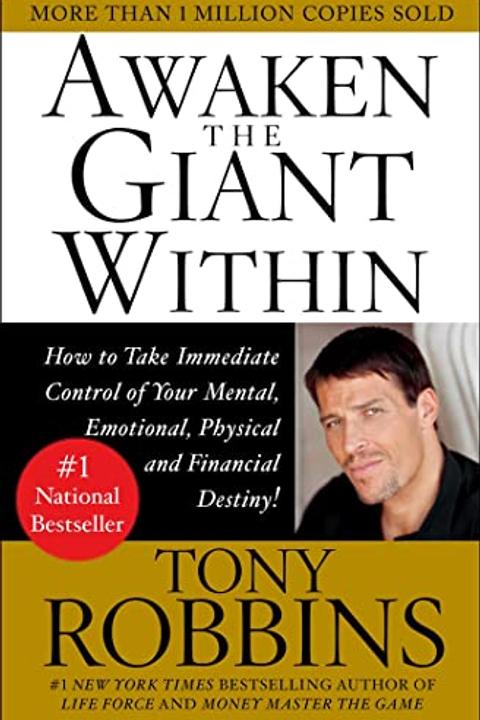
Awaken the Giant Within
by Tony Robbins
Why read this book
- It's one of the foundational mass-market self-help books, and a lot of later "take control of your state" and "change your story" advice traces back to Robbins, so it's useful to see the source.
- The pain-vs-pleasure model is a genuinely practical lens for understanding why you do things you don't want to do and skip things you do.
- The chapter on decisions, and the idea that a real decision is cutting off any other possibility, is a clean reframe of what most people mean when they say they "decided."
- The material on beliefs, questions, and the words you use to label your emotions has held up better than the seminar packaging around it.
- Reading it shows you how much is motivation and repetition versus actual method, which helps you keep the tools and drop the hype.
In one sentence
Tony Robbins' 1991 manual for taking control of your life by mastering your decisions, the pain-and-pleasure forces behind your behavior, your emotional state, your beliefs, and the rules and values you live by.
Key takeaways
- The power of decisions. Robbins' opening claim is that your life is shaped not by your conditions but by your decisions, and that most people never truly decide, they just prefer. A real decision commits and cuts off the alternatives. The three decisions you make constantly: what to focus on, what things mean, and what to do.
- Pain vs pleasure drive all behavior. The core engine of the book: everything you do is an attempt to avoid pain or gain pleasure. You don't fail to act because you're lazy, you act on whatever your nervous system currently links to more pain or more pleasure. Change the associations and the behavior follows.
- State management. Your emotional state, not your circumstances, drives what you do in the moment, and you can change state deliberately. Robbins' levers are physiology (how you move, breathe, hold yourself), focus (what you point your attention at), and language (the words you run). Manage the state and better action becomes available.
- Transforming limiting beliefs. A belief is just a feeling of certainty about what something means, often built on shaky "references." Robbins' move is to question the beliefs that hold you back, attach enough pain to keeping them, and build new empowering ones with fresh references. Beliefs are treated as chosen tools, not fixed facts.
- The power of empowering questions. Robbins argues that the quality of your life is the quality of the questions you habitually ask. "Why does this always happen to me?" and "What's great about this?" send your brain hunting in opposite directions. Changing your default questions changes what you notice and how you feel.
- Defining your values and rules. Your values are the emotional states you've decided matter most (love, freedom, security), and your rules are the conditions that have to be met before you let yourself feel them. Most frustration comes from rules that are impossible to satisfy. Robbins has you make your values explicit and rewrite the rules so they're actually reachable.
- Neuro-Associative Conditioning (NAC). The umbrella system: get leverage (make change a must, not a should), interrupt the old pattern, create a new empowering alternative, condition it through repetition, and check that it fits your life. It's behavior change framed as deliberately rewiring associations.
- Transformational Vocabulary. The specific words you use to describe an emotion change its intensity. Swapping "I'm furious" for "I'm a little annoyed," or "I'm devastated" for "I'm a bit let down," dials the feeling up or down. Small habit, outsized effect on state.
Summary
Awaken the Giant Within came out in 1991 and is Tony Robbins' big, sprawling attempt to put his seminar material into a single book on self-mastery. The through-line is that you, not your circumstances, are responsible for the quality of your life, and that you take control by mastering a handful of internal systems: your decisions, the pain and pleasure that drive your behavior, your emotional state, your beliefs, and the values and rules you live by. The signature line, "it is in your moments of decision that your destiny is shaped," sets the tone.
The engine underneath everything is pain and pleasure. Robbins argues that every choice you make is really an attempt to avoid pain or gain pleasure, and that you keep doing things you "shouldn't" because, in the moment, your nervous system links more pain to changing than to staying stuck. His method, which he calls Neuro-Associative Conditioning, is about consciously rewiring those links: get enough leverage that change becomes a must, interrupt the old pattern, install a better alternative, and repeat it until it sticks. Around that sit the practical tools the book is best known for. State management says you can shift how you feel on demand by changing your physiology, your focus, and your language. The chapters on beliefs and questions argue that a belief is just a feeling of certainty you can question and replace, and that the questions you habitually ask steer what your brain looks for. Transformational Vocabulary is the small, concrete idea that the words you pick for an emotion change how strongly you feel it.
The honest problem with the book is its style and length. It's written in Robbins' high-octane seminar voice, which means a lot of capitalized slogans, exclamation points, repetition, and motivational padding wrapped around the actual methods. There are long stretches that feel like a transcribed pep talk, and the science is presented with more certainty than it earns, NAC and "neuro-associative conditioning" sound more rigorous than they are. You can feel the infomercial DNA in it. If you're allergic to that register, the book will be a slog, and a good chunk of it can be skimmed without losing the core tools.
Read for the framework rather than the delivery, though, a fair amount survives. The decision/values/rules material is genuinely useful for figuring out why you feel chronically frustrated (usually impossible rules), and the pain-pleasure lens explains procrastination and avoidance better than willpower talk does. State management and the questions you ask yourself are small, repeatable habits with real leverage. None of it is a magic giant, but the better ideas in here show up, less loudly, in a lot of more recent and more measured self-help.
Reflections
The parts that hold up are the unglamorous, mechanical ones: a real decision cuts off the alternatives, behavior follows whatever you currently link to more pain or pleasure, and you stay frustrated mostly because your rules for feeling good are impossible. That last one is the idea I'd keep, the gap between your values and the rules you've quietly set for satisfying them explains a lot of low-grade unhappiness.
Robbins wraps all of it in a very loud seminar voice and science that's stated more confidently than it's earned, and it's easy to roll your eyes. But the pain-pleasure lens beats willpower talk for explaining why you avoid things, and state management is a small habit with real leverage.
The honest read is to take the decisions, pain-pleasure, beliefs, questions, and values tools, skim past the pep-talk padding, and notice that the specificity of the exercises is what does the work, not the volume.
“"It is in your moments of decision that your destiny is shaped."”
— Tony Robbins
Who should read this
- People who want the source of the modern "take control of your state and your story" genre, and don't mind digging the tools out of a lot of motivational packaging.
- Anyone who procrastinates or avoids and wants a model (pain vs pleasure) that explains it better than "just try harder."
- Readers who'll actually use the values-and-rules exercise to figure out why they feel frustrated even when things are going fine.
- Skip it if you bounce off high-energy seminar writing, capitalized slogans, and overstated science. For calmer, more evidence-based takes on the same terrain, Dweck's Mindset, Duckworth's Grit, or Clear's Atomic Habits cover a lot of it with less hype.
Favorite quotes
- "It is in your moments of decision that your destiny is shaped."
- "The only way to grow is to take on the challenges that frighten you and to push yourself to do what you've never done before."
- "If you can't, you must, and if you must, you can."
FAQ
What is Awaken the Giant Within about?
Taking control of your life by mastering your decisions, the pain and pleasure that drive your behavior, your emotional state, your beliefs, and the values and rules you live by. Robbins ties it together in a system he calls Neuro-Associative Conditioning.
What is the main idea of Awaken the Giant Within?
That your decisions, not your conditions, shape your life, and that all behavior is driven by avoiding pain and gaining pleasure, so you change your life by consciously rewiring which things you link to pain and which to pleasure.
What is Neuro-Associative Conditioning (NAC)?
Robbins' method for lasting change: get leverage so change is a must, interrupt the old pattern, create a new empowering alternative, condition it through repetition, and confirm it fits your life. It's behavior change framed as deliberately changing your associations.
What are values and rules in the book?
Values are the emotional states you've decided matter most (love, freedom, security). Rules are the conditions that have to be met before you let yourself feel them. Robbins argues most frustration comes from rules that are impossible to satisfy, and has you rewrite them to be reachable.
Is Awaken the Giant Within worth reading?
It depends. The decision, pain-pleasure, state, beliefs, and values tools are genuinely useful, and it's the source of a lot of later advice. But it's long and written in a high-energy seminar style with overstated science, so many readers get more from a shorter, calmer modern book.
How is it different from Robbins' other work?
It's his attempt to package the full seminar system into one book, broader and more method-heavy than his earlier Unlimited Power, and the place most of his core ideas (decisions, NAC, values and rules, state) are laid out in one place.
Detailed Notes
Click to expand the full detailed notes →
Detailed Notes
Click to expand the full detailed notes →
- The thesis: your decisions, not your conditions, shape your life. "It is in your moments of decision that your destiny is shaped." A real decision commits and cuts off other options, most people only ever prefer.
- The three decisions you're always making: what to focus on, what it means, and what to do about it. Control these and you control your experience.
- Pain vs pleasure (the engine): all behavior is an attempt to avoid pain or gain pleasure. You don't act on what's good for you, you act on what you currently link to more pain or more pleasure. Change the link, change the behavior.
- Neuro-Associative Conditioning (NAC): Robbins' change system. Get leverage (make it a must), interrupt the old pattern, create a new empowering alternative, condition it with repetition, test that it fits your life. Behavior change as deliberately rewiring associations. The "neuro-science" framing is louder than it's earned.
- Leverage: change only sticks when you tie enough pain to staying the same and enough pleasure to changing, so it becomes a must rather than a should. Most "I'll try" goals fail for lack of leverage.
- State management: your state drives your actions in the moment, and you can shift it on demand through physiology (posture, breath, movement), focus (what you attend to), and language (the words you run).
- Transforming limiting beliefs: a belief is just a feeling of certainty about what something means, built on "references" you can question. Attach pain to the limiting belief, build a new one with better references, and reinforce it.
- The power of questions: "the quality of your life is the quality of your questions." Habitual questions steer what your brain searches for. "What's great about this?" and "Why does this always happen to me?" point you in opposite directions.
- Transformational Vocabulary: the words you choose for an emotion change its intensity. "Annoyed" instead of "furious," "challenged" instead of "overwhelmed." A small habit with an outsized effect on state.
- Values and rules: values are the emotional states you most want to feel (love, freedom, security); rules are the conditions you've set for letting yourself feel them. Most frustration is impossible rules. Make values explicit, rewrite rules to be reachable.
- The Master System: Robbins' name for the combined set of beliefs, values, rules, references, questions, and emotional states that runs your evaluations and decisions automatically. The book is about making that system conscious and editing it.
- Incantations and the "Dickens process": he leans on spoken, physically energized affirmations ("incantations") and a visualization of living out the future cost of not changing. Useful for some, very seminar-flavored.
- The honest verdict: strong tools (decisions, pain-pleasure, state, beliefs, questions, values/rules) buried in a long, loud, repetitive seminar book with overstated science. Worth it for the framework if you can skim the padding.
- Anchor quotes: "It is in your moments of decision that your destiny is shaped." And: "If you can't, you must, and if you must, you can."