What Lunenburg's UNESCO boundaries actually mean for housing
Old Town, the UNESCO buffer, the local heritage district, and its Transition Area have different rules. None is a town-wide ban on housing.
 ByGraham Mann7-min read
Lunenburg's UNESCO designation is a source of debate whenever the Town considers new construction.
Most of that construction should still move forward.
Outside the World Heritage property and its buffer, appropriate housing should go through the normal planning process. Inside the buffer, the Town should identify possible heritage effects early and adjust the design before positions harden. Only a project that cannot avoid serious harm to the designation should stop for that reason.
The Blockhouse Hill concepts do not show that kind of unavoidable harm. The site is in the buffer, not Old Town. The 2024 heritage assessment found that housing could be designed there with further study and safeguards.
Old Town, the buffer, the Town's Heritage Conservation District, and the local Transition Area still have different boundaries and rules. Understanding them should make decisions easier, not provide four interchangeable reasons to say no.
Start with the UNESCO map
The World Heritage property covers 33.85 hectares. Its buffer adds 32.44 hectares around it.
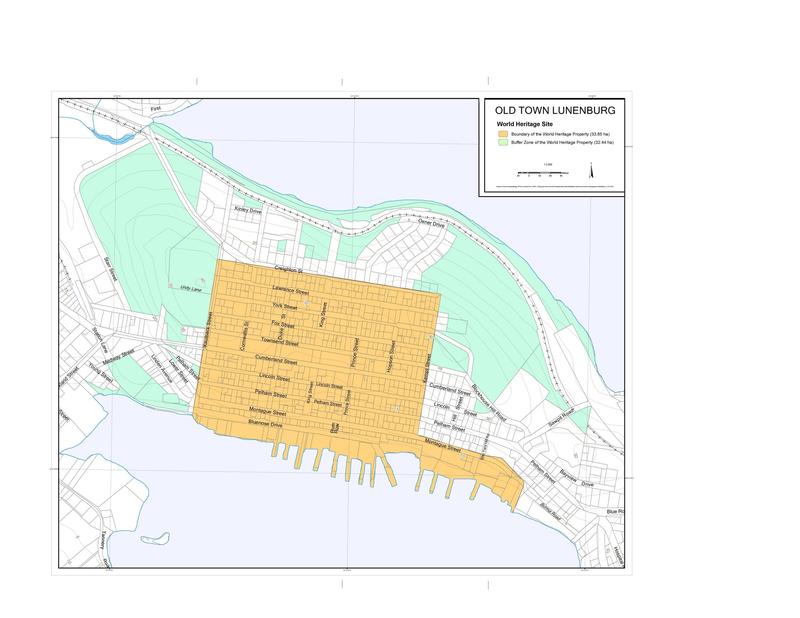
The orange area is the listed property. UNESCO recognizes it as the best surviving planned British colonial settlement in North America. Its rectangular street grid, public spaces, wooden buildings, scale, siting, materials, working waterfront, and continuing town functions are the specific features the designation protects.
The green buffer is not part of the listed property. Its job is to manage change around Old Town. A building there can be allowed. The question is whether its height, overall size and shape, location, design, or use could harm the setting or one of the features above.
There is no generic UNESCO height limit for Lunenburg. Numeric height, form, and material rules come from local planning documents. UNESCO's concern is the effect on the World Heritage value.
The local heritage map is different
Lunenburg also has a Heritage Conservation District governed by a Town plan and bylaw. That is the local legal system used to review work in the district.
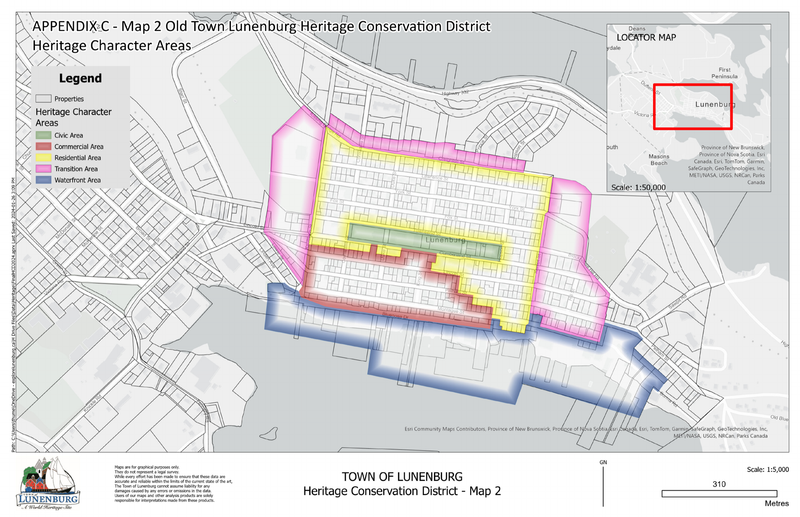
The Transition Area on this map is a local character area. It is not another name for the UNESCO buffer.
The Town's 2024 plan describes the Transition Area as residential and mixed use. It is “targeted for gentle mixed-use development.” New buildings have to be compatible with and subordinate to character-defining buildings. They must protect important views and use wood shingles or clapboard. The plan allows more contrast than it does in the historic core.
The plan allows new development to make the transition between Old Town and the areas around it without overwhelming the buildings or views that matter.
What each area means for a housing proposal
| Location | What governs the decision | What housing should expect |
|---|---|---|
| Inside the World Heritage property | UNESCO obligations plus the Town's planning and heritage rules | The closest review of street pattern, scale, siting, materials, public space, uses, and effects on character-defining buildings; infill is possible but the design burden is high |
| Inside the UNESCO buffer | Local zoning and heritage rules, plus review of possible effects on the World Heritage setting | No automatic ban; larger, taller, or highly visible projects should test important views and compare ways to make the buildings lower, smaller, stepped, moved, or split into several parts |
| Inside the local Heritage Conservation District | The Town's HCD plan and bylaw, including the relevant character area | A Certificate of Appropriateness or other local approvals may be required; the detailed local design rules matter more than a UNESCO slogan |
| Inside the local Transition Area | Transition Area policies within the HCD plan and other Town rules | Gentle mixed-use development is an intended use, with compatibility, view, and cladding requirements |
| Outside all of them | The Municipal Planning Strategy, Land Use By-law, and other ordinary approvals | Appropriate housing should proceed; UNESCO is relevant only when a project could have a real effect on the protected setting |
These areas overlap, so a project may sit in more than one row. The correct review begins by identifying the actual parcel and the rules that apply to it.
Blockhouse Hill exposed a real management gap
Blockhouse Hill is in the UNESCO buffer. It is not inside the World Heritage property.
In 2023, Friends of Blockhouse Hill submitted a report prepared by James Hallett. It argued that the Town had not managed the designation or buffer adequately. It raised serious questions about the lack of a clear World Heritage management plan and the timing of impact work.
It also questioned the protection of views and setting and coordination with Parks Canada.
Those were useful challenges. Heritage assessment should happen before Council, a developer, and the public become committed to one design. By the time a report arrives late, the easiest opportunities to move a building, lower part of it, protect a view, or change access may be gone.
The report went further when it treated development on Blockhouse Hill as though it was inherently incompatible with the designation or placed Lunenburg near losing its status. I do not think the evidence supports that conclusion.
The Town's 2024 Blockhouse Heritage Impact Assessment made the counter-case. Development can occur in a buffer. Lower parts of the hill had residential zoning at relevant points in the designation's history.
The concepts could also be changed to reduce their effects. The Town said Parks Canada had been notified and the assessment would continue as a design developed.
Council stopped the active sale route in December 2025 when it removed the lower slopes from the surplus-property list. A housing proposal would require Council to restart the process and complete the unfinished work.
The Friends report identified a governance weakness, not a prohibition on housing. None of the four Blockhouse concepts was a final development proposal, and the heritage assessment did not find that housing on the site had to be abandoned. Lunenburg should choose a lower-impact concept, complete the missing work, and bring a real proposal forward.
For any future plan, I would expect public view studies from the original blockhouse locations and key streets. The Town should show several layouts. Buildings could be shorter or stepped down the hill. They could move to less visible parts of the site or be divided into smaller clusters.
Archaeology and Mi'kmaq engagement should happen where relevant. Height, location, views, materials, and tree retention can then become enforceable terms before the land is sold.
This work should decide what gets built on Blockhouse Hill, not whether the Town is allowed to consider housing there at all.
The Solterre appeal shows why the lines matter
The Solterre proposal on Brook and Falkland streets was outside both the World Heritage property and the UNESCO buffer.
Public views still differed. Wendy Rofihe is a Lunenburg resident with a master's degree in heritage conservation. She supported the proposal and argued that it did not threaten the designation.
Architect and long-time resident Irma Da Sie supported well-designed housing at an appropriate scale. She supported Council's refusal because of the planning and form questions she saw in this proposal.
Both positions accepted that housing could be built. They differed on whether this design and rule change fit.
The Nova Scotia Regulatory and Appeals Board's 2026 decision found that Town staff had screened the project. Staff expected little or no direct negative effect on Outstanding Universal Value and did not recommend a full heritage impact assessment.
The Board found no contrary evidence. It concluded that UNESCO concern did not support refusing the rezoning under the Town's planning strategy.
The Board was deciding whether Council's refusal reasonably carried out the Municipal Planning Strategy. It was not declaring that buildings outside a buffer can never affect a World Heritage site.
For development outside the property and buffer, the Town should screen for a plausible effect. If staff identify one, do more heritage work. If they do not, decide the application under the ordinary planning rules. UNESCO concern should not be allowed to fill a gap where the evidence is missing.
Smaller World Heritage towns still build
The most useful comparisons are not all large cities. Smaller World Heritage towns also add homes, reuse buildings, and consider major projects. Their status depends on what changes and how the effect is handled.
| World Heritage site | Project and review | What happened |
|---|---|---|
| Bath, England | The Western Riverside plan included about 2,000 homes in buildings of roughly six to nine storeys | A 2008 mission found the first phase would not harm the site's Outstanding Universal Value. Later Gasworks designs drew strong ICOMOS criticism and requests for revision. Bath remains listed. Approval of one phase did not remove scrutiny from the next. |
| Visby, Sweden | Old warehouses were converted to housing and new buildings were added within the walled town over time. A detailed local plan now regulates conservation and new construction. | Visby remains a living town and remains listed. UNESCO identifies cumulative small changes and growth around the walls as risks, so development is controlled rather than prohibited. |
| Český Krumlov, Czechia | A revolving theatre harmed the castle garden. UNESCO supported removing it and left room for a replacement beside the garden in the buffer. | Any replacement must follow earlier design advice and undergo a heritage impact assessment. The town remains listed. A harmful location did not become a ban on the use or on a better proposal. |
| St George, Bermuda | A hotel and two condominium buildings were built in the buffer near historic forts before UNESCO's concerns were resolved. Five more condominium buildings were planned. | A 2024 UNESCO-ICOMOS mission found a high negative effect and recommended reconsidering the remaining phases through a proper impact assessment. St George remains listed, but the completed work cannot easily be undone. This is what Lunenburg should avoid by reviewing early. |
| Liverpool Maritime Mercantile City | Liverpool Waters and other waterfront changes produced years of concern about scale, design, and cumulative loss | UNESCO removed Liverpool from the World Heritage List in 2021. This followed repeated warnings and large cumulative change, not one ordinary nearby housing building. |
| Dresden Elbe Valley | A four-lane bridge was built through the core cultural landscape | UNESCO delisted the property in 2009 after earlier danger-list action. The bridge directly altered the landscape the designation protected. |
Sources: UNESCO records for Bath, Visby, Český Krumlov, St George, Liverpool, and Dresden.
Together, these cases show the difference between managed change and a veto.
Projects can proceed when assessment starts early and the design can still change. A harmful part can be moved, lowered, reduced, or refused without abandoning all development. Trouble grows when governments approve work before resolving the effect, dismiss repeated warnings, or allow several damaging projects to accumulate.
A bridge through a listed river valley and a 30-unit apartment building outside a buffer are not equivalent risks.
What Lunenburg should require
The UNESCO impact-assessment toolkit calls for assessing projects that may affect Outstanding Universal Value early enough to change them.
For Lunenburg, that should mean:
- confirm the parcel's UNESCO and local-planning boundaries;
- identify the specific heritage attributes that could be affected;
- screen the proposal before Council treats one design as the answer;
- require a full heritage impact assessment when the likely effect warrants it;
- compare building height, overall size and shape, location, access, and a no-build option;
- publish the evidence and Parks Canada coordination where appropriate; and
- turn mitigation into enforceable approval terms.
Not every shed or secondary suite needs a World Heritage study. A large public-land project in the buffer deserves more work than a small addition outside it. The review should match the risk.
Outside the property and buffer, appropriate housing should move forward unless a real effect on the protected setting is identified. Inside the buffer, the extra work should happen early enough to improve the proposal. It should stop the whole project only when serious harm cannot be designed out.
Blockhouse Hill has not reached that threshold. Put the site on the right map, test the views, choose a lower-impact layout, make the safeguards enforceable, and move a housing proposal forward.