Why aren't we 3D printing more boats?
Boats are expensive because boatbuilding is slow, manual, and tooling-heavy. Large-format 3D printing may help first with molds and prototypes.
 ByGraham Mann14-min read
Growing up in Nova Scotia, boats were always around: fishing boats, aluminum skiffs, sailboats, runabouts, old hulls in yards.
I have always wanted one. Then every time I look at what a decent boat costs, the number feels absurd.
Some of that is easy to explain. A boat is a luxury purchase for a lot of people. It needs an engine, electronics, hardware, storage, insurance, a trailer or a mooring, and constant maintenance. But even stripped down to the object itself, I wanted to understand why the manufacturing still costs so much.
A hull is mostly a shape. A complicated shape, yes, and one that has to survive real abuse, but still a shape.
How boats are made today
Most boats are built in ways that are more manual than people probably assume.
Fiberglass is the dominant material for a lot of recreational boats, and it is also used well beyond the small-boat market. Many larger yachts and superyachts use composite construction too, whether that means fiberglass, carbon fiber, epoxy systems, foam cores, or more advanced layup and infusion processes. The exact materials and methods change with the size and price of the boat, but the basic manufacturing problem is often similar: you need a large, accurate shape, and you need a way to repeat it.
For a fiberglass hull, a builder usually starts with a plug, which is a full-size positive shape of the hull or part being made. From that plug, they make a mold. Then the finished hull is built inside the mold using layers of fiberglass reinforcement and resin. Depending on the builder and the price point, that might involve hand layup, spray-up, vacuum bagging, resin infusion, or some mix of those processes.
The mold is the expensive bet. If you are building a lot of the same hull, it makes sense. You spend the money up front, dial in the process, and spread the tooling cost over many boats. That is why fiberglass works so well for production boats. The material is familiar, repair yards understand it, buyers trust it, and the finish can be excellent.
But getting there is slow. You need the plug. You need the mold. You need skilled labor. You need finishing work. You need enough confidence in the model to justify all that tooling before the first customer boat exists.
That matters because boats are relatively low-volume products compared with cars. A popular car model might be built in the hundreds of thousands. A boat model might sell in the hundreds, dozens, or fewer, especially once you get into larger yachts, commercial vessels, specialty workboats, or custom layouts. The tooling still has to be paid for, but there are fewer finished units to absorb the cost.
Aluminum boats are different. They are usually cut, bent, welded, and assembled from plate or formed parts. This can be rugged and practical, especially for workboats, fishing boats, landing craft, and smaller utility boats. Aluminum can be easier to repair than composites in some contexts, and it does not require the same kind of full mold investment. But it still takes skilled fabrication, careful welding, fairing, outfitting, and a lot of hands-on work.
Higher-end composite boats may use carbon fiber, Kevlar, epoxy composites, foam or balsa cores, pre-pregs, autoclaves, or more advanced infusion methods. Those materials can make lighter, stiffer, faster boats, but they do not make the manufacturing problem disappear. If anything, they can increase the need for controlled process, skilled labor, and expensive tooling.
Some boats are plastic, made through processes like rotational molding. Companies like Whaly make tough HDPE utility boats this way. People will buy plastic boats when the product is rugged, practical, and low maintenance. Rotomolding still has its own tooling and design constraints. You still need molds, and the economics still work best when you can sell enough units to justify them.
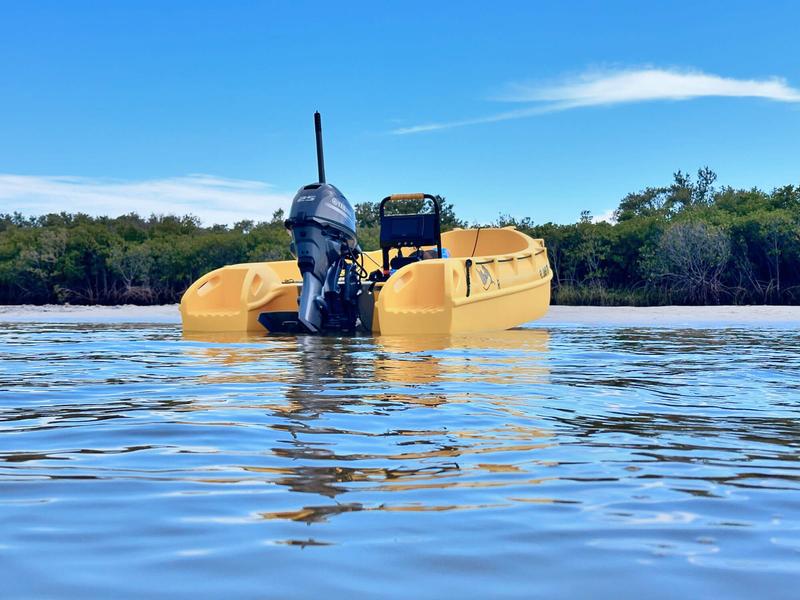
That is the pattern. Boats are expensive partly because they are physically large, exposed to harsh conditions, and full of systems. The manufacturing adds another layer: a new shape has to become a real product through a slow, tooling-heavy, low-volume process that depends on people who know what they are doing.
Can 3D printing help?
I was 3D printing a small part the other day and had the obvious thought: why can't we 3D print boats?
Desktop 3D printing changed the way a lot of people think about objects. If you can model something, you can make it, at least in miniature. You can make one part without tooling. You can change the file and print another version. You can make awkward geometry without paying extra for every curve and corner.
That sounds like it should map well to boats. Boatbuilding has big shapes, expensive tooling, lots of variation, and slow iteration. A printer that can go from digital model to physical object should be useful somewhere in that chain.
The catch is scale.
A modern desktop or prosumer printer is impressive until you compare it with a hull. Bambu Lab's H2D lists a single-nozzle build volume of 325 x 320 x 325 mm, with a larger total dual-nozzle envelope. Creality's K2 Plus is marketed around a 350 x 350 x 350 mm build volume. The Prusa XL is larger for a desktop-style machine at 360 x 360 x 360 mm.
Those are useful volumes. You can print a cup holder, a bracket, a drain cover, a hinge prototype, a replacement fitting, a mold for a small part, or a piece of tooling. But you are still measuring the build area in centimeters, not feet.
Commercial machines get bigger. A BigRep ONE has a one-cubic-meter build volume. Modix sells machines like the BIG-180X with a listed print volume of 1,800 x 600 x 600 mm. Those sizes are much more useful for furniture, fixtures, molds, prototypes, automotive parts, and some marine components. They still do not get you close to printing a 20-foot hull in one piece.
You could split a boat into smaller printed sections and join them, but then the hard question moves from printing to joining. The seams would have to handle loads, water, vibration, thermal movement, impact, and long-term fatigue. They would need to be inspected and repaired, and they need to be trusted by those using them. On a boat, a bad joint can become a failure point in a wet, moving, corrosive environment.
That is one reason small-format printing has not turned into backyard boat manufacturing. The available print volume is too small, and scaling by assembly creates its own engineering problem. You might be able to print accessories, interior pieces, molds for small components, or prototype parts. Printing the hull itself is a different category.
Big printers do exist
For boat-sized work, the relevant machines look less like desktop printers and more like industrial manufacturing cells.
Instead of filament spools and desktop frames, these systems use pellet-fed extruders, robotic arms, gantries, big beds, machining heads, and industrial controls. They print near-net shapes in reinforced thermoplastics or other materials, then often need CNC machining afterward to get the final surface tolerance and finish.
Thermwood's lower-cost LSAM Additive Printer line, for example, includes 5 x 5 foot and 5 x 10 foot table sizes, with parts up to 4 feet high and a maximum table print weight of 1,000 pounds. That is a different world from desktop printing, but even that does not mean finished boats come out ready for the water. Thermwood describes these as lower-cost print-only systems, often paired with a separate trimmer when parts need machining.
The University of Maine has one of the most visible setups. Its Advanced Structures and Composites Center, working with Ingersoll's MasterPrint platform, printed 3Dirigo, a 25-foot, 5,000-pound boat, in 72 hours. UMaine has also worked on large 3D printed logistics vessel prototypes for the U.S. Marines, where speed and prototyping matter more than retail showroom polish.
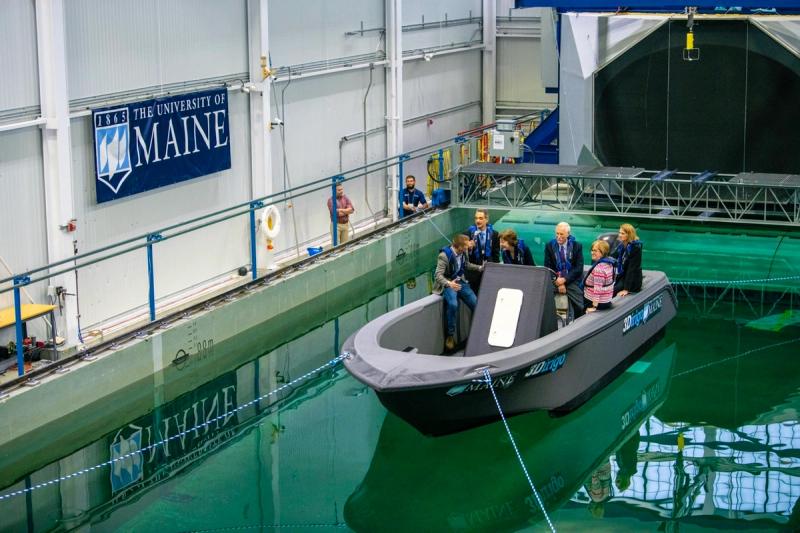
The launch photo shows the finished object. The time-lapse below is more useful for seeing the manufacturing process itself.
Thermwood has pushed large-scale additive manufacturing from a tooling angle. In one example, it printed a large boat hull pattern weighing roughly 3,000 pounds. The print took about 30 hours, machining took another 30 hours, and the whole process was completed in under 10 working days. TAHOE Boats also used Thermwood printed tooling for the T16.
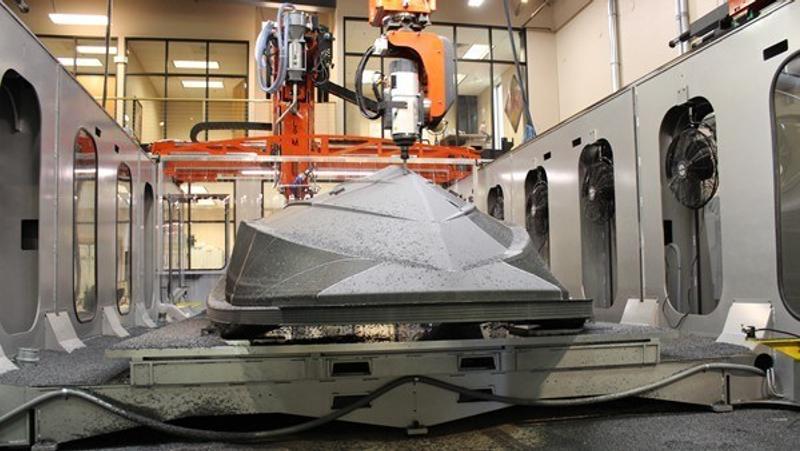
Oak Ridge National Laboratory used big-area additive manufacturing to make a 34-foot catamaran hull mold. It was printed in 12 sections over five days, then CNC finished and used as a mold.
CEAD, based in the Netherlands, sells robotic large-format systems into marine, defense, tooling, and industrial applications. Caracol, based in Italy, has been doing similar work with robotic large-format printing. These are not little printers scaled up slightly. They are manufacturing cells, often closer to a robot plus extrusion system plus machining workflow than to what most people picture when they hear "3D printer."
There is an open-source side to this too, though it sits in a different part of the market. Marlin describes itself as an open-source 3D printer driver, and Klipper is free software that controls 3D printers through a general-purpose computer and one or more microcontrollers. Companies like re:3D sell open-source industrial printers using Klipper, including pellet-printing machines. Researchers have also experimented with Hangprinter-style large-format systems using pellet extrusion and recycled plastic.
The hobby and prosumer world keeps pushing the low end outward. Thermwood is not in that category. LSAM is a proprietary industrial system with its own LSAM Print 3D software inside Mastercam.
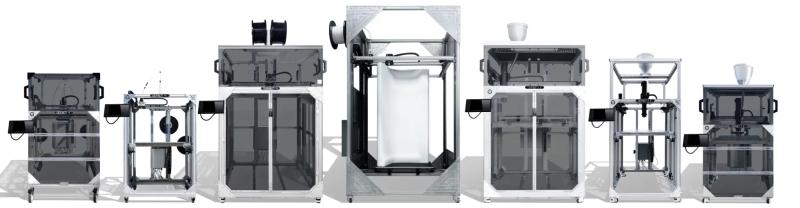
This helps explain why there are not more of them.
A large-format system needs space, material handling, trained operators, safety systems, process knowledge, and often CNC finishing capacity. It may need climate control or at least a controlled production environment. The materials are not trivial. The parts are big enough that mistakes are expensive. And if the final object is going on the water, someone still has to prove it will survive.
A small boatbuilder cannot casually put one of these in the corner of the shop next to the table saw.
The economics should improve
Printer capability keeps moving outward.
Desktop machines have become much better over the last decade. They are faster, easier to use, more reliable, and larger for the money than they used to be. A machine like the Bambu H2D, Creality K2 Plus, or Prusa XL would have felt wildly capable to many hobbyists not long ago. Commercial systems have also moved into sizes that can handle large fixtures, molds, furniture, prototypes, and real production aids without jumping all the way to a giant custom cell.
That does not mean large-format boat printing becomes cheap quickly. The jump from a one-meter printer to a boat-scale pellet extrusion system is still enormous. But the direction matters. As smaller printers get more capable and mid-size printers become more common, more people learn the workflow: designing for additive, slicing large parts, choosing materials, post-processing, machining, bonding, inspecting, and repairing printed objects.
The machine cost matters too, but utilization may matter even more. A big printer is hard to justify if it only makes one boat mold every few months. The case gets stronger if the same machine can print boat plugs, molds, construction components, architectural parts, repair jigs, composite tooling, industrial fixtures, and odd one-off structures for local companies.
This is probably where large-format printing becomes economically feasible first: as shared manufacturing capacity rather than a single-purpose boat printer.
What 3D printing is already doing for boats
Near term, 3D printers probably do not replace boatbuilders. They shorten some of the painful steps before a boat can be built.
In fiberglass production, a shape becomes a plug, the plug becomes a mold, and the mold eventually produces a hull. Every design change can ripple through that process. If a builder wants to test a different hull, deck, console, hatch layout, hardtop, drain path, storage compartment, or interior structure, the physical work can become slow and expensive fast.
Large-format 3D printing can shorten that loop.
Printed plugs and molds may be the less flashy application, but it might be the most important one. A printer can turn a digital model into a full-size pattern or mold much faster than conventional methods in some cases. Then CNC machining brings the surface closer to spec. The final boat may still be made from fiberglass or another composite, but the tooling loop gets shorter.
This also avoids some of the joining problem. If you print a mold in sections, the joints still matter for accuracy, surface quality, and the molding process. But the mold is not the finished boat. It does not have to spend years taking slamming loads, saltwater, UV, trailering stress, and hardware loads. Joining sections for tooling is a much easier problem than joining sections of a structural hull that people trust with their lives.
That matters because many boats are not cars. They are low-volume products with model changes, regional preferences, customer-specific layouts, and a lot of design variation. A builder might not need a million identical hulls. They might need a faster way to try a new version without betting months of labor on the first shape.
There is also a more direct path: printed parts that become part of the boat. Consoles, seating bases, internal structures, tooling aids, forms, hardtop parts, transom structures, tanks, ducting, cable runs, and complex inserts may all be better early candidates than a finished hull. Boats are full of awkward internal geometry. A lot of value hides in places the customer never sees.
If those details can be integrated into printed structures, boatbuilding starts to look a little less like craft work and a little more like product manufacturing.
The printed boat examples are real, but narrow
Whole printed boats make better headlines, and there are real examples.
UMaine's 3Dirigo is the obvious one: 25 feet, 5,000 pounds, printed in 72 hours. Al Seer Marine and Abu Dhabi Maritime unveiled an 11.98 metre 3D printed water taxi, with hulls printed using CEAD equipment. Caracol and V2 Group built a 6 metre monolithic catamaran from glass-fiber reinforced recycled polypropylene. Moi Composites has shown a 3D printed glass-fiber boat.
Boat-scale printing already exists. The hard part now is finding the places where it makes economic and engineering sense.
Printing the shape is only one part of the problem. A finished boat still needs surface finish, waterproofing, bonding, inserts, inspection access, repairability, classification, insurance, and buyer trust.
We can print a boat. The harder question is where printing changes the economics enough to overcome the new problems it introduces.
Where the economics probably work first
The best early categories probably have a few traits in common: low volume, custom or semi-custom design, high tooling burden, lots of integrated structure, less obsession with perfect yacht finish, and a real premium on speed.
That points toward workboats, defense boats, ferries, prototypes, specialty sportboats, research vessels, some sailboat structures, superyacht components, and tooling for recreational boatbuilders. Center consoles are a good example too. Even if the whole boat is still built conventionally, the console itself is a big utility shell full of hidden complexity: cable gutters, drains, tanks, storage, seating, backing zones, inspection ports, mounting surfaces, and transom loads.
If printing can fold some of that complexity into the structure, the value is larger than cheaper plastic. It is fewer separate steps, fewer custom subassemblies, faster iteration, and less tooling risk.
Mass-market recreational boats are a harder target. If a builder already has a mold, a trained crew, known materials, known suppliers, and a product that sells at volume, printing the whole hull may not help. The old process may still be better. That is manufacturing reality.
New processes usually win first where old processes are awkward.
The bigger implication
Boats are a useful example because they combine shape, material, tooling, labor, and trust. The same pattern shows up elsewhere.
Large-format 3D printing is already being used or tested for aerospace tooling, automotive fixtures, composite layup tools, architectural components, construction, defense parts, molds, patterns, and prototypes. In many cases, the early value is not the final consumer product. It is the hidden object that helps a factory make the final product faster.
The same mental model works for boats. The printer may matter most before the customer sees anything: faster plugs, faster molds, faster prototypes, more integrated structures, and a few direct-printed vessels where customization and speed beat the need for perfect finish.
Over time, that could still change what gets built. If the cost of trying a new hull shape drops, more niche boats become viable. If tooling is faster, small builders can experiment more. If large printed structures become easier to certify and repair, direct-printed workboats may become normal in specific markets. If the same large-format systems can print molds for boats one week and construction components or industrial tooling the next, the economics of owning the machine start to make more sense.
That may be the practical version of the story for places like Nova Scotia. Not every marina needs a printer. But a region full of boatbuilders, repair yards, ocean tech companies, construction needs, defense contracts, and weird coastal problems might eventually support shared large-format manufacturing capacity in a way a single small boatbuilder cannot.
That sounds more plausible to me than cheap printed yachts for everyone.
The honest answer
Why aren't we 3D printing more boats yet?
The short answer: cheap printers are too small, and big printers are still expensive, specialized, and hard to run. Splitting a hull into smaller pieces creates a joining problem. Printing a full-size part creates a finishing, testing, certification, and trust problem. Existing methods already work well in many parts of the market.
But none of that makes the idea silly. It just makes it more specific.
I would not bet on a near future where every 24-foot fishing boat is printed in one piece. I would bet on 3D printing creeping into the boatbuilding process through the parts no one gets excited about: plugs, molds, patterns, prototypes, tooling, internal structures, and odd low-volume boats that would have been too expensive to try before.
We can already print a boat. The more useful question is which parts of boatbuilding are genuinely hard, and which parts are still expensive because the process has not caught up yet.
That is where the real manufacturing shift would start.