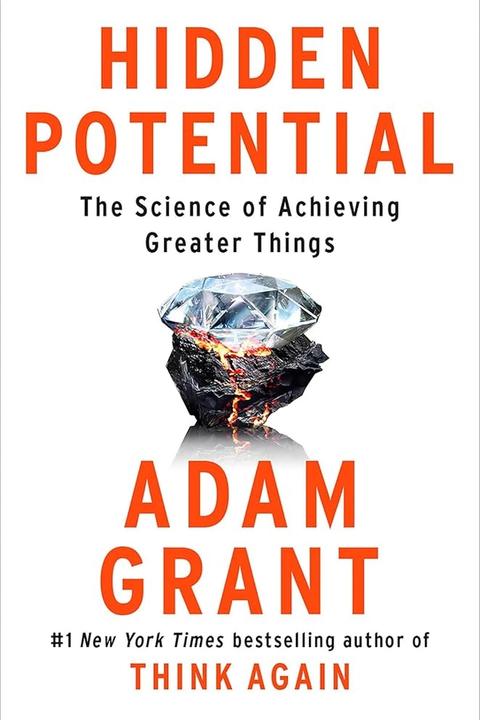
Hidden Potential: The Science of Achieving Greater Things
by Adam Grant
In one sentence
Hidden Potential is about how ordinary people can achieve extraordinary growth by building character skills, surrounding themselves with the right scaffolding, and creating systems of opportunity that let effort compound over time.
Key takeaways
- Natural talent is wildly overrated; opportunity, motivation, and character skills (proactivity, discipline, determination, prosocial behavior) are what actually drive long-term success.
- Character isn’t just “who you are” — it’s a set of learnable skills that help you live your values, embrace discomfort, and keep improving.
- The best growth comes when we deliberately seek discomfort, make a lot of mistakes, and treat effort itself as rewarding.
- Scaffolding — temporary structures of support from people, tools, and environments — makes hard things feel doable and helps us move through plateaus and ruts.
- Harmonious passion and deliberate play (not grindy obsession) are what transform practice from a slog into something sustainable and joyful.
- Progress rarely follows a straight line; often you have to back up, experiment, or take a detour before you can climb to a higher peak.
- Systems and institutions (schools, workplaces, neighborhoods) massively shape who gets to realize their potential — and we can redesign them to widen opportunity.
- Real potential is measured not by the height of your current peak, but by how far you’ve climbed and how fast your slope is still rising.
Summary
Hidden Potential argues that what we call “talent” is usually just the visible tip of a much deeper process: access to opportunities, the willingness to embrace discomfort, and the character skills to keep going when the work gets hard. Grant shows that people who seem exceptional are less often prodigies and more often “roses grown from concrete”—given the right conditions to practice, learn, and keep climbing.
He distinguishes ambition from aspiration: ambition is about outcomes, aspiration is about the kind of person you’re becoming. The book is ultimately about aspiration. Rather than fixating on status symbols or fixed traits, Grant focuses on skills like proactivity, discipline, determination, and prosocial behavior, and how we can deliberately build them. These skills matter more than IQ when it comes to long-term performance in fields as varied as chess, entrepreneurship, and education.
The first part of the book explores “skills of character”: how to become a creature of discomfort, how to become a sponge for high-quality information, and how to be an “imperfectionist” who holds high standards without being paralyzed by perfectionism. Grant offers practical tools like seeking advice instead of feedback, measuring progress by mistakes made, and using judging “committees” or pop-up workshops to refine important work.
The second part looks at “structures for motivation,” especially scaffolding and deliberate play. Rather than glorifying grind, Grant shows how the best performers transform practice into something joyful and varied. He explains how interleaving, breaks, detours, hobbies, and teaching others can reignite progress when we hit plateaus, and how serving people beyond ourselves can create a powerful source of motivation.
The final part zooms out to “systems of opportunity”: how schools, workplaces, and entire societies can be designed to bring out hidden potential. Grant highlights Finland’s education system, looping between teachers and students, student welfare teams, and a culture that treats play and reading as core work. He then turns to teams and organizations, showing how to mine collective intelligence, avoid the “babble effect,” promote people based on slope rather than just current performance, and replace ladders with lattices to open more paths upward.
Across it all, Grant argues that impostor feelings and big dreams can actually be signs of hidden potential. Success, in this frame, isn’t about reaching a final destination; it’s about living your values, continuing to grow, and building systems that help more people climb further than anyone expected.
Reflections
- I really like the distinction between ambition and aspiration. It’s a good gut check: am I optimizing for outcomes (money, titles, status), or for becoming a certain kind of person? The reminder that “what counts is not how hard you work but how much you grow” feels like a direct challenge to my default productivity brain.
- The “character as skills” framing is super useful. It makes proactivity, discipline, determination, and prosocial behavior feel like muscles I can train rather than fixed traits I either have or don’t. The kindergarten teacher story (and Chetty’s research) really drives this home — the impact of being taught to be proactive, prosocial, disciplined, and determined is still visible in adult earnings.
- The creatures of discomfort chapter hits close to home. Seeing procrastination as emotion management, not time management, is a helpful reframe. I also like the idea of actively seeking awkwardness and using it as a metric — like Benny’s goal to make 200 mistakes a day. It shifts the game from “avoid failure” to “collect reps.” That’s a healthier way to think about learning languages, writing, or even shipping projects.
- The feedback vs. advice distinction is one I want to steal outright: “What’s one thing I can do better?” is simple, disarming, and forward-looking. Pairing that with judging committees and explicit scoring (0–10, then “how do I get closer to 10?”) gives a concrete mechanism for improving important work without drowning in vague comments.
- I really like the framing around deliberate play. It fits with how I naturally learn when I’m at my best: making games out of drills, changing constraints, tracking scores. The Curry example and interleaving research are useful reminders not to grind the same exact task over and over. Variety isn’t just for motivation; it’s actually superior for learning. Also: short breaks are not indulgent — they’re part of the system.
- The “map vs. compass” bit is a nice way to think about navigating big career or learning decisions. It’s easy to over-index on having the perfect plan. The book pushes the idea that what matters more is direction, feedback loops, and willingness to backtrack. Also: experts aren’t always the best starting guides, which is a good reminder to look for people just a few steps ahead.
- The Finland section is both inspiring and a bit depressing. It’s a concrete example of how much systems and culture matter. Looping, autonomy for teachers, embedded welfare teams, mandated play — all of that is the opposite of test-driven, stress-heavy education. The takeaway for me is: whenever I’m teaching or mentoring, I should aim to recreate some of that scaffolding: more continuity, more autonomy, more play, more belief in potential.
- The chapters on teams and promotions resonate with a lot of dysfunctional patterns I’ve seen: promoting top individual contributors into management, mistaking the loudest voice for leadership, and undervaluing prosocial behavior. The “slope over level” idea — looking at improvement, not just current output — is something I want to bake into how I evaluate people (and myself).
- The impostor syndrome reframing at the end is a nice way to tie everything together. Feeling like an impostor can be a sign that other people are seeing your potential before you do. If multiple people consistently bet on you, maybe the correct move is to trust their assessment and grow into it instead of trying to prove them wrong.
Who should read this
- People who feel “behind” or worry they’re not naturally gifted enough and want a more hopeful, evidence-based way to think about growth.
- Teachers, coaches, and managers who are in a position to shape environments, build scaffolding, and bring out hidden potential in others.
- Parents who care about raising kids with resilience, curiosity, and a love of learning (and want to move beyond “work hard and be smart”).
- High achievers who are stuck in perfectionism, burnout, or plateau and need better ways to structure practice, feedback, and progress.
- Leaders who want to design teams and organizations that truly reward learning, collaboration, and trajectory rather than just loud confidence and past achievements.
Favorite quotes
- The true measure of your potential is not the height of the peak you’ve reached, but how far you’ve climbed to get there.
- What look like differences in natural ability are often just differences in opportunity and motivation.
- Character is not about willpower; it’s a set of skills for living your principles.
- Becoming a creature of discomfort means having the courage to abandon your usual methods, step into the ring before you feel ready, and make more mistakes than others even attempt.
- The way you like to learn is what makes you comfortable; it isn’t always how you learn best.
- Procrastination is not a time management problem — it’s an emotion management problem.
- Being polite is withholding feedback to make someone feel good today; being kind is offering candid advice to help them be better tomorrow.
- The purpose of reviewing your mistakes isn’t to shame your past self; it’s to educate your future self.
- Harmonious passion pulls you toward practice with “I want to,” instead of pushing you with “I should.”
- Without enjoyment, potential stays hidden.
- A rut is not proof that you’ve peaked; it’s a sign you may need a different route, a different method, or a fresh source of fuel.
- The best experts are often the worst guides for beginners, because they’ve forgotten what it’s like not to know.
- The strongest force in daily motivation is a sense of progress.
- The best way to learn something is to teach it; the best way to believe in yourself is to coach someone else through a struggle you know well.
- When others believe in our potential, they hand us a ladder; when they underestimate us, it can weigh us down like lead boots.
- If natural talent sets where people start, learned character shapes how far they go.
- Colleges and employers often focus on averages, but what really matters is whether your grades — and your skills — are rising over time.
- Impostor syndrome says, “I don’t know what I’m doing, and I’ll be found out”; growth mindset says, “I don’t know what I’m doing yet, but I can figure it out.”
- Success is more than reaching our goals — it’s living our values.
- There’s no higher aspiration than to be better tomorrow than you are today.
FAQ
Is Hidden Potential worth reading?
Yes. If you care about growth — your own or others’ — this book pulls together a lot of research into a cohesive, practical framework. It moves beyond generic “growth mindset” slogans and gives concrete tools for building character skills, structuring practice, and redesigning systems to unlock potential.
What is the main idea of Hidden Potential?
The core idea is that potential is not fixed or purely a function of talent. It’s shaped by character skills (proactivity, discipline, determination, prosocial behavior), scaffolding and motivation structures, and systems of opportunity. What matters most is not where you start, but how far and how steadily you can climb.
How is this book different from other self-help or performance books?
Instead of focusing only on individual hacks or “mindset,” Grant zooms out to show how teachers, teams, organizations, and whole countries shape who gets to develop their abilities. There’s a strong emphasis on evidence: large-scale studies, meta-analyses, and real-world experiments, not just anecdotes. It connects personal growth with structural change.
Does the book argue that talent doesn’t matter at all?
No. Talent and early advantages matter, especially at the beginning. But over longer time horizons, character skills, learning strategies, and opportunity structures matter more. Studies in chess, entrepreneurship, and education show that early cognitive advantages fade, while proactivity, discipline, and determination keep compounding.
Is Hidden Potential still relevant if I’m already successful?
Definitely. The book is as much about getting unstuck and climbing to higher peaks as it is about early growth. It addresses plateaus, perfectionism, burnout, and how to redesign your practice, environment, and relationships to keep progressing — even when you’re already doing well by conventional standards.
Who will get the most out of this book: individuals or leaders?
Both, but in different ways. Individuals will get tactics for improving how they learn, practice, handle feedback, and structure their lives. Leaders, teachers, and parents will see how to build scaffolding, redefine evaluation, and design systems (like classrooms or teams) that help more people thrive.
Is this book similar to Grit or Mindset?
It’s in the same family but covers different ground. Like Grit and Mindset, it emphasizes effort and growth, but Hidden Potential goes further into systems design, collective intelligence, and the role of opportunity. It spends more time on practical structures (looping, brainwriting, lattices) and less on just individual persistence.
What are the most actionable ideas I can use right away?
A few quick wins:
- Ask people “What’s one thing I can do better?” instead of vague feedback.
- Set specific, difficult goals instead of “do your best.”
- Turn practice into deliberate play with constraints, scoring, and variety.
- Seek out discomfort on purpose and measure progress by mistakes made.
- Look at your own (and others’) slope, not just current level, when judging potential.
Is the book more about personal development or education reform?
It’s both, but it starts from personal development and then scales up. The early chapters are about individual skills and habits; later chapters show how schools, teams, and organizations can embed those principles and create environments where more people can grow.
How can I use this book if I’m a parent or teacher?
You can focus on nurturing character skills (proactive, prosocial, disciplined, determined), embracing play as serious work, creating scaffolding that’s tailored and temporary, and emphasizing improvement over raw performance. Practices like looping, giving kids more autonomy in reading, and structuring learning as deliberate play all come straight from the book’s research.
Detailed Notes
Click to expand the full detailed notes →
Detailed Notes
Click to expand the full detailed notes →
Core Concepts & Big Ideas
A. Skills of Character
- Character vs. personality
- Personality = your default tendencies.
- Character = your capacity to prioritize values over impulses (e.g., being proactive when you’d rather avoid, disciplined when you’d rather drift).
- The four key character skills
- Proactive: Taking initiative, asking questions, volunteering, engaging beyond what’s required.
- Prosocial: Collaborating, getting along, and contributing to others.
- Disciplined: Paying attention, resisting distractions, staying on task.
- Determined: Taking on challenges, doing more than required, persisting through obstacles.
- Creatures of discomfort (Chapter 1)
- Growth accelerates when you deliberately seek awkwardness and discomfort.
- Three kinds of courage: abandon familiar methods, step into the arena before you feel ready, and make more mistakes than others even attempt.
- Learning styles are largely a myth; what feels comfortable isn’t always what works best.
- Procrastination isn’t a time problem, it’s an emotion problem — you’re avoiding feelings, not effort.
- For critical thinking, reading beats listening; for language learning, you must produce (speak) not just comprehend.
- Reframing discomfort (“your goal is to feel awkward”) increases persistence and risk-taking.
- Human sponges (Chapter 2)
- Growth depends more on the quality of information you absorb than the quantity.
- Instead of worshipping “work ethic,” focus on literacy and learning capacity.
- Being coachable: reacting to events with an eye toward improvement, staying moldable.
- Ask for advice, not feedback (“What’s one thing I can do better?”) to get forward-looking input.
- Choose coaches based on care, credibility, and familiarity.
- Champions don’t just take criticism; they adapt.
- The imperfectionists (Chapter 3)
- Perfectionists:
- Obsess over trivial details.
- Avoid hard, unfamiliar tasks that might lead to failure.
- Shame themselves for mistakes instead of learning from them.
- High standards fuel growth; vague “do your best” goals underperform specific, difficult goals.
- Use pop-up judging committees: get numeric scores, then ask how to get closer to a 10.
- Set both aspirational and acceptable targets.
- Before shipping, ask: If this was the only thing people saw of mine, would I be proud of it?
- Perfectionists:
B. Structures for Motivation & Scaffolding
- Scaffolding basics
- Comes from other people (teachers, coaches, peers).
- Is tailored to a specific obstacle (like Tetris reducing intrusive flashbacks by occupying visual-spatial processing).
- Arrives at pivotal moments.
- Is temporary — removed once you can stand on your own.
- Transforming the daily grind (Chapter 4)
- Deliberate practice is crucial but works best on predictable skills with consistent moves.
- Obsessive passion leads to burnout and “boreout.”
- Harmonious passion = taking joy in the process, feeling pulled toward practice instead of pushed by “shoulds.”
- Deliberate play = structured fun designed for learning: games, constraints, role-plays, improvisation.
- Use games, scores, and variety (interleaving) to keep practice engaging and improve learning.
- Interleaving and small variations (different drills, tools, or constraints) improve learning more than rote repetition.
- Breaks (even 5–10 minutes) reduce fatigue, boost creativity, and deepen retention.
- Getting unstuck (Chapter 5)
- Ruts and plateaus aren’t signs you’ve peaked; they’re signals to change route, methods, or fuel.
- Performance often dips before it climbs when you adopt a better method.
- You don’t always need a map, just a compass (a sense of direction and course correction).
- Experts can be poor guides for beginners (curse of knowledge + different strengths/weaknesses).
- Use multiple guides, get them to “drop pins” (key decisions, turning points, skills) and then synthesize your own route.
- Languishing = feeling flat, stuck, “blah” — not depressed, but not thriving.
- Detours and serious hobbies in different domains can restore confidence and a sense of progress.
- Defying gravity (Chapter 6)
- Focusing beyond yourself (people you care about, future generations) creates powerful motivation.
- Viewing obstacles as challenges, not threats, helps you rise to occasions.
- Studying with knowledgeable peers and teaching others drives learning (the “tutor effect”).
- Coaching others boosts your own confidence (the “coach effect”).
- Expectations matter:
- High expectations → Pygmalion effect (people rise).
- Low expectations from experts can crush motivation (Golem effect).
- Low expectations from uninformed audiences can fuel an underdog effect.
C. Systems of Opportunity
- Opportunity gaps & invention
- Kids from top 1% families are ten times more likely to become inventors than those below median income, even with similar cognitive skills.
- Exposure to innovators and high-innovation zip codes creates more future inventors.
- Designing schools for growth (Chapter 7)
- Finland’s system is built on belief in every student’s potential: small achievement gaps, high performers and few low performers.
- Teachers are highly trained (master’s degrees), well paid, and treated as trusted professionals.
- Culture shift: teachers have autonomy, collaborate, and aren’t forced to teach to tests.
- Looping: students keep the same teacher for multiple years (often up to six), which especially helps lower-achieving students and less-effective teachers grow together.
- Schools have student welfare teams (psychologist, social worker, nurse, special ed teacher, principal, classroom teacher).
- School days include more breaks; short lessons (max 45 minutes) followed by 15 minutes of recess.
- Play is seen as the work of childhood; experiential learning (like Me & MyCity) builds proactivity, prosocial skills, and real-world competence.
- Reading is treated as foundational; motivation to read is cultivated through choice and embedding books in daily life.
- Mining collective intelligence (Chapter 8)
- Collective intelligence depends more on prosocial skills than on raw IQ.
- Being a team player = figuring out what the group needs and rallying contributions, not just being “nice.”
- Best teams: aligned around common goals, clear roles, shared outcomes, constant coaching.
- Beware the babble effect: we often mistake the most talkative person for the best leader.
- In proactive teams, introverted leaders outperform extraverts because they listen more and absorb ideas.
- Brainwriting beats brainstorming: generate ideas alone, share anonymously, evaluate individually, then discuss.
- Lattices > ladders: multiple paths to influence and progress instead of a single vertical hierarchy.
- Diamonds in the rough (Chapter 9)
- We overvalue past performance and undervalue slope (trajectory).
- Prior experience is often a poor predictor of future performance, especially when the new role requires different skills.
- Example: top salespeople promoted to managers often struggle; the best managers were prosocial collaborators, not just rainmakers. (Peter Principle in action.)
- In grades, improvement over time predicts income and college completion better than early performance.
- Skills are best seen in what people can do now and how they respond to a second chance, not just in their resumes.
- Epilogue themes
- Bigger dreams often predict bigger achievements.
- Impostor syndrome can be a sign of hidden potential; others may see your capacity before you do.
- Growth mindset reframes incompetence as “not yet,” not “never.”
- Real success = living your values and continually building character, not just collecting status.
Prologue – Growing Roses from Concrete
- Landmark study of exceptional talent (musicians, artists, scientists, athletes):
- 120 Guggenheim-winning sculptors, concert pianists, prizewinning mathematicians, neurology researchers, Olympic swimmers, world-class tennis players (and their parents, teachers, coaches).
- Very few were child prodigies.
- To master a new concept in math, science, or languages usually takes 7–8 practice sessions across thousands of students, from elementary to college.
- Some students excelled with fewer sessions, but they weren’t “faster learners” — they had more initial knowledge, exposure, or motivation.
- Early head start via related material, parental teaching, or self-teaching.
- Apparent ability often = opportunity + motivation.
- Book is about aspiration, not ambition.
- Ambition = outcome you want.
- Aspiration = person you hope to become.
- Status symbols (money, titles, awards) are poor proxies for progress.
- What counts is how much you grow, not just how hard you work.
- Growth starts with skills, not just mindset — skills we often overlook.
- Tennessee experiment (Chetty):
- Success at age 25 could be predicted by who taught kindergarten.
- Students with more experienced kindergarten teachers earned significantly more at 25.
- To understand what carried over from kindergarten, researchers looked at 4th and 8th grade teacher ratings:
- Proactive: asking questions, volunteering, seeking info beyond class.
- Prosocial: getting along and collaborating.
- Disciplined: paying attention, resisting disruption.
- Determined: taking on hard problems, doing more than required, persisting.
- Students taught by more experienced kindergarten teachers scored higher on all four attributes in 4th and 8th grade.
- These capacities lasted longer and were more powerful than early math/reading skills.
Acting Out of Character
- Character is more than principles; it’s the capacity to live by those principles.
- Character skills enable:
- A chronic procrastinator to meet a deadline for someone important.
- A shy introvert to speak out against injustice.
- A bully to defuse a fight before a game.
- Great kindergarten teachers and coaches cultivate these skills.
- Grant now sees character less as will, more as skills.
- Chess evidence:
- Intelligence helps kids/novices learn faster initially.
- But among adults/advanced players, intelligence becomes nearly irrelevant.
- Early cognitive advantages dissipate; progress depends on proactivity, discipline, determination.
- Takes ~20,000 hours to become chess master, ~30,000 for grandmaster.
- Character skills both help you perform at your peak and propel you to higher peaks.
If You Build It, They Will Climb
- Scaffolding in learning:
- Teacher/coach gives initial instruction and removes support gradually.
- Goal: shift responsibility to the learner.
- “Where there’s a will, there’s a way” misses that when people can’t see a path, they stop dreaming.
- To ignite will, show a concrete way — that’s what scaffolding does.
- Example: Maurice teaching chess in reverse:
- Start with how to corner a king.
- Once students see a route to victory, they develop will to learn.
- Maurice also scaffolds players to support each other:
- Cartoons about chess moves.
- Sci-fi stories about matches.
- Rap songs about commanding the center.
- They learn to treat chess as prosocial teamwork.
- Key line: True measure of potential = how far you’ve climbed, not the peak you’ve reached.
PART I – Skills of Character
Getting Better at Getting Better
- Character skills training for founders:
- Just five days of training led to 30% profit growth over two years.
- Nearly triple the benefit of cognitive (finance/marketing) training.
- Proactivity and discipline helped them generate opportunities, not just capitalize on them.
- They anticipated market changes, developed more creative ideas, launched more products.
- When facing financial obstacles, they were more resilient and resourceful (e.g., seeking loans).
- Shows that character skills can be developed and it’s never too late.
- Character ≠ personality:
- Personality = predisposition, default instincts.
- Character = capacity to prioritize values over instincts.
Chapter 1 – Creatures of Discomfort
- Polyglots (Sara Maria, Benny):
- Sara Maria learned six languages in less than a decade.
- Benny:
- Czech in a few months.
- Conversational Hungarian in three months.
- Egyptian Arabic (while in Brazil) in three months.
- Intermediate Mandarin in five months, enough for an hour-long discussion.
- Their breakthrough came from clearing a motivational hurdle, not a cognitive one.
- They got comfortable being uncomfortable.
- Becoming a creature of discomfort = unlocking hidden potential:
- A key character skill, a form of determination.
- Requires courage to:
- Abandon tried-and-true methods.
- Enter the ring before feeling ready.
- Make more mistakes than others attempt.
- Best way to accelerate growth is to seek, embrace, and amplify discomfort.
- Learning styles myth:
- Comprehensive review found little support for learning styles theory.
- Preferred mode = comfort, not necessarily effectiveness.
- Sometimes you learn better in uncomfortable modes because you must work harder.
- Procrastination:
- Often mistaken for laziness.
- Psychologists: procrastination = emotion management problem.
- Avoiding unpleasant feelings, not effort.
- But this avoidance also delays getting where you want to go.
- Lesson: not everyone who hates writing must write, but avoiding discomfort of hard techniques limits growth.
- Reading vs listening:
- Reading improves comprehension and recall.
- Listening promotes intuitive thinking; reading activates analytical processing.
- Unless you have a reading disability, there’s no substitute for reading for critical thinking.
- Language learning:
- To understand, you must listen.
- To speak, you must practice speaking out loud.
- Meta-analyses: people learn to understand and speak better when taught to produce, not just comprehend.
- Flipped classrooms (vocab before class, communication in class) work well.
- Sara Maria example:
- Moved to Madrid to teach English, lived with a Spanish-only family.
- By end of summer, spoke Spanish fluently.
- Improv experiment (Woolley & Fishbach):
- People randomized to focus on discomfort persisted longer and took more creative risks than those focused on learning.
- Instructions: feeling awkward/uncomfortable is a sign the exercise is working.
- Seeing discomfort as growth signals pushes people beyond comfort zones.
- Benny’s metric:
- Aim for at least 200 mistakes a day.
- Progress measured by error count.
- Learned industriousness:
- When effort is praised, effort itself becomes rewarding.
- You feel pulled toward trying, instead of having to push yourself.
Chapter 2 – Human Sponges
- Being a sponge = character skill, a form of proactivity.
- Growth depends more on quality of info taken in than sheer effort.
- Max Weber & Protestant work ethic:
- Work reframed as a moral calling.
- Determination and discipline became virtues, idleness a vice.
- Today many “worship at the altar of hustle.”
- Becker & Woessmann’s argument:
- Engine of the Reformation was literacy more than work ethic.
- Learning is likely when people are reactive and growth-oriented:
- Responding with an improvement lens makes people “moldable,” coachable, teachable.
- People hesitate to share helpful input (e.g., food in teeth).
- Confuse politeness with kindness.
- Politeness = withholding feedback to keep someone feeling good now.
- Kindness = candid feedback for future improvement.
- Feedback vs advice:
- Feedback = how you did last time.
- Advice = how to do better next time.
- Grant replaced feedback questions with “What’s the one thing I can do better?” and got more useful tips.
- Example of advice he got:
- Don’t open with a joke unless you’re sure it will land; bombing amplifies anxiety.
- Open with a personal story to humanize and connect.
- Trying to make it “about the audience” by avoiding talking about yourself can actually distance you.
- Being a sponge also means filtering info and choosing coaches wisely.
- Trustworthiness = care, credibility, familiarity.
- Many people overreact to criticism but under-correct.
- Mellody’s resolution: champions adapt instead.
Chapter 3 – The Imperfectionists
- Perfectionists’ three errors:
- Obsess over trivial details; solve tiny problems instead of the right ones (can’t see forest for trees).
- Avoid unfamiliar/difficult tasks that might lead to failure, so they refine existing skills instead of developing new ones.
- Berate themselves for mistakes, making learning harder.
- Purpose of reviewing mistakes: to educate future self, not shame past self.
- Evidence: high personal standards drive growth, not perfection.
- “Do your best” underperforms specific, difficult goals across hundreds of experiments.
- Grant’s judging committees:
- Temporary, project-based scaffolding.
- 5–7 insiders/outsiders with complementary skills.
- First ask for a score (0–10), then “How can I get closer to 10?”
- Targets: aspirational (e.g., 9) and acceptable (e.g., 8).
- If everyone scores 8, he can be satisfied.
- Final self-judge:
- If this were the only work people saw of you, would you be proud?
PART II – Structures for Motivation
Tetris and Scaffolding
- After watching upsetting film clips, people usually have 6–7 flashbacks over the next week.
- Playing Tetris shortly afterward cuts flashbacks in half.
- Tetris = rotating, moving, dropping blocks; it shields against intrusive thoughts/emotions.
- Tetris effect illustrates four features of scaffolding:
- Comes from other people.
- Tailored to specific obstacles.
- Arrives at pivotal times.
- Temporary.
Chapter 4 – Transforming the Daily Grind
- We’re told to push through long, monotonous practice.
- Best way to unlock hidden potential is not to suffer but to turn the grind into joy.
- In music, practice is literally called “play.”
- Hours required for excellence vary widely.
- Deliberate practice is especially valuable for predictable tasks with consistent moves (golf swing, Rubik’s cube, violin).
- Obsessive workers:
- Put in longer hours but don’t necessarily perform better.
- Higher risk of burnout and boreout.
- Boreout = emotional deadness from under-stimulation.
- Elite musicians:
- Usually driven by harmonious passion: joy in the process, not pressure for outcomes.
- Shift from “I should practice” to “I want to practice.”
- Flow becomes easier; practice enriches life instead of controlling it.
- Deliberate play:
- Structured activity designed to make skill development enjoyable.
- Mixes deliberate practice and free play.
- Breaks complex tasks into simpler parts; often in game/role-play/improv form.
- Teachers/coaches often set it up, but you can do it solo.
- Examples:
- Scrabble: drawing random tiles and seeing how many words you can form in a minute.
- Sports:
- Early specialization often leads to quick peak then burnout.
- Deliberate play organizes around subcomponents (e.g., tennis serves).
- People with the most discipline often use the least willpower.
- Angela Duckworth: they change situations to reduce strain instead of just powering through.
- Brandon’s drills for Curry:
- Every drill is a game with time and number to beat.
- If you beat number but not time, you still lose.
- He mixes challenges in 20-minute intervals; variety is motivating and better for learning.
- Interleaving:
- Alternating between different but related skills leads to faster improvement.
- Works in painting, math, sports, etc.
- Even small variations (different brush thickness, ball weight) help.
- Break benefits:
- Sustain harmonious passion (reduce fatigue, raise energy, even via 5–10 minute micro-breaks).
- Unlock fresh ideas (incubation).
- Deepen learning (10-minute post-learning break improves recall by 10–30%, especially for stroke/Alzheimer’s patients).
- Without enjoyment, potential remains hidden.
Chapter 5 – Getting Unstuck
- Ruts and plateaus:
- Not signs of failure; signs to change direction, path, or fuel.
- Momentum often requires backing up and trying a new road.
- Gray & Lindstedt:
- Over a century of data shows performance often declines after plateau before improving again.
- Seen in Tetris, golf, memorization tasks.
- Backsteps may be necessary when trying new methods.
- Trials and errors:
- Some trials are just errors with bad strategies.
- Even better methods make you worse at first due to inexperience.
- NHL example:
- Teams that experimented with lineups after injuries performed better.
- Map vs compass:
- You don’t need a full map to move; you need a compass (sense of direction and feedback when off course).
- Example: moving from C++ to Python as a better tool for many projects.
- What Those Who Can Do Can’t Teach:
- Northwestern study of freshmen (2001–2008):
- Students who took intro classes from experts (tenure-track/tenured) did worse in later courses than those taught by lecturers.
- Held across fields, years, tough/easy grading, and was worst for less-prepared students.
- Experts struggle to teach beginners due to:
- Distance traveled (curse of knowledge).
- Different strengths/weaknesses (their path ≠ your path).
- Northwestern study of freshmen (2001–2008):
- Conclusion:
- Don’t rely only on the most eminent experts for rudimentary instruction.
- Avoid relying on a single guide; you need a range of guides.
- The more uncertain and ambitious the goal, the wider the range of guides needed.
- Writing Your Own Guidebook:
- Goal: make guides’ implicit knowledge explicit.
- Ask them to retrace their route, drop pins (landmarks, turning points).
- Ask about crossroads: skills, advice taken/ignored, changes made.
- Share your own path so they can see new avenues for you.
- Running on Empty:
- After turning back, discouragement is common because progress is invisible.
- Your path might be looping around the mountain, not obviously upward.
- Languishing = the emotional experience of stalling: feeling blah, “every day is Monday,” life in gray.
- Taking a Detour:
- Serious hobbies at home can raise confidence at work — but mainly if they’re in a different domain.
- Sense of progress is the strongest known driver of daily motivation.
- Sometimes the best way to rekindle momentum is to progress somewhere else.
Chapter 6 – Defying Gravity
- When odds are against us, focusing beyond ourselves helps us lift off.
- Viewing hurdles:
- Threat → withdrawal, giving up.
- Challenge → rising to the occasion.
- Studying with knowledgeable colleagues boosts growth.
- In U.S. intelligence agencies, top-performing teams are those where colleagues frequently teach and coach each other.
- In medical schools, students learn as much from peers as from faculty.
- Tutor effect:
- Meta-analysis of 16 studies: students randomly assigned to tutor peers score higher on material they teach.
- Works even for novices: teaching solidifies learning.
- Coach effect:
- Coaching others builds confidence in your own ability to overcome struggles.
- Guiding others through obstacles strengthens your faith in your own resilience.
- Lighting a Spark:
- Expectations can become self-fulfilling prophecies.
- High expectations from leaders → employees work harder, learn more, perform better.
- Low expectations → Golem effect, limiting effort and growth.
- For invested goals, doubts from experts feel like threats.
- Doubts from uninformed audiences can motivate you to prove them wrong (underdog effect).
- Carrying a torch for others (those who matter to you, future generations) makes it easier to overcome obstacles.
- Example: Alison completing the Adventurers Grand Slam (seven summits + skiing to both poles).
- Key idea: more important to be good ancestors than dutiful descendants.
PART III – Systems of Opportunity
- Chetty’s team linking tax returns with patent records:
- Children from top 1% income families are 10x more likely to become inventors than those from below-median income families.
- Even math whizzes (95th percentile) from low-income families are no more likely to invent than wealthy kids with below-average math scores.
- Source of gap:
- Wealthy kids have more exposure to innovators around them.
- More guides to provide compass and drop pins.
- They dream bigger and aim higher.
- Geography:
- Some zip codes are innovation hotbeds.
- Moving to high-innovation areas raises kids’ odds of becoming inventors.
Chapter 7 – Every Child Gets Ahead
- Finland’s success:
- Culture rooted in belief in all students’ potential.
- Schools designed to grow everyone, not just “best and brightest.”
- Among smallest achievement gaps in the world.
- Disadvantage matters less; high rate of high performers + low rate of low performers.
- Inspired by Edgar Schein’s iceberg model of culture.
- Reforms:
- Teacher recruitment & training overhauled.
- All teachers must complete master’s degrees at top universities.
- Attracted motivated, mission-driven candidates trained in evidence-based practices.
- Teachers are paid well.
- Culture change in early 1990s:
- New leader pushed for “a new culture of education.”
- Policymakers invited teachers and students to co-define ideal culture.
- Assumption: teachers are trusted professionals.
- Practices introduced to give teachers freedom and flexibility over previously rigid curriculum.
- Teachers:
- Have autonomy to help students grow.
- Expected to stay current with research and coach each other.
- Don’t waste time teaching to the test.
- Looping:
- North Carolina study: students with same teacher for two years progressed more.
- Benefits replicated with nearly a million students in Indiana.
- Looping helped most for less effective teachers and lower-achieving students — they grew together.
- Finland: looping extended up to six years with same teacher.
- Personalized support in Finland:
- School leaders monitor progress and well-being of every student.
- Principals expected to teach classes too.
- Each school has a student welfare team (psychologist, social worker, nurse, special ed teacher, principal, classroom teacher).
- Finnish school day:
- Similar length to U.S., but with more breaks.
- Teachers and students have roughly an extra hour of break time.
- Allows teachers to do planning, grading, and development during work hours, not nights/weekends.
- Child’s Play:
- Tim’s observation: Finnish kindergartners sit at desks for academics only one day per week.
- Lessons max 45 minutes, followed by 15 minutes recess.
- Short activity breaks improve attention and learning, as research shows.
- Belief: enjoyment of school predicts long-term achievement (UK study: enjoyment at age six → higher test scores at sixteen, controlling for IQ and SES).
- Finnish motto: “The work of a child is to play.”
- In U.S., this is mostly in Montessori; in Finland, mandated for all primary schools.
- Example: Finnish kindergarten ice cream shop:
- Students buy/sell pretend ice cream with Monopoly money.
- Use cash register, take orders, count change.
- Practice proactivity, prosocial behavior, math, and verbal skills.
- Keeping the Love:
- Me & MyCity experiential program reaches majority of Finnish sixth graders.
- Kari’s view: experiential programs are good, but motivation to read is foundational because reading supports every subject.
- A Different Kind of Recess (Reading):
- Finnish Reading Center found over half of parents felt they didn’t read enough to their kids.
- Solution: free bag of books for every baby born in Finland.
- Having books at home is a start, but not enough.
- Parents need to make books part of life: talk about books, visit libraries/stores, give books as gifts, model reading.
- Children watch where adults’ attention goes.
- One failing of English/literature classes: forcing classics instead of letting students choose interesting books.
- Research: allowing choice and in-class reading builds passion for reading.
- Virtuous cycle: reading for fun → gets better at reading → like it more → learn more → better exam performance.
Chapter 8 – Mining for Gold
- Meta-analysis of 22 studies (Anita & colleagues):
- Collective intelligence depends more on prosocial skills than cognitive skills.
- Best teams have team players skilled at collaboration.
- Being a team player:
- Not about constant harmony.
- About figuring out group needs and harnessing everyone’s contributions.
- Some analyst teams underperform because they don’t exchange ideas or coach/learn together.
- Best groups of analysts formed real teams:
- Evaluated on collective outcomes.
- Shared goals, distinct roles.
- Dependent on everyone’s input.
- Frequent knowledge sharing and coaching.
- Functioned as “one big sponge” for info.
- Babble effect:
- We often choose leaders based on who talks most, not who leads best.
- Results vs relationships:
- In cultures that prioritize results, leaders who put people first actually drive better performance.
- Example of effective leader:
- Noted for patience and exceptional listening.
- Reaches conclusions after hearing all sides.
- Extraverts vs introverts as leaders:
- When teams are reactive and wait for direction, extraverts drive best results.
- When teams are proactive and full of ideas, introverts lead them to greater achievements by being receptive to input.
- With “teams of sponges,” best leader is the best listener.
- Mine superintendent example:
- Consultative leadership style.
- Actively sought team input on strategy and explained his reasoning for each decision.
- Many Brains Make Light Work:
- Brainwriting as an alternative to brainstorming.
- Steps:
- Individuals generate ideas alone.
- Pool and share ideas anonymously.
- Each member evaluates individually.
- Team comes together to select/refine best ideas.
- This process elevates ideas that might otherwise be ignored.
- Barbarians vs Gatekeepers:
- Ladders create narrow path to the top.
- Lattices offer multiple cross-level paths.
- Lattices improve access and flow of ideas and influence.
Chapter 9 – Diamonds in the Rough
- Mistake: confusing past performance with future potential.
- We miss people who have climbed steep slopes.
- Need to consider difficulty of their path and how far they’ve climbed.
- Meta-analysis of 44 studies (11,000 people):
- Prior work experience barely predicts job performance.
- Past performance is useful only when new job requires similar skills.
- Eg., study of 38,000 salespeople:
- Top salespeople more likely to be promoted to manager.
- But sales skills ≠ managerial skills.
- Best managers were the most prosocial (e.g., did collaborative sales).
- Eg., study of 38,000 salespeople:
- Peter Principle:
- People get promoted based on prior success until they reach roles where they’re incompetent.
- Talent vs character:
- Natural talent sets starting point; learned character determines how far they go.
- Rise over Run:
- George Bulman’s study of all Florida high school grads (1999–2002):
- Freshman GPA predicted nothing about future income.
- Sophomore/junior GPA mattered (each GPA point = 5% more income).
- Senior GPA mattered more (each GPA point = 10% more income).
- Most predictive factor: whether grades improved over time.
- Colleges often ignore trajectory by collapsing grades into a single average.
- George Bulman’s study of all Florida high school grads (1999–2002):
- Similar patterns for college completion:
- Students whose grades improved from freshman to junior year more likely to graduate and less likely to drop out than those whose grades declined.
- Skills are best measured by what people can do now, not just what they say or did.
- Rather than trying to trip people up, give do-overs and see how they adapt and improve.
Epilogue – Going the Distance
- Langston Hughes lines about dreams and broken-winged birds.
- New evidence: people with bigger dreams often achieve greater things.
- Impostor syndrome vs growth mindset:
- Impostor: “I don’t know what I’m doing; I’ll be found out.”
- Growth mindset: “I don’t know what I’m doing yet; I’ll figure it out.”
- Grant’s view: impostor syndrome can be a sign of hidden potential.
- You feel others overestimate you, but you’re likely underestimating yourself.
- Others might have recognized growth capacity you can’t yet see.
- If multiple people believe in you, maybe it’s time to believe them.
- Many people measure progress by status and accolades.
- But the most meaningful gains are hardest to count.
- Most meaningful growth = building character, not just careers.
- Success = reaching goals and living values.
- Highest value: aspiring to be better tomorrow than today.
- Greatest accomplishment: unleashing hidden potential.
Actions for Impact
- Finland loops in hockey too:
- Young players stay with same coach until 15.
- Then work with same pro coaches until 20.