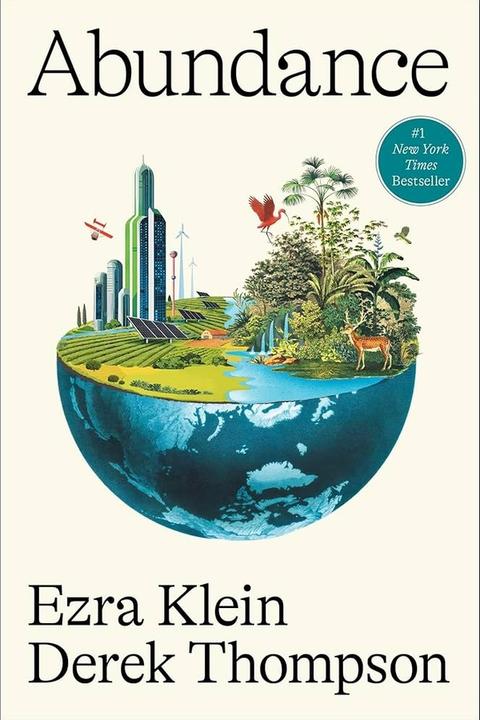
Abundance
by Ezra Klein & Derek Thompson
In one sentence
This book argues that many of our biggest problems—housing, energy, health, science, and infrastructure—are the result of chosen scarcity, and that a “liberalism that builds” can replace this with an abundance of the things that actually make life better.
Key takeaways
- Scarcity in core areas like housing, energy, and health care is mostly political and institutional, not technological or inevitable.
- Subsidizing demand without increasing supply (housing, college, health care, child care) just drives prices up and fuels rationing.
- Cities are engines of innovation and mobility—but zoning, NIMBYism, and restrictive rules have turned them into exclusionary luxury goods.
- Affluent societies accumulate rules, veto points, and organized interests that make actually building things painfully slow and expensive.
- American science is structurally biased against young researchers and risky, weird ideas—leading to lots of safe papers and too few breakthroughs.
- Government is not just a regulator; historically it has been a key inventor, funder, and deployer of major technologies (penicillin, highways, NASA, Warp Speed, etc.).
- The real bottlenecks are often organizational and political (rules, permitting, funding design), not purely technological.
- A politics of abundance asks, again and again: What is scarce that should be abundant? If we can’t build more of it, why not—and how do we fix that?
Summary
The book starts from a blunt thesis: scarcity is often a choice. We say we care about climate change, housing as a human right, and curing disease, yet we block clean energy projects, restrict new housing, and fund science in a way that punishes risk. Policymakers spend trillions subsidizing demand for goods whose supply is deliberately choked—housing, health care, education—creating a world where middle-class feel is cheap (TVs, gadgets) while middle-class security (housing, care, stability) is wildly expensive.
From there, the authors argue that growth and abundance come from productivity—doing more with the same people and resources through better ideas, technologies, and systems. They focus on a handful of building blocks that matter most: housing, transportation, energy, and health. They contrast our “Consumers’ Republic” (endless stuff to buy) with a new agenda that prioritizes what we can build: homes, clean power, medical breakthroughs, and the institutions needed to deliver them.
A big chunk of the book explores how we got stuck. Zoning, environmental review, local vetoes, adversarial legalism, and a culture of process-over-outcomes have made building anything—from apartments to solar to high-speed rail—slow and expensive. Affluence creates powerful organized groups that fight over distribution and values, and the political system increasingly rewards those who can navigate or create complexity (lawyers, consultants) rather than those who can pour concrete or design bridges.
On science and invention, the book diagnoses the “Karikó Problem”: young, risky, paradigm-shifting researchers are systematically disadvantaged by grant systems biased toward safe, incremental work. Despite more scientists, more papers, and more tools, many fields show diminishing returns. The burden of knowledge is real, but so is the organizational problem: everyone is crowding into the same safe topics and ignoring the weird trees in the forest that might hide the next penicillin, CRISPR, or GLP-1.
Finally, the authors lay out a political and institutional agenda: treat bottlenecks as design problems, use both push and pull funding (like Operation Warp Speed) to accelerate key technologies, reform zoning and permitting to make building easier, and shift liberalism away from everything-bagel proceduralism toward outcomes. They position abundance as an emerging political order that can cut through both right-wing scarcity populism and blue-state NIMBY scarcity, aiming for a society with more homes, more energy, more cures, and more capacity to build.
Reflections
This book basically frames a lot of things I already felt in my gut: the problem isn’t just “capitalism” or “markets,” it’s that we keep choosing structures that make it almost impossible to build the stuff that matters. We scream about affordability and climate, but then layer rules, veto points, and procedural safeguards on top of everything until it all grinds to a halt.
The housing sections hit hard. The idea that homelessness tracks rents and vacancy—more than poverty or unemployment—turns the whole debate on its head. It’s not that “these cities just have more broken people”; it’s that they have deliberately constrained housing. Same with the story of boardinghouses: we regulated out the cheap, imperfect options, then acted shocked when the only remaining alternative for some people is a tent under an overpass. That’s a brutal but clarifying way to see “housing as a policy choice.”
I also like the way the book refuses to romanticize “small is beautiful” or endless local control. The Olson/corporate-lawyer angle explains why a lot of ambitious people run toward software and away from things like high-speed rail or housing: it’s just soul-crushing to spend your life in permitting hell. That rings true. Building in the real world (or even just renovating) feels like fighting a thousand tiny vetoes, each backed by some piece of process or some group doing “values-based” opposition.
On science, the Karikó story and the novelty-bias experiments make the slowdown feel less mysterious. It’s not that we ran out of ideas; it’s that we’ve built a giant machine that punishes the exact mindset that produces breakthroughs. I like the “weird trees in the forest” metaphor—most people are staring at the same couple of trees because that’s where the citations and grants are. Meanwhile, things like GLP-1 from lizard venom and CRISPR from obscure bacterial defenses remind us how weird the actual path of discovery is.
The abundance framing also feels optimistic in a grounded way. It doesn’t say “tech will save us” or “government is the problem.” It says progress comes from pairing public vision and risk with private ingenuity and iteration. Government should do what others can’t or won’t: fund the early stages, de-risk deployment, pick some big bets (penicillin, solar, Warp Speed), and then get out of the way where it’s actually the bottleneck. The questions at the end—What’s scarce that should be abundant? What is hard to build that should be easy?—are a useful lens for basically any project, from national science policy down to “how do we build more housing in my county.”
For me personally, there’s an obvious throughline: if housing and energy abundance are this central, it’s not crazy to think about organizing a local “build club” or investment group to add units in places like Lunenburg County (or Nova Scotia, or Canada). The book nudges me to look at rules and bottlenecks first, not just “market demand.” Where exactly are the chokepoints—zoning, permitting, financing—and how do you design around or push through them? That’s a much more actionable way to think about “making things better” than just tweeting about inequality.
Who should read this
- People who care about housing, climate, or infrastructure and feel frustrated that nothing big ever seems to get built.
- Policy nerds and political junkies who want a framework beyond “left vs right” to explain why government keeps failing at execution.
- Scientists, founders, and technologists who sense that institutions are holding back progress and want language for the bottlenecks.
- Liberals who feel uneasy about NIMBY politics, process obsession, or blue-state dysfunction and want a constructive alternative.
- Anyone curious about how cities, zoning, science funding, and government design quietly shape their opportunities and quality of life.
Favorite quotes
- Scarcity is often a choice: if we truly want a different future, we have to build and invent more of what we need, not just argue about who gets the too-small pie.
- Giving people subsidies for goods whose supply is choked is like building a ladder to chase an elevator that’s racing upward.
- We have an uncanny economy where the secure middle-class life is receding, but the material trappings of middle-class success have never been cheaper.
- “Abundance…is a state in which there is enough of what we need to create lives better than what we have had.”
- Cities are “the absence of physical space between people and companies,” and proximity has become more valuable as the cost of long-distance connection has fallen.
- Symbolically liberal, operationally conservative: blue America puts “No human being is illegal” signs in single-family-only zones and then blocks the housing that would actually include more people.
- “Homeownership works for some because it cannot work for all.” Housing cannot be both a universal wealth machine and universally cheap.
- We didn’t just stop building boardinghouses; we made them at least functionally illegal—then wondered why more people ended up in encampments.
- Affluent societies accumulate organized interests and procedures until the hardest thing to do is to actually complete a big project.
- When the government is judged on processes instead of outcomes, legitimacy gets tied to box-checking rather than solving problems.
- In science, “too many projects get funding because they are probable, but science moves forward one improbability at a time.”
- The “burden of knowledge” is real, but an equally big problem is everyone looking at the same few trees, while weird, neglected trees—like lizard venom or bacterial immune systems—hide the next breakthrough.
- DARPA’s lesson: give smart program managers power, let them make counterintuitive bets, don’t punish failure, and don’t subject everything to risk-averse peer review.
- Most major inventions don’t matter at first; the world changes through tinkering, embodiment in infrastructure, and scaling—microinventions more than eureka moments.
- The highest purpose of a pro-invention government is to make possible what would otherwise be impossible.
- Advance market commitments and pull funding solve a basic problem: companies won’t scale production of expensive new tech if they can’t trust demand will be there.
- Operation Warp Speed worked because everyone, from generals to staffers, could answer the same question the same way: deliver at least one safe and effective vaccine, at scale, by the end of the year.
- “Rather than climate denial, the environmental community has tradeoff denial”—we act like we can avoid hard choices and still build fast.
- Right-wing populism thrives on scarcity; blue-state scarcity politics (like tight housing) helped create the conditions for that populism.
- Abundance is “a liberalism that builds”: more homes, more energy, more cures, more construction, and institutions that can actually deliver.
FAQ
Is this book worth reading?
Yes, especially if you feel stuck in the usual “taxes and culture war” framing. The book offers a clear, coherent explanation for why we can’t build housing, infrastructure, or clean energy at the speed we need—and what a different politics might look like. It’s part diagnosis, part blueprint, and it’s concrete enough to change how you see local fights over zoning, permitting, and science funding.
What is the main argument of the book?
The core argument is that many of our scarcities are chosen: we’ve built institutions, rules, and funding systems that block supply in crucial areas. Instead of focusing only on redistribution or demand, we need a “politics of abundance” obsessed with making it easier to build more of what matters—homes, clean power, medical breakthroughs, and public works.
How is this different from a normal pro-growth or pro-market book?
This isn’t a simple “free market” or “cut red tape” rant. The authors are very explicit that markets alone won’t prioritize clean energy or risky, socially valuable science. Government has to act as investor, inventor, and bottleneck-solver—using models like DARPA, Warp Speed, and advance market commitments—while also reforming the very processes that make public projects so slow and expensive.
What does the book say about housing and homelessness?
It argues that high housing costs and homelessness are fundamentally about supply: places with high rents and low vacancy have more homelessness, regardless of poverty and unemployment rates. Zoning, minimum lot sizes, parking rules, and bans on “low-end” options like boardinghouses created artificial scarcity. Fixing homelessness at scale means building a lot more housing and undoing the policies that made that hard.
Why do the authors focus so much on cities?
Cities are where innovation, productivity, and mobility happen. Evidence shows that people in large metros are about 50% more productive, and kids who grow up in high-innovation places are more likely to become inventors themselves. But when housing in those cities becomes insanely expensive, poor and middle-class families are pushed out, and cities stop being engines of opportunity and turn into gated communities for the already-successful.
What’s the “Karikó Problem” in science?
The Karikó Problem is shorthand for a system where young, risky, high-potential scientists are sidelined by funding structures biased toward safe, incremental work. NIH peer review penalizes highly novel proposals, younger scientists struggle to get grants, and everyone is nudged into crowded safe topics. That’s bad for breakthroughs in medicine, climate tech, and everything else we need.
How does the book think government should support innovation?
It highlights a few tools: empowering DARPA-style program managers, using push and pull funding (grants plus guaranteed purchases), experimenting with grant models (lotteries, golden tickets, reduced paperwork), and focusing on big, clear goals like Warp Speed did. The key is to make possible what private actors alone cannot, then let the market compete and iterate on top.
Is the book critical of liberals?
Yes, but from the inside. It argues that liberal politics often overvalues process and underweights outcomes: everything-bagel projects with too many goals, environmental rules that block clean energy as much as fossil projects, zoning used to keep out new neighbors while flying progressive flags. The book calls for a “liberalism that builds” instead of one that mainly regulates and litigates.
Is this book still relevant in a polarized, populist era?
Probably more relevant. Scarcity and dysfunction are fuel for populism: when housing, health care, and energy feel out of reach, it’s easy to blame outsiders or “elites.” The abundance lens suggests an alternative: fix the supply bottlenecks, build visibly useful things, and restore some trust that democratic government can deliver. That doesn’t solve polarization on its own, but it shrinks the space where demagogues thrive.
How can I use this book practically?
You can use it as a diagnostic tool. For any local or national issue, ask: What should be abundant here? What is hard to build that should be easy? Where is the bottleneck—rules, funding design, permitting, capacity, political veto points? It’s a lens you can apply to housing in your town, deployment of clean energy, or even how your own projects are structured.
Detailed Notes
Click to expand the full detailed notes →
Detailed Notes
Click to expand the full detailed notes →
Core Ideas of the Abundance Agenda
1. Scarcity Is a Choice
- Many shortages (housing, doctors, clean energy build-out) are downstream of explicit policy choices: zoning rules, residency caps, permitting processes, funding designs.
2. Demand Subsidies Without Supply = Disaster
- We pour money into housing, college, and health care access, but when supply is constrained, subsidies just raise prices and force rationing (“a ladder chasing an elevator that’s racing upward”).
3. Cities as Engines of Innovation and Mobility
- Cities are “the absence of physical space between people and companies.”
- Despite remote tech, proximity has become more valuable: people in large metros are ~50% more productive even after controlling for education and IQ.
- Cities drive idea spillovers, innovation, and upward mobility (Chetty-style evidence on where kids grow up and later outcomes).
4. Lawn-Sign Liberalism & Zoning as a Scarcity Machine
- Blue-state voters are symbolically liberal but operationally conservative: they display inclusive values while blocking new housing in their neighborhoods.
- Zoning evolved from basic separation of uses into a dense web of anti-growth rules: minimum lot sizes, parking requirements, bans on boardinghouses, limits on roommates, etc.
- Homelessness is strongly correlated with high rents and low vacancy, not with poverty or unemployment per se—making it fundamentally a housing/supply problem.
5. The 1970s Inflection Point & the Home as Asset
- Around the 1970s, housing shifted from affordable good to primary wealth asset.
- Rising inflation + slower homebuilding made existing homes more valuable, and homeowners turned to zoning and local politics to protect that value by restricting supply.
- “Homeownership works for some because it cannot work for all”—you can’t have housing that’s both a wealth machine and cheap and plentiful for everyone.
6. The Construction & Institutions Puzzle
- Historically, construction productivity grew like manufacturing; since the 1970s it stagnated.
- Construction is dominated by tiny firms, constrained by local rules and politics, whereas manufacturing can scale in one place and sell everywhere.
- Mancur Olson’s “organizations of affluence” + America’s lawyer-heavy, process-centric governance create endless veto points and legal battles that stall projects.
7. Government Capacity and Process Overload
- Federal spending has grown ~5x since 1960, but the federal workforce is roughly the same size.
- Public agencies outsource more, lose in-house expertise, and become dependent on consultants and vendors—often raising costs.
- Liberal governance has drifted into “adversarial legalism” and “everything-bagel liberalism”: layering on procedures and extra goals until nothing gets finished.
8. The Karikó Problem & Science Slowdown
- American science funding is biased against young researchers and highly novel ideas.
- NIH peer review systematically gives lower scores to more novel proposals.
- The “burden of knowledge” is real, but organizational incentives—publish a lot, don’t rock the boat—steer scientists to safe topics and incremental work.
9. Idea Factories & Better Funding Models
- DARPA is a model: empowered program managers, freedom from peer review, tolerance for failure, ability to assemble teams across academia and industry.
- Howard Hughes–style funding (back the person, not the project) produces more flops and more hits.
- “Metascience” argues we should treat science funding itself as an experiment—test different grant models, lotteries, golden tickets, paperwork reductions, and study what works.
10. The Eureka Myth & Microinventions
- Inventions rarely matter until they’re tinkered with, embodied in infrastructure, and scaled.
- Penicillin, solar, nuclear, batteries—what changed the world was not just discovery but coordinated, messy, large-scale deployment and cost reduction (Wright’s law learning curves).
11. Bottleneck Detection & Funding Design
- Many crises are bottleneck problems: doctor shortages driven by residency caps, vaccine delays driven by demand uncertainty, etc.
- Push funding (grants, loans) + pull funding (advance market commitments, guaranteed purchases) together can unlock private investment and speed deployment.
12. Focus as a Superpower
- Operation Warp Speed worked because everyone had the same clear goal: at least one safe and effective vaccine, at scale, by year-end.
- Crises can be reframed as mandates for focused abundance agendas: a Warp Speed for heart disease, clean energy permitting, or malaria.
13. Abundance vs Scarcity Politics
- Right-wing populism leans on scarcity—blaming immigrants or outsiders for resource competition and calling for strongmen to fix “failed” democracy.
- Blue America manufactures scarcity via zoning and process, then suffers the backlash.
- An abundance agenda asks: what should be abundant, what’s blocking it, and what institutions, technologies, and rules do we need to unlock it?
Introduction – Beyond Scarcity
- Thesis: to have the future we want, we must build and invent more of what we need; many scarcities are chosen, not inevitable.
- We claim to want climate action, housing as a right, and better health care, yet we shut down nuclear plants, fight solar farms, block housing, and tolerate research systems that pull scientists away from their most promising work.
- Subsidizing demand for scarce goods (housing, doctors, college) without increasing supply just drives up prices or creates rationing.
- Example stats:
- Median home price went from 2.2x average annual income (1950) to 6x (2020).
- Employer family health premiums tripled+ from 1999 to 2023; worker contributions quadrupled.
- Tuition exploded at both public and private colleges.
- Child care costs are eye-watering in states like MA, CA, MN.
- Example stats:
- We live in an “uncanny economy”: secure middle-class lifestyle receded, but cheap consumer goods proliferated. It used to be easy to attend college debt-free and impossible to buy a flat-screen TV; now it’s the reverse.
- Growth ultimately comes from productivity—doing more with what we have through new ideas, processes, and technologies. That’s where real abundance comes from.
- The market doesn’t distinguish between dirty and clean sources of wealth; government can and must. It also won’t fund risky technologies whose payoff is social, not immediately economic.
- Technology and politics co-shape each other: abundant cheap renewables or modular construction would open very different political possibilities than a world of energy scarcity and expensive building.
A Liberalism That Builds & The Abundant Society
- Authors focus on the left because they take decarbonization seriously; they see less value in designing green policies for a right that doesn’t broadly accept climate risk.
- Yet in practice, it is sometimes easier to build renewable energy in red states than blue, despite Republican climate skepticism.
- Populists feed on ineffective government: they promise to replace it with “effective” autocracy.
- Abundance is defined as a state: enough of what we need to create better lives.
- American policy has focused on a “Consumers’ Republic” (Lizabeth Cohen): abundant goods to buy, but shortages of what’s needed for a good life.
- The book calls for a reorientation toward production: housing, transportation, energy, health—and the people and institutions that build them.
1. Grow – Housing, Cities, and the Great Divergence
Cities & Housing Crisis
- Historically, moving to cities did more to change people’s status than moving to the frontier.
- Today, ~30% of American adults are “house poor” (30%+ of income spent on housing). This underestimates the problem because costs are worst in superstar cities where jobs are best.
- Many people choose between long commutes or moving to worse job markets just to find affordable housing—hidden drags on the economy and on lives.
- Ed Glaeser: before the 1980s, wages in NYC were high even after cost of living; by 2000, most people took an effective pay cut by moving there because housing costs rose so much.
Why Cities Matter
- Cities are “the absence of physical space between people and companies”—they solve the distance problem.
- Despite tech, cities have become more central, not less: proximity is more valuable in an ideas-and-services economy.
- People in metros >1M are 50% more productive than those in smaller metros, even controlling for education, industry, and IQ.
- Innovation often happens in dense, overlapping communities—think Bay Area AI scenes with engineers moving across companies and social groups.
Mobility & Place
- Raj Chetty’s work: mobility is heavily place-based. Kids born poor in San Jose have ~3x the chance of becoming wealthy vs kids born poor in Charlotte.
- Moving children to better neighborhoods earlier improves outcomes, including the likelihood of becoming inventors in the dominant local fields.
- But parents can’t move to high-opportunity places if housing is unaffordable—high costs repel the very people who would benefit most.
Lawn-Sign Liberalism, Zoning, and Homelessness
- Americans are symbolically conservative but operationally liberal; blue states invert this: symbolically liberal, operationally conservative.
- Yard signs proclaim inclusive values while zoning rules lock in exclusion: single-family-only areas, organized opposition to new housing.
- Zoning is relatively new historically: almost no city had zoning in 1900; by 1933, zoning covered 70% of the US population.
- It evolved from simple use separation (industrial vs residential) to anti-growth regulation controlling density, lot size, parking, and building types.
Homelessness as a Housing Problem
- Colburn & Aldern: poverty/unemployment don’t predict homelessness across cities; many poor cities have low homelessness, and rich cities have high.
- Strong relationship: high rents + low vacancy = more homelessness.
- If homelessness is a housing problem, it’s also the result of many small policy choices—zoning, building codes, parking rules, residency limits—that restrict supply.
- Boardinghouses once offered low-cost, modest rooms but were gradually regulated out of existence or rendered nonviable by modern codes and parking requirements.
What Happened in the 1970s?
- Multiple economic charts kink in the 1970s: stagnating wages, rising inequality, rising inflation, and sharply rising housing prices.
- Years of saving needed to buy a home: relatively flat mid-century, then jumps from ~2.4 years (1970) to 7 years (2000), with big regional differences.
- Rising inflation + slow home building turned existing homes into key wealth assets. To protect those assets, homeowners turned to politics:
- Bigger minimum lots, stricter parking requirements, opposition to apartments, constrained sewer expansion, etc.
- This created a structural tension: housing as affordable good vs housing as wealth machine. It cannot do both for everyone.
2. Build – Land, Energy, Construction, and Organizations
Land Use & Animal Agriculture
- Only 2–3% of habitable land is cities. About half of habitable land is used for agriculture, three-quarters of that for livestock or livestock feed.
- Animal agriculture drives climate change, deforestation, mass extinction, and water scarcity (e.g., 1,800 gallons of water per pound of beef).
- From a climate and moral perspective, industrial animal farming is a prime target for elimination; humans can thrive on vegetarian diets.
Energy & Pollution
- “Energy is the nucleus of wealth.” Abundant, clean energy is central to prosperity.
- Fossil fuels are finite and lethal; air pollution kills 7–9 million people annually, especially in places where people are energy-poor and burn dirty fuels.
- Hannah Ritchie: environmental action and economic growth are not in conflict; richer societies tend to clean their air and water as tech improves.
- Decarbonization in practice means: electrify everything—cars, heating, cooking, drying—and make that electricity clean.
The Construction Puzzle & Organizations of Affluence
- Mancur Olson: over time, stable, affluent societies accumulate organized interests that fight over distribution and process.
- These groups are slow to form but persistent, making policy more complex and making big projects harder.
- Construction productivity grew alongside manufacturing until ~1970; since then, construction productivity stalled while manufacturing continued to improve.
- Construction is dominated by small firms (<10 employees), limited by local land-use rules and politics; they can’t easily scale across jurisdictions.
- Complexity rewards people skilled at navigating it (lawyers, consultants), not necessarily those who build things.
Legalism and Losing Trust
- US is unusually legalistic: lots of lawyers, lots of litigation, many political questions resolved in courts.
- Lawsuits to enforce federal law rose from 3 per 100,000 people (1967) to 40 per 100,000 (2014).
- Lawyers dominate political leadership, especially in the Democratic Party.
- Public trust in government fell from 77% (1964) to 16% (2023), even as more processes were added trying to prove government’s legitimacy.
The Green Dilemma
- In the 1970s, the problem was building too much too heedlessly; now the problem is building too little and being paralyzed by process.
3. Govern – Capacity, Procedure, and Execution
Blue vs Red Housing Outcomes
- In 2023:
- SF metro: ~7,500 housing permits.
- Boston metro: ~10,500.
- NYC/Newark/Jersey City: <40,000.
- Houston metro: ~70,000.
- Houston has lower homelessness and cheaper housing (~$300K median vs ~$1.7M in SF), and can house homeless residents for far less per person.
- The key difference: it’s easier to build housing in places like Houston.
Procedure vs Outcomes
- Liberal governance tends to seek legitimacy through rule-following and process instead of results.
- Example: LA homelessness agencies spend huge time on audits and compliance while people live and die on the streets.
- Michael Gerrard’s “tradeoff denial”: trying to preserve everything and optimize for every value at once leads to paralysis, especially on climate infrastructure.
State Capacity & In-House Expertise
- Federal spending has grown massively since 1960, but the federal workforce is roughly the same size.
- Agencies outsource more and lose internal technical knowledge, leaving them vulnerable to cost overruns and vendor dependence.
- BART rail cars came in cheaper than expected when BART used in-house engineering capacity.
- Research: more staff in state DOTs correlates with lower highway cost per mile. Government needs enough in-house know-how to manage big projects.
Sedimented Systems & Civic Tech
- Jen Pahlka describes government tech and regulation as layers of sediment—new layers added without removing the old.
- Systems and rules have become “complex beyond our ability to imagine,” even as dedicated public servants do heroic work with outdated tools (e.g., pandemic tax credits and stimulus checks).
A Government That Chooses
- Example: I-95 collapse in Pennsylvania; emergency powers let the governor cut through process and reopen the highway in 12 days.
- The point isn’t “big vs small government” but whether government can choose and deliver outcomes, not just follow rules.
4. Invent – Science, Funding, and Metascience
Karikó & mRNA
- Katalin Karikó’s chance encounter at a photocopier with Drew Weissman led to the idea of using synthetic mRNA to trigger immune responses—eventually key to mRNA vaccines.
- Her story illustrates how risky, off-track ideas can be transformative, but often struggle within existing funding and career structures.
Science Slowdown & Burden of Knowledge
- Despite more professors, more tools, more data, and more papers, progress in many fields appears to be slowing.
- “Are Ideas Getting Harder to Find?”: it takes more and more research effort to eke out similar gains (e.g., in medicine).
- Benjamin Jones’s “burden of knowledge”: over time, more training is needed to get to the research frontier; the low-hanging fruit is gone, and climbing higher takes more resources.
Organizational Problems in Science
- The system favors safe, incremental projects that are “probable,” not improbable bets that drive big leaps.
- The share of young NIH-funded scientists (≤35) fell from 22% (1980) to <2% by the 2010s.
- Papers and patents are becoming less disruptive; many publications may be low impact, while truly novel research struggles to get funded.
- NIH-style peer review penalizes novelty: lab experiments show highly novel proposals get systematically lower scores.
Weird Trees & Surprise Breakthroughs
- GLP-1 drugs (e.g., Ozempic) trace back to obscure work on Gila monster venom.
- CRISPR emerged from studying strange bacterial immune reactions, initially with few citations.
- Breakthroughs often come from odd, under-the-radar obsessions, not from the crowded mainstream topics.
Idea Factories & Alternative Models
- DARPA works by empowering program managers with autonomy, no peer review, and tolerance for failure; they design ambitious programs, recruit teams, and cut across institutional boundaries.
- HHMI funding, which backs scientists rather than specific projects, leads to more failures but also more big hits.
Metascience and Experimenting with Funding
- Metascience: treat the science funding system itself as an object of experimentation.
- Ideas:
- Reduce paperwork and evaluate the effect.
- Expand early-career programs.
- Give reviewers “golden tickets” to fund one proposal regardless of scores.
- Use partial lotteries among meritorious proposals.
- Relax progress reporting for some grantees.
- Compare these experimentally to see which approaches yield more breakthrough work.
5. Deploy – From Invention to Impact
The Eureka Myth
- Invention is only the starting gun; progress is about implementation.
- Penicillin’s world-changing impact came from a massive, coordinated effort to produce and deploy it at scale during WWII.
- Joel Mokyr: microinventions (tinkering, incremental improvements, infrastructure, scaling) are often more important than the original breakthrough.
Learning Curves & Wright’s Law
- Wright’s law: costs fall as cumulative production rises—learning-by-doing.
- Solar and batteries are classic examples where sustained deployment drove down costs.
The Entrepreneurial State & Picking Winners
- The idea that government is “lousy at picking winners” doesn’t match history.
- Government helped “pick” or enable the internet, GPS, multitouch, highways, shale gas, and more.
- John Maynard Keynes: government should focus on doing things that aren’t being done at all, not duplicating what the private sector already does.
Advance Market Commitments & Warp Speed
- Push funding: grants, loans, and guarantees that lower the cost of trying.
- Pull funding: promises to buy successful products (advance market commitments), paying for success and reducing demand uncertainty.
- Operation Warp Speed used both push and pull funding to accelerate COVID vaccines.
Bottleneck Detective
- Many shortages (doctors, rockets, vaccines) have a specific bottleneck:
- Doctor shortage: federally limited residency slots.
- New tech: firms scared to invest without demand certainty.
- Policy can either remove blockers (expand residencies) or create new enabling programs (AMCs, guarantees).
Focus as a Choice
- Warp Speed’s edge was intense focus: one clear goal everyone shared.
- Crises are plentiful (heart disease, climate, malaria); choosing to treat them like Warp Speed is political, not technical.
Conclusion – Toward Abundance
- We’re living through the end of the neoliberal political order: deregulated markets, faith in free trade, and minimal industrial policy have lost credibility.
- Crises from the Great Recession to climate change to inflation have exposed the limits of that order.
- Right-wing populism thrives on scarcity, nostalgia, and the sense that government is incompetent and corrupt.
- Liberal scarcity politics (especially housing and procedural paralysis) unintentionally fuel that populism by making everyday life harder and more expensive.
- Abundance is offered as a new political lens:
- What is scarce that should be abundant?
- What is hard to build that should be easy?
- What inventions do we need but don’t yet have—and what’s stopping them?
- The agenda is not just more growth, but more of what matters: homes, energy, cures, and capacity. A liberalism that builds, not just one that regulates and redistributes.