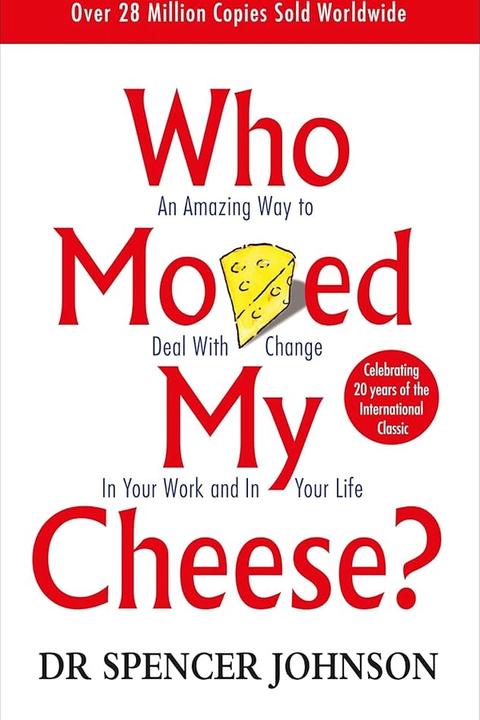
Who Moved My Cheese? by Spencer Johnson: Summary & Notes
by Spencer Johnson
3/10
Pass
creativityentrepreneurshiphabitsmindset
Related reading: Essentialism, Poor Charlie's Almanack, The 4-Hour Workweek
In one sentence
Change is inevitable—those who adapt quickly and look for new "cheese" thrive, while those who resist and complain get left behind.
Key takeaways
The Story & the Lesson, in 60 Seconds
- The setup: two mice (Sniff and Scurry) and two little people (Hem and Haw) live in a maze, relying on a station of Cheese — a metaphor for what you want (a job, money, a relationship).
- The Cheese disappears. The mice immediately scurry off to hunt new Cheese; Hem and Haw freeze, feel entitled to the old Cheese, and waste time in denial, blame, and fear.
- Haw finally adapts — laughs at his fear, ventures back into the maze, and finds New Cheese, leaving lessons on the wall as he goes.
- The Handwriting on the Wall (the takeaways): Change happens — they keep moving the Cheese. Anticipate it. Monitor it (smell the Cheese often so you know when it’s getting old). Adapt quickly. Change. Enjoy change. And be ready to change again, fast.
- The one question to sit with: "What would you do if you weren’t afraid?"
- Change happens—expect it and anticipate it
- The faster you let go of old cheese, the sooner you find new cheese
- Move with the cheese—don't cling to the past
- Enjoy change—embrace the adventure
- Be ready to change quickly and enjoy it again
- What would you do if you weren't afraid?
Summary
A silly story about mice and cheese meant to demonstrate that change is uncomfortable but we’re better off adapting to it.
The story might be useful for children; I think it’s just too silly and condescending for many adults to take it seriously.
The authors acknowledge that it’s not for everyone—apparently some people enjoy it!
Who should read this
- Anyone facing change at work or life
- People resistant to change
- Teams going through transitions
- Leaders managing organizational change
FAQ
What is the message of Who Moved My Cheese?
Change is inevitable and resistance is futile. The parable shows four characters reacting to change—those who anticipate and adapt thrive, while those who deny and resist fail. Success requires letting go and moving forward.
Detailed Notes
Notes
- The more important something is to you, the more you want to hold on to it.
- If you aren’t willing to change, you’ll become extinct.
- What would you do if you weren’t afraid?
- Things are rarely as bad as we think they will be in our heads.
- It’s better to take control of your own fate than let things happen to you.
- Be aware of your surroundings—the market, the world, the company, etc.—so you know when things are starting to change.
- Taking action—moving in a direction—is always better for figuring out what’s next when you’re uncertain.
- Being afraid is what causes us so much anxiety; getting started and losing that fear makes us feel much better.
- Imagine what your future will hold to motivate yourself to change in the present.
- Old beliefs will keep you tied to old behaviors. You need new beliefs—and an open mind—to encourage new behaviors.
- If you can laugh at your own folly, it will be much easier to change. Taking ourselves too seriously limits us to our old ways.
- The biggest inhibitor to change always lies within ourselves.
- We want to keep things simple, be flexible, and move quickly.
- Beware of imposing change in others; they will resist it if you force them.