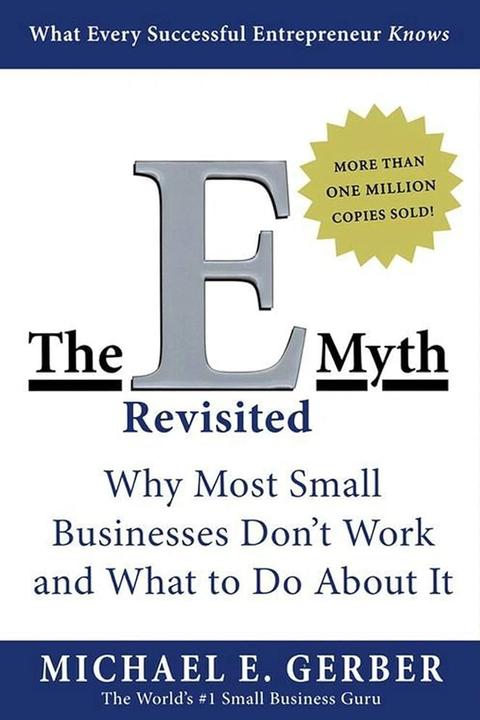
The E-Myth Revisited: Why Most Small Businesses Don't Work and What to Do About It
by Michael E. Gerber
In one sentence
This book argues that most small businesses fail because their owners think like technicians, not entrepreneurs, and shows how to build a systems-driven “franchise-style” business that serves your life instead of consuming it.
Key takeaways
The Core Framework
- The E-Myth (the fatal assumption): most small businesses are started by a "technician" who’s great at the work and wrongly assumes that’s enough to run a business. It isn’t — doing the work and owning the business are different jobs.
- The three roles in every owner: the Technician (does the work, lives in the present), the Manager (builds order and systems), and the Entrepreneur (the visionary). Most owners are ~70% Technician — that imbalance is the core problem.
- Work ON your business, not just IN it: build the business as a system that can run without you.
- The Franchise Prototype: design your business like a franchise — documented systems and processes that deliver consistent results and could be replicated by anyone.
- The Business Development Process: Innovation, Quantification, and Orchestration — continuously improve, measure, then systematize what works.
- Most small businesses are not started by true entrepreneurs; they’re started by technicians having an “Entrepreneurial Seizure” who mistakenly believe that knowing the work means they know how to run a business.
- You are not one person in business—you’re a mix of Entrepreneur (vision), Manager (order), and Technician (doer), and your problems come from over-identifying with the Technician.
- A business has life stages—Infancy, Adolescence, and Maturity—and most companies get stuck or die because the owner never makes the shift from “doing the work” to building a business that works.
- The real product of your business is not what you sell, but how you sell it—the business itself is the product.
- Great businesses are built as prototypes, with systems that are innovation-driven, quantified, and orchestrated so they can run consistently without depending on heroic individuals.
- Your business exists to serve your life, not the other way around—so you must start with your Primary Aim and then design a Strategic Objective and structure to fulfill it.
- Everything in the business should be organized around clear standards, roles, and documented systems, not personalities and improvisation.
- Marketing, management, hiring, and operations should all be built on systems that can be replicated, measured, and improved—like a franchise that could be cloned 5,000 times.
Summary
This book dismantles the romantic myth of the lone entrepreneur. It says most small business owners are actually technicians who got tired of working for someone else and decided to “go out on their own.” They assume that understanding the technical work of a business means they understand the business itself. That fatal assumption leads them into a trap: they build jobs for themselves instead of businesses.
To explain why this happens, the book introduces three personalities inside every owner: the Entrepreneur (visionary), the Manager (organizer), and the Technician (doer). Most owners are dominated by the Technician—70% or more—so they focus on “doing the work” and neglect the vision, systems, and structure their business needs to grow. As a result, their companies get stuck in Infancy or chaotic Adolescence, and rarely reach true Maturity.
The core idea is the “Turn-Key Revolution”: the shift to viewing your business as a prototype that could be replicated thousands of times, like a franchise. The real product isn’t your commodity—pies, financial plans, software, whatever—but your business itself: the predictable, systematized way you deliver value. Instead of relying on extraordinary people, you build extraordinary systems that ordinary people can run.
From there, the book lays out the Business Development Process: Innovation, Quantification, and Orchestration. You experiment to find better ways to do things, measure their impact, and then lock in what works through clear procedures and standards. This process is applied across seven key areas: your Primary Aim, Strategic Objective, Organizational Strategy, Management Strategy, People Strategy, Marketing Strategy, and Systems Strategy.
Ultimately, the book zooms out beyond business mechanics. It argues that a small business can be a dojo—a training ground for self-knowledge and growth. The purpose is not just profit; it’s to create meaning by caring deeply about the work, the people, and the systems you build. The business becomes a way to confront your own chaos, bring order to it, and build a world of your own.
Reflections
This book is basically a slap in the face for anyone who’s ever thought, “I’m good at this work, so I should start a business doing it.” The “Entrepreneurial Seizure” line hits hard because it describes the default path: you’re great at the craft, you get frustrated with your boss, and you decide to go solo—then suddenly you’re doing bookkeeping at midnight and managing people badly instead of doing the work you love.
The Entrepreneur–Manager–Technician split is one of those mental models that sticks. It’s easy to recognize myself in the Technician’s “If you want it done right, do it yourself” mindset. The problem is that this mindset scales exactly zero. The idea that a mature business starts with an entrepreneurial perspective—not just survives into it—forces a different question: if I’m building something now, am I acting like a future franchisor or like an overworked employee?
The franchise prototype concept is especially useful. Even if I never intend to actually franchise anything, thinking of my project as “unit #1 of 5,000” changes how I design it. Suddenly “documented checklist” goes from “nice to have” to “non-negotiable.” The rule about running the business with the lowest possible skill level is a bit humbling; it means I can’t hide lazy design behind my own competence.
I also like the way the book ties business back to life. Primary Aim comes first: what do you want your life to look like when it’s over? It’s a good antidote to the default assumption that the business is the point. Instead, the business is a training ground—a dojo—for confronting your own chaos and learning to care about the details. The idea that the business is where you test who you are, and that meaning comes from caring, makes the whole thing feel less like “optimize revenue” and more like “build something worthy.”
Finally, the systems section reminds me that most “talent gaps” are actually system gaps. The 20% of people who bring in 80% of the sales are usually just using some informal system the rest of the team doesn’t have. Turning that into scripts, benchmarks, and information systems is unsexy, but it’s the difference between a business that works once and a business that works every time.
Who should read this
- Technicians, freelancers, and solo operators who are considering turning their skill into a business.
- Small business owners who feel trapped in their own company, working constantly but never really “getting ahead.”
- Founders who want to build companies that can scale beyond their personal effort and heroics.
- Managers and operators who need a framework for building systems, roles, and processes that actually work.
- Anyone interested in treating their business as a dojo for personal growth, not just a machine for making money.
Favorite quotes
- The basic difference between an ordinary person and a warrior is that a warrior sees everything as a challenge, while an ordinary person sees everything as a blessing or a curse.
- The greatest businesspeople aren’t defined by what they know, but by their insatiable need to know more.
- Most failing businesses are run by owners who spend their time defending what they think they know instead of trying to get it right.
- A technician’s fatal assumption is that understanding the technical work of a business means understanding a business that does that work.
- If your business depends on you, you don’t own a business—you own a job, and it’s the worst job in the world because you work for a lunatic.
- A mature business doesn’t accidentally end up that way—it starts with a clear vision of what it is and why it works.
- The true product of a business is not what it sells but how it sells it; the business itself is the product.
- Your life does not exist to serve your business; your business exists to serve your life.
- Innovation without quantification goes nowhere; if you don’t measure it, you’re just guessing.
- If you haven’t orchestrated it, you don’t own it—and if you don’t own it, you can’t depend on it.
- Great people know how they got where they are and what they need to do to get where they’re going.
- People don’t buy commodities; they buy feelings—hope, control, peace of mind, power, love.
- The work we do is a reflection of who we are: if we’re sloppy at it, it’s because we’re sloppy inside.
- A business is a martial arts dojo where the real combat is not with others but with ourselves.
- Most people today aren’t getting what they want—from their jobs, families, religion, government, or themselves—because they lack a Game Worth Playing.
- Everything in your business is a system—things, actions, ideas, and information interacting to change other systems.
- You can’t change your life by starting “out there.” You have to start “in here” and build a world small enough to study—like a small business.
FAQ
Is this book worth reading for someone who’s just starting a business?
Yes. It’s almost especially valuable before you start. The book helps you avoid the default “technician trap” where you simply create a job for yourself. It gives you a way to think about designing your business as a prototype from day one, rather than fixing chaos later.
What is the “E-Myth” in simple terms?
The E-Myth is the myth that small businesses are started by entrepreneurs who understand business. In reality, most are started by technicians who understand the work, not the business. The myth is dangerous because it tricks people into thinking technical skill is enough.
How is this different from typical small business advice?
Instead of tactics (ads, pricing, hiring tips), this book focuses on structure and perspective. It teaches you to see your business as a franchise prototype, to design systems, and to build around roles and processes rather than personalities. It’s less “do these 10 hacks” and more “here’s how to think about building something that works.”
Is this book still relevant in a modern, online/tech world?
Yes. The examples are often brick-and-mortar, but the principles—systems, prototypes, roles, documented processes, customer-centric design—apply just as much to SaaS, solo creators, agencies, and productized services. “Your business is the product” is arguably more relevant now.
What are the main lessons about how to structure a business?
The key lessons are: separate your life from your business; define your Primary Aim; design a Strategic Objective; build an org chart around functions, not people; document and systematize everything; and treat your business as a prototype that could be replicated 5,000 times. Structure comes before growth.
How does this book suggest I approach marketing?
Marketing starts with the customer, not with your product. You identify your Central Demographic Model (who they are) and your Central Psychographic Model (why they buy), then design your business, messaging, and systems around their frustrations and desires. You use questionnaires, data, and observation to learn more about your customers than they know about themselves.
What’s the difference between working “in” the business and working “on” the business?
Working in the business is doing the technical work—baking pies, writing code, serving customers. Working on the business is designing systems, defining roles, documenting processes, and improving the model so the business can operate without your constant involvement. The book argues that your main job as an owner is to work on it.
How does the book connect business to personal meaning?
It argues that meaning comes from caring, and a business is a dojo where you can practice caring about details, people, systems, and standards. By clarifying your Primary Aim in life and designing a business to serve that aim, you turn entrepreneurship into a path of self-knowledge, not just income.
Does the book offer a concrete step-by-step framework?
Yes. The Business Development Program outlines seven steps: Primary Aim, Strategic Objective, Organizational Strategy, Management Strategy, People Strategy, Marketing Strategy, and Systems Strategy. Each step comes with questions, standards, and examples you can use as a checklist.
Is this book only for owners who want to franchise?
No. Franchising is used as a metaphor and design standard. You don’t need to actually franchise; the point is to build your business as if it were a prototype that must be replicable, consistent, and systems-driven. Even if you never open a second location, that mindset makes the first one far more resilient.
Detailed Notes
Click to expand the full detailed notes →
Detailed Notes
Click to expand the full detailed notes →
Foreword & Introduction
- Great businesspeople are defined by their relentless need to know more, not by what they already know.
- Failing owners often spend their energy defending what they think they know instead of examining it.
- Great businesses are built from many small, “boring” things done exactly right, with intention.
- Paying attention to these small things creates an essence that separates great businesses from mediocre ones.
- Survival and success don’t require superhuman traits; they require knowing what to do.
Key Ideas Introduced:
- Idea #1 – The E-Myth
- Myth: small businesses are started by entrepreneurs risking capital for profit.
- Reality: most are started for reasons unrelated to true entrepreneurship.
- Idea #2 – The Turn-Key Revolution
- A revolution in small business: who starts businesses, how they’re run, and how long they survive.
- Called the Turn-Key Revolution.
- Idea #3 – Business Development Process
- At the heart of the Turn-Key Revolution is the Business Development Process.
- When systematized and applied, it can transform any small business.
- Idea #4 – Step-by-Step Application
- The Business Development Process can be applied by any owner, step-by-step.
- It becomes a predictable way to create results and vitality if given time and attention.
Part I – The E-Myth and American Small Business
1. The Entrepreneurial Myth
- Huxley quote: people intoxicate themselves with work to avoid seeing themselves clearly.
- Technicians suffering an Entrepreneurial Seizure take work they love and turn it into a job.
- The work loses its specialness and becomes a chore among many others.
- Stages experienced by such technicians:
- Exhilaration
- Terror
- Exhaustion
- Despair
- Fatal Assumption: understanding technical work = understanding a business that does it.
2. The Entrepreneur, The Manager, and The Technician
- The owner is a three-way battle between Entrepreneur, Manager, Technician—no one wins unless integrated.
The Entrepreneur:
- Turns trivial situations into opportunities.
- Visionary, dreamer, catalyst.
- Lives in the future; happiest imagining “what-if” and “if-when.”
The Manager:
- Lives in the past.
- Craves order where the Entrepreneur thrives on change.
- Without the Manager, there is no planning, order, or predictability.
The Technician:
- The doer; motto: “If you want it done right, do it yourself.”
- Loves to tinker and do, not to dream.
- Lives in the present; loves the feel of work and getting things done.
- Typical owner mix: ~10% Entrepreneur, 20% Manager, 70% Technician.
- The Entrepreneur’s role: envision the business as something apart from the owner, ask why this business, and not another.
3. Infancy: The Technician’s Phase
- Infancy ends when the owner realizes the business can’t continue as-is and must change to survive.
- At that point, many owners quit—lock the door and walk away.
- The rest move into Adolescence.
- Business in Infancy = owner and business are the same.
- If the business depends on you, you have a job, not a business—and a terrible job at that.
- To move forward, the Technician must let go and make room for the rest of the self.
- Adolescence begins when the owner decides to get some help.
4. Adolescence: Getting Some Help
- Triggered by a crisis in Infancy.
- Owner hires help but often abdicates responsibility instead of managing.
- “Harry,” the helper, is also a Technician and needs clarity:
- Why he’s doing what he’s doing.
- The results he’s accountable for.
- Standards for evaluating his work.
- Where the business is going and how his role fits.
- Without management, the business goes into a tailspin.
- As the business grows beyond the owner’s Comfort Zone, three options emerge:
- Return to Infancy (“getting small”).
- Go for broke (grow until self-destruction).
- Hang on for dear life (Adolescent Survival).
Getting Small Again:
- Owner shrinks operations to regain control.
- Over time, the business atrophies and dies.
Going for Broke:
- Keep growing with no structure until the business collapses under its own momentum.
Adolescent Survival:
- Owner is strong-willed, stubborn, and refuses to quit.
- Approaches business as a jungle; fights daily battles.
- Survives through constant effort, but never changes.
- Consumed by the business; eventually the owner, not the business, explodes.
- Planning is essential: asking where you want to be, by when, what capital and people it requires, and what contingencies exist.
- Failures in planning are widespread—few owners have anything written down.
5. Beyond the Comfort Zone
- Comfort Zone = boundary of perceived control.
- Technician’s boundary: how much they can do themselves.
- Manager’s boundary: how many technicians or managers they can handle.
- Entrepreneur’s boundary: how many managers they can engage in pursuing the vision.
- Growth pushes beyond these boundaries, forcing change.
- Without clear roles and planning, chaos escalates.
6. Maturity and the Entrepreneurial Perspective
- Mature businesses know:
- How they got where they are.
- What they must do to get where they want to go.
- Maturity is not a natural consequence of Infancy and Adolescence; it must be designed.
- Companies like McDonald’s, FedEx, Disney started with a mature model.
- The founder with an Entrepreneurial Perspective goes through all stages differently.
Entrepreneurial vs Technician’s Perspective:
- Entrepreneur:
- Asks: “How must the business work?”
- Sees business as a system for outside results (customer, profits).
- Starts with future vision and works backward.
- Envisions whole first, then parts.
- Integrated worldview.
- Technician:
- Asks: “What work has to be done?”
- Sees business as a place to work for inside results (income).
- Starts with present and hopes to maintain it.
- Envisions parts and constructs a whole.
- Fragmented worldview.
Entrepreneurial Model:
- A model that fulfills needs of a specific customer segment in an innovative way.
- Sees business as a product on a shelf, competing with others.
- Focuses on how it’s done, not just what’s sold.
- Starts with a clear picture of the customer; without it, no business can succeed.
- Technician starts with their own skills and then asks, “How can I sell them?”
- Technician-designed businesses serve the creator, not the customer.
- To the Entrepreneur, the business is the product; to the Technician, the product is the commodity.
- Entrepreneur sees the customer as opportunity; Technician sees them as a problem.
- The task: give your inner entrepreneur a model of a business that works.
Part II – The Turn-Key Revolution: A New View of Business
7. The Turn-Key Revolution
- Systems theory: a system is an integrated whole whose properties can’t be reduced to its parts.
- Business Format Franchise: provides not just a name, but an entire system of doing business.
- Most founders still believe business success = product success.
- Trade name franchises rely on brand value only—this is less effective in a crowded brand world.
- Business Format Franchise drives growth in franchising:
- True product is the business itself—how it sells, not what it sells.
8. The Franchise Prototype
- Robert Pirsig’s metaphor: precision instruments create near-perfection that feels like magic.
- Franchise Prototype:
- A place to conceive and perfect systems.
- The system is derived from building the business, not brought in fully formed.
- Serves Entrepreneur (vision), Manager (order), Technician (technical work).
- Lets the owner feed all three personalities while building a business that works.
9. Working On Your Business, Not In It
- Your business is not your life; they’re separate.
- Purpose of your business = serve your life.
- Once you internalize this, you can work on the business with clarity.
- Pretend your business is the prototype for 5,000 more.
Rules of the Franchise Model:
- Provide consistent value beyond expectations to customers, employees, suppliers, lenders.
- Operate with the lowest possible level of skill so the model is replicable.
- Stand out as a place of impeccable order.
- Document all work in Operations Manuals.
- Provide uniformly predictable service.
- Use a uniform color, dress, and facilities code.
Value:
- Value is what people perceive it to be.
- Value shows up in small things: words, gestures, price, recognition, help.
Systems vs Experts:
- Build a business that’s systems-dependent, not expert-dependent.
- Ask: how can I systematically deliver the customer’s desired result?
Key Questions (Working On, Not In):
- How can I get my business to work without me?
- How can my people work without my constant interference?
- How can I systematize so the 5,000th unit runs as smoothly as the first?
- How can I own my business and still be free of it?
- How can I spend most of my time doing the work I love?
Part III – Building a Small Business That Works
10. The Business Development Process
- Building the Prototype is a continuous Business Development Process.
- Three integrated activities: Innovation, Quantification, Orchestration.
- Where the business is the product, how it interacts with the customer matters more than what it sells.
Innovation:
- Differentiates your business in the customer’s mind.
- Example: physically touching customers on the arm when asking for something increases positive responses.
- Innovation asks: “What’s the best way to do this?”—knowing the best way will never be found, but better ways will.
Quantification:
- Innovation without measurement is useless.
- Quantify everything related to how you do business:
- Number of customers per day, by time.
- Number of calls, inquiries, purchases.
- Units of specific products sold, by day/time.
- Busiest days and how busy they are.
Orchestration:
- Once you find what works, orchestrate it:
- Eliminate discretion at the operating level.
- Standardize behavior to ensure consistent results.
- Discretion is the enemy of order, standardization, and quality.
- If you haven’t orchestrated it, you don’t own it; if you don’t own it, you can’t depend on it; without dependability, you don’t have a franchise.
- Craftsperson mindset: quality is harmony, balance, passion, intention, attention—embodied in the work.
11. Your Business Development Program
- A seven-step Program:
- Primary Aim
- Strategic Objective
- Organizational Strategy
- Management Strategy
- People Strategy
- Marketing Strategy
- Systems Strategy
12. Your Primary Aim
- Volitional acts are defined by purpose and clear aim.
- Exercise: imagine your own funeral and the tape of your life story. What would you want it to say?
- That’s your Primary Aim.
- Ask:
- What do I wish my life to look like?
- How do I want my days to feel?
- What do I want to truly know?
- How do I want to be with others?
- How do I want to be thought of?
- What do I want to be doing in 2, 10, 20 years, and at the end of life?
- What do I want to learn (spiritually, physically, financially, technically, intellectually, relationally)?
- How much money will I need, and by when?
- Great people know how they got where they are and what they need to do next.
- Don Juan’s warrior vs ordinary man quote: warrior sees everything as a challenge.
13. Your Strategic Objective
- Strategic Objective is not a business plan; it’s a product of your Life Plan and Business Strategy.
- It’s a list of standards that help you measure progress.
First Standard: Money
- How big is your vision? What will the company’s revenues and profits be when done?
- Key question: how much money do you need—not in income, but in assets—to be free of work?
- Ultimately, there’s one reason to build a business: to sell it.
- Decide how much you want for it (e.g., multiples of earnings) and by when.
- Someone will buy it if it works.
Second Standard: An Opportunity Worth Pursuing
- The business must be capable of fulfilling your financial standards.
- Does it alleviate a frustration experienced by a large enough group of consumers?
- If not, no matter how exciting, walk away.
What Kind of Business Am I In?
- Most people answer with the commodity they sell (computers, hot tubs).
- Commodity = what the customer physically walks out with.
- Product = what the customer feels when they leave.
- Great businesses understand and sell that feeling (e.g., Revlon sells hope).
Who Is My Customer?
- Every business has a Central Demographic Model (most probable customer with defined characteristics).
- Also has a Central Psychographic Model (why they buy, their motivations).
- Demographics = who buys; psychographics = why they buy.
- To know if the opportunity is worth pursuing, you need enough selling opportunities (demographics) and the ability to satisfy perceived needs (psychographics).
Standards Three and Beyond:
- No fixed number; just necessary questions:
- When will the Prototype be completed?
- Where will you do business (local, regional, national, international)?
- How will you operate (retail, wholesale, hybrid)?
- What standards will you insist on (reporting, cleanliness, clothing, management, hiring, firing, training, etc.)?
14. Your Organizational Strategy
- Most companies organize around personalities, not functions, leading to chaos.
- Organize around positions and accountabilities.
- Position Contract: defines:
- Results to be achieved.
- Work and accountabilities.
- Standards for evaluation.
- Signature line for the person accepting the role.
Prototyping Positions:
- Create the picture of the finished business, then prototype from the bottom.
- Each position is treated as a mini-franchise.
- As you work in a position, you also work on it:
- Apply Innovation, Quantification, Orchestration.
- Ask: what best serves the customer, maximizes profit, and creates a good experience for the person in this role?
- Gurdjieff’s metaphor: the “driver” must take charge of the horse and carriage—one part of us must direct the others.
15. Your Management Strategy
- “The System is the Solution.”
- A Management System is designed into your Prototype to produce a marketing result.
- The more automatic it is, the more effective the Franchise Prototype.
Example: Hotel Operations Manual
- Manual = series of checklists, color-coded:
- Yellow: Room Setup.
- Blue: Guest Support Services (lighting fires, mints on pillows, etc.).
- Each room support person receives packages of checklists for their rooms daily.
- Each checklist details the specific steps needed to perform their tasks.
16. Your People Strategy
- “Life games reflect life aims.”
- To get things done, create an environment where doing the work well is more important than not doing it.
- Manager’s respect for the Boss translates into respect for the work.
Boss’s Philosophy:
- Work reflects who we are inside.
- Sloppy work = sloppy inside; lateness or boredom at work reflects inner state.
- Even menial work can be art when done by an artist.
- Work is not outside us; it’s a mirror of our inner world.
Three Core Ideas:
- The customer is not always right, but it’s our job to make them feel that way.
- Everyone is expected to work toward being the best at their tasks; if they can’t yet, they should act as if they are until they get there—or leave if unwilling.
- The business is a place where what we know is tested by what we don’t; growth and meaning come from that conflict.
- The business is a dojo—a place to practice being the best we can be.
- The real combat is internal, not between people.
Rules of the “People Game”:
- Don’t decide what you want people to do then try to create a game around it; the game must come first.
- Don’t create a game you’re unwilling to play yourself.
- Build in ways to win without ending the game; victories keep people engaged.
- Change tactics over time but keep the core ethic intact.
- Don’t expect the game to be self-sustaining; remind people constantly.
- The game must make sense—logic plus emotional commitment.
- Plan for fun occasionally; not all the time, but often enough to look forward to.
- If you can’t think of a good game, borrow one and learn it deeply.
Hiring Process Example:
- Scripted group presentation of the Boss’s idea, business history, and candidate attributes.
- Individual meetings to discuss reactions, feelings, and fit.
- Scripted phone notification for successful candidates.
- Standard letter for unsuccessful applicants.
- First-day training:
- Review Boss’s idea and business systems.
- Facility tour showing systems and interdependence.
- Answer questions clearly.
- Issue uniform and Operations Manual.
- Review Strategic Objective, Organizational Strategy, Position Contract.
- Complete paperwork.
Hierarchy of Systems:
- How We Do It Here.
- How We Recruit, Hire, and Train People to Do It Here.
- How We Manage It Here.
- How We Change It Here.
- The “It” is the stated purpose of the business (e.g., Caring).
- Express the “It” in every action—from answering the phone to taking money.
17. Your Marketing Strategy
- Marketing Strategy starts, ends, lives, and dies with the customer.
- Customers’ buying decisions are irrational; what they want is often different from what you think they want.
Two Pillars: Demographics & Psychographics
- You can’t know what the customer wants unless you know them better than they know themselves.
- Demographics: who buys.
- Psychographics: why they buy.
Data Collection Example:
- Use questionnaires in exchange for a free product (e.g., pie).
- Collect:
- Demographic data (age, income, etc.).
- Psychographic and preference data:
- Colors, shapes, words.
- Brands of perfume, cars, clothes, jewelry, food.
- Study ads used by brands your customers already buy from.
- Use that data to design your own messaging.
Trading Zone:
- Identify where your current customers live.
- Plot addresses, draw a boundary—this is your Trading Zone.
- Buy lists of similar people within that zone.
18. Your Systems Strategy
- A system: set of things, actions, ideas, and information that interact and alter other systems.
- Everything is a system.
Three Types of Systems:
- Hard Systems: inanimate (computers, colors, layout).
- Soft Systems: living or idea-based (people, scripts, processes).
- Information Systems: measure interactions (inventory, cash flow, sales reports).
Example Soft System: Selling System
- “80/20” sales rule: top 20% use a system; others don’t.
- Selling system = orchestrated interaction between salesperson and customer.
Six Steps to a Selling System:
- Identify Benchmarks (decision points).
- Script the words for each Benchmark.
- Create materials for use with each script.
- Memorize scripts.
- Deliver scripts identically.
- Communicate effectively by engaging prospects fully.
Structure vs Substance:
- Structure = what you do (scripts, materials, clothing).
- Substance = how you do it (tone, presence, delivery).
Power Point Selling Process Benchmarks:
- Appointment Presentation
- Needs Analysis Presentation
- Solutions Presentation
Appointment Presentation:
- Purpose: make an appointment, not qualify the customer.
- Uses emotionally compelling language about product (e.g., control over money) rather than commodity.
Needs Analysis Presentation:
- Reestablish emotional commitment from the initial contact.
- Explain how the meeting will proceed.
- Establish company credibility and personal commitment.
- Describe the system and its benefits (e.g., Money-Controlling System).
- Complete the diagnostic questionnaire.
- Provide initial information and show relevance to future solutions.
- Schedule Solutions Presentation.
Solutions Presentation:
- Easiest stage if previous steps were done right—the sale is emotionally made.
- Selling is opening, not closing.
- Review prior meetings, go through the Financial Report in detail, ask which option best serves the prospect now, then stay quiet.
- The next person who speaks buys—either the product, or a “no sale.”
Information System Example:
- Track:
- Calls made, prospects reached, appointments scheduled/confirmed/held.
- Needs Analyses scheduled/confirmed/completed.
- Solutions Presentations scheduled/confirmed/completed.
- Number of solutions sold and average dollar value.
- This data:
- Shows conversion rates between Benchmarks.
- Reveals where each salesperson needs help.
- Differentiates who’s “on the system” vs. off.
- Allows calculation of cost per call, per Benchmark, and per sale.
19. A Letter to Sarah & Epilogue
- Freedom is achieved gradually, not in a single leap.
- Existential writers saw meaning as a life-and-death question.
- Meaning comes from caring; we lack meaning because we don’t care deeply about things that matter.
- Many modern cares are insignificant compared to weightier standards.
- We’re not very serious people; our inner chaos shows up as outer chaos.
Epilogue – Bringing the Dream Back
- Old boundaries and rules are dissolving; new ones arise but don’t stick in a world of accelerated change.
- Result: chaos and disorder—externally and internally.
- The world is not the problem; we are. The world’s apparent chaos mirrors our inner turmoil.
Small Business as Dojo:
- Dojo: miniature cosmos to confront fears, habits, and reactions.
- Business is like a dojo:
- It instantly responds to our actions.
- It’s a place to implement ideas that change lives.
- It’s a lab for testing our assumptions about ourselves.
- The entrepreneurial revolution is a flight from external chaos into a personally designed world.
- It reflects a yearning for structure, form, control, and a deeper relationship with ourselves and the world.
- We can’t change our lives by starting “out there”; we must start “in here” with a small world we can study—like a small business.
Chinese Proverb:
- When you hear something, you forget it.
- When you see something, you remember it.
- When you do something, you understand it.
The small business is where you do—and finally understand.