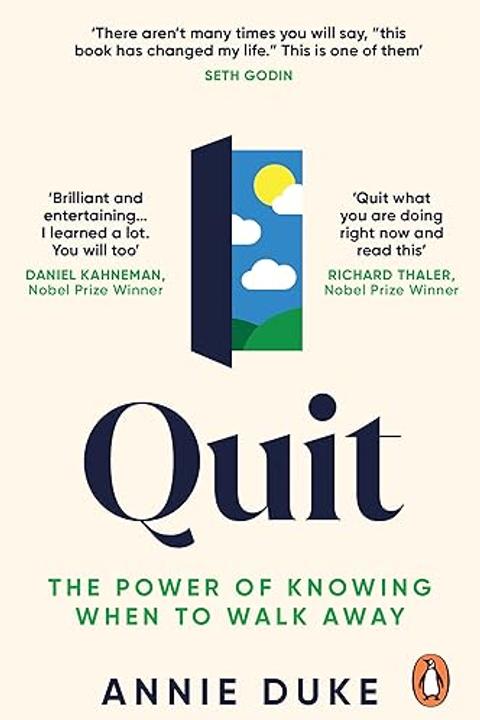
Quit: The Power of Knowing When to Walk Away
by Annie Duke
In one sentence
Quit argues that the real skill in life isn’t grinding forever, it’s knowing when to walk away from the wrong path so you can double down on the right one.
Key takeaways
- Quitting and grit are two sides of the same decision: what to walk away from so you can stick to something better.
- Good decisions under uncertainty rely on expected value, not hope or sunk effort.
- Quitting on time almost always feels like quitting too early, especially when you’re “in the losses.”
- Loss aversion, sunk costs, endowment, and status quo bias all conspire to keep you stuck in bad paths.
- You should tackle the hardest part first (“monkeys and pedestals”) and set kill criteria in advance.
- Identity, ego, and fear of looking inconsistent make quitting much harder than it logically should be.
- Having a “quitting coach”—someone who loves you but doesn’t care about your hurt feelings—is one of the best tools for better quitting.
- The point isn’t to quit more or grit more; it’s to optimize opportunity cost and free up time, money, and energy for higher-value paths.
Summary
This book is a systematic defense of quitting in a world that worships perseverance. Annie Duke argues that most of us quit too late, not too early, because we overvalue grit, underestimate uncertainty, and ignore the hidden cost of sticking with the wrong things. She makes the case that quitting is not the opposite of success—it’s often the prerequisite for it.
A central theme is that we make decisions under uncertainty with incomplete information. As we get new information, we should update our beliefs and be willing to walk away. The problem is that our brains are wired with biases—loss aversion, sunk cost, endowment, status quo bias, identity, and optimism—that make it emotionally painful to quit, even when the rational expected value is clearly negative.
To counteract those forces, Duke offers tools: thinking in expected value, “monkeys and pedestals” to focus on the hardest problem first, and “kill criteria” that combine clear states and dates for when you’ll exit. She also emphasizes the value of exploration and optionality: even when something is going well, you should still be looking around, building skills and options so you’re not trapped when circumstances change.
The book also tackles the emotional and social side of quitting. We tie our identity to our beliefs, projects, and careers, then feel like quitting means we’re admitting failure or inconsistency. We overestimate how harshly other people will judge us, and we confuse being “nice” with avoiding uncomfortable truths. Duke suggests deliberately recruiting a quitting coach—someone who cares about your long-term interests more than your short-term feelings.
Finally, she reframes failure and waste. Failure isn’t stopping before the finish line; it’s continuing down a path that no longer has a positive expected value. Waste isn’t what you’ve already spent—you can’t get that back—it’s the extra time and money you keep pouring into a losing cause. Quitting, done well, is how you stop that waste and redirect yourself toward better opportunities.
Reflections
This book reframes quitting from “personal weakness” to a core decision-making skill. The line that sticks with me is that success isn’t about sticking to things—it’s about picking the right things to stick to and quitting the rest. That’s a very different lens from the usual “never give up” mantra.
The expected value framing is especially useful. Instead of asking “Can I make this work if I grind hard enough?”, the better question is “Given the probabilities and potential payoffs, is this still the best use of my limited time and energy compared to other options?” It forces you to compare, not just persevere.
The idea that “quitting on time feels like quitting too early” is uncomfortable but true. The moment that’s emotionally safe to quit is usually well after the rational exit point. That helps explain why so many jobs, projects, and relationships drag on long after everyone knows they’re not working.
“Monkeys and pedestals” is a simple but brutal filter for projects. It’s a direct attack on procrastination disguised as productivity—the hours spent polishing logos, refining minor features, or over-optimizing small things before you’ve proven the hard part is even possible. It’s a reminder to deliberately chase fast “no’s,” not just slow “maybe’s.”
The sunk cost + identity combo feels like the deepest trap. It’s not just the time/money invested—it’s “what it means about me” if I stop. This explains why people stay at prestigious but miserable jobs, cling to public opinions long after the evidence changes, or keep pushing a failing project because “I’m not a quitter.” The book makes a strong case that clinging to an outdated identity is the real quitting—quitting on your future self.
I like the notion of having a quitting coach. It’s very hard to be objective when you’re emotionally and financially invested. Having someone you’ve explicitly empowered to tell you, “Hey, by your own criteria, it’s time to walk away,” is a practical hack around your own biases.
The redefinition of “waste” is probably the most actionable mental shift: the waste isn’t behind you, it’s ahead of you if you keep going down the wrong path. Once you see it that way, quitting stops feeling like throwing everything away and starts feeling like cutting off the real waste.
Who should read this
- Founders, creators, and professionals who struggle to know when to shut down a project, pivot, or walk away.
- Anyone stuck in a job, relationship, or path that might be wrong, but feels too expensive to leave.
- Investors, poker players, traders, and decision-makers who operate under uncertainty and want a better quitting framework.
- High-achievers who default to “grit” and feel guilty at the idea of quitting anything.
- Leaders and managers who need to decide which projects to kill and how to design better decision processes.
- People who want a more rational, less emotional relationship with goals, failure, and “wasted” time.
Favorite quotes
- Success does not lie in sticking to things; it lies in picking the right thing to stick to and quitting the rest.
- Quitting and grit are two sides of the same decision.
- Decision-making in the real world requires action without complete information. Quitting is how we react to new information.
- Sticking with a course of action is the only way to know for sure how it would have turned out. Quitting requires being okay with never knowing “what might have been.”
- Quitting on time usually feels like quitting too early.Thinking in expected value helps you decide if the path you’re on is worth sticking to—not just in money, but in happiness, health, and fulfillment.
- When you feel like the choice between persevering and walking away is a close call, quitting is probably the better choice.Losses hurt about twice as much as equivalent gains feel good.
- When we’re in the gains, we tend to quit too early. When we’re in the losses, we tend to stick too long.
- The sunk cost effect turns your life into a Katamari: the more you roll forward, the more debris you accumulate, and the harder it is to stop.
- We don’t like to close mental accounts in the losses.Figure out the hard thing first, try to solve it as quickly as possible, and beware of false progress.
- Building pedestals creates the illusion of progress; tackling the monkey first gets you to “no” faster.
- When you say, “I’m not ready to decide yet,” what you’re really saying is, “For now, I choose the status quo.”
- We own what we’ve bought and what we’ve thought.
- When it comes to quitting, the hardest thing to quit is who you are.
- Optimism makes you stick longer, but it doesn’t necessarily make you succeed more. Unchecked optimism keeps you in losing games.
- What everybody needs is a friend who really loves them but doesn’t care much about hurt feelings in the moment.
- Success means following a good decision process, not just crossing a finish line.
- Waste is a forward-looking problem: the real waste is spending more time and money on something that’s no longer worth it.
FAQ
Is Quit worth reading?
Yes. If you’ve ever stayed too long in a job, relationship, or project, this book gives you a clear framework for making better exit decisions. It’s especially valuable if your default is to “just push harder” and you rarely consider quitting as a legitimate, strategic option.
What is the main idea of Quit?
The core argument is that quitting is not the opposite of success, but a key ingredient of it. Because we live in an uncertain world with limited time and energy, we need to constantly reassess whether our current path still has a positive expected value—and be willing to walk away when it doesn’t.
How does the book suggest we decide when to quit?
Duke recommends thinking in expected value, confronting the hardest part of a project early (“monkeys and pedestals”), and setting explicit kill criteria that combine states and dates. These tools help you avoid in-the-moment emotional decisions and instead follow a pre-committed, rational process.
What are the biggest psychological barriers to quitting?
The book highlights loss aversion, sunk cost, endowment effect, status quo bias, and identity. We hate realizing losses, overvalue what we own or built, prefer what’s familiar, and worry about looking inconsistent. All of these biases push us to stick with losing paths long after the data says we should exit.
How does Quit compare to books about grit and perseverance?
Where many books celebrate relentless persistence, Quit argues that grit without judgment is dangerous. It doesn’t dismiss persistence, but reframes it: the real question isn’t “How do I stick no matter what?” but “What is worth sticking to, and when should I stop?” It’s a complementary, corrective lens.
Is the book only about gambling, startups, or investing?
No. While it uses poker, trading, and startups as vivid examples, the principles apply to relationships, careers, health habits, and personal goals. Anywhere you face uncertainty and opportunity cost, the logic of quitting and expected value is relevant.
What is “monkeys and pedestals,” and why does it matter?
It’s a mental model for complex projects: the “monkey” is the hard, uncertain part; the “pedestal” is the easy, cosmetic part. Most of us spend too much time building pedestals to feel productive. Duke argues you should attack the monkey first so you can quickly learn if the project is viable or if you should quit.
How can I actually apply kill criteria in real life?
Before starting a project, job, or commitment, write down specific conditions under which you’d walk away: metrics not met by a certain date, quality-of-life thresholds, or behavior you won’t tolerate. Share these with a trusted “quitting coach” and agree to revisit them on a set schedule so you’re held accountable to your own rules.
Does quitting mean I wasted my time?
The book turns that idea upside down. The time and money already spent are gone either way. Quitting doesn’t waste them; it simply stops you from wasting more on a low-value path. The true waste is staying in something that no longer serves your goals when you could be doing something better.
Is this book still relevant in a “hustle culture” world?
If anything, it’s more relevant. Hustle culture often glorifies sacrifice and endurance for their own sake. Quit pushes you to ask whether the thing you’re hustling on is still worth it—and to see strategic quitting as a way to protect your time, health, and long-term upside.
Detailed Notes
Click to expand the full detailed notes →
Detailed Notes
Click to expand the full detailed notes →
Section I – The Case for Quitting
Chapter 1 – The Opposite of a Great Virtue Is Also a Great Virtue
- We celebrate people who respond to adversity by “soldiering on,” but quitters are invisible.
- If we don’t see or study good quitting decisions, it’s hard to learn from them.
- Quitting a course of action is sometimes the best way to “win” in the long run, whether that’s cutting losses at the poker table or getting to climb another day.
- Quit and grit are two sides of the same decision: what to continue and what to walk away from.
- Real-world decision-making happens under uncertainty:
- The world is stochastic (probabilistic); even good choices sometimes lead to bad outcomes.
- We lack complete information when we decide.
- After we act, new information shows up—facts, new models, preference changes, or observed outcomes.
- Quitting is the tool that lets us react to that new information and adjust course.
- Sticking is the only way to know for sure how a path would have turned out; quitting requires accepting that we’ll never know what might have been.
- Having the option to quit lets us explore more, learn more, and eventually discover the right things to stick with.
Chapter 2 – Quitting On Time Usually Feels Like Quitting Too Early
- The story of Glitch (Tiny Speck) illustrates that quitting on time feels like quitting too early.
- When it’s objectively right to quit, nothing catastrophic is necessarily happening at that moment.
- Getting the timing right means glimpsing the range of future outcomes and concluding the odds of success are too low.
Thinking in Expected Value
- To decide whether to stick or quit, you need an educated guess at the probability of good vs bad outcomes.
- Expected value (EV) helps answer:
- Is this option positive or negative for me in the long run?
- Which of my options has the highest expected value?
- EV calculation: identify reasonable outcomes, estimate their probabilities, multiply by their payoffs, and sum.
- Step 1: ask if the course of action (new or ongoing) has positive EV.
- Step 2: compare that EV to other options, acknowledging limited time, attention, and money.
- If another path has higher EV, switching will likely get you to your goals faster.
- EV applies beyond money: to marriage, where to live, happiness, health, and quality of life.
Examples & Heuristics
- Stewart Butterfield recognized that the probability of Glitch becoming a unicorn was too low to justify continued effort.
- A coaching conversation with a woman unhappy in her job:
- Staying: 100% probability of being unhappy in a year.
- Switching: <100% probability of being unhappy, with some chance of fulfillment.
- This showed that switching had higher EV even with uncertainty.
- EV can be measured in health, well-being, happiness, time, fulfillment, relationships, etc.
Empirical Evidence on Quitting
- Economist Steven Levitt studied people making big decisions via coin flips.
- Follow-ups at two and six months showed that, for big decisions, people who quit were happier on average than those who stuck.
- People generally quit too late.
- Rule of thumb: If the choice between quitting and persevering feels like a close call, quitting is likely the better option.
Chapter 3 – Should I Stay, or Should I Go?
Paper Gains and Paper Losses
- Behavior of 1990s NYC cab drivers matched patterns described by Kahneman and Tversky’s prospect theory.
- Prospect theory: a model of decision-making under risk that accounts for systematic biases.
- Key concept: loss aversion—losses hurt about twice as much as equivalent gains feel good.
- When deciding fresh, loss aversion makes us prefer options with lower chance of loss; it makes us risk averse and can stop us from starting.
- Once we have paper losses, we become risk seeking; we avoid locking in losses.
- Kahneman called this tendency sure-loss aversion.
- Sure-loss aversion makes us resist quitting something we’ve already started because quitting would “realize” the loss.
- Continuing keeps alive the hope of avoiding that realized loss.
- Revised aphorism: Quitting on time usually feels like quitting too early, especially when you’re in the losses.
Quit While You’re Ahead?
- Culturally, there’s tons of anti-quitting advice, but “Quit while you’re ahead” is a rare pro-quitting slogan.
- It’s often bad advice because it amplifies irrationality: we lock in small gains even when the game has positive EV.
- Reasonable only when the underlying game is negative EV (e.g., casino games like baccarat or craps).
- Better advice: Quit while you’re ahead when the game is a losing long-run proposition.
- If EV is negative, quit; if EV is positive, keep going, regardless of short-term gains or losses.
Take the Money and Run (Retail Traders)
- Retail traders show the same pattern:
- They set stop-loss (to cap losses) and take-profit orders (to lock gains).
- They tend to ignore stop-losses (keep losers) and honor take-profits (cut winners).
- Adhering to stop-loss forces realization of a loss, which is emotionally painful.
- Take-gain orders keep gains at risk once triggered; they’re used less rationally.
How Smart Is the Smart Money?
- Even experts struggle with quitting:
- Experienced cab drivers are better at quitting than new ones, but not perfect.
- In investing, portfolio managers outperform on buying decisions but underperform on selling.
- Experts earn excess returns on buys but lose basis points on sells, to the point that random selling from the portfolio would have been better.
- When buying, they focus on future potential; when selling, they neglect careful EV analysis.
- Best strategy: examine all holdings and sell the ones with the lowest future EV, not just the extreme winners/losers.
Feedback Problem in Quitting
- We naturally track what we’re doing; we see outcomes on the path we’re in.
- Once we quit, we:
- Lack data on what would have happened if we stuck (counterfactual).
- Tend to stop paying attention entirely (“out of sight, out of mind”).
- This lack of feedback makes it harder to improve our quitting skill.
Chapter 3 Summary Points
- Loss aversion: losses feel worse than equivalent gains feel good.
- Loss aversion makes us risk averse at the start.
- In gains, we quit too early; in losses, we stick too long (sure-loss aversion).
- Retail investors quit winners and hold losers.
- Even expert investors underperform on selling decisions.
- We get feedback on what we do, but not on what we quit, which hinders learning about quitting.
Section II – In the Losses
Chapter 4 – Escalating Commitment
- When in the losses, we’re more likely not only to stick to a losing course of action but to double down.
- This is escalation of commitment.
- Escalation is robust and universal: individuals, organizations, governments.
- It appears in high-stakes and low-stakes situations, showing how pervasive and deep the error is.
Chapter 5 – Sunk Cost and the Fear of Waste
The Sunk Cost Effect
- A rational decision-maker should only consider future costs and benefits.
- If continuing has positive EV, persist.
- If negative EV, quit.
- The sunk cost effect: people consider past, irrecoverable costs when deciding whether to continue.
- This causes people to stick to situations they should quit.
Katamari Relationships & Mental Accounts
- Example: dysfunctional relationships.
- People say “I’ve put so much time into this relationship” or “I’ve put my heart and soul into it.”
- The more time invested, the less likely they are to leave, so they keep investing, making it even harder to quit.
- The relationship accumulates living arrangements, shared friends, pets, property—like a Katamari rolling up more mass.
- Starting something opens a mental account; quitting closes it.
- In poker: starting a hand or sitting in a game opens accounts.
- In life: jobs, relationships, investments.
- We don’t like closing accounts in the losses.
- Folding means realizing money lost in the pot.
- Leaving a losing game means walking away with less than you started.
- Quitting a job/relationship feels like wasting the time and effort invested.
- Rational perspective: maximize EV across all accounts, not per account.
- Across a portfolio, some investments win, some lose.
- What matters is whether the portfolio as a whole is up.
- Poker players remind themselves “poker is one long game”; life is also one long game.
Chapter 5 Summary Points
- Sunk cost effect: we let past investments influence future decisions.
- It keeps us stuck in situations we should leave.
- Fear of “waste” is central: we don’t want to feel like time/money/effort was wasted.
- Phrases like “I’ll have wasted years of my life” are a red flag for sunk cost thinking.
- Sunk costs snowball: prior investment → harder to quit → more investment → even harder to quit.
- We dislike closing accounts in the losses.
- Knowing about sunk costs doesn’t fully protect us from them.
- You can’t easily “reset” your brain by pretending it’s a fresh decision.
Chapter 6 – Monkeys and Pedestals
Monkeys and Pedestals Model
- Advice distilled:
- Figure out the hard thing first.
- Try to solve that as quickly as possible.
- Beware of false progress.
- Pedestals: tasks you already know you can solve (e.g., logos, business cards).
- Monkey: the hardest, most uncertain part of the problem.
- Building pedestals creates an illusion of progress if the monkey is actually impossible or too hard.
Tackling the Monkey First
- Solving the monkey first gets you to “no” quickly.
- Reduces time, effort, and money sunk into dead-end projects.
- When we hit a hard problem, we often revert to pedestal-building instead of confronting that we might need to quit.
Kill Criteria
- Advance planning and precommitment can help you quit sooner.
- When entering an endeavor, ask:
- What signs would tell me it’s no longer worth pursuing?
- What could I learn about the world or myself that would change my commitment?
- Premortem: imagine failure and work backward to identify contributing factors; use these to craft kill criteria.
States and Dates
- Good kill criteria combine a state (a measurable condition) and a date (a time bound).
- Examples:
- “If I haven’t achieved X by Y date, I’ll quit.”
- “If by the time I’ve spent Z resources I haven’t hit target A, I should exit.”
- This can be applied to relationships (e.g., commitment by a certain time) and projects, jobs, etc.
Better, Not Perfect
- In poker, Duke used:
- Stop-losses (quit after losing a certain amount).
- Session length limits (quit after 6–8 hours).
- Conditions on game quality (quit if the table lineup worsened).
Chapter 6 Summary Points
- Monkeys and pedestals is a mental model to help you quit sooner.
- Pedestals = easy, already-solvable parts; monkey = the hard problem.
- Identify the hard part first, solve it fast, and beware of false progress.
- Doing easy tasks is wasted effort if the hard part is impossible.
- Tackling the monkey first limits sunk costs and makes quitting easier.
- We tend to build pedestals when we hit hard problems instead of quitting.
- Advance planning and precommitment (kill criteria) support better quitting.
- Kill criteria reduce the number of emotional decisions in gains/losses.
- In organizations, kill criteria reward rational exits instead of blind persistence.
- States and dates are a simple, common framework for kill criteria.
Section III – Identity and Other Impediments
Chapter 7 – You Own What You’ve Bought and What You’ve Thought: Endowment and Status Quo Bias
Endowment Effect & IKEA Effect
- Endowment effect: we value something more just because we own it.
- It applies to physical objects (wine, cars, houses) and to decisions about whether to sell (quitting ownership).
- Research shows we can become endowed to beliefs, ideas, and decisions too.
- “We own what we’ve bought and what we’ve thought.”
- IKEA effect: we value things we built ourselves even more.
- Starting with easy parts (pedestals) creates both sunk costs and endowment, making quitting harder.
Status Quo Bias & Omission-Commission Bias
- Status quo bias: preference for paths we’re already on or ways we’ve always done things.
- We view switching as a new, active decision; sticking as non-decision.
- We’re more concerned about bad outcomes from action (commission) than from inaction (omission).
- This omission-commission bias leads us to tolerate poor outcomes from the status quo more than from new choices.
- One key step to being a better quitter:
- Stop saying “I’m not ready to decide.”
- Recognize it as “For now, I choose the status quo.”
- It’s okay to need more information, but fear of switching shouldn’t freeze you.
Better the Devil You Know
- We prefer what we know to ambiguous alternatives, even if the alternative has higher EV.
- Reframing the choice (e.g., 100% certain unhappiness vs some probability of happiness) can make the EV advantage of switching clearer.
Chapter 7 Summary Points
- Endowment effect: we overvalue what we own.
- We can be endowed to objects, ideas, beliefs.
- Endowment obstructs quitting by inflating perceived value of what we own or started.
- We prefer the status quo.
- We accept bad outcomes from sticking more than bad outcomes from switching (omission-commission).
- “I’m not ready to decide” really means choosing the status quo.
- Even data-rich environments like professional sports suffer from sunk cost, endowment, and status quo bias.
Chapter 8 – The Hardest Thing to Quit Is Who You Are: Identity and Dissonance
- Quitting is hardest when it touches identity—our sense of who we are.
- Our ideas, beliefs, and actions become part of our identity.
Cognitive Dissonance
- When new information conflicts with beliefs, we experience dissonance.
- To resolve it, we can:
- Change the belief, or
- Rationalize away the new information.
- We often choose rationalization, preserving identity at the cost of accuracy.
- Dissonance can also arise from conflicts between new information and past actions.
- We want internal consistency between past and present beliefs and behavior.
- We also want others to see us as consistent; we fear being judged as wrong or irrational.
- When we believe our decisions are being evaluated, we think we’ll be more rational, but external evaluation often increases escalation of commitment.
- The more extreme the belief, the more mental gymnastics we’ll do to defend it.
- Facts are more likely to move you away from mainstream consensus than from a fringe belief.
- We often misjudge how others see us, so many irrational non-quitting decisions are based on incorrect fears about how we’ll look.
- Advice:
- Be picky about what you stick to.
- Persevere in things that matter and move you toward your goals.
- Quit everything else to free resources for what matters.
- Tools: identify the hard part first, use kill criteria and precommitment, and enlist outside help.
Chapter 8 Summary Points
- Hardest thing to quit is who you are.
- New information vs beliefs/action = cognitive dissonance.
- We often resolve dissonance by rationalizing instead of updating.
- We crave internal consistency and want others to see us as consistent.
- External scrutiny can increase escalation of commitment.
- Extreme positions are harder to abandon; consensus positions can be easier to leave.
- Fears about how others view quitting are usually overblown.
Chapter 9 – Find Someone Who Loves You but Doesn’t Care about Hurt Feelings
- Question: Does a founder owe it to employees to persevere?
- Ron Conway’s answer: life’s too short—for founders and employees.
- If success is no longer realistically on the table, continuing traps employees too.
Optimism & Calibration
- Study: more optimistic people stick with tasks longer but don’t perform better.
- They quit later, with no performance benefit.
- Optimism helps you persist when it’s worthwhile, but also when it’s no longer worthwhile.
- Optimism overestimates likelihood and magnitude of success, skewing EV.
- Unchecked optimism prevents quitting when you should.
Nice vs Kind; Quitting Coach
- Daniel Kahneman’s recipe: “Everyone needs a friend who loves them but doesn’t care much about hurt feelings in the moment.”
- A good quitting coach:
- Loves you.
- Looks out for your long-term well-being.
- Is willing to tell you hard truths that might hurt in the short term.
- Ideally, you both find a quitting coach and serve as one for people you care about.
- For organizations:
- Separate decision-makers for starting vs stopping projects when possible.
- This reduces emotional attachment and sunk cost bias.
Permission & Process
- For a quitting coach to be effective, you must explicitly give them permission to speak hard truths.
- Asking for advice ≠ giving permission.
- Ron Conway’s four-step method:
- Let them know you think they should consider quitting.
- When they push back, agree they might turn it around.
- Define clear short-term success metrics and write them as kill criteria.
- Revisit; if benchmarks aren’t met, have a serious quitting conversation.
Chapter 9 Summary Points
- Optimism can keep you stuck in low-EV options without improving outcomes.
- Life’s too short to spend time on no-longer-worthwhile opportunities.
- Outsiders can usually see your situation more rationally.
- Best quitting coach loves you and prioritizes your long-term interests over short-term comfort.
- Separating “start” and “stop” decision-makers improves quitting decisions.
- Permission is essential for an effective quitting coach.
Section IV – Opportunity Cost
Interlude III – The Ants Go Marching… Mostly
- Even when something is working, it’s wise to keep exploring other options.
- Jobs, careers, products, strategies, even favorite restaurants: keep looking.
- “Never stop exploring” is a good strategy in an uncertain world.
Chapter 10 – Lessons from Forced Quitting
- Defaults and nudges (from Thaler & Sunstein’s Nudge) illustrate how systems can push us into or out of paths without explicit decisions.
- Being forced to quit (e.g., layoffs, business failures) forces exploration of new opportunities.
- Sometimes Plan B is better than Plan A—but we only discover that if we explore.
- We shouldn’t wait to be forced to find a backup plan.
- Even if you have a path you like, keep exploring, because:
- The world changes.
- You change.
- Exploration diversifies your portfolio of skills, interests, and opportunities and protects against uncertainty.
- Backup plans aren’t just safety nets; sometimes they’re upgrades.
- We know that once an account is open, it’s hard to walk away because quitting feels like failure.
Chapter 10 Summary Points
- Forced quitting pushes you to explore new options, but you should explore before you’re forced.
- Keep exploring even after finding a path you like; it might stop being the best path.
- Exploration diversifies your portfolio and guards against uncertainty.
- Backup plans can be better than your current plan.
Chapter 11 – The Myopia of Goals
The Problem with Pass-Fail Goals
- Goals define direction and motivate effort, especially when specific and challenging.
- But goals are pass-fail: you either hit the finish line or not; interim progress can feel irrelevant.
- Fixed goals in a changing world encourage escalation of commitment.
Fixed Objects in a Changing World
- We rarely revisit or adjust goals once set; they become “set-and-forget.”
- The finish line stays fixed even when circumstances change.
Every Goal Needs at Least One “Unless”
- Add “unless” conditions to make goals flexible and reduce escalation of commitment.
- Examples:
- “I’ll pursue this lead unless I can’t get an executive in the room.”
- “I’ll stay in this job unless I’m consistently taking work home and dreading my workday.”
- “I’ll keep developing this product unless I miss benchmarks over the next two months that I’ve set with my quitting coach.”
- “I’ll keep running this marathon unless I break a bone.”
- Kill criteria provide the unlesses that help you walk away rationally.
- Poker-specific unlesses:
- Stop after losing a certain amount.
- Stop when better players join.
- Stop after a certain number of hours.
- Stop when tired, emotional, or sick.
Goal-Induced Myopia & Redefining Failure/Waste
- Goals can make you blind to alternative paths and opportunities.
- Quitting triggers two main fears:
- Fear of having failed.
- Fear of wasting time, effort, money.
- Redefinitions:
- Failure: not stopping before the finish line, but failing to follow a good decision process.
- Success: following good processes (EV, kill criteria, listening to quitting coaches), not just hitting arbitrary goals.
- Waste: forward-looking; continuing to invest in a no-longer-worthwhile path is the real waste.
- Progress and learning along the way counts, even if you quit before the goal.
Chapter 11 Summary Points
- Goals help achieve worthwhile things but can also fuel escalation when we should quit.
- Goals are pass-fail; progress is undervalued.
- Measure not just goal completion but what you achieved and learned along the way.
- Use intermediate goals and goals that create value even if you miss the final target.
- Goals are proxies for an EV calculation.
- Inflexible goals don’t fit a flexible world.
- Use monkeys and pedestals, kill criteria, quitting coaches, and at least one “unless” per goal.
- When we quit, we fear failure and wasted effort.
- Waste is a forward-looking problem: continuing on a negative-EV path is the real waste.