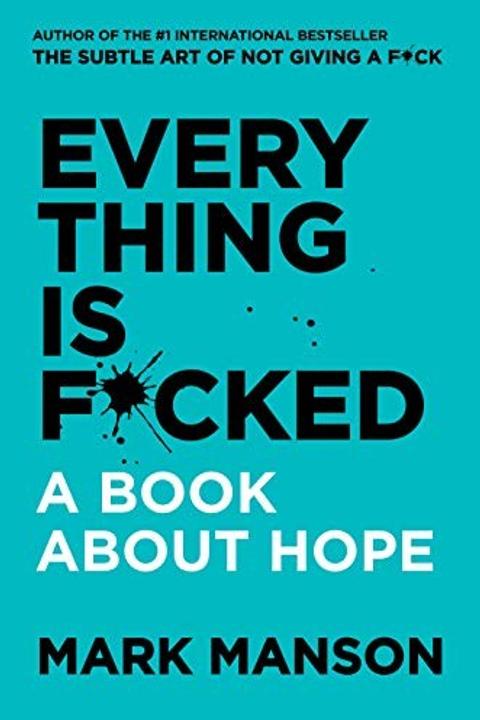
Everything is F*cked by Mark Manson: Summary & Notes
by Mark Manson
In one sentence
Hope is the source of both our greatest achievements and our deepest suffering—true contentment comes from accepting life's inherent meaninglessness and choosing to engage anyway.
Key takeaways
- Hope requires problems—we need something to struggle against
- The Feeling Brain runs the show; the Thinking Brain just rationalizes
- Pain is necessary for growth and meaning
- The paradox of progress: solving problems creates new ones
- Mature hope accepts uncertainty and impermanence
- The Blue Dot Effect: we expand definitions to maintain problems
Summary
I like Mark Manson.
I enjoyed The Subtle Art of Not Giving a F*ck, and I enjoy his blog.
I couldn’t, however, finish this book.
I think it’s the style of writing.
It’s colloquial to the point of being annoying, and overstuffed with his trademark "f*ck"s.
The notes below are those I added while skimming through the book.
Who should read this
- Fans of The Subtle Art
- Anyone struggling with hope and meaning
- Philosophy enthusiasts
- People who question modern optimism
FAQ
What is the main message of Everything Is F*cked?
Hope—which we think is purely good—is actually the source of much suffering because it requires problems. True contentment comes not from solving all problems but from accepting uncertainty and choosing meaningful struggle anyway.
Detailed Notes
Click to expand the full detailed notes →
Detailed Notes
Click to expand the full detailed notes →
Notes
- Being heroic is the ability to conjure hope where this is none.
- "I have tried to live my life such that in the hour of my death I would feel joy rather than fear.” - Wiltold Pilecki
- The opposite of happiness is not anger or sadness but hopelessness, an endless gray horizon of resignation and indifference. It’s the belief that everything is fucked, so why do anything at all?
- To build and maintain hope, we need three things: a sense of control, a belief in the value of something, and a community.
- “Control" means we feel as though we’re in control of our own life, that we can affect our fate.
- “Values" means we find something important enough to work toward, something better, that’s worth striving for.
- And “community" means we are part of a group that values the same things we do and is working toward achieving those things.
- Amor fati, for Nietzsche, meant the unconditional acceptance of all life and experience: the highs and the lows, the meaning and the meaninglessness. It meant loving one’s pain, embracing one’s suffering. It meant closing the separation between one’s desires and reality not by striving for more desires, but by simply desiring reality.
- It basically meant: hope for nothing. Hope for what already is—because hope is ultimately empty.
- This is our challenge, our calling: To act without hope. To not hope for better. To be better. In this moment and the next. And the next. And the next.
- When we pursue pain, we are able to choose what pain we bring into our lives. And this choice makes the pain meaningful—and therefore, it is what makes life feel meaningful.
- Pain is the source of all value. To numb ourselves to our pain is to numb ourselves to anything that matters in the world. Pain opens up the moral gaps that eventually become our most deeply held values and beliefs.
- When we deny ourselves the ability to feel pain for a purpose, we deny ourselves the ability to feel any purpose in our life at all.
- The only true form of freedom, the only ethical form of freedom, is through self-limitation.