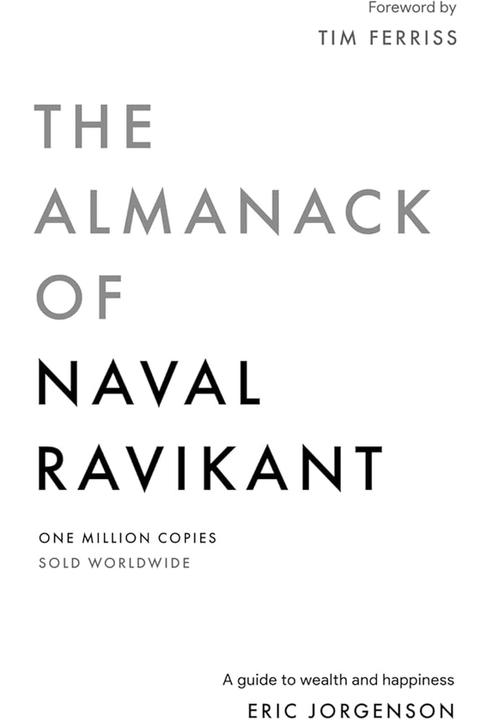
The Almanack of Naval Ravikant: A Guide to Wealth and Happiness
by Eric Jorgenson
In one sentence
This book distills Naval Ravikant’s philosophy on how to build wealth, think clearly, and cultivate lasting happiness by combining specific knowledge, leverage, judgment, and inner freedom.
Key takeaways
The Core Frameworks
- Wealth = Specific Knowledge × Accountability × Leverage. Specific knowledge is what you're uniquely good at (found by following curiosity, not credentials); accountability means putting your name on outcomes; leverage (capital, labor, and especially code & media) multiplies the output.
- Earn with your mind, not your time. Trade your judgment and equity, not hours — money buys back your time, which is the real goal.
- Play long-term games with long-term people. Compounding (in wealth, relationships, and reputation) only works if you stay in the game.
- Happiness is a skill, and desire is the enemy. A desire is "a contract you make with yourself to be unhappy until you get what you want" — so want less, react less.
- Freedom from over freedom to. Naval values freedom from anger, from needing things to go his way, and from social programming over the freedom to chase more.
Naval's Frameworks at a Glance
- Wealth, not money: build wealth through ownership and leverage, not by renting your time — seek specific knowledge, accountability, and leverage (capital, labor, code, media).
- "Earn with your mind, not your time": code and media are permissionless leverage that works while you sleep.
- Play long-term games with long-term people: wealth, relationships, and knowledge all compound.
- Happiness is a skill: it's the subtraction of desire, not the addition of more — peace is happiness at rest.
- Desire is a contract you make with yourself to be unhappy until you get what you want, so pick your few desires deliberately.
- Free the monkey mind: present-moment awareness, fewer reactions, and reading what you love until you love to read.
- Seek wealth, not money or status: own assets that earn while you sleep instead of renting out your time.
- Build specific knowledge by following your curiosity and natural talents, then combine it with leverage (capital, people, code, and media) and accountability.
- Play long-term games with long-term people—trust, reputation, and compounding drive both wealth and relationships.
- Learn to think clearly: drop rigid identities, question inherited beliefs, and build mental models from science, math, evolution, and economics.
- Happiness is a learned skill: it’s a default state that emerges when you reduce desire, live in the present, and stop believing something “out there” will complete you.
- Desire is a chosen unhappiness: each desire is a contract to be unhappy until you get what you want—so be very selective.
- Freedom is shifting from “freedom to do anything” to “freedom from” anger, compulsion, expectations, and social programming.
- Reading, meditation, good habits, and environment design are the core tools for building wealth, wisdom, and peace over decades.
Summary
This book is a collection of Naval Ravikant’s ideas on how to build a rich life—financially and emotionally. On the wealth side, he argues that making money is a skill, not a one-time event, and that true wealth comes from owning assets and building systems that compound while you sleep. Instead of chasing hot trends or status, you focus on specific knowledge, leverage, and accountability.
Specific knowledge is the set of skills that feels like play to you but looks like work to others. Naval explains that you uncover this by following your curiosity, talents, and obsessions—not by blindly chasing credentials or “hot” careers. Once you have specific knowledge, you pair it with leverage: capital, people, and especially code and media—products with zero marginal cost of replication that work for you at scale.
Alongside this, Naval emphasizes the importance of clear thinking and sound judgment. He leans on mental models from evolution, game theory, probability, and economics as tools to navigate a complex world. Good judgment, he says, is wisdom applied to external problems: understanding the long-term consequences of your actions and making decisions accordingly, especially in an age where one good decision under leverage can change everything.
The second half centers on happiness, presence, and inner freedom. Naval treats happiness as a trainable skill and a default state: it appears when the mind stops insisting something is missing. He links suffering to unchecked desires, expectations, and identification with a rigid self. By lowering identity, dropping “shoulds,” reducing vices, and designing a life around peace, he believes you can live with more contentment and less anxiety.
Ultimately, the book ties everything together into a personal philosophy Naval calls “Rational Buddhism”: combining scientific realism with timeless wisdom. Wealth, health, and happiness are all governed by compound interest, habits, and values. The aim is not just to get rich, but to become the kind of person who can continuously create, learn, and enjoy life on your own terms.
Reflections
This book is basically a life operating system. On the wealth side, the biggest reframe is that making money is a skill, not a one-time lucky break. Naval keeps hammering that you’re not going to get rich renting out your time; you need equity, leverage, and specific knowledge. That’s a helpful filter for work decisions: “Is this building my specific knowledge and leverage, or just paying me a wage?”
The idea of “productize yourself” is deceptively simple but huge. You take the stuff that feels like play to you—your weird combination of skills, curiosities, and personality—and you wrap it in something repeatable and scalable. That’s a long game, and he’s honest about it possibly taking a decade. But it’s a better long game than endlessly trying to win status games or chase higher salaries.
On thinking, his emphasis on clear judgment and mental models is grounding. Concepts like the principal–agent problem, compound interest, falsifiability, and “if you can’t decide, the answer is no” are the kind of heuristics that simplify messy choices. The reminder that “99% of effort is wasted” is brutal but clarifying: the goal is to identify the few things that deserve compounding over decades.
The happiness section lands surprisingly hard. Naval’s definition of happiness as a default state—what’s left when you remove the sense that something is missing—cuts through a lot of self-help fluff. The framing of desire as a chosen contract for unhappiness is a good check: is this thing really worth being unhappy about until I get it? That alone can prune a ton of low-quality wants.
His shift from “freedom to” to “freedom from” feels like a mid-game life insight: you start trying to have all the options, and eventually you just want peace. A lot of the habits he shares are small (sunlight, less caffeine, less screens, more exercise, meditation), but they all push in the direction of a quiet mind and a body that isn’t constantly freaking out.
Overall, the book pushes you toward two parallel projects: build a leveraged, high-judgment career that compounds, and build an inner life grounded in presence and low desire. Wealth solves money problems, but happiness is its own skill. Naval never pretends one substitutes fully for the other.
Who should read this
- Ambitious people who want to build wealth through startups, tech, or creative work rather than traditional careers.
- Knowledge workers who feel stuck trading time for money and want a path toward leverage and ownership.
- Anyone interested in mental models, rational thinking, and a more systematic approach to decision-making.
- People exploring meditation, Stoicism, or Buddhism who also care about business and modern life.
- High-achievers who have “succeeded” on paper but still feel restless, anxious, or unsatisfied.
- Young professionals deciding where to live, who to work with, and what games to play for the next decade.
Favorite quotes
- Seek wealth, not money or status. Wealth is having assets that earn while you sleep.
- You’re never going to get rich renting out your time. You must own equity to gain financial freedom.
- Specific knowledge is found by pursuing your innate talents, genuine curiosity, and passion—not by chasing what’s hot.
- Escape competition through authenticity. When you’re authentic, you’re not competing; you’re just being you.
- Earn with your mind, not your time.
- All the returns in life, whether in wealth, relationships, or knowledge, come from compound interest.
- If they can train you to do it, eventually they will train a computer to do it.
- If you can’t decide, the answer is no.
- If you’re evenly split on a difficult decision, take the path more painful in the short term—run uphill.
- You don’t get rich by spending your time to save money. You get rich by saving your time to make money.
- Happiness is what’s there when you remove the sense that something is missing in your life.
- Desire is a contract you make with yourself to be unhappy until you get what you want.
- The fundamental delusion is that there is something out there that will make you happy and fulfilled forever.
- A rational person can find peace by cultivating indifference to things outside of their control.
- When working, surround yourself with people more successful than you. When playing, surround yourself with people happier than you.
- Impatience with actions, patience with results.
- Reading (learning) is the ultimate meta-skill and can be traded for anything else.
- Health, love, and your mission, in that order. Nothing else matters.
- Anger is a hot coal you hold in your hand while waiting to throw it at someone else.
- Enlightenment is the space between your thoughts.
FAQ
Is this book worth reading if I’ve already listened to Naval’s podcasts or read his tweets?
Yes. The book organizes his scattered ideas into a coherent framework, strips out repetition, and adds context. It’s like having a distilled “best of Naval” that’s easier to revisit and apply over time.
What is the main lesson of The Almanack of Naval Ravikant?
The core lesson is that wealth and happiness are both skills you can learn. By developing specific knowledge, using leverage, exercising good judgment, and training your mind away from endless desire and status games, you can build a life that is both financially free and internally peaceful.
How does this book help me get rich in practical terms?
It doesn’t give you a step-by-step business plan or stock picks. Instead, it reshapes how you think about work: focus on ownership over wages, leverage over raw effort, and specific knowledge over generic credentials. Those principles guide what jobs you take, what skills you learn, and what projects you commit to over years.
Is this book similar to other personal development books?
It overlaps with Stoicism, rationalist thinking, and startup culture, but the tone is more direct and less fluffy. Think of it as a mash-up of entrepreneurship, philosophy, and mental models—closer to a cross between Charlie Munger, Tim Ferriss, and a modern Stoic than a standard self-help book.
Is the book still relevant in a fast-changing tech world?
Yes, because most of Naval’s principles are about human nature, incentives, and compounding—things that change slowly, if at all. Technology may shift, but specific knowledge, leverage, judgment, and happiness as a skill remain core advantages.
Do I need to be in tech or startups to benefit from this book?
Not at all. While many examples come from tech and Silicon Valley, the ideas apply to any knowledge work or creative field. Specific knowledge, leverage, clear thinking, and happiness habits are broadly useful whether you’re an artist, consultant, investor, or employee.
How actionable is the happiness section?
It’s more philosophical than “do these 10 steps,” but there are plenty of practical habits: meditate, reduce screens, exercise, get sunlight, drop caffeine, question “shoulds,” and consciously reduce the number of desires you pursue. The deeper shift is learning to see happiness as a skill instead of a byproduct of achievements.
How does Naval define freedom?
He moves from “freedom to”—the ability to do anything you want—to “freedom from”: freedom from automatic reactions, anger, social expectations, and dependencies. Real freedom, for him, is internal calm and the ability to live by your values, not just having unlimited options.
What are the most important ideas for a younger person starting out?
Spend serious time on the three big decisions: where you live, who you’re with, and what you do. Build specific knowledge around your curiosities, learn to sell and to build, aim for equity and leverage, and surround yourself with long-term, high-integrity people. And start reading—a lot.
Can this book replace formal education?
No, but it can radically change how you approach education. It pushes you toward self-directed learning, particularly in reading, math, and persuasion, and away from blindly chasing degrees. It gives you a mental framework for deciding what is worth learning and why.
Detailed Notes
Click to expand the full detailed notes →
Detailed Notes
Click to expand the full detailed notes →
Core Concepts & Big Ideas
Wealth vs. Money vs. Status
- Wealth: Assets that earn while you sleep—businesses, IP, and productive assets, not just cash.
- Money: A way to transfer time and wealth; a store of value and medium of exchange, not the end goal.
- Status: Your position in the social hierarchy; often a zero-sum game where people attack wealth-creators to gain status.
Specific Knowledge
- Specific knowledge is what you cannot be easily trained for—rooted in your DNA, upbringing, curiosity, and obsessions.
- It feels like play to you and work to others; it’s often technical or creative and hard to automate or outsource.
- You find it by looking at what you did effortlessly as a kid or teen and what you still do for fun today.
- Sales, tinkering with technology, analytical thinking, and communication can all be forms of specific knowledge.
- You can’t be taught specific knowledge in school, but you can learn it through apprenticeships and self-directed exploration.
Leverage: Labor, Capital, and Code/Media
- Labor: Other humans working for you; the oldest and messiest form of leverage because people are hard to manage.
- Capital: Money amplifying your decisions; dominant in the last century and core to many large fortunes.
- Code & Media: Products with no marginal cost of replication—software, books, videos, podcasts—the most democratic, permissionless leverage.
Productize Yourself
- “Yourself” is uniqueness, personality, and accountability; “productize” is leverage and repeatability.
- Productizing yourself means discovering what only you can do and packaging it into scalable products, services, or media.
- It can take a decade to figure out what you can uniquely provide; you keep refining until you can be the best in the world at your niche.
Play Long-Term Games with Long-Term People
- All returns—money, relationships, knowledge—come from compound interest over long periods.
- Great careers and reputations are built with people you trust and enjoy working with over many years.
- Focus your effort on the few relationships, projects, and fields where compounding can really work.
Accountability and Ownership
- Embrace accountability; put your name on the line. Society rewards those who take risks with responsibility, equity, and leverage.
- You will not achieve financial freedom renting out your time; you must own a piece of a business, product, or IP.
- Stock options, founding companies, and investing are paths to ownership.
Judgment and Clear Thinking
- Wisdom: knowing the long-term consequences of your actions; judgment: applying that wisdom to real-world choices.
- One correct decision under high leverage can have enormous impact, but judgment is earned through hard work and experience.
- Clear thinking requires dropping identity, questioning beliefs taken as a package (political, religious, cultural), and facing reality as it is.
- “If you can’t explain it to a child, you don’t really understand it.” Confusion while reading is like the pain of exercise—it means you’re growing.
Mental Models & Decision Heuristics
- Use models from evolution, thermodynamics, complexity, information theory, economics, and game theory to understand the world.
- Principal–agent problem: people care more when they act as principals (owners) than as agents (employees).
- Compound interest dominates in money, knowledge, and relationships; small, consistent actions matter over decades.
- Falsifiability: if a claim doesn’t make testable predictions, it’s not science.
- “If you can’t decide, the answer is no” for big life choices.
- “Run uphill”: when split, choose the more painful short-term path that leads to long-term growth.
Time, Focus, and Priorities
- Value your time with an aspirational hourly rate; ruthlessly outsource or ignore tasks below that value.
- You get rich by saving time to make money, not by spending your time to save money.
- Most effort is wasted; your real job is to find the few things you should go all-in on and drop the rest.
- The three big life decisions: where you live, who you’re with, and what you do. Spend serious time on them.
Four Kinds of Luck
- Blind luck: random good things that just happen.
- Luck from motion: hustling, creating opportunities, stirring the pot.
- Luck from preparation: developing skill so you notice opportunities others miss.
- Luck that finds you: becoming uniquely “you” so opportunities seek you out.
Reading & Lifelong Learning
- The most important skill for getting rich is becoming a perpetual learner.
- Reading is faster than listening, doing is faster than watching; read what you love until you love to read.
- Heavy reading in science, math, and philosophy for one hour a day can place you in the top tier of success within years.
- Teach what you learn to internalize it.
Happiness as a Skill
- Happiness is a default state: what remains when you remove the sense that something is missing.
- It’s not about positive vs. negative thoughts; it’s about minimizing desire, especially for external things.
- Happiness is mainly peace—freedom from mental chatter about past and future.
- Happiness, love, and passion are choices you make and skills you practice.
Desire, Suffering, and Presence
- Desire is a contract you make with yourself to be unhappy until you get what you want.
- The fundamental delusion: something external will finally make you happy forever.
- Happiness requires presence: clear attention in the current moment, without clinging to memories or anxiously anticipating future vices.
Success vs. Happiness
- Happiness is being satisfied with what you have; success often comes from dissatisfaction—so choose consciously.
- Games with large rewards (career, startups) can trap you long after they stop serving you.
- The ultimate winners are those who can step off the game entirely, content in a room alone with themselves.
Envy, Expectations, and Comparison
- The enemy of peace is expectations drilled into you by society and “shoulds” in your self-talk.
- Envy is irrational unless you’re willing to swap your entire life with the other person.
- Surround yourself with people more successful than you at work and happier than you in play.
Happiness Habits & Environment Design
- Small habits: reframing judgments, sunlight, smiling, daily exercise, cutting caffeine, reducing screens, meditation.
- Non-screen activities correlate with more happiness; screen activities with less.
- You are a combination of your habits and the people you spend the most time with.
Saving, Building, and Freeing Yourself
- Do what you truly want—not what you think you “should” want.
- To make an original contribution, you need irrational obsession.
- Build yourself over a decade through sustainable, compounding habits; be impatient with actions, patient with results.
- Design environments (work, city, friends) that statistically make success and growth likely.
Freedom: “To” vs. “From”
- Early on, you may chase “freedom to” do anything you want; later, the goal becomes “freedom from” anger, compulsion, and obligation.
- Courage is not caring what others think; other people’s expectations (without explicit agreements) are their problem.
- Time is your scarcest resource—more important than money or friends—so don’t waste it.
Naval’s Life Formulas & Rules
- Happiness = Health + Wealth + Good Relationships.
- Health = Exercise + Diet + Sleep; Wealth = Income + Wealth * ROI.
- Income = Accountability + Leverage + Specific Knowledge.
- Life rules: be present; desire is suffering; earn with your mind, not your time; all benefits come from compound interest; health, love, and mission—in that order.
Part I – Wealth
Building Wealth
- Making money is not a thing you do—it’s a skill you learn.
- Getting rich is about knowing what to do, who to do it with, and when to do it; understanding matters more than pure hard work.
- Seek wealth, not money or status.
- Wealth: assets that earn while you sleep.
- Money: how we transfer time and wealth.
- Status: your place in the social hierarchy.
- Ethical wealth creation is possible; if you secretly despise wealth, it will elude you.
- Ignore people playing status games; they gain status by attacking people playing wealth-creation games.
- You’re not going to get rich renting out your time.
- You must own equity—a piece of a business—to gain financial freedom.
- You will get rich by giving society what it wants but does not yet know how to get—at scale.
- Pick an industry where you can play long-term games with long-term people.
- Play iterated games; all returns in life—wealth, relationships, knowledge—come from compound interest.
- Learn to sell. Learn to build. If you can do both, you will be unstoppable.
Wealth vs. Money
- Even a house can be wealth if rented out, though it may be lower productivity than commercial use.
- Wealth is businesses and assets that can earn while you sleep.
- Technology is the set of things that don’t quite work yet; once something works, it’s no longer “technology.”
- Society always wants new things; to be wealthy, find what society will want that it doesn’t yet know how to get, and that fits your natural skills.
Find and Build Specific Knowledge
- Sales skills are a form of specific knowledge.
- “Naturals” in sales exist; you recognize them instantly in startups and VC.
- They may learn, but not in classrooms.
- You can improve sales skills via books (e.g., Cialdini), training, and brutal but effective door-to-door sales.
- Specific knowledge cannot be taught conventionally, but it can be learned.
Finding Specific Knowledge
- Look at what you did as a kid or teen almost effortlessly, that others noticed.
- Examples of specific knowledge:
- Sales skills.
- Musical talents, ability to pick up any instrument.
- Obsessive personality: diving into things and remembering quickly.
- Love of science fiction, absorbing knowledge quickly.
- Playing many games, intuitively grasping game theory.
- Gossiping and digging into networks—potentially a great journalist.
- Specific knowledge is a unique mix of DNA, upbringing, and response—baked into personality and identity, then honed.
Naval’s Example
- Loves to read and loves technology.
- Learns quickly and gets bored fast.
- Values science and once wanted to be a great scientist.
- In reality, he gravitated to making money, tinkering with tech, and selling/explaining things.
- Has sales skills, money-making analytical skills, and a talent for absorbing data, obsessing over it, and breaking it down.
- Loves tinkering with tech; it feels like play to him but looks like work to others.
- Others may ask how to get good at being pithy and selling ideas; if it’s not natural or enjoyable, it may not be their thing.
Principles of Specific Knowledge
- Found by pursuing innate talents, genuine curiosity, and passion—not by chasing “hot” jobs or investor-favored fields.
- Often at the edges of knowledge—new, hard, and just being figured out.
- “Escape competition through authenticity”: competition comes from copying; authenticity eliminates direct competition.
- The best jobs are neither decreed nor degreed; they are creative expressions of continuous learners in free markets.
- The most important skill for getting rich is becoming a perpetual learner.
- Today it’s more important to become an expert in a new field in 9–12 months than to have studied the “right” thing long ago.
- You must be deep in something; otherwise, you’ll be a mile wide and an inch deep.
- You can only achieve mastery in one or two things—usually what you’re obsessed with.
Play Long-Term Games with Long-Term People
- Top roles (e.g., CEO, large asset managers) are based on trust built over time.
- Their relationships and work have compounded; they have visible, accountable track records of high integrity.
- Reputation compounds like interest; a sterling reputation built over decades becomes a powerful asset.
- Long-term collaborators: if you still enjoy working with someone after 5–10 years, you trust them and have moved past minor foibles.
- Person to read more about: Elad Gil (often invests with Naval).
- “Intentions don't matter. Actions do. That's why being ethical is hard.”
- When you find the right thing and the right people, invest deeply and stick with it for decades for big returns in money and relationships.
- “99% of effort is wasted.”
- Be thoughtful: in relationships, work, and learning, find the thing to go all-in on for compound interest.
- Dating: once you know a relationship won’t lead to marriage, move on.
- Studying: drop subjects you’ll never use to avoid wasting time and mental energy.
Take on Accountability
- Embrace accountability and take business risks under your own name.
- Society will reward you with responsibility, equity, and leverage.
- In modern societies, downside risk is limited; even personal bankruptcy can wipe debts clean in good ecosystems.
Build or Buy Equity in a Business
- “If you don’t own a piece of a business, you don’t have a path towards financial freedom.”
- Ownership vs. wage work:
- Renting time (even as a high-paid professional) caps you; you won’t reach real financial freedom or passive income.
- True wealth: business or IP earning for you while you are on vacation.
- Paths to ownership:
- Stock options in tech companies (good way to start).
- Starting your own businesses.
- Investing in others’ businesses.
Find a Position of Leverage
- We live in an age of infinite leverage; rewards for genuine intellectual curiosity are higher than ever.
- Following your intellectual curiosity is a better career foundation than chasing what makes money right now.
- Knowledge that only you or a small group knows emerges from your passions and hobbies.
- Hobbies around your intellectual curiosity can become passions and specific knowledge.
Distractions vs. Signals
- “If it entertains you now but will bore you someday, it’s a distraction. Keep looking.”
- Follow curiosity over what’s hot.
Automation Warning
- “If they can train you to do it, then eventually they will train a computer to do it.”
Three Broad Classes of Leverage
- Labor
- Other humans working for you.
- Oldest form of leverage; messy and difficult.
- Requires leadership; risk of “mutiny” or being torn apart by the mob.
- Money (Capital)
- Multiplies each decision with capital.
- Tricky but powerful; dominant in the last century.
- Many richest people: bankers, politicians who print money, large capital allocators.
- CEOs of many old companies are mainly financial managers; capital scales more easily than people.
- Products with No Marginal Cost of Replication (Code & Media)
- Books, media, movies, code.
- Most democratic and important modern leverage.
- Code may be the most powerful: all you need is a computer.
- Permissionless: no one needs to grant you permission to build or distribute.
Leverage and the Modern Divide
- “Forget rich versus poor, white-collar versus blue. It’s now leveraged versus un-leveraged.”
- Interesting and important leverage lies in products with no marginal cost of replication.
- Permissionless leverage lets you succeed without gatekeepers.
Time and Independence
- “You're never going to get rich renting out your time.”
- Whenever possible, optimize for independence rather than pay.
- 40-hour work weeks are Industrial Age relics.
- Knowledge workers function like athletes: train and sprint, then rest and reassess.
Sell or Build
- Sales and building are broad categories that exist in every industry.
- Builders in tech: CTOs, programmers, hardware engineers.
- Builders in other industries: people who make the system work.
- Sales: marketing, communication, recruiting, fundraising, PR, inspiring others.
- “If you want to be part of a great tech company, then you need to be able to SELL or BUILD. If you don’t do either, learn.”
- Learn to sell, learn to build; if you can do both, you will be unstoppable.
Risk of Ruin
- “Earn with your mind, not your time.”
- Avoid risk of ruin: don’t engage in bets that can wipe out all capital or savings.
- Take rationally optimistic bets with big upsides, but never all-in gambles.
Get Paid for Your Judgment
- Judgment, especially demonstrated judgment with accountability and a clear track record, is critical.
- In an age of leverage, being extreme in your art or domain becomes very valuable.
Prioritize and Focus
- Naval’s wealth came from many small wins, not one giant payout.
- Wealth accumulates as a stack: more options, businesses, investments, and opportunities accumulating over time.
Valuing Time
- “Value your time at an hourly rate, and ruthlessly spend to save time at that rate. You will never be worth more than you think you’re worth.”
- If you can outsource something for less than your hourly rate, outsource it or don’t do it.
- Set an aspirational hourly rate that feels absurdly high (Naval used $5,000/hour even before he had money).
Despising Wealth
- On “If you secretly despise wealth, it will elude you”:
- Be optimistic and positive; optimism pays off in the long run.
- Business world split:
- Many play zero-sum status games.
- A few play positive-sum wealth creation games and search for each other.
- Wealth creation is a positive-sum, evolutionarily recent game; status is an older zero-sum game.
- Those attacking wealth creation are often seeking status.
Status Games
- Politics and sports are examples of status games (winners and losers).
- Status games serve a social role (figuring out who’s in charge) but are a “necessary evil.”
- “Play stupid games, win stupid prizes.”
Advice for Young People
- Spend more time on big decisions: where to live, who to be with, what to do.
- We spend little time on relationships, jobs, and cities despite their outsized impact.
- For decade-long commitments (city, job, relationship), consider spending 1–2 years deciding.
Surrounding Yourself with Successful People
- Step 1: figure out what you’re good at.
- Step 2: help people with that skill; give it away and pay it forward.
- Karma works; people are consistent.
Warning from an Old Boss
- “You’ll never be rich since you’re obviously smart, and someone will always offer you a job that’s just good enough.”
Find Work That Feels Like Play
- What you really want is freedom from money problems.
- Once you solve money problems (by lowering lifestyle or earning enough), you want to “retire.”
Definition of Retirement
- Retirement is when you stop sacrificing today for an imaginary tomorrow.
- When today is complete in itself, you’re retired.
Paths to Retirement
- Save enough money that passive income covers your burn rate.
- Drive your burn rate to near zero (monk-like lifestyle).
- Do something you love so much that it’s not about the money.
Art and Creativity
- History remembers the artists—those who create for its own sake.
- Art is anything done for its own sake: loving, creating, playing.
- For Naval, creating businesses is play; money is a side effect.
- He can assemble a team, raise money, and launch a business in ~3 months because it’s fun.
- As an investor, he looks for interesting products and people; passes on “great” investments if the product isn’t interesting.
Money and Addiction to Games
- Lusting for money is a bottomless pit; it always occupies the mind.
- The winners of any game are those so addicted they keep playing even as marginal utility declines.
- In Silicon Valley, consistently successful people are:
- Venture capitalists (diversified, controlling scarce resources).
- People who are talented at identifying companies that just hit product/market fit.
How to Get Lucky
- Four kinds of luck:
- Blind luck: random, uncontrollable events.
- Luck via persistence, hustle, and motion: stirring things up, creating opportunities.
- Luck from preparation: being skilled enough to notice lucky breaks others miss.
- Luck that finds you: building unique character/brand so opportunities seek you out.
Ways to Get Lucky
- Hope luck finds you.
- Hustle until you stumble into it.
- Prepare the mind and be sensitive to chances others miss.
- Become the best at what you do; refine it until it’s true, and opportunity will seek you out so luck becomes destiny.
Reputation as a Luck Magnet
- Having a strong reputation makes people want to do deals through you.
Long-Term vs Short-Term Games
- “In a long-term game, it seems that everybody is making each other rich. In a short-term game, it seems like everybody is making themselves rich.”
- Long-term games are positive-sum (baking a bigger pie); short-term games are about slicing up the existing pie.
Be Patient
- In tech/Silicon Valley, great people consistently have great outcomes over time.
- Everyone Naval recognized as extremely capable early on eventually became very successful—given enough years.
- Outcomes rarely arrive on the timeline you want, but they come with patience.
Principle
- “Apply specific knowledge with leverage and eventually, you will get what you deserve.”
Bad Advice
- “You’re too young” is common bad advice.
- Much of history was built by young people; they often got credit only when older.
- The only way to really learn is by doing; listen to guidance but don’t wait.
Suffering and Résumés
- Your real résumé is a catalog of your suffering and sacrifices—the hard things you did.
Money and Happiness
- Making money solves money problems but doesn’t create happiness.
- It removes obstacles to happiness but doesn’t supply happiness itself.
Building Judgment
- “You don’t get rich by spending your time to save money. You get rich by saving your time to make money.”
- Wisdom: knowing long-term consequences of your actions.
- Judgment: applying that wisdom to external problems.
- In an age of leverage, one correct decision can win everything—but hard work is still needed to build judgment and leverage.
How to Think Clearly
- “Clear thinker” is a better compliment than “smart.”
- The smartest people can explain things to a child; if you can’t, you don’t really know it.
Reality and the Monkey Mind
- Make effective decisions by dealing with reality as it is, not as you wish it to be.
- A strong sense of self, rigid judgments, and “monkey mind” responses cloud reality.
- Desires and preconceived notions (especially mixing politics and business) distort perception.
- The number one obstacle to seeing reality: what we wish to be true.
Suffering and Reality
- “What we wish to be true clouds our perception of what is true. Suffering is the moment when we can no longer deny reality.”
- “What you feel tells you nothing about the facts—it merely tells you something about your estimate of the facts.”
Space to Think
- It’s important to have empty space in your calendar.
- Without one or two days per week without constant meetings and busyness, you can’t think clearly or have good ideas.
- Take at least one day a week (preferably two) just to think.
Contrarians, Cynics, and Mimics
- Very smart people tend to be weird; they insist on thinking everything through themselves.
- A contrarian isn’t someone who always objects—that’s just a different kind of conformist.
- A true contrarian reasons independently from the ground up and resists pressure to conform.
- Cynicism and mimicry are easy; optimistic contrarians are rare.
Shed Your Identity to See Reality
- “Tension is who you think you should be. Relaxation is who you are.” —Buddhist saying
- Any belief taken as a package (Democrat, Catholic, American, etc.) is suspect and should be re-evaluated from first principles.
- To be honest, speak without identity.
Learn the Skills of Decision-Making
- Classical virtues are decision-making heuristics to optimize for the long term.
- Self-serving conclusions should be held to a higher bar of evidence.
- Most biases are time-saving heuristics; for important decisions, discard memory and identity and focus purely on the problem.
- Richard Feynman approach: “I never ask if ‘I like it’ or ‘I don’t like it.’ I think, ‘this is what it is’ or ‘this is what it isn’t.’”
Diversification
- “The more you know, the less you diversify.”
Collect Mental Models
- Best mental models came to Naval through evolution, game theory, and Charlie Munger.
- Uses tweets (his and others’) as compressed maxims to store and recall learning.
Evolution
- Evolution, thermodynamics, information theory, and complexity have broad explanatory and predictive power.
Inversion
- Naval doesn’t try to predict what will work; he tries to eliminate what won’t work.
Complexity Theory
- We’re fundamentally ignorant and very bad at predicting the future.
Economics
- Principal–agent problem:
- Julius Caesar: “If you want it done, then go. And if not, then send.”
- Principals (owners) care and do a great job; agents optimize for themselves.
- Smaller companies feel more like everyone is a principal.
Compound Interest
- Intellectual domain is also ruled by compound interest.
Basic Math
- Be solid on multiplication, division, compounding, probability, and statistics.
- Black swans: branch of probability focusing on tail events.
Falsifiability
- If it doesn’t make falsifiable predictions, it’s not science.
Heuristics
- “If you can’t decide, the answer is no” for big life choices (marriage, job, house, city, business partners).
- If you’re making pro–con spreadsheets and are still unsure, the answer is no.
- “Run uphill”: when evenly split, choose the more painful short-term path.
Building Mental Models
- Read a lot, across domains.
- “Reading science, math, and philosophy one hour per day will likely put you at the upper echelon of human success within seven years.”
Learn to Love to Read
- Genuine love for reading is a superpower.
- Read what you love until you love to read.
- The better the book, the slower it should be absorbed; reading is not a race.
- Charlie Munger: “As long as I have a book in my hand, I don’t feel like I’m wasting time.”
- When pointing out exceptions, avoid implying the listener is dumb or the target is dumb.
Internalizing Books
- Explain what you learned to someone else; teaching forces learning.
Becoming a Clear Thinker in 60 Days
- Study logic and math to remove fear of any book.
- Confusion while reading is like pain in the gym—necessary for growth.
On Learning from the Classics
- To learn macroeconomics, start with foundational thinkers like Adam Smith, von Mises, or Hayek.
- For problem-solving, older problems often have older, time-tested solutions.
Part II – Happiness
Learning Happiness
- The three big pursuits: wealth, health, happiness—chased in that order, but importance is reversed.
- Don’t take yourself so seriously; you’re just a monkey with a plan.
Happiness as a Skill
- Happiness may not be inherited or chosen but a highly personal skill that can be learned like fitness or nutrition.
- Definitions vary: flow, satisfaction, contentment.
- Naval’s evolving definition: happiness is a default state that appears when you remove the sense that something is missing.
Thoughts and Desire
- People think happiness is positive thoughts and actions, but every positive thought implies a negative.
- Happiness isn’t about positive vs. negative thoughts; it’s about the absence of desire, especially for external things.
- The more present you are, the happier and more content you’ll be.
- Happiness = not suffering, not desiring, not overthinking the future or past; embracing the present reality.
Good and Evil
- “If you ever want to have peace in your life, you have to move beyond good and evil.”
- Reality is neutral and reflects your feelings back at you; there are no inherent judgments.
No External Forces on Emotions
- There are no external forces affecting your emotions as much as it feels like it.
- Recognizing the insignificance of the self helps.
- “Happiness is what’s there when you remove the sense that something is missing in your life.”
- Children live in this state more naturally—immersed in the moment.
Control and Peace
- We think we’re fixed and the world is malleable; it’s often the opposite.
- “A rational person can find peace by cultivating indifference to things outside of their control.”
Naval’s Practices
- Lower identity.
- Lower mental chatter.
- Don’t care about things that don’t matter.
- Avoid politics.
- Avoid unhappy people.
- Value time.
- Read philosophy.
- Meditate.
- Spend time with happy people.
- “And it works.”
Happiness Is a Choice
- “Happiness, love, and passion…aren’t things you find—they’re choices you make.”
- Happiness is both a choice and a skill you develop.
Happiness Requires Presence
- Naval doesn’t “believe in” anything from his past—no memories, no regrets, no trips.
- A lot of unhappiness comes from comparing past to present.
- Anticipation of vices pulls you into the future; eliminating vices makes presence easier.
- “What if this life is the paradise we were promised, and we’re just squandering it?”
Happiness Requires Peace
- Combating anxiety:
- Don’t fight it; notice it arises from thoughts.
- Ask: “Would I rather have this thought right now, or my peace?”
- As long as you have certain thoughts, you can’t have your peace.
- For Naval, happiness = peace; others may equate happiness with joy or bliss, but he prioritizes peace.
Every Desire Is a Chosen Unhappiness
- “The fundamental delusion: There is something out there that will make me happy and fulfilled forever.”
- Desire = contract to be unhappy until you get what you want.
- It’s more important to perfect your desires than to do things you’re not 100% committed to.
Time, Money, Health Trifecta
- Young: time + health, no money.
- Middle-aged: health + money, no time.
- Old: time + money, no health.
- The trifecta is capturing all three at once.
Success Does Not Earn Happiness
- Happiness: being satisfied with what you have.
- Success: comes from dissatisfaction.
- You must choose consciously between the two or balance them.
Games and Treadmills
- Getting good at high-reward games can trap you beyond their usefulness.
- Survival and replication drives put us on the work treadmill; hedonic adaptation keeps us there.
- The trick is knowing when to jump off and play instead.
Winners Who Step Out
- True winners step out of the game entirely; they need nothing from others.
- They have strong self-awareness and self-control.
- Naval notes people like Jerzy Gregorek as examples.
Pascal’s Insight
- Blaise Pascal: “All of man’s troubles arise because he cannot sit in a room quietly by himself.”
- If you can sit for 30 minutes and be happy, you are successful.
Focus and Desire
- “You can get almost anything you want out of life, as long as it’s one thing and you want it far more than anything else.”
Envy Is the Enemy of Happiness
- Life isn’t that hard; we make it hard.
- Naval tries to eliminate “should” from his vocabulary:
- “Should” implies guilt or social programming.
- Doing something because you “should” means you don’t truly want to do it and become miserable.
- Enemy of peace of mind: expectations from society and others.
On Jealousy
- If you wouldn’t do a full 24/7 life swap with someone, there’s no point being jealous of them.
Work and Play Company
- “When working, surround yourself with people more successful than you. When playing, surround yourself with people happier than you.”
Happiness as Skill
- Happiness skill is built via trial and error; you see what works.
- At the end of the day, you’re a combo of habits and your closest people.
Work Partners
- “If you can’t see yourself working with someone for life, don’t work with them for a day.”
- The key trick to being happy: realize happiness is a skill and a choice; choose it and then work at it.
Happiness Habits
- When judging someone, stop and ask: “What’s the positive interpretation of this?”
- Shift from annoyance to positive framing.
- Get more sunlight and smile.
- When you catch yourself desiring something, ask: “Is it so important I’ll be unhappy unless this goes my way?” Usually the answer is no.
Lifestyle Tweaks
- Dropping caffeine made Naval happier and more stable.
- Working out daily contributes to peace of body and mind.
- To reset a funk: use meditation, music, and exercise, then consciously choose a new path for your emotional energy for the rest of the day.
- All screen activities are linked to less happiness; all non-screen activities linked to more.
Stages of Understanding
- “First, you know it. Then, you understand it. Then, you can explain it. Then, you can feel it. Finally, you are it.”
Find Happiness in Acceptance
- In any situation, you have three options: change it, accept it, or leave it.
- Change = desire; it brings suffering until you succeed.
- Don’t pick too many big desires; choose one major desire at a time for purpose and motivation.
Why Not Two Big Desires?
- You’ll be distracted.
Practices of Acceptance
- For minor annoyances, Naval asks: “What is the positive of this situation?”
- Acceptance of what you can’t change ties to embracing death.
Embracing Death
- Death is the most important event in your life.
- Facing it instead of denying it gives life meaning.
- Reflecting on the rise and fall of whole civilizations makes ego battles seem trivial.
- You’re going to die and none of this will matter; so enjoy yourself, do positive things, project love, make someone happy, laugh, appreciate the moment, and do your work.
Saving Yourself
Choosing to Be Yourself
- All you should do is what you want to do.
- Your goal is to find the people, business, project, or art that needs you most—something uniquely suited to you.
- To make an original contribution, you must be irrationally obsessed with something.
Choosing to Care for Yourself
- “When everyone is sick, we no longer consider it a disease.”
- Life-hack: in bed, meditate; you’ll either meditate deeply or fall asleep—both wins.
Meditation
- Another practice: sit with eyes closed for at least an hour a day, surrendering without effort.
- “Meditation is turning off society and listening to yourself.”
- It only “works” when done for its own sake.
- Hiking = walking meditation.
- Journaling = writing meditation.
- Praying = gratitude meditation.
- Showering = accidental meditation.
- Sitting quietly = direct meditation.
Choosing to Build Yourself
- Sustainable fitness/health change is a 10-year journey; break bad habits and build good ones every ~6 months.
- Saying “I’m going to do this/be that” is often a delay tactic; if you truly wanted it, you’d already be doing it.
- “Impatience with actions, patience with results.”
Choosing to Grow Yourself
- Naval doesn’t believe in specific goals; instead, he prefers systems.
- Scott Adams: “Set up systems, not goals.”
- Use judgment to find environments where you can thrive, then design your environment so you’re statistically likely to succeed.
- “The current environment programs the brain, but the clever brain can choose its upcoming environment.”
- “If there’s something you want to do later, do it now. There is no ‘later.’”
Advice to Kids
- Principle #1: Read—read anything and everything to develop a love of reading.
- Don’t limit yourself to “serious” books; even comics or romances are fine at first.
- Over time, you’ll steer toward what you should and want to read.
- Related skills: mathematics and persuasion.
- Persuasion: influence others, get things done; it’s learnable.
- Math: core for money, science, game theory, politics, economics, investments, and computers.
- Nature speaks in mathematics; math is reverse-engineering nature’s language.
- You don’t need advanced math—just solid statistics, arithmetic, probability.
- You should know probability and statistics thoroughly.
Choosing to Free Yourself
- Hardest thing isn’t doing what you want; it’s knowing what you want.
Evolving Values
- Old definition of freedom: “freedom to” do anything at any time.
- New definition: “freedom from”—
- Freedom from reaction.
- Freedom from anger.
- Freedom from sadness.
- Freedom from being forced.
- Naval seeks internal and external “freedom from” now.
Advice to Younger Self
- “Be exactly who you are.”
- Holding back leads to staying in bad jobs and relationships for years instead of minutes.
Freedom From Expectations
- If you hurt people because they had expectations of you, that’s their problem—unless you had explicit agreements.
- Expectations without agreement are their issue, not yours.
- “Courage is not caring what other people think.”
Value of Time
- Time is all you have; more important than money, friends, anything.
- Don’t waste your time.
- Relaxation is fine as long as it’s what you truly want to do.
- If you’re not earning, not learning, and not doing what you want, ask what you’re doing.
Freedom from Employment
- People who live far below their means enjoy a freedom that lifestyle-upgraders can’t fathom.
The Modern Struggle
- Lone individuals must deploy extreme willpower—fasting, meditating, exercising—
- Against armies of scientists and statisticians optimizing junk food, clickbait, infinite porn, endless games, and addictive drugs.
Philosophy
- “The real truths are heresies. They cannot be spoken. Only discovered, whispered, and perhaps read.”
The Meanings of Life
- Naval doesn’t buy traditional everlasting afterlife narratives; they lack evidence.
- It seems insane to believe eternal destiny is based on ~70 years of life.
- Afterlife is likely like before you were born—nonexistence.
Live by Your Values
- Honesty is a core value; Naval wants to be fully himself without watching his words.
- He rejects short-term thinking or dealing.
- All benefits in life come from compound interest: money, relationships, love, health, activities, habits.
- He believes only in peer relationships; no hierarchy:
- Doesn’t want to be above or below anyone.
- If he can’t interact as a peer, he doesn’t want to interact.
- He doesn’t believe in anger anymore;
- Anger as a young man was useful, but now: “Anger is a hot coal you hold in your hand while waiting to throw it at somebody.”
Rational Buddhism
- “The older the question, the older the answers.”
- His philosophy, “Rational Buddhism,” must reconcile with science and evolution.
Wisdom Defined
- Wisdom: understanding the long-term consequences of your actions.
Life Formulas I (2008)
- Happiness = Health + Wealth + Good Relationships
- Health = Exercise + Diet + Sleep
- Exercise = High Intensity Resistance Training + Sports + Rest
- Diet = Natural Foods + Intermittent Fasting + Plants
- Sleep = No alarms + 8–9 hours + Circadian rhythms
- Wealth = Income + Wealth * (Return on Investment)
- Income = Accountability + Leverage + Specific Knowledge
- Accountability = Personal Branding + Personal Platform + Taking Risk?
- Leverage = Capital + People + Intellectual Property
- Specific Knowledge = Knowing how to do something society cannot yet easily train other people to do
- Return on Investment = “Buy-and-Hold” + Valuation + Margin of Safety
Naval’s Rules (2016)
- Be present above all else.
- Desire is suffering. (Buddha)
- Anger is a hot coal you hold in your hand while waiting to throw it at someone else. (Buddha)
- If you can’t see yourself working with someone for life, don’t work with them for a day.
- Reading (learning) is the ultimate meta-skill and can be traded for anything else.
- All the real benefits in life come from compound interest.
- Earn with your mind, not your time.
- 99 percent of all effort is wasted.
- Total honesty at all times. It’s almost always possible to be honest and positive.
- Praise specifically, criticize generally. (Warren Buffett)
- Truth is that which has predictive power.
- Watch every thought. (Ask “Why am I having this thought?”)
- All greatness comes from suffering.
- Love is given, not received.
- Enlightenment is the space between your thoughts. (Eckhart Tolle)
- Mathematics is the language of nature.
- Every moment has to be complete in and of itself.
- “Health, love, and your mission, in that order. Nothing else matters.”