How to Grow Your Followers on X (Twitter): What's Actually Working in 2026
Most Twitter growth advice is recycled from 2023. The algorithm changed. Here's what's actually working now — from reply strategies to content formats to the tools worth paying for.
 ByGraham Mann14-min read
I've spent the last few months trying to figure out X growth. Reading every thread, testing different strategies, tracking what moves the needle and what doesn't.
Most of the advice out there is recycled from 2023. Post threads. Use hashtags. "Engage authentically." Okay, but the algorithm changed. Multiple times. What worked two years ago barely registers now.
Here's what I've learned so far, both from my own account and from studying people who are actually growing fast right now.
The algorithm isn't what you think it is
X open-sourced parts of their algorithm on GitHub back in 2023. But the version running today looks nothing like that. In January 2026, Grok started handling ranking decisions. That changed everything.
Here's what matters now:
Engagement velocity in the first 30 minutes. This is the single biggest factor. If your tweet gets likes, replies, and retweets in the first half hour, the algorithm pushes it to more people. If it sits there quietly, it dies.
Sentiment analysis. This is the weird new one. Grok reads the tone of every post. Positive, constructive content gets wider distribution. Negative, combative stuff gets throttled even if it generates engagement. The rage-bait playbook is dying.
Replies are weighted heavily. A tweet with 20 replies outperforms a tweet with 100 likes but no conversation. X wants you to start discussions, not just collect hearts.
Video gets preferential treatment. Native video gets roughly 10x the engagement of text-only posts. Four out of five user sessions now include watching video. If you're only posting text, you're leaving reach on the table.
X Premium matters. Verified accounts get priority in the For You feed. Long-form posts (up to 4,000 characters) are available to Premium subscribers. Whether long-form actually performs better than threads is debatable, but the verification boost is real.
Profile optimization (still the most overlooked part)
Everyone skips this. They want the growth hacks. But your profile is your landing page. If someone sees a great reply from you and clicks your name, you have about 2 seconds to convince them to follow.
Bio formula that works:
What you do → who you help → why believe you → something human.
Bad: "Entrepreneur. Builder. Dreamer. ✨"
Better: "Building SEOTakeoff — automated SEO for startups. Sharing what's working and what's not."
The second one tells me something. The first tells me nothing.
Pinned post: This should be working 24/7 as your best piece of content or an intro thread. Not a random tweet from three months ago.
Banner image: Show proof. A number. A result. A screenshot of something real. Most people waste this space on a gradient or a stock photo.
Content strategy: the 80/20 that actually drives growth
The most common advice is "post 3-5 times a day." Which is correct, but useless without knowing *what* to post.
The best content provides value
This sounds obvious, but most people get it wrong. They think "value" means polished tips or frameworks. It doesn't. The content that performs best on X is almost always someone sharing real experience.
What actually works:
- "Here's what I tried and the result" — People love seeing real experiments. "I tested 3 different cold email subject lines this week. Here's what happened." That's infinitely more engaging than "5 tips for better subject lines."
- "This worked for me (and this didn't)" — The failures are often more interesting than the wins. A post about a feature you built that nobody used will outperform a feature announcement every time.
- "Here's how I solved this specific problem" — Not abstract advice. The actual steps you took, the tools you used, the mistakes along the way. Specificity is what separates useful content from noise.
- "I noticed something others might find useful" — Share an observation, a pattern, or a resource that helped you. Curating knowledge for your audience is underrated.
The common thread: you're giving people something they can use, learn from, or relate to. You're not asking for anything. The follow comes naturally when someone thinks "I want to see what this person posts next."
If you're stuck on what to post, ask yourself: "What did I learn this week that I wish someone had told me sooner?" Start there.
Here's the content mix I've seen working across accounts that are actually growing:
- 40% entertaining — stories, personality, relatable struggles
- 30% educational — teaching, how-tos, tactical stuff
- 20% inspirational — wins, milestones, encouragement
- 10% selling — product mentions, CTAs, offers
Most people invert this. They post 80% self-promotion and wonder why nobody engages.
Formats that are working right now
Short threads (3-6 tweets) with proof. Not the 20-tweet mega-threads from 2023. Those are dead. Keep it tight, include screenshots or data, and front-load the value.
Multi-image posts. First image = bold headline or hook. Middle = the actual content. Last = CTA or takeaway. These outperform single-image and text-only posts consistently.
Process screenshots. Show your actual workflow. Your dashboard. Your prompts. Your analytics. People love seeing how others work.
Contrarian takes with reasoning. Not rage-bait. Actual contrarian opinions where you explain your thinking. These generate replies because people want to argue (or agree).
Formats that are dying
One-liners without context. Long threads that drift. AI-generated posts with no personal point of view. Copy-paste frameworks with no real results behind them.
The reply strategy (this is the actual growth hack)
If you only do one thing from this post, do this.
Spend 30 minutes a day replying to bigger accounts in your niche. Not "great post 🔥" replies. Real ones. Add an insight. Share a related experience. Ask a question that extends the conversation.
One good reply on a viral tweet can drive more profile visits than five of your own posts. Marshall (@mdnlabs) attributes a big chunk of his early growth to replies. Andy, who audited over 100 accounts, found that the top performers all spend 30+ minutes daily in bigger accounts' comments.
One underrated move: ask a follow-up question. Not a generic "what do you think?" — a specific question that shows you actually read what they said. "Did you find that worked differently for B2B vs B2C?" or "Curious — did the results hold after the first month?" Questions do two things: they almost guarantee a reply from the original poster (which extends the thread's visibility), and they signal to everyone reading that you're thinking critically, not just brown-nosing.
Here's the system:
- Find 10-20 accounts bigger than you in your space
- Turn on notifications for them (or check their profiles daily)
- Reply early, within the first 30 minutes of their post (when engagement velocity matters most)
- Add something that makes people click your profile — an insight, a related experience, or a thoughtful follow-up question
- Be consistent. Do this every single day.
X's algorithm now rewards conversation threads inside posts. A good back-and-forth reply chain extends the lifespan of the original post and gives everyone in the conversation more visibility.
Here's a real example from my account. I left a simple reply on someone's post — just a genuine follow-up question about their experience with two AI models:
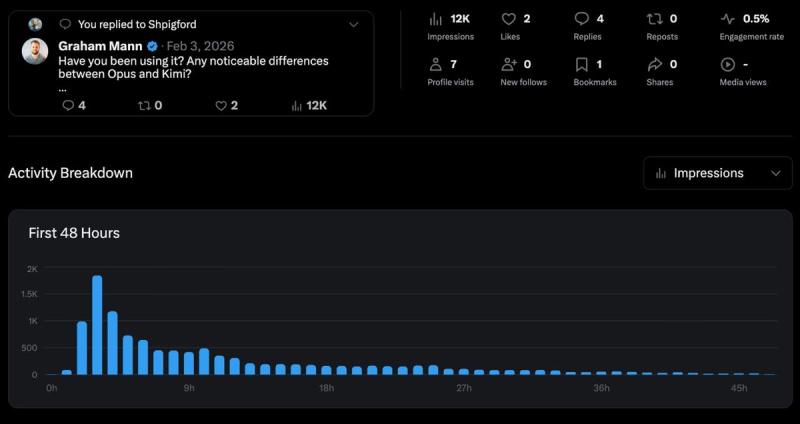
12K impressions from one reply. 7 profile visits. The first 48 hours chart shows it spiked to nearly 2,000 impressions/hour right away, then tapered off over two days. I didn't say anything clever. I asked a question I actually wanted the answer to. That's it.
Now compare that to an original post from my own feed:
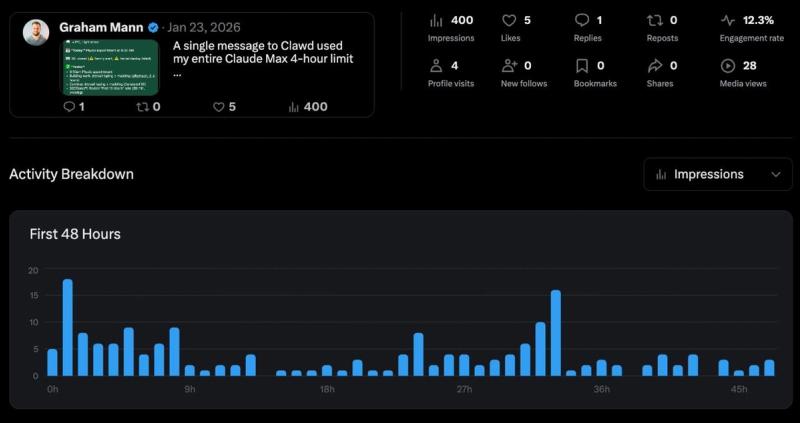
400 impressions. But 12.3% engagement rate — 5 likes, a reply, 28 media views, 4 profile visits. The reply got 30x the eyeballs. The original post got 24x the engagement rate.
Both matter. Replies put you in front of new audiences. Original posts build depth with the audience you already have. The mistake is doing only one or the other.
Posting frequency and timing
The data is pretty clear here. More posts = more growth, up to a point. Metricool's 2024 X study confirmed it: larger accounts post more frequently, and the correlation holds across niches.
Here's a rough guide for daily volume by account size:
| Follower count | Daily posts | Daily replies |
|---|---|---|
| 0–1K | 3–5 | 20–30 |
| 1K–10K | 5–10 | 30–50 |
| 10K–50K | 10–15 | 50+ |
The best posting windows are:
- Morning: 7-9am (your audience's timezone)
- Midday: 12pm
- Afternoon: 3-4pm
- Evening: 7-9pm
But honestly? Consistency matters more than perfect timing. Posting 3x a day at random times beats posting once a day at the "optimal" time.
My own data on this
Here's what my December 2025 looked like on X:
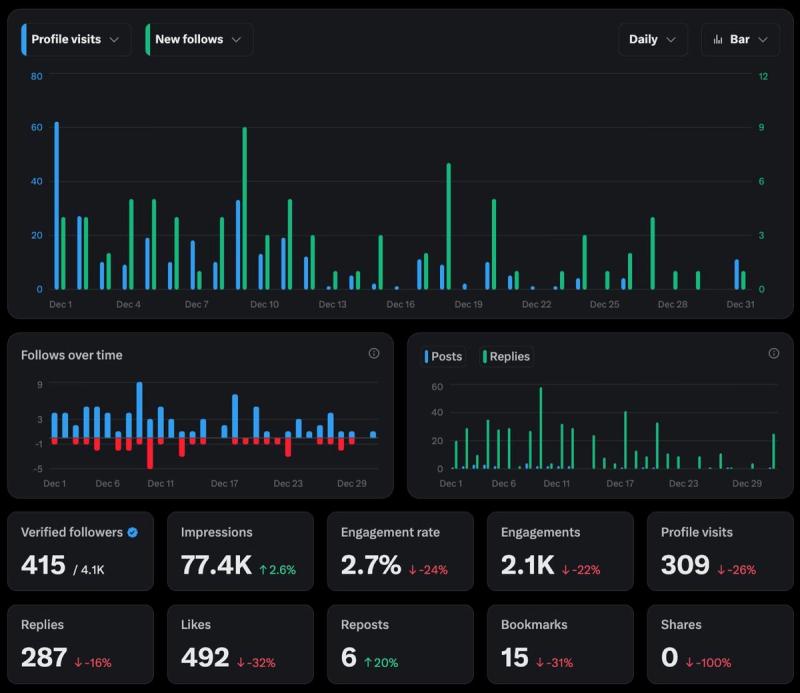
I took most of the back half of December off for Christmas. You can see the result: engagement rate down 24%, likes down 32%, profile visits down 26%. The follows chart flipped — more unfollows than new follows by the end of the month. Everything red except impressions, which only held because of a few earlier posts still circulating.
Now compare that to late January through early February, when I started posting consistently and replying more:
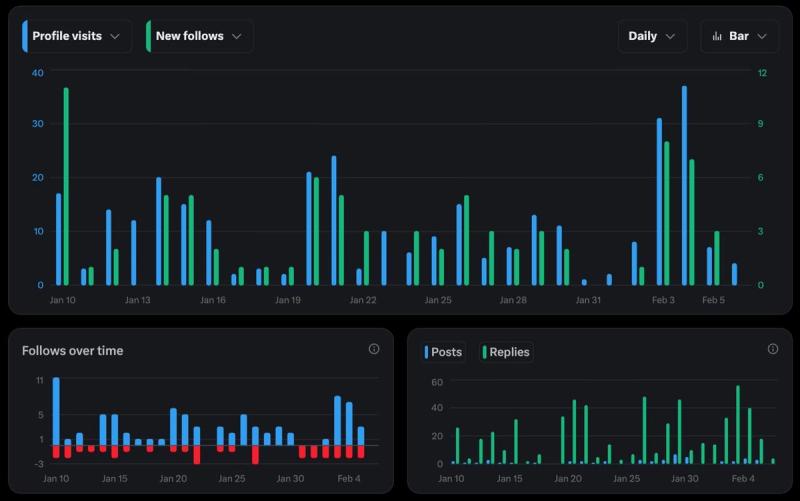
When posting and replies ramped up (some days hitting 40-60 combined), profile visits jumped to 30-35/day and new follows spiked to 7-8/day. When I slacked off, everything dropped.
The correlation between reply volume and follower growth is the part that surprised me most. The days I posted a lot but didn't reply much still underperformed. The days I replied heavily to other accounts, even with fewer original posts, drove the most profile visits.
Two months of data, same account, same niche. The only variable was consistency.
Tools I actually use
I've tried a bunch of scheduling and analytics tools. Most are fine. Two stand out.
For analytics and replies: SuperX
SuperX is a Chrome extension that overlays analytics directly on your X feed. You can see engagement data, hidden insights, and performance metrics on any profile or post without leaving the timeline.
What I like about it:
- See anyone's real engagement metrics while browsing
- Track which of your posts are actually performing (not just impressions, but meaningful engagement)
- The data sits right inside X — no switching between dashboards
- The reply feature is a game-changer. It automatically surfaces high-performing tweets in your niche for you to reply to. Instead of scrolling the main timeline (which is designed to distract you), you get a curated feed of posts worth engaging with. This alone saves me 20+ minutes a day and keeps me focused on replies that actually matter.
- Solid inspiration tools that show you what's working in your space right now — useful when you're staring at a blank compose box
- AI helper tools for drafting and refining posts
It's $39/month. Not cheap, but cheaper than guessing. If you're posting 3-5x a day and have no idea what's working, you're wasting effort. The reply feature alone is worth it if you're serious about the reply strategy above.
For scheduling and cross-platform publishing: Typefully
Typefully is purpose-built for X. It's where I write and schedule posts, and it handles threads better than anything else I've tried.
What makes it different from Buffer/Hootsuite/etc:
- The editor is designed for tweets and threads specifically (not a generic social media scheduler)
- AI writing assistant that helps you tighten hooks and punchlines
- Real-time analytics on scheduled content
- Clean, distraction-free writing environment
- Cross-platform publishing to LinkedIn — write once, publish to both X and LinkedIn with formatting adapted for each platform. If you're building a professional audience, LinkedIn is free distribution for the same content.
Pricing runs Free / Pro (~$8-10/month) / Business (~$18-20/month) depending on team features — cheap for the amount of time it saves on scheduling alone. The LinkedIn cross-posting is a bonus that most people underutilize.
Neither of these tools will grow your account by themselves. But they remove the friction so you can focus on the actual work: creating content and engaging with people.
The proof-post habit
This is something I picked up from studying accounts that grow fast. They post proof at least once a week. Screenshots. Revenue numbers. Analytics graphs. Before-and-after results.
Why? Because proof is the most shareable content format. People retweet results. They reply with questions about how you did it. It generates the kind of genuine engagement the algorithm rewards.
What counts as proof:
- Analytics dashboard screenshots
- Stripe/revenue screenshots
- Traffic graphs
- Customer messages (with permission)
- Before/after comparisons
- Feature demos or screen recordings
You don't need massive numbers. "Day 14: from 0 to 47 visitors" is more interesting than another motivational quote.
Common mistakes that kill growth
I've made most of these. Listing them so you don't have to.
Posting sporadically. Two posts on Monday, nothing until Thursday. The algorithm rewards consistency. Disappearing for days resets your momentum.
Ignoring replies on your own posts. Someone takes the time to reply to you and you say nothing? That conversation is free engagement. Reply to everything, especially early on.
Only promoting yourself. If your feed is just product links and CTAs, people will scroll past. Give value first. Sell rarely.
Buying followers. Instant credibility killer. Anyone with SuperX or similar tools can spot fake follower counts in seconds. And the algorithm knows too — low engagement relative to follower count gets you deprioritized.
Overthinking instead of posting. I spent two weeks "refining my content strategy" before posting anything. That's two weeks of zero growth. Publish, learn, adjust. The strategy reveals itself through doing.
The honest truth about timeline
Growing on X in 2026 isn't fast. The accounts posting "0 to 10K in 30 days" are either lying or spent money on ads they're not telling you about.
Here's a more realistic trajectory if you're consistent:
- Month 1: Getting your rhythm. Figuring out what resonates. Probably 100-300 new followers.
- Month 2-3: Finding your voice. A post or two starts to pop. 300-1,000 new followers.
- Month 3-6: Compounding kicks in. Your replies start getting noticed. People recognize your name. Growth accelerates.
The people who win on X are the ones who are still posting at month 6. Most quit at month 2.
Blake Emal put it well: "Most founders quit at month 2. The ones who win are still posting at month 12."
The formula is boring. Post consistently. Reply more than you post. Share proof. Use tools that remove friction. Don't quit.
That's it. There's no secret algorithm hack. There's just showing up.
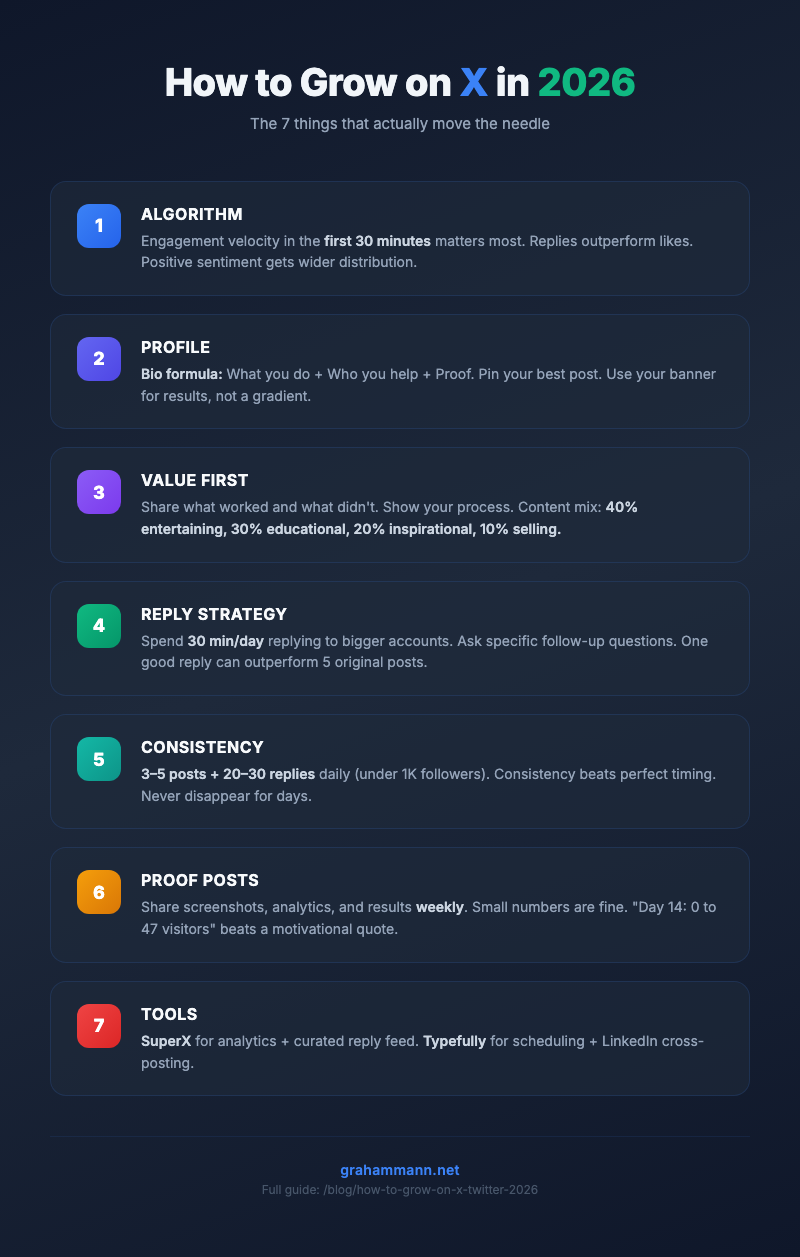
The cheat sheet
Here's everything above in one image. Save it, screenshot it, pin it to your wall — whatever helps you stay consistent.
Frequently asked questions
Do hashtags still work on X in 2026?
Yes, but their role has shrunk. The Grok-powered algorithm reads your post's actual content directly and doesn't need hashtags to categorize it. Data across multiple trackers shows 1-2 hashtags still earn roughly 21% more engagement than none, but 3+ hashtags cost you about 17%, and 5+ costs about 40%. Use one or two only when there's an active real-time tag worth being in (a launch, a conference, #buildinpublic) — not as a discovery hack.
Are likes visible on your X profile?
No. X made all likes private by default in June 2024, and that hasn't changed as of 2026 — not for free accounts, not for Premium. Nobody can browse what you've liked, including your followers. The total like count on a post is still public; who liked it isn't, except the post's own author can see that from their own analytics.
Can you edit posts on X?
Yes, but only if you're on X Premium — free accounts don't get the edit button at all. You get a 60-minute window after posting, up to 5 edits per post, and every edited post shows an "Edited" label with a visible edit history anyone can check. Replies can't be edited, only your own original posts.
How do you grow your followers on X?
Reply to bigger accounts in your niche more than you post your own content — one good reply on a viral tweet drives more profile visits than five original posts. Combine that with posting consistently (3-5x/day), leading with real proof (screenshots, numbers, results) instead of generic advice, and giving it 3-6 months before expecting compounding growth.
How many times should you tweet per day?
3-5 posts minimum if you're under 1K followers, scaling up from there. But replies count more than posts for growth. A person posting 3x and replying 30x will outgrow someone posting 10x with no engagement.
Do threads still work on X in 2026?
Short ones do. 3-6 tweets with a clear hook and proof. The 15-tweet epic threads from 2023 are dead. People scroll past them. If you can say it in 4 tweets, don't stretch it to 12.
Does the X algorithm favor paid/verified accounts?
Yes. X Premium accounts get priority in the For You feed. Whether that's worth the subscription depends on how seriously you're treating growth. If you're posting daily, the visibility boost pays for itself.
How long does it take to grow on X?
Expect 3-6 months of consistent posting before things start compounding. Month 1 is figuring out what resonates. Months 2-3 are finding your voice. Month 4+ is where growth accelerates if you've been consistent.
Is it too late to grow on X/Twitter?
No. New accounts are growing every day. The difference is that the low-effort tactics (follow-for-follow, hashtag spam, engagement pods) don't work anymore. You need real content and real engagement. That's actually good news if you have something worth saying.
Currently building SEOTakeoff and sharing the journey on X. If this was useful, I'd appreciate a share.